Moed Katan 3a: Talmud study for Daf Yomi
Daf Yomi is the daily study of one Talmud folio. Explore 37 tractates with scans, Hebrew text, Sefaria English and AI-generated French translations where annotated.
Passage selection and English or AI-generated French translation are available where the scan has annotations. Daf Study is independent of Torah-Box and Sefaria.
Browse Moed Katan · מועד קטן · All tractatesMoed Katan 3a text and translations
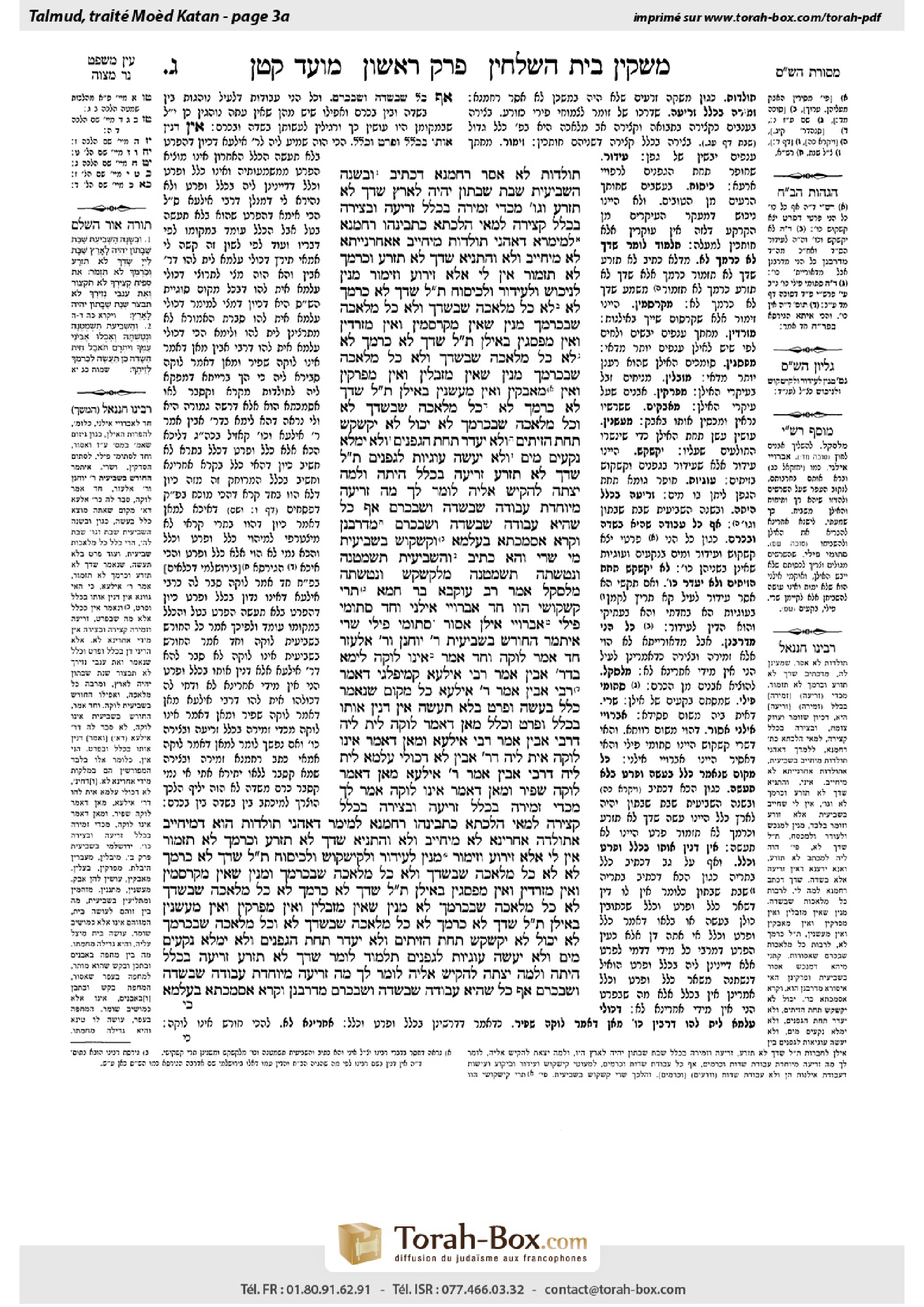
This page of Moed Katan includes the Aramaic text, an English translation and an AI-generated French translation, alongside the scan above.
מועד קטן ג׳ א · Aramaic and Hebrew text
תּוֹלָדוֹת לָא אָסַר רַחֲמָנָא. דִּכְתִיב: ״וּבַשָּׁנָה הַשְּׁבִיעִית שַׁבַּת שַׁבָּתוֹן יִהְיֶה לָאָרֶץ שָׂדְךָ לֹא תִזְרָע וְגוֹ׳״.
מִכְּדֵי, זְמִירָה בִּכְלַל זְרִיעָה, וּבְצִירָה בִּכְלַל קְצִירָה. לְמַאי הִלְכְתָא כַּתְבִינְהוּ רַחֲמָנָא?
לְמֵימְרָא דְּאַהָנֵי תּוֹלָדוֹת מִיחַיַּיב, אַאַחְרָנְיָיתָא לָא מִיחַיַּיב.
וְלָא? וְהָתַנְיָא: ״שָׂדְךָ לֹא תִזְרַע וְכַרְמְךָ לֹא תִזְמוֹר״. אֵין לִי אֶלָּא זֵירוּעַ וְזִימּוּר, מִנַּיִן לְנִיכּוּשׁ וּלְעִידּוּר וּלְכִיסּוּחַ — תַּלְמוּד לוֹמַר: ״שָׂדְךָ לֹא״, ״כַּרְמְךָ לֹא״. לֹא כׇּל מְלָאכָה שֶׁבְּשָׂדְךָ, וְלֹא כׇּל מְלָאכָה שֶׁבְּכַרְמְךָ.
מִנַּיִן שֶׁאֵין מְקַרְסְמִין וְאֵין מְזָרְדִין וְאֵין מְפַסְּגִין בָּאִילָן? תַּלְמוּד לוֹמַר: ״שָׂדְךָ לֹא״, ״כַּרְמְךָ לֹא״. לֹא כׇּל מְלָאכָה שֶׁבְּשָׂדְךָ, וְלֹא כׇּל מְלָאכָה שֶׁבְּכַרְמְךָ.
מִנַּיִן שֶׁאֵין מְזַבְּלִין וְאֵין מְפָרְקִין וְאֵין מְאַבְּקִין וְאֵין מְעַשְּׁנִין בָּאִילָן? תַּלְמוּד לוֹמַר: ״שָׂדְךָ לֹא״, ״כַּרְמְךָ לֹא״. כׇּל מְלָאכָה שֶׁבְּשָׂדְךָ לֹא, וְכׇל מְלָאכָה שֶׁבְּכַרְמְךָ לֹא.
יָכוֹל לֹא יְקַשְׁקֵשׁ תַּחַת הַזֵּיתִים, וְלֹא יְעַדֵּר תַּחַת הַגְּפָנִים, וְלֹא יְמַלֵּא נְקָעִים מַיִם, וְלֹא יַעֲשֶׂה עוּגִיּוֹת לַגְּפָנִים — תַּלְמוּד לוֹמַר: ״שָׂדְךָ לֹא תִזְרָע״.
זְרִיעָה בַּכְּלָל הָיְתָה, וְלָמָּה יָצְתָה — לְהַקִּישׁ אֵלֶיהָ, לוֹמַר לְךָ: מָה זְרִיעָה מְיוּחֶדֶת עֲבוֹדָה שֶׁבַּשָּׂדֶה וְשֶׁבַּכֶּרֶם, אַף כֹּל שֶׁהִיא עֲבוֹדָה שֶׁבַּשָּׂדֶה וְשֶׁבַּכֶּרֶם!
מִדְּרַבָּנַן, וּקְרָא אַסְמַכְתָּא בְּעָלְמָא.
וְקִשְׁקוּשׁ בִּשְׁבִיעִית מִי שְׁרֵי? וְהָא כְּתִיב: ״וְהַשְּׁבִיעִית תִּשְׁמְטֶנָּה וּנְטַשְׁתָּהּ״ — ״תִּשְׁמְטֶנָּה״ מִלְּקַשְׁקֵשׁ, ״וּנְטַשְׁתָּהּ״ מִלְּסַקֵּל!
אָמַר רַב עוּקְבָא בַּר חָמָא: תְּרֵי קִשְׁקוּשֵׁי הָווּ. חַד אַבְרוֹיֵי אִילָנֵי, וְחַד סַתּוֹמֵי פִּילֵי. אַבְרוֹיֵי אִילָן — אָסוּר, סַתּוֹמֵי פִּילֵי — שְׁרֵי.
אִיתְּמַר: הַחוֹרֵשׁ בַּשְּׁבִיעִית, רַבִּי יוֹחָנָן וְרַבִּי אֶלְעָזָר, חַד אָמַר: לוֹקֶה, וְחַד אָמַר: אֵינוֹ לוֹקֶה. לֵימָא בִּדְרַבִּי אָבִין אָמַר רַבִּי אִילְעָא קָמִיפַּלְגִי. דְּאָמַר רַבִּי אָבִין אָמַר רַבִּי אִילְעָא: כׇּל מָקוֹם שֶׁנֶּאֱמַר כְּלָל בַּעֲשֵׂה וּפְרָט בְּלֹא תַעֲשֶׂה — אֵין דָּנִין אוֹתוֹ בִּכְלָל וּפְרָט וּכְלָל.
מַאן דְּאָמַר לוֹקֶה — לֵית לֵיהּ דְּרַבִּי אָבִין אָמַר רַבִּי אִילְעָא.
וּמַאן דְּאָמַר אֵינוֹ לוֹקֶה — אִית לֵיהּ דְּרַבִּי אָבִין.
לָא, דְּכוּלֵּי עָלְמָא לֵית לֵיהּ דְּרַבִּי אָבִין אָמַר רַבִּי אִילְעָא, מַאן דְּאָמַר לוֹקֶה — שַׁפִּיר.
וּמַאן דְּאָמַר אֵינוֹ לוֹקֶה, אָמַר לָךְ: מִכְּדִי זְמִירָה בִּכְלַל זְרִיעָה וּבְצִירָה בִּכְלַל קְצִירָה, לְמַאי הִלְכְתָא כַּתְבִינְהוּ רַחֲמָנָא? לְמֵימַר דְּאַהָנֵי תּוֹלָדוֹת הוּא דְּמִיחַיַּיב, אַתּוֹלָדָה אַחֲרִינָא לָא מִיחַיַּיב.
וְלָא? וְהָתַנְיָא: ״שָׂדְךָ לֹא תִזְרַע וְכַרְמְךָ לֹא תִזְמוֹר״, אֵין לִי אֶלָּא זֵירוּעַ וְזִימּוּר. מִנְיָן לְעִידּוּר וּלְקִישְׁקוּשׁ וּלְכִיסּוּחַ? תַּלְמוּד לוֹמַר: ״שָׂדְךָ לֹא״, ״כַּרְמְךָ לֹא״. לֹא כׇּל מְלָאכָה שֶׁבְּשָׂדְךָ וְלֹא כׇּל מְלָאכָה שֶׁבְּכַרְמְךָ.
וּמִנַּיִן שֶׁאֵין מְקַרְסְמִין, וְאֵין מְזָרְדִין, וְאֵין מְפַסְּגִין בָּאִילָן תַּלְמוּד לוֹמַר: ״שָׂדְךָ לֹא״, ״כַּרְמְךָ לֹא״: כׇּל מְלָאכָה שֶׁבְּשָׂדְךָ לֹא כׇּל מְלָאכָה שֶׁבְּכַרְמְךָ לֹא.
מִנַּיִן שֶׁאֵין מְזַבְּלִין וְאֵין מְפָרְקִין וְאֵין מְעַשְּׁנִין בָּאִילָן? תַּלְמוּד לוֹמַר: ״שָׂדְךָ לֹא״, ״כַּרְמְךָ לֹא״. כׇּל מְלָאכָה שֶׁבְּשָׂדְךָ לֹא, וְכׇל מְלָאכָה שֶׁבְּכַרְמְךָ לֹא.
יָכוֹל לֹא יְקַשְׁקֵשׁ תַּחַת הַזֵּיתִים, וְלֹא יְעַדֵּר תַּחַת הַגְּפָנִים, וְלֹא יְמַלֵּא נְקָעִים מַיִם, וְלֹא יַעֲשֶׂה עוּגִיּוֹת לַגְּפָנִים — תַּלְמוּד לוֹמַר: ״שָׂדְךָ לֹא תִזְרָע״.
זְרִיעָה בַּכְּלָל הָיְתָה, וְלָמָּה יָצְתָה — לְהַקִּישׁ אֵלֶיהָ, לוֹמַר לָךְ: מָה זְרִיעָה מְיוּחֶדֶת עֲבוֹדָה שֶׁבַּשָּׂדֶה וְשֶׁבַּכֶּרֶם, אַף כֹּל שֶׁהִיא עֲבוֹדָה שֶׁבַּשָּׂדֶה וְשֶׁבַּכֶּרֶם!
מִדְּרַבָּנַן, וּקְרָא אַסְמַכְתָּא בְּעָלְמָא.
Moed Katan 3a · English translation
whereas the subcategories of labor that are derived from them, e.g., watering, were not prohibited by the Merciful One, i.e., by Torah law, but only by rabbinic law; and in a case of loss the Sages were lenient. The source for this distinction is as it is written: “But in the seventh year shall be a sabbath of solemn rest for the land, a sabbath for the Lord: Your field you shall not sow, and your vineyard you shall not prune. That which grows of its own accord of your harvest you shall not reap, nor gather the grapes of your undressed vines” (Leviticus 25:4–5).
Since pruning is included in the principal category of sowing, as its objective is to encourage the plant’s growth, and picking grapes is included in the principal category of reaping grain, as both involve removal of produce from a plant, for the purpose of teaching what halakha did the Merciful One write them? Why did the Torah explicitly prohibit pruning and picking grapes, rather than sufficing with the general prohibitions against sowing and reaping?
The Gemara answers that these were individually enumerated to say that only for these subcategories of labor is one liable to be flogged, while for other subcategories of labor, i.e., watering a field, one is not liable. Consequently, there are only four types of labor that are prohibited by Torah law during the Sabbatical Year: Sowing and its subcategory of pruning, as well as reaping and its subcategory of grape picking. All other subcategories of labor are prohibited only by rabbinic decree.
The Gemara asks: And is there really no liability for other subcategories of labor? Isn’t it taught in a baraita: “Your field you shall not sow, and your vineyard you shall not prune” (Leviticus 25:4). I have derived from here an explicit prohibition only against sowing and pruning. From where do I derive that weeding, i.e., uprooting weeds, hoeing, and cutting weeds, even without uprooting them, are also prohibited? The verse states: “Your field you shall not sow” and “your vineyard you shall not prune.” This wording indicates that no labor may be performed in your field, and no labor may be performed in your vineyard.
Similarly, from where is it derived that one may not prune trees, and one may not trim dry branches from trees, and one may not cut large branches [mefasegin] from trees? The verse states: “Your field you shall not sow” and “your vineyard you shall not prune,” thereby teaching that no labor may be performed in your field, and no labor may be performed in your vineyard.
Similarly, from where is it derived that one may not fertilize fields and vineyards, and one may not remove stones that surround the base of a tree and impede its growth, and one may not cover exposed roots with dust, and one may not fumigate a tree in order to exterminate worms? The verse states: “Your field you shall not sow” and “your vineyard you shall not prune,” thereby indicating that no labor may be performed in your field, and no labor may be performed in your vineyard.
The apparent conclusion from this is that all labor in a field or a vineyard is prohibited. One might have thought that one may also not hoe lightly under olive trees and one may not hoe under grapevines, and one may not fill cracks in the ground with water, and one may not construct circular ditches around the bases of grapevines in order to collect rainwater. Therefore, the verse states: “Your field you shall not sow.”
The Gemara explains the derivation: Sowing was included in the general prohibition against performing agricultural labors during the Sabbatical Year, as the verse states “But in the seventh year shall be a sabbath of solemn rest for the land” (Leviticus 25:4). Why was sowing singled out and mentioned explicitly? In order to compare other types of labor to it and to say to you: Just as sowing is unique in that it is labor performed both in the field and in the vineyard, so too, any other labor performed both in the field and in the vineyard is prohibited. However, labors performed only in the vineyard but not in the field, i.e., whose objective is merely to sustain the vines from year to year, such as the labors mentioned above, are permitted. In any case, this baraita indicates that many subcategories of labor are prohibited during the seventh year, and not just sowing and pruning, as Rava had stated.
The Gemara rejects this opinion: These labors, with the exceptions of sowing, pruning, grape picking, and reaping, are all prohibited only by rabbinic law, and the verse that is cited as a source from the Torah is a mere support, and not a bona fide source.
Incidental to this discussion, the Gemara asks: Is light hoeing under olive trees in fact permitted during the Sabbatical Year? Isn’t it written: “But the seventh year you shall let it rest and lie fallow” (Exodus 23:11), and it is taught with regard to this verse: “You shall let it rest” from light hoeing, “and lie fallow” from clearing the field of stones. This indicates that light hoeing is indeed prohibited during the Sabbatical Year.
Rav Ukva bar Ḥama said: There are two types of light hoeing, one whose objective is to strengthen the trees, and another that is intended to seal cracks. There is a practical halakhic difference between them: Hoeing performed in order to strengthen the tree is prohibited, as it is similar to plowing in that it enhances the tree’s growth. However, hoeing undertaken in order to seal cracks is permitted, as by doing so one prevents damage to the tree.
§ It was stated that Rabbi Yoḥanan and Rabbi Elazar disagreed with regard to one who plows during the Sabbatical Year. One said: He is flogged for doing so, while the other one said: He is not flogged. The Gemara suggests: Let us say that they disagree with regard to the principle that Rabbi Avin said that Rabbi Ile’a said, and one accepts this principle while the other does not. As, Rabbi Avin said that Rabbi Ile’a said: Wherever a generalization is stated in the Torah as a positive mitzva, and a detail relating to that generalization is stated as a negative mitzva, one does not apply the hermeneutical principle of a generalization, and a detail, and a generalization, according to which the halakha under discussion is expanded to all cases that resemble the detail.
The Gemara explains: The one who said that one who plows during the Sabbatical Year is flogged does not accept the principle that Rabbi Avin said that Rabbi Ile’a said. Accordingly, he expounds the verses as follows: The verse “But in the seventh year shall be a sabbath of solemn rest for the land” (Leviticus 25:4) is a generalization stated as a positive mitzva. The continuation of the verse is “Your field you shall not sow,” which is a detail stated as a negative mitzva. This is followed by another generalization: “For it shall be a year of rest for the land” (Leviticus 25:5). By applying the principle of a generalization, a detail, and a generalization, one can derive that there is a prohibition against performing any agricultural task that is similar to sowing, including plowing.
And the one who said that one is not flogged for plowing holds in accordance with the ruling that Rabbi Avin stated in the name of Rabbi Ile’a. Therefore, the prohibition stated as a detail, i.e., the prohibition against sowing, is not extended to include any other labor. One who plows violates the positive command to let the land rest, but does not transgress a Torah law phrased as a negative mitzva, and therefore he is not flogged.
The Gemara rejects this suggestion: No, one can say that everyone holds that the halakha is not in accordance with the principle that Rabbi Avin said that Rabbi Ile’a said. According to the one who said he is flogged, all is well, as he applies the hermeneutical principle of a generalization, a detail, and a generalization to derive a prohibition for plowing.
And the one who said that he is not flogged could have said to you: Since pruning is included in the primary category of sowing, and grape picking is included in the primary category of reaping, for the purpose of teaching what halakha did the Merciful One write them? They were individually enumerated to say that only for these specific subcategories of labor is one liable to be flogged, but for performing other subcategories of labor one is not liable. According to this opinion, the verse comes to teach that one is not liable to be flogged for performing any labor not explicitly enumerated in the Torah, including plowing.
The Gemara asks: And is there really no liability for other subcategories of labor? Isn’t it taught in a baraita with regard to the verse “Your field you shall not sow, and your vineyard you shall not prune” that I have derived from here an explicit prohibition only against sowing and pruning? From where do I derive that weeding, hoeing, and cutting weeds are also prohibited? The verse states: “Your field you shall not sow and your vineyard you shall not prune” (Leviticus 25:4). By placing the word “not” immediately following the words “field” and “vineyard,” the verse indicates that one may not perform any labor that is generally performed in your field, and one may not perform any labor that is generally performed in your vineyard.
Similarly, from where is it derived that one may not prune trees, and one may not trim dry branches from trees, and one may not cut large branches from trees? The verse states: “Your field you shall not sow and your vineyard you shall not prune,” indicating that any labor that is generally performed in your field may not be performed during the Sabbatical Year, and any labor generally performed in your vineyard may not be performed during the Sabbatical Year.
From where is it derived that one may not fertilize fields and vineyards, and one may not remove stones from around the base of a tree that impede its growth, and one may not fumigate a tree in order to exterminate worms? The verse states: “Your field you shall not sow and your vineyard you shall not prune,” thereby indicating that any labor that is generally performed in your field may not be performed during the Sabbatical Year, and any labor generally performed in your vineyard may not be performed during the Sabbatical Year.
One might have thought that one may also not hoe lightly under olive trees and one may not hoe under grapevines, and one may not fill cracks in the ground with water, and one may not construct circular ditches around the bases of grapevines in order to collect rainwater. Therefore, the verse states: “Your field you shall not sow.”
Sowing was included in the general prohibition against performing agricultural labors during the Sabbatical Year. Why was sowing singled out and mentioned explicitly? In order to compare other types of labor to it and to say to you: Just as sowing is unique in that it is labor performed both in the field and in the vineyard, so too, any other labor performed both in the field and in the vineyard is prohibited. However, labor performed only in the vineyard, but not in the field, i.e., whose objective is merely to sustain the vines from year to year, is permitted. In any case, this baraita indicates that many labors are prohibited during the seventh year, and not just sowing and pruning.
The Gemara rejects this opinion: These labors, with the exceptions of sowing, pruning, grape picking, and reaping, are all prohibited only by rabbinic law, and the verse that is cited as source from the Torah is a mere support, and not a bona fide source.
Moed Katan 3a · Traduction française (IA)
tandis que les catégories secondaires de travaux qui en découlent, par exemple l’arrosage, n’ont pas été interdites par le Miséricordieux, c’est-à-dire par la Torah écrite, mais seulement par décret rabbinique ; et, en cas de perte, les Sages se sont montrés indulgents. La source de cette distinction est le verset : « Mais la septième année sera un sabbat de repos solennel pour la terre, un sabbat pour le Seigneur : tu n’ensemenceras pas ton champ et tu ne tailleras pas ta vigne. Tu ne moissonneras pas ce qui pousse spontanément de ta récolte, et tu ne vendangeras pas les raisins de tes vignes non taillées » (Lévitique 25, 4-5).
Puisque la taille est comprise dans la catégorie principale de l’ensemencement, car elle vise à favoriser la croissance de la plante, et que la vendange est comprise dans la catégorie principale de la moisson des céréales, car toutes deux consistent à retirer des produits d’une plante, dans quel but le Miséricordieux les a-t-il mentionnées ? Pourquoi la Torah a-t-elle explicitement interdit la taille et la vendange, au lieu de se contenter des interdictions générales d’ensemencer et de moissonner ?
La Guemara répond qu’elles ont été mentionnées séparément pour enseigner que seule l’exécution de ces catégories secondaires de travaux entraîne la flagellation, tandis que l’exécution des autres, par exemple l’arrosage d’un champ, ne l’entraîne pas. Par conséquent, seuls quatre types de travaux sont interdits par la Torah durant l’année sabbatique : l’ensemencement et sa catégorie secondaire, la taille, ainsi que la moisson et sa catégorie secondaire, la vendange. Toutes les autres catégories secondaires de travaux ne sont interdites que par décret rabbinique.
La Guemara demande : Est-il vraiment exact que l’exécution des autres catégories secondaires de travaux n’entraîne pas de flagellation ? N’est-il pas enseigné dans une baraïta : « Tu n’ensemenceras pas ton champ et tu ne tailleras pas ta vigne » (Lévitique 25, 4). J’en ai déduit une interdiction explicite de l’ensemencement et de la taille seulement. D’où déduis-je que le désherbage, c’est-à-dire l’arrachage des mauvaises herbes, le binage et la coupe des mauvaises herbes, même sans les arracher, sont également interdits ? Le verset dit : « Tu n’ensemenceras pas ton champ » et « tu ne tailleras pas ta vigne ». Cette formulation indique qu’aucun travail ne peut être effectué dans ton champ et qu’aucun travail ne peut être effectué dans ta vigne.
De même, d’où déduit-on qu’il est interdit de tailler les arbres, d’en couper les branches sèches et d’en couper les grosses branches [mefasegin] ? Le verset dit : « Tu n’ensemenceras pas ton champ » et « tu ne tailleras pas ta vigne », enseignant ainsi qu’aucun travail ne peut être effectué dans ton champ ni dans ta vigne.
De même, d’où déduit-on qu’il est interdit de fertiliser les champs et les vignes, d’enlever les pierres qui entourent le pied d’un arbre et entravent sa croissance, de recouvrir de terre les racines exposées et de fumiger un arbre afin d’exterminer les vers ? Le verset dit : « Tu n’ensemenceras pas ton champ » et « tu ne tailleras pas ta vigne », indiquant ainsi qu’aucun travail ne peut être effectué dans ton champ ni dans ta vigne.
Il semblerait donc que tout travail dans un champ ou une vigne soit interdit. On aurait pu penser qu’il est également interdit de biner légèrement sous les oliviers, de biner sous les vignes, de remplir d’eau les fissures du sol et de creuser des rigoles circulaires autour du pied des vignes afin de recueillir l’eau de pluie. Le verset dit donc : « Tu n’ensemenceras pas ton champ. »
La Guemara explique cette déduction : l’ensemencement était inclus dans l’interdiction générale d’effectuer des travaux agricoles durant l’année sabbatique, comme le dit le verset : « Mais la septième année sera un sabbat de repos solennel pour la terre » (Lévitique 25, 4). Pourquoi l’ensemencement a-t-il été distingué et mentionné explicitement ? Afin de comparer les autres types de travaux à celui-ci et de t’enseigner que, de même que l’ensemencement se caractérise par le fait qu’il s’effectue aussi bien dans un champ que dans une vigne, tout autre travail effectué aussi bien dans un champ que dans une vigne est également interdit. En revanche, les travaux effectués uniquement dans une vigne, et non dans un champ, c’est-à-dire ceux dont le seul objectif est de préserver les vignes d’une année à l’autre, comme les travaux mentionnés plus haut, sont permis. Quoi qu’il en soit, cette baraïta indique que de nombreuses catégories secondaires de travaux sont interdites durant la septième année, et pas seulement l’ensemencement et la taille, contrairement à ce qu’avait affirmé Rava.
La Guemara rejette cette opinion : ces travaux, à l’exception de l’ensemencement, de la taille, de la vendange et de la moisson, ne sont interdits que par la loi rabbinique ; le verset cité comme source dans la Torah écrite ne constitue qu’un appui, et non une source véritable.
À propos de cette discussion, la Guemara demande : Est-il donc effectivement permis de biner légèrement sous les oliviers durant l’année sabbatique ? N’est-il pas écrit : « Mais la septième année, tu la laisseras se reposer et demeurer en jachère » (Exode 23, 11), et n’enseigne-t-on pas à propos de ce verset : « Tu la laisseras se reposer » signifie qu’il faut s’abstenir de biner légèrement, et « demeurer en jachère » signifie qu’il faut s’abstenir de débarrasser le champ des pierres ? Cela indique que le binage léger est bien interdit durant l’année sabbatique.
Rav Ukva bar Ḥama dit : Il existe deux sortes de binage léger, l’un visant à fortifier les arbres, l’autre à colmater les fissures. Il y a entre les deux une différence pratique en halakha : le binage effectué pour fortifier l’arbre est interdit, car il s’apparente au labour en ce qu’il favorise la croissance de l’arbre. En revanche, le binage destiné à colmater les fissures est permis, car il permet ainsi d’éviter que l’arbre soit endommagé.
§ Il a été rapporté que Rabbi Yoḥanan et Rabbi Elazar sont en désaccord au sujet de celui qui laboure durant l’année sabbatique. Selon l’un, il est passible de flagellation ; selon l’autre, il ne l’est pas. La Guemara propose : Peut-on dire qu’ils sont en désaccord sur le principe énoncé par Rabbi Avin au nom de Rabbi Ile’a, l’un l’acceptant et l’autre non ? Car Rabbi Avin a dit au nom de Rabbi Ile’a : Chaque fois qu’une règle générale est formulée dans la Torah écrite sous la forme d’une mitsva positive, et qu’un détail relevant de cette règle générale est formulé sous la forme d’une mitsva négative, on n’applique pas le principe herméneutique de la règle générale, du détail et de la règle générale, selon lequel la halakha en question est étendue à tous les cas qui ressemblent au détail.
La Guemara explique : Celui qui dit que celui qui laboure durant l’année sabbatique est passible de flagellation n’accepte pas le principe énoncé par Rabbi Avin au nom de Rabbi Ile’a. Il interprète donc les versets ainsi : « Mais la septième année sera un sabbat de repos solennel pour la terre » (Lévitique 25, 4) est une règle générale formulée comme une mitsva positive. La suite du verset dit : « Tu n’ensemenceras pas ton champ », détail formulé comme une mitsva négative. Puis vient une autre règle générale : « Car ce sera une année de repos pour la terre » (Lévitique 25, 5). En appliquant le principe de la règle générale, du détail et de la règle générale, on peut déduire l’interdiction d’effectuer toute tâche agricole semblable à l’ensemencement, y compris le labour.
Celui qui dit que le labour n’entraîne pas de flagellation suit la décision de Rabbi Avin au nom de Rabbi Ile’a. Par conséquent, l’interdiction formulée comme un détail, c’est-à-dire l’interdiction d’ensemencer, n’est pas étendue à d’autres travaux. Celui qui laboure enfreint le commandement positif de laisser la terre se reposer, mais ne transgresse pas une loi de la Torah écrite formulée comme une mitsva négative ; il n’est donc pas passible de flagellation.
La Guemara rejette cette proposition : Non, on peut dire que tous conviennent que la halakha ne suit pas le principe énoncé par Rabbi Avin au nom de Rabbi Ile’a. Pour celui qui affirme qu’il est passible de flagellation, cela ne pose pas de difficulté, puisqu’il applique le principe herméneutique de la règle générale, du détail et de la règle générale pour déduire l’interdiction du labour.
Et celui qui affirme qu’il n’est pas passible de flagellation pourrait te répondre : Puisque la taille est incluse dans la catégorie principale de l’ensemencement, et que la vendange est incluse dans la catégorie principale de la moisson, dans quel but le Miséricordieux les a-t-il mentionnées ? Elles ont été mentionnées séparément pour enseigner que seule l’exécution de ces catégories secondaires précises de travaux entraîne la flagellation, tandis que l’exécution des autres catégories secondaires de travaux ne l’entraîne pas. Selon cette opinion, le verset vient enseigner que l’on n’est pas passible de flagellation pour l’exécution d’un travail qui n’est pas explicitement mentionné dans la Torah écrite, y compris le labour.
La Guemara demande : Est-il vraiment exact que l’exécution des autres catégories secondaires de travaux n’entraîne pas de flagellation ? N’est-il pas enseigné dans une baraïta, à propos du verset « Tu n’ensemenceras pas ton champ et tu ne tailleras pas ta vigne », que j’en ai déduit une interdiction explicite de l’ensemencement et de la taille seulement ? D’où déduis-je que le désherbage, le binage et la coupe des mauvaises herbes sont également interdits ? Le verset dit : « Tu n’ensemenceras pas ton champ et tu ne tailleras pas ta vigne » (Lévitique 25, 4). En plaçant le mot « pas » immédiatement après les mots « champ » et « vigne », le verset indique qu’on ne peut effectuer aucun travail généralement accompli dans son champ, ni aucun travail généralement accompli dans sa vigne.
De même, d’où déduit-on qu’il est interdit de tailler les arbres, d’en couper les branches sèches et d’en couper les grosses branches ? Le verset dit : « Tu n’ensemenceras pas ton champ et tu ne tailleras pas ta vigne », indiquant que tout travail généralement accompli dans ton champ est interdit durant l’année sabbatique, ainsi que tout travail généralement accompli dans ta vigne.
D’où déduit-on qu’il est interdit de fertiliser les champs et les vignes, d’enlever autour du pied d’un arbre les pierres qui entravent sa croissance et de fumiger un arbre afin d’exterminer les vers ? Le verset dit : « Tu n’ensemenceras pas ton champ et tu ne tailleras pas ta vigne », indiquant ainsi que tout travail généralement accompli dans ton champ est interdit durant l’année sabbatique, ainsi que tout travail généralement accompli dans ta vigne.
On aurait pu penser qu’il est également interdit de biner légèrement sous les oliviers, de biner sous les vignes, de remplir d’eau les fissures du sol et de creuser des rigoles circulaires autour du pied des vignes afin de recueillir l’eau de pluie. Le verset dit donc : « Tu n’ensemenceras pas ton champ. »
L’ensemencement était inclus dans l’interdiction générale d’effectuer des travaux agricoles durant l’année sabbatique. Pourquoi a-t-il été distingué et mentionné explicitement ? Afin de comparer les autres types de travaux à celui-ci et de t’enseigner que, de même que l’ensemencement se caractérise par le fait qu’il s’effectue aussi bien dans un champ que dans une vigne, tout autre travail effectué aussi bien dans un champ que dans une vigne est également interdit. En revanche, les travaux effectués uniquement dans une vigne, et non dans un champ, c’est-à-dire ceux dont le seul objectif est de préserver les vignes d’une année à l’autre, sont permis. Quoi qu’il en soit, cette baraïta indique que de nombreux travaux sont interdits durant la septième année, et pas seulement l’ensemencement et la taille.
La Guemara rejette cette opinion : ces travaux, à l’exception de l’ensemencement, de la taille, de la vendange et de la moisson, ne sont interdits que par la loi rabbinique ; le verset cité comme source dans la Torah écrite ne constitue qu’un appui, et non une source véritable.
Traduction française générée par IA à partir de l’édition anglaise de Sefaria. Vérifie toujours un passage avec le texte source.
Text from Sefaria: William Davidson Edition - Vocalized Aramaic (CC BY NC); William Davidson Edition - English (CC BY NC).