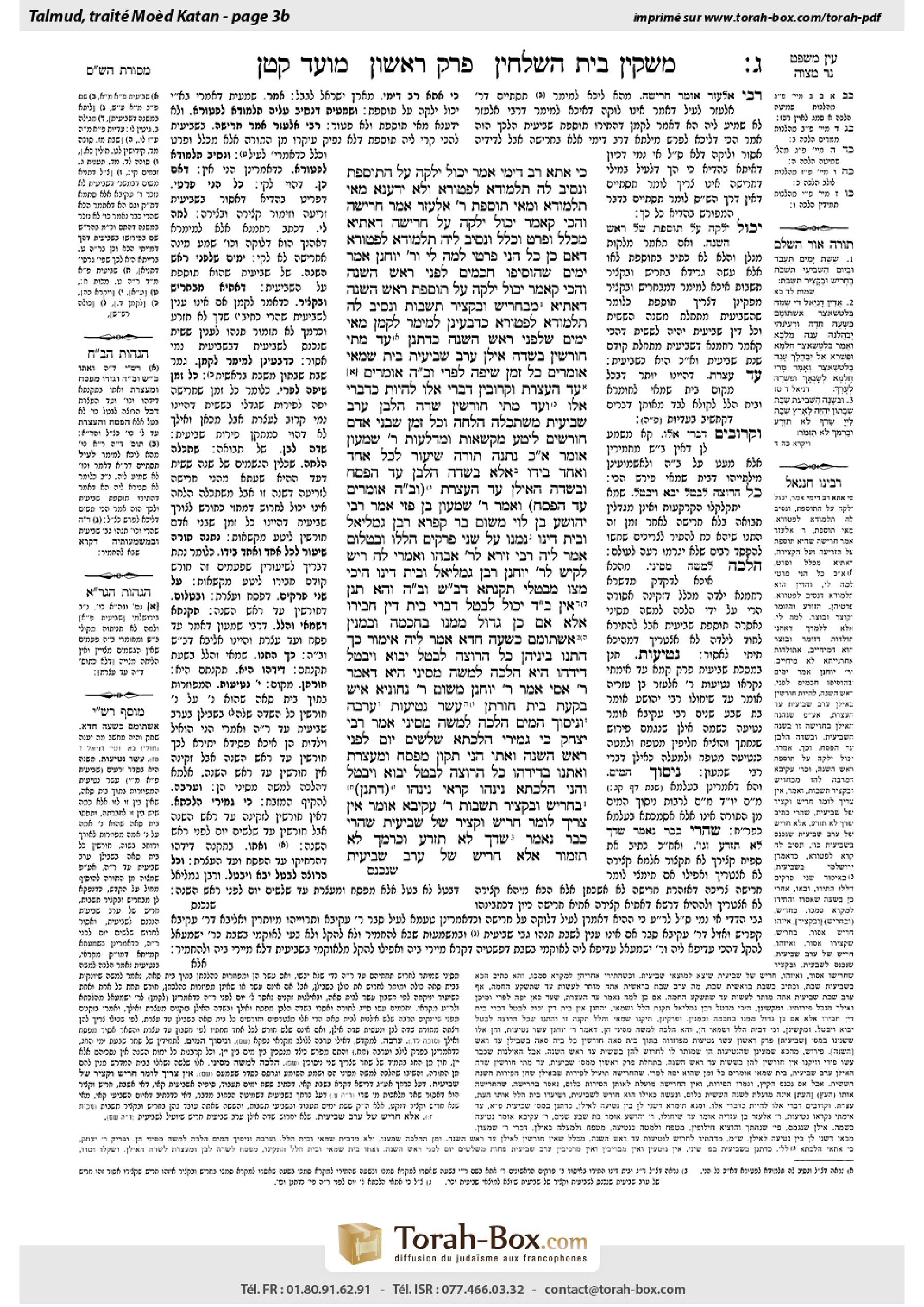
Moed Katan 3b: Talmud study for Daf Yomi
Daf Yomi is the daily study of one Talmud folio. Explore 37 tractates with scans, Hebrew text, Sefaria English and AI-generated French translations where annotated.
Passage selection and English or AI-generated French translation are available where the scan has annotations. Daf Study is independent of Torah-Box and Sefaria.
Browse Moed Katan · מועד קטן · All tractatesMoed Katan 3b text and translations
This page of Moed Katan includes the Aramaic text, an English translation and an AI-generated French translation, alongside the scan above.
מועד קטן ג׳ ב · Aramaic and Hebrew text
כִּי אֲתָא רַב דִּימִי, אָמַר: יָכוֹל יִלְקֶה עַל הַתּוֹסֶפֶת. וְנָסֵיב לַהּ תַּלְמוּדָא לִפְטוּרָא, וְלָא יָדַעְנָא מַאי תַּלְמוּדָא וּמַאי תּוֹסֶפֶת.
רַבִּי אֶלְעָזָר אָמַר: חֲרִישָׁה. וְהָכִי קָאָמַר: יָכוֹל יִלְקֶה עַל חֲרִישָׁה דְּאָתְיָא מִכְּלָל וּפְרָט וּכְלָל, וְנָסֵיב לֵיהּ תַּלְמוּדָא לִפְטוּרָא.
דְּאִם כֵּן, כׇּל הָנֵי פְּרָטֵי לְמָה לִי?
וְרַבִּי יוֹחָנָן אָמַר: יָמִים שֶׁהוֹסִיפוּ חֲכָמִים לִפְנֵי רֹאשׁ הַשָּׁנָה. וְהָכִי קָאָמַר: יָכוֹל יִלְקֶה עַל תּוֹסֶפֶת רֹאשׁ הַשָּׁנָה, דְּאָתְיָא ״מִבֶּחָרִישׁ וּבַקָּצִיר תִּשְׁבֹּת״, וְנָסֵיב לַהּ תַּלְמוּדָא לִפְטוּרָא, כִּדְבָעֵינַן לְמֵימַר לְקַמַּן.
מַאי יָמִים שֶׁלִּפְנֵי רֹאשׁ הַשָּׁנָה, כְּדִתְנַן: עַד מָתַי חוֹרְשִׁין בִּשְׂדֵה אִילָן עֶרֶב שְׁבִיעִית? בֵּית שַׁמַּאי אוֹמְרִים: כׇּל זְמַן שֶׁיָּפֶה לַפְּרִי — וּבֵית הִלֵּל אוֹמְרִים: עַד הָעֲצֶרֶת. וּקְרוֹבִין דִּבְרֵי אֵלּוּ לִהְיוֹת כְּדִבְרֵי אֵלּוּ.
וְעַד מָתַי חוֹרְשִׁין שְׂדֵה הַלָּבָן עֶרֶב שְׁבִיעִית? מִשֶּׁתִּכְלֶה הַלֵּחָה, וְכׇל זְמַן שֶׁבְּנֵי אָדָם חוֹרְשִׁים לִיטַּע מִקְשָׁאוֹת וּמִדְלָעוֹת.
רַבִּי שִׁמְעוֹן אוֹמֵר: אִם כֵּן נָתְנָה תּוֹרָה שִׁיעוּר לְכׇל אֶחָד וְאֶחָד בְּיָדוֹ. אֶלָּא: בִּשְׂדֵה הַלָּבָן — עַד הַפֶּסַח, וּבִשְׂדֵה הָאִילָן — עַד הָעֲצֶרֶת. וּבֵית הִלֵּל אוֹמְרִים: עַד הַפֶּסַח.
וְאָמַר רַבִּי שִׁמְעוֹן בֶּן פַּזִּי אָמַר רַבִּי יְהוֹשֻׁעַ בֶּן לֵוִי מִשּׁוּם בַּר קַפָּרָא: רַבָּן גַּמְלִיאֵל וּבֵית דִּינוֹ נִמְנוּ עַל שְׁנֵי פְּרָקִים הַלָּלוּ, וּבִטְּלוּם.
אֲמַר לֵיהּ רַבִּי זֵירָא לְרַבִּי אֲבָהוּ, וְאָמְרִי לַהּ רֵישׁ לָקִישׁ לְרַבִּי יוֹחָנָן: רַבָּן גַּמְלִיאֵל וּבֵית דִּינוֹ הֵיכִי מָצוּ מְבַטְּלִי תַּקַּנְתָּא דְּבֵית שַׁמַּאי וּבֵית הִלֵּל? וְהָא תְּנַן: אֵין בֵּית דִּין יָכוֹל לְבַטֵּל דִּבְרֵי בֵּית דִּין חֲבֵירוֹ אֶלָּא אִם כֵּן גָּדוֹל מִמֶּנּוּ בְּחָכְמָה וּבְמִנְיָן!
״אֶשְׁתּוֹמַם כְּשָׁעָה חֲדָא״. אֲמַר לֵיהּ: אֵימוֹר, כָּךְ הִתְנוּ בֵּינֵיהֶן: כָּל הָרוֹצֶה לְבַטֵּל — יָבוֹא וִיבַטֵּל.
דִּידְהוּ הִיא? הֲלָכָה לְמֹשֶׁה מִסִּינַי הִיא! דְּאָמַר רַבִּי אַסִּי אָמַר רַבִּי יוֹחָנָן מִשּׁוּם רַבִּי נְחוּנְיָא אִישׁ בִּקְעַת בֵּית חוֹרְתָן: עֶשֶׂר נְטִיעוֹת, עֲרָבָה, וְנִיסּוּךְ הַמַּיִם, הֲלָכָה לְמֹשֶׁה מִסִּינַי!
אָמַר רַבִּי יִצְחָק: כִּי גְּמִירִי הִלְכְתָא, שְׁלֹשִׁים יוֹם לִפְנֵי רֹאשׁ הַשָּׁנָה, וַאֲתוֹ הָנֵי תַּקּוּן מִפֶּסַח וּמֵעֲצֶרֶת, וְאַתְנוֹ בְּדִידְהוּ: כָּל הָרוֹצֶה לְבַטֵּל יָבוֹא וִיבַטֵּל.
וְהָנֵי הִלְכְתָא נִינְהוּ? קְרָאֵי נִינְהוּ, דִּתְנַן: ״בֶּחָרִישׁ וּבַקָּצִיר תִּשְׁבֹּת״, רַבִּי עֲקִיבָא אוֹמֵר: אֵין צָרִיךְ לוֹמַר חָרִישׁ וְקָצִיר שֶׁל שְׁבִיעִית, שֶׁהֲרֵי כְּבָר נֶאֱמַר: ״שָׂדְךָ לֹא תִזְרָע וְכַרְמְךָ לֹא תִזְמֹר״, אֶלָּא חָרִישׁ שֶׁל עֶרֶב שְׁבִיעִית
Moed Katan 3b · English translation
When Rav Dimi came from Eretz Yisrael to Babylonia, he stated a tradition he had heard from the Sages in Eretz Yisrael: One might have thought that one would be flogged for the addition, but a teaching states an exemption from lashes. Rav Dimi noted: But I do not know what teaching or what addition this tradition is referring to.
The Sages disputed the meaning of this tradition. Rabbi Elazar said: The addition in question is plowing during the Sabbatical Year, for which there is no explicit prohibition in the Torah, and so it may be regarded as an addition to the labors explicitly enumerated in the Torah. And this is what it is saying: One might have thought that one would be flogged for plowing during the Sabbatical Year, as it is derived by way of the hermeneutical principle of a generalization, and a detail, and a generalization that teaches that plowing is prohibited. But a teaching states an exemption from lashes for the labor of plowing.
This is logical, because if one is flogged for plowing, why do I need all these details that were enumerated in the verse, i.e., pruning and picking grapes? Rather, one must certainly conclude that these were singled out in order to teach that one is flogged only for these specific labors, but not for any other.
And Rabbi Yoḥanan said: This addition is referring to the extra days that the Sages added to the prohibition against performing agricultural labor, before Rosh HaShana of the seventh year, when the Sabbatical Year formally begins. And this is what it is saying: One might have thought that one would be flogged for working the land during the additional period prior to Rosh HaShana of the Sabbatical Year, as this prohibition is derived from the verse: “In plowing and in reaping you shall rest” (Exodus 34:21). This seemingly superfluous verse is understood as teaching that not only is working the land prohibited during the seventh year, but plowing a field during the sixth year to prepare the land for the seventh year, and reaping what grew in the seventh year during the eighth year are also prohibited. But a teaching states an exemption from lashes for these actions, as we are about to state below.
The Gemara elaborates: What are the extra days before Rosh HaShana? As we learned in a mishna (Shevi’it 1:1): Until when may one plow an orchard on the eve of the Sabbatical Year? Beit Shammai say: One may plow so long as the plowing is beneficial for the fruit already on the trees. Once the plowing serves to benefit only the tree itself and the fruit it will produce the following year, it is prohibited. And Beit Hillel say: One may plow until Shavuot. The mishna notes: And the statement of these, Beit Shammai, is close to being like the statement of these, Beit Hillel; i.e., in practice, there is little difference between the dates established by the two opinions.
The mishna (see Shevi’it 2:1) additionally states: And until when may one plow a white field, i.e., a grain field, on the eve of the Sabbatical Year? One may plow until the residual moisture in the fields from the rain ceases and so long as people continue to plow their fields in order to plant cucumbers and gourds, which are planted at the end of the winter.
Rabbi Shimon says: If it is so that no set time was established, then the Torah has given an individual measure of time into the hands of each and every individual. One may plow until a self-determined time, as he can always claim that he is plowing in order to plant during the sixth year. Rather, a fixed time must be established: In a white field one may plow until Passover, in an orchard one may plow until Shavuot, and Beit Hillel say: Until Passover.
And Rabbi Shimon ben Pazi said that Rabbi Yehoshua ben Levi said in the name of bar Kappara: Rabban Gamliel and his court discussed and then voted about the prohibitions of these two periods, i.e., from Passover or Shavuot until Rosh HaShana, and nullified them, thereby permitting plowing until Rosh HaShana, the actual beginning of the Sabbatical Year.
Rabbi Zeira said to Rabbi Abbahu, and some say that it was Reish Lakish who said to Rabbi Yoḥanan: How could Rabban Gamliel and his court nullify an ordinance instituted by Beit Shammai and Beit Hillel, who were greater authorities than they were? Didn’t we learn in a mishna (Eduyyot 1:5): A court cannot nullify the ruling of another court unless it surpasses it in wisdom and in number?
Rabbi Abbahu “was astonished for a while” (Daniel 4:16), and then said to him: Say that when Beit Shammai and Beit Hillel established their decree, they stipulated among themselves: Anyone who later wishes to nullify this decree may come and nullify it.
The Gemara asks: Is this ordinance theirs? Did Beit Shammai and Beit Hillel institute the ordinance and as such have the authority to attach stipulations to it? It is a halakha transmitted to Moses from Sinai. As Rabbi Asi said that Rabbi Yoḥanan said in the name of Rabbi Neḥunya from the valley of Beit Ḥortan: The halakha of ten saplings, the mitzva of bringing willow branches to the Temple on Sukkot and standing them up around the altar, and the halakha of water libation on Sukkot are all halakhot transmitted to Moses from Sinai. Consequently, the prohibition against plowing on the eve of the seventh year is a not a rabbinic ordinance from the Second Temple period, but rather an oral tradition dating back to Moses at Sinai.
Rabbi Yitzḥak said: When they learned this halakha as a tradition dating back to Moses at Sinai, the prohibition applied from only thirty days before Rosh HaShana. Afterward, these Sages of Beit Shammai and Beit Hillel came and instituted lengthier periods of restriction, from Passover and from Shavuot, respectively, but they stipulated among themselves: Anyone who later wishes to nullify this decree may come and nullify it. Rabban Gamliel and his court were therefore able to nullify extended restrictions instituted by Beit Shammai and Beit Hillel.
The Gemara raises another question: Are these prohibitions of plowing before the Sabbatical Year really halakhot transmitted to Moses from Sinai? They are actually prohibitions based on explicit verses. As we learned in a baraita with regard to the verse “In plowing and in reaping you shall rest” (Exodus 34:21) that Rabbi Akiva says: It is unnecessary for the verse to speak about plowing and reaping during the Sabbatical Year, as it was already stated: “But in the seventh year shall be a sabbath of solemn rest for the land, a sabbath for the Lord; your field you shall not sow, and your vineyard you shall not prune” (Leviticus 25:4). This teaches that during the seventh year all agricultural labor is prohibited. Rather, the verse comes to prohibit plowing on the eve of the Sabbatical Year
Moed Katan 3b · Traduction française (IA)
Lorsque Rav Dimi arriva d’Eretz Israël en Babylonie, il rapporta une tradition qu’il avait entendue des Sages d’Eretz Israël : On aurait pu penser que l’on serait passible de flagellation pour cet ajout, mais un enseignement exempte de flagellation. Rav Dimi précisa : Toutefois, je ne sais pas à quel enseignement ni à quel ajout cette tradition fait référence.
Les Sages discutèrent du sens de cette tradition. Rabbi Elazar dit : L’ajout en question est le labour pendant l’année de jachère, pour lequel la Torah ne formule aucune interdiction explicite ; il peut donc être considéré comme un ajout aux travaux explicitement énumérés dans la Torah. Voici ce que signifie la tradition : On aurait pu penser que l’on serait passible de flagellation pour le labour pendant l’année de jachère, puisque son interdiction est déduite au moyen du principe herméneutique de généralisation, de détail et de généralisation, qui enseigne que le labour est interdit. Mais un enseignement exempte de flagellation pour le travail de labour.
C’est logique, car si l’on était passible de flagellation pour le labour, pourquoi faudrait-il tous les détails énumérés dans le verset, c’est-à-dire l’émondage et la cueillette des raisins ? Il faut donc nécessairement en conclure que ces travaux ont été mentionnés spécifiquement afin d’enseigner que l’on n’est passible de flagellation que pour ces travaux précis, et non pour tout autre travail.
Et Rabbi Yoḥanan dit : Cet ajout fait référence aux jours supplémentaires que les Sages ont ajoutés à l’interdiction d’effectuer des travaux agricoles avant Roch Hachana de la septième année, lorsque l’année de jachère commence officiellement. Voici ce que signifie la tradition : On aurait pu penser que l’on serait passible de flagellation pour avoir travaillé la terre pendant la période supplémentaire précédant Roch Hachana de l’année de jachère, puisque cette interdiction est déduite du verset : « Tu te reposeras au temps du labour et de la moisson » (Exode 34, 21). Ce verset apparemment superflu est compris comme enseignant que non seulement le travail de la terre est interdit pendant la septième année, mais que le labour d’un champ durant la sixième année pour préparer la terre à la septième année, ainsi que la moisson, durant la huitième année, de ce qui a poussé pendant la septième, sont également interdits. Mais un enseignement exempte de flagellation pour ces actes, comme nous allons le voir ci-dessous.
La Guemara développe : Quels sont ces jours supplémentaires précédant Roch Hachana ? Comme nous l’avons appris dans une Michna (Shevi’it 1:1) : Jusqu’à quand peut-on labourer un verger à la veille de l’année de jachère ? Beit Shammaï disent : On peut labourer tant que le labour profite aux fruits déjà présents sur les arbres. Dès que le labour ne sert plus qu’à favoriser l’arbre lui-même et les fruits qu’il produira l’année suivante, il est interdit. Et Beit Hillel disent : On peut labourer jusqu’à Chavouot. La Michna note : La position de ceux-ci, Beit Shammaï, est proche de celle de ceux-là, Beit Hillel ; autrement dit, dans la pratique, il y a peu de différence entre les dates fixées par les deux avis.
La Michna (voir Shevi’it 2:1) enseigne également : Jusqu’à quand peut-on labourer un champ blanc, c’est-à-dire un champ de céréales, à la veille de l’année de jachère ? On peut labourer jusqu’à ce que l’humidité résiduelle laissée dans les champs par les pluies ait disparu, et tant que les gens continuent à labourer leurs champs pour y planter des concombres et des courges, que l’on plante à la fin de l’hiver.
Rabbi Shimon dit : Si aucun moment précis n’a été fixé, la Torah a remis à chacun le soin de déterminer lui-même la durée. Chacun pourrait labourer jusqu’au moment qu’il choisit, puisqu’il pourrait toujours prétendre labourer en vue de planter durant la sixième année. Il faut donc fixer une date : dans un champ blanc, on peut labourer jusqu’à Pessa’h ; dans un verger, jusqu’à Chavouot. Et Beit Hillel disent : jusqu’à Pessa’h.
Et Rabbi Shimon ben Pazi dit que Rabbi Yehoshua ben Levi a dit au nom de bar Kappara : Rabban Gamliel et son tribunal examinèrent les interdictions applicables pendant ces deux périodes, c’est-à-dire de Pessa’h ou de Chavouot jusqu’à Roch Hachana, puis votèrent pour les abroger, autorisant ainsi le labour jusqu’à Roch Hachana, début effectif de l’année de jachère.
Rabbi Zeira dit à Rabbi Abbahu — et certains disent que c’est Reish Lakish qui dit à Rabbi Yoḥanan : Comment Rabban Gamliel et son tribunal ont-ils pu abroger une ordonnance instituée par Beit Shammaï et Beit Hillel, dont l’autorité était supérieure à la leur ? N’avons-nous pas appris dans une Michna (Eduyyot 1:5) qu’un tribunal ne peut abroger la décision d’un autre tribunal que s’il le dépasse en sagesse et en nombre ?
Rabbi Abbahu « resta stupéfait un moment » (Daniel 4:16), puis lui dit : Dis plutôt que, lorsque Beit Shammaï et Beit Hillel établirent leur décret, ils stipulèrent entre eux : Quiconque souhaitera ultérieurement abroger ce décret pourra venir le faire.
La Guemara demande : Cette ordonnance est-elle de leur fait ? Beit Shammaï et Beit Hillel ont-ils institué cette ordonnance et, par conséquent, eu le pouvoir d’y assortir des conditions ? Il s’agit d’une halakha transmise à Moïse au Sinaï. Car Rabbi Asi dit que Rabbi Yoḥanan a dit au nom de Rabbi Neḥunya, de la vallée de Beit Ḥortan : La halakha des dix jeunes pousses, la mitsva d’apporter des branches de saule au Temple à Soukkot et de les dresser autour de l’autel, ainsi que la halakha de la libation d’eau à Soukkot, sont toutes des halakhot transmises à Moïse au Sinaï. Par conséquent, l’interdiction de labourer à la veille de la septième année n’est pas une ordonnance rabbinique datant de la période du Second Temple, mais une tradition orale remontant à Moïse au Sinaï.
Rabbi Yitzḥak dit : Lorsque cette halakha fut transmise comme une tradition remontant à Moïse au Sinaï, l’interdiction ne s’appliquait que pendant les trente jours précédant Roch Hachana. Par la suite, ces Sages de Beit Shammaï et Beit Hillel vinrent et instituèrent des périodes de restriction plus longues, à partir de Pessa’h et de Chavouot respectivement, mais ils stipulèrent entre eux : Quiconque souhaitera ultérieurement abroger ce décret pourra venir le faire. Rabban Gamliel et son tribunal purent donc abroger les restrictions prolongées instituées par Beit Shammaï et Beit Hillel.
La Guemara soulève une autre question : Ces interdictions du labour avant l’année de jachère sont-elles vraiment des halakhot transmises à Moïse au Sinaï ? Ce sont en réalité des interdictions fondées sur des versets explicites. En effet, nous avons appris dans une baraïta, à propos du verset « Tu te reposeras au temps du labour et de la moisson » (Exode 34, 21), que Rabbi Akiva dit : Il n’est pas nécessaire que le verset parle du labour et de la moisson pendant l’année de jachère, car il est déjà dit : « Mais la septième année sera un sabbat, un repos solennel pour la terre, un sabbat pour le Seigneur ; tu n’ensemenceras pas ton champ et tu ne tailleras pas ta vigne » (Lévitique 25, 4). Cela enseigne que tous les travaux agricoles sont interdits pendant la septième année. Le verset vient plutôt interdire le labour à la veille de l’année de jachère.
Traduction française générée par IA à partir de l’édition anglaise de Sefaria. Vérifie toujours un passage avec le texte source.
Text from Sefaria: William Davidson Edition - Vocalized Aramaic (CC BY NC); William Davidson Edition - English (CC BY NC).