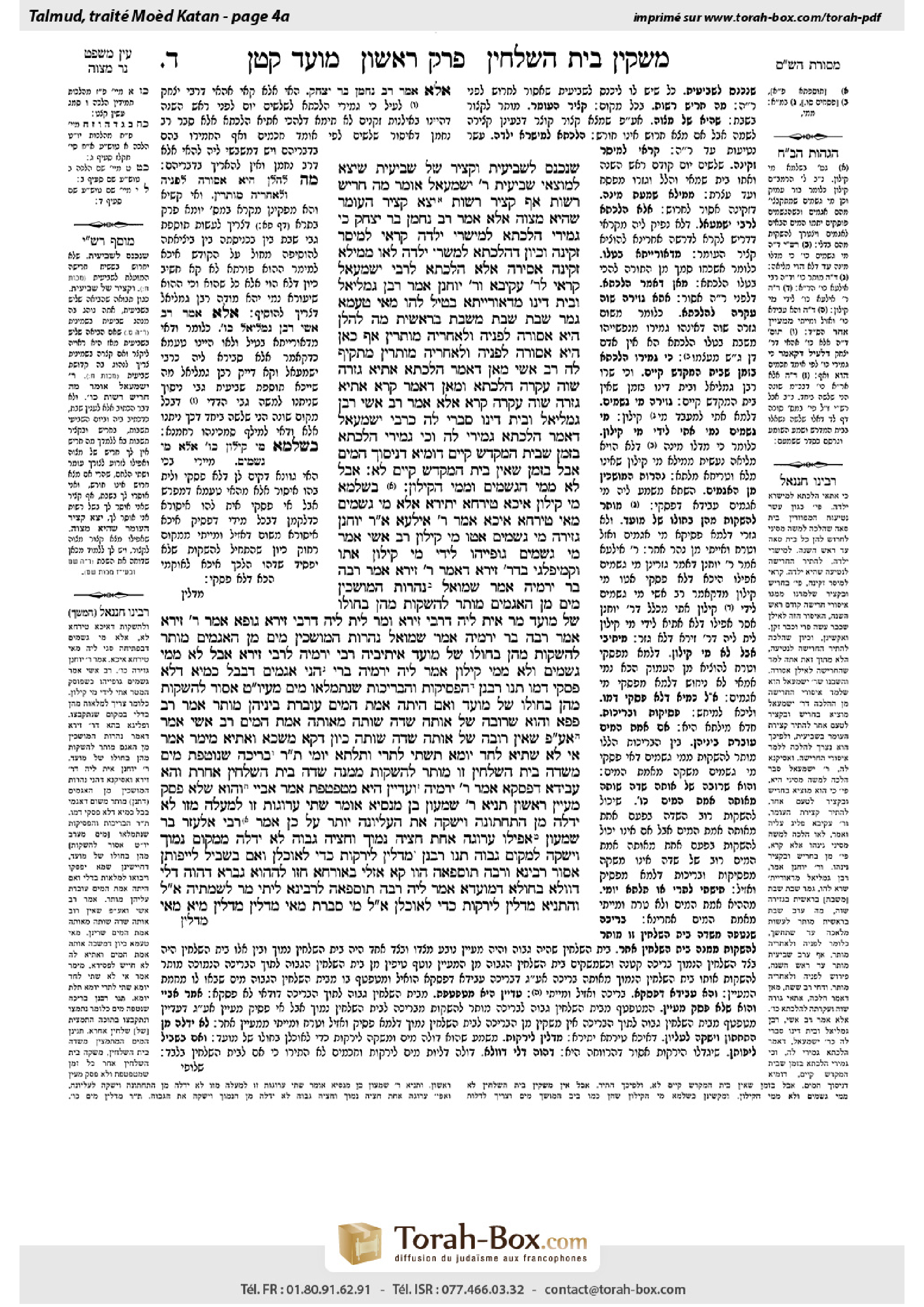
Moed Katan 4a: Talmud study for Daf Yomi
Daf Yomi is the daily study of one Talmud folio. Explore 37 tractates with scans, Hebrew text, Sefaria English and AI-generated French translations where annotated.
Passage selection and English or AI-generated French translation are available where the scan has annotations. Daf Study is independent of Torah-Box and Sefaria.
Browse Moed Katan · מועד קטן · All tractatesMoed Katan 4a text and translations
This page of Moed Katan includes the Aramaic text, an English translation and an AI-generated French translation, alongside the scan above.
מועד קטן ד׳ א · Aramaic and Hebrew text
שֶׁנִּכְנָס לִשְׁבִיעִית, וְקָצִיר שֶׁל שְׁבִיעִית שֶׁיָּצָא לְמוֹצָאֵי שְׁבִיעִית.
רַבִּי יִשְׁמָעֵאל אוֹמֵר: מָה חָרִישׁ רְשׁוּת, אַף קָצִיר — רְשׁוּת, יָצָא קְצִיר הָעוֹמֶר שֶׁהִיא מִצְוָה!
אֶלָּא אָמַר רַב נַחְמָן בַּר יִצְחָק: כִּי גְּמִירִי הִלְכְתָא — לְמִישְׁרֵי יַלְדָּה. קְרָאֵי — לְמֵיסַר זְקֵינָה.
וְכֵיוָן דְּהִלְכְתָא לְמִשְׁרֵי יַלְדָּה, לָאו מִמֵּילָא זְקֵינָה אֲסִירָה?!
אֶלָּא: הִלְכְתָא לְרַבִּי יִשְׁמָעֵאל, קְרָאֵי לְרַבִּי עֲקִיבָא.
וְרַבִּי יוֹחָנָן אָמַר: רַבָּן גַּמְלִיאֵל וּבֵית דִּינוֹ מִדְּאוֹרָיְיתָא בַּטֻּל לְהוּ.
מַאי טַעְמָא? גָּמַר ״שַׁבָּת״ ״שַׁבָּת״ מִשַּׁבַּת בְּרֵאשִׁית. מָה לְהַלָּן — הִיא אֲסוּרָה לְפָנֶיהָ וּלְאַחֲרֶיהָ מוּתָּרִין, אַף כָּאן — הִיא אֲסוּרָה לְפָנֶיהָ וּלְאַחֲרֶיהָ מוּתָּרִין.
מַתְקֵיף לַהּ רַב אָשֵׁי: מַאן דְּאָמַר הִלְכְתָא — אָתְיָא גְּזֵרָה שָׁוָה עָקְרָה הִלְכְתָא? וּמַאן דְּאָמַר קְרָא — אָתְיָא גְּזֵרָה שָׁוָה עָקְרָה קְרָא?
אֶלָּא אָמַר רַב אָשֵׁי: רַבָּן גַּמְלִיאֵל וּבֵית דִּינוֹ סָבְרִי לַהּ כְּרַבִּי יִשְׁמָעֵאל, דְּאָמַר הִלְכְתָא גְּמִירִי לַהּ. וְכִי גְּמִירִי הִלְכְתָא, בִּזְמַן שֶׁבֵּית הַמִּקְדָּשׁ קַיָּים — דּוּמְיָא דְּנִיסּוּךְ הַמַּיִם. אֲבָל בִּזְמַן שֶׁאֵין בֵּית הַמִּקְדָּשׁ קַיָּים — לָא.
אֲבָל לֹא מִמֵּי הַגְּשָׁמִים וּמִמֵּי הַקִּילוֹן. בִּשְׁלָמָא מֵי קִילוֹן — אִיכָּא טִירְחָא יַתִּירָא, אֶלָּא מֵי גְּשָׁמִים מַאי טִירְחָא אִיכָּא?
אָמַר רַבִּי אִילְעָא אָמַר יוֹחָנָן: גְּזֵירָה מֵי גְשָׁמִים אַטּוּ מֵי קִילוֹן. רַב אָשֵׁי אָמַר: מֵי גְשָׁמִים גּוּפַיְיהוּ לִידֵי מֵי קִילוֹן אָתוּ.
וְקָמִיפַּלְגִי בִּדְרַבִּי זֵירָא. דְּאָמַר רַבִּי זֵירָא אָמַר רַבָּה בַּר יִרְמְיָה אָמַר שְׁמוּאֵל: נְהָרוֹת הַמּוֹשְׁכִין מַיִם מִן הָאֲגַמִּים מוּתָּר לְהַשְׁקוֹת מֵהֶן בְּחוּלּוֹ שֶׁל מוֹעֵד.
מָר אִית לֵיהּ דְּרַבִּי זֵירָא, וּמָר לֵית לֵיהּ דְּרַבִּי זֵירָא.
גּוּפָא, אָמַר רַבִּי זֵירָא אָמַר רַבָּה בַּר יִרְמְיָה אָמַר שְׁמוּאֵל: נְהָרוֹת הַמּוֹשְׁכִין מַיִם מִן הָאֲגַמִּים — מוּתָּר לְהַשְׁקוֹת מֵהֶן בְּחוּלּוֹ שֶׁל מוֹעֵד.
אֵיתִיבֵיהּ רַבִּי יִרְמְיָה לְרַבִּי זֵירָא: אֲבָל לֹא מִמֵּי גְשָׁמִים וְלֹא מִמֵּי קִילוֹן! אֲמַר לֵיהּ: יִרְמְיָה בְּרִי, הָנֵי אַגַּמִּים דְּבָבֶל — כְּמַיָּא דְּלָא פָּסְקִי דָּמוּ.
תָּנוּ רַבָּנַן: הַפְּסִיקוֹת וְהַבְּרֵיכוֹת שֶׁנִּתְמַלְּאוּ מַיִם מֵעֶרֶב יוֹם טוֹב — אָסוּר לְהַשְׁקוֹת מֵהֶן בְּחוּלּוֹ שֶׁל מוֹעֵד. וְאִם הָיְתָה אַמַּת הַמַּיִם עוֹבֶרֶת בֵּינֵיהֶן — מוּתָּר.
אָמַר רַב פָּפָּא: וְהוּא שֶׁרוּבָּהּ שֶׁל אוֹתָהּ שָׂדֶה שׁוֹתָה מֵאוֹתָהּ אַמַּת הַמַּיִם. רַב אָשֵׁי אָמַר: אַף עַל פִּי שֶׁאֵין רוּבָּהּ שֶׁל אוֹתָהּ שָׂדֶה שׁוֹתָה, כֵּיוָן דְּקָא מָשְׁכָא וְאָתְיָא, מֵימָר אָמַר: אִי לָא שָׁתְיָא לְחַד יוֹמָא — תִּשְׁתֵּי לִתְרֵי וּתְלָתָא יוֹמֵי.
תָּנוּ רַבָּנַן: בְּרֵיכָה שֶׁנּוֹטֶפֶת מַיִם מִשְּׂדֵה בֵּית הַשְּׁלָחִין זוֹ — מוּתָּר לְהַשְׁקוֹת מִמֶּנָּה שְׂדֵה בֵּית הַשְּׁלָחִין אַחֶרֶת.
וְהָא עֲבִידָא דְּפָסְקָא! אָמַר רַבִּי יִרְמְיָה: וַעֲדַיִין הִיא מְטַפְטֶפֶת. אָמַר אַבָּיֵי: וְהוּא שֶׁלֹּא פָּסַק מַעְיָין רִאשׁוֹן.
תַּנְיָא, רַבִּי שִׁמְעוֹן בֶּן מְנַסְיָא אוֹמֵר: שְׁתֵּי עֲרוּגוֹת זוֹ לְמַעְלָה מִזּוֹ — לֹא יִדְלֶה מִן הַתַּחְתּוֹנָה וְיַשְׁקֶה אֶת הָעֶלְיוֹנָה. יוֹתֵר עַל כֵּן אָמַר רַבִּי אֶלְעָזָר בַּר שִׁמְעוֹן: אֲפִילּוּ עֲרוּגָה אַחַת חֶצְיָהּ נָמוּךְ וְחֶצְיָהּ גָּבוֹהַּ — לֹא יִדְלֶה מִמָּקוֹם נָמוּךְ וְיַשְׁקֶה לְמָקוֹם גָּבוֹהַּ.
תָּנוּ רַבָּנַן: מַדְלִין לִירָקוֹת כְּדֵי לְאוֹכְלָן, וְאִם בִּשְׁבִיל לְיַיפּוֹתָן — אָסוּר.
רָבִינָא וְרַבָּה תּוֹסְפָאָה הֲווֹ קָא אָזְלִי בְּאוֹרְחָא. חֲזוֹ לְהָהוּא גַּבְרָא דַּהֲוָה דָּלֵי דַּוְולָא בְּחוּלָּא דְּמוֹעֲדָא, אֲמַר לֵיהּ רַבָּה תּוֹסְפָאָה לְרָבִינָא: לֵיתֵי מָר לְשַׁמְּתֵיהּ. אֲמַר לֵיהּ: וְהָתַנְיָא: מַדְלִין לִירָקוֹת כְּדֵי לְאוֹכְלָן. אֲמַר לֵיהּ: מִי סָבְרַתְּ מַאי ״מַדְלִין״ — מַדְלִין מַיָּא? מַאי
Moed Katan 4a · English translation
that entered into the Sabbatical Year, i.e., plowing in the sixth year that will benefit crops growing in the seventh year, and reaping the crops of the Sabbatical Year that continued into the conclusion of the Sabbatical Year, i.e., reaping seventh-year produce that continued to grow into the eighth year.
Rabbi Yishmael says that this verse is to be understood as referring to Shabbat and not to the Sabbatical Year, in accordance with the straightforward meaning of the verse. It teaches as follows: Just as only optional plowing is prohibited on Shabbat, as there is no instance where plowing fulfills a biblical mitzva, so too, only optional reaping is prohibited, to the exclusion of the reaping of the omer offering, which is a mitzva, and consequently permitted on Shabbat. Nonetheless, the first opinion cited in the baraita, that of Rabbi Akiva, holds that the prohibition against plowing on the eve of the Sabbatical Year is derived from an explicit verse.
Rather, Rav Naḥman bar Yitzḥak said: When we learned this as a halakha transmitted to Moses from Sinai, it was to permit plowing in the case of young saplings until Rosh HaShana. In contrast, the verses that were cited come to prohibit plowing in the case of mature and well-rooted trees thirty days before Rosh HaShana of the Sabbatical Year.
The Gemara asks: But since the halakha transmitted to Moses from Sinai comes to permit plowing in the case of young saplings until Rosh HaShana, does it not automatically follow that in the case of mature trees, plowing is prohibited before Rosh HaShana? Therefore, not only the allowance, but the prohibition as well was learned by tradition as a halakha transmitted to Moses from Sinai, and not from the verses.
Rather, the halakha transmitted to Moses from Sinai is the basis of the prohibition against plowing on the eve of the Sabbatical Year according to the opinion of Rabbi Yishmael, who interprets the verse as referring to Shabbat, and not to the Sabbatical Year, whereas the verses are the basis of the prohibition according to the opinion of Rabbi Akiva.
The Gemara previously cited Rabbi Yitzḥak, who explained how Rabban Gamliel’s court nullified the extension to the prohibition against plowing before the Sabbatical Year that had been enacted by Beit Shammai and Beit Hillel. The Gemara now cites another opinion, which holds that Rabban Gamliel’s court abolished the prohibition against plowing before the Sabbatical Year entirely. And Rabbi Yoḥanan said that Rabban Gamliel and his court nullified the restrictions on working the land on the eve of the Sabbatical Year based on a source written in the Torah.
What is the reason? He derives it by means of a verbal analogy between the word Shabbat stated with regard to the Sabbatical Year in the verse: “But in the seventh year shall be a sabbath of solemn rest for the land” (Leviticus 25:4), and the word Shabbat stated with regard to the weekly Shabbat, which commemorates the Shabbat of Creation. Just as there, on Shabbat itself it is prohibited to perform labor, but before and after Shabbat it is permitted, so too here, in the case of the Sabbatical Year, during the Sabbatical Year itself it is prohibited to perform labor, but before and after the Sabbatical Year it is permitted.
Rav Ashi strongly objects to this: If Rabban Gamliel and his court nullified the restrictions based on a verbal analogy, then according to the one who said that the prohibition against plowing thirty days before Rosh HaShana of the Sabbatical Year is a halakha that was transmitted to Moses from Sinai, can a verbal analogy come and uproot a halakha that was transmitted to Moses from Sinai? And similarly, according to the one who said that the prohibition against plowing is derived from a verse, can a verbal analogy come and uproot a verse?
Rather, Rav Ashi said: Rabban Gamliel and his court held in accordance with the opinion of Rabbi Yishmael, who said that they learned this prohibition as a halakha transmitted to Moses from Sinai. But they learned this halakha only with regard to the time period when the Temple is standing. This is evidenced by the fact that it is similar to the other halakha stated along with it, that of the water libation, which was part of the service in the Temple. But when the Temple is not standing this halakha does not apply, and therefore Rabban Gamliel and his court nullified the prohibition after the destruction of the Temple.
§ It was taught in the mishna: However, one may not irrigate a field on the intermediate days of a Festival with rainwater collected in a cistern or with water drawn with a shadoof. The Gemara asks: Granted, irrigating a field with water drawn with a shadoof involves excessive effort, and so it is prohibited on the intermediate days of a Festival. But what excessive effort is involved in irrigating a field with rainwater? Rainwater collects on its own and one merely has to channel it to where it is needed.
Rabbi Ile’a said that Rabbi Yoḥanan said: A rabbinic decree was enacted with regard to rainwater due to its similarity to water drawn with a shadoof. Rav Ashi said: Rainwater itself will come to be like water drawn with a shadoof. Once the level of the collected rainwater drops, it will become necessary to draw it with a bucket, a procedure involving excessive effort.
The Gemara comments: Rabbi Ile’a and Rav Ashi disagree with regard to the ruling issued by Rabbi Zeira, as Rabbi Zeira said that Rabba bar Yirmeya said that Shmuel said: With regard to streams that draw water from pools of collected water, one is permitted to irrigate his field from them on the intermediate days of a Festival, because the flow of water is steady.
One Sage, Rav Ashi, is of the opinion that the ruling is in accordance with the opinion of Rabbi Zeira, as he prohibits only irrigating with rainwater, because the supply might come to an end, but he does not prohibit watering from a source whose flow is steady. And one Sage, Rabbi Yoḥanan, is not of the opinion that the ruling is in accordance with the opinion of Rabbi Zeira, as he prohibits irrigating with rainwater due to its similarity to water drawn with a shadoof. This applies regardless of whether the level of the rainwater will drop, and therefore Rabbi Yoḥanan would prohibit using collected water even if a stream flows through it and it will not dry up.
After mentioning the statement of Rabbi Zeira in the course of the previous discussion, the Gemara examines the matter itself. Rabbi Zeira said that Rabba bar Yirmeya said that Shmuel said: With regard to streams that draw water from pools of water, one is permitted to irrigate his field from them on the intermediate days of a Festival.
Rabbi Yirmeya raised an objection to Rabbi Zeira from what is taught in the mishna: However, one may not irrigate a field on the intermediate days of a Festival with rainwater collected in cisterns or with water drawn with a shadoof. This indicates that whenever there is a concern that the water might run out, it is prohibited to irrigate from this water source. Consequently, Rabbi Yirmeya wanted to know why this concern did not exist in the case of the pools of water as well. Rabbi Zeira said to him: Yirmeya, my son, these pools in Babylonia are like water that does not stop flowing. Therefore, there is no concern that the water level in these pools might go down to such an extent that it will become necessary to draw the water with buckets.
The Sages taught in a baraita: With regard to temporary pools and regular pools that were filled with water on the eve of a Festival, it is prohibited for one to irrigate his field from them on the intermediate days of the Festival, lest they run out of water and he will come to exert himself and bring water from elsewhere. But if a water channel passes between them so that water flows from the one to the other, it is permitted.
Rav Pappa said: And this allowance applies only when the majority of that field can be irrigated from that water channel, such that most of the field can be irrigated at the same time. In this case, there is no concern that when the water runs out, he will come to exert himself and irrigate the rest of the field from another source of water. Rav Ashi said: It applies even though the majority of that field cannot be irrigated from that water channel at the same time. Since the channel continuously draws water, constantly replenishing its supply, even if it does so at a slow rate, one will say to himself that even if the entire field cannot be irrigated from that water channel on a single day, it can be irrigated from it over the course of two or three days. Accordingly, he will not find it necessary to exert himself to quickly irrigate that portion of the field that did not already receive its water.
The Sages taught in a baraita: With regard to a pool that receives drips of water from this field that requires irrigation, which itself receives water from a spring, one is permitted to irrigate from this pool another field situated below it that requires irrigation.
The Gemara asks: But isn’t the pool likely to stop flowing, which will force him to exert himself and draw water from somewhere else? Rabbi Yirmeya said: The case is where the upper field is still trickling water into the pool and does not stop. Abaye said: And this allowance applies only when the water from the first spring that irrigates the upper field has not stopped flowing. Only in that case can one rely on the water trickling from the upper field and consequently irrigating the lower field from the pool.
It is taught in a baraita that Rabbi Shimon ben Menasya says: With regard to two garden beds located one above the other, one may not draw water from the channel supplying the lower garden bed in order to irrigate the upper garden bed, due to the excessive exertion involved. Furthermore, Rabbi Elazar bar Shimon said: Even in the case of a single garden bed, half of which is lower and half of which is higher, one may not draw water from the channel supplying the lower area to irrigate the upper area, even though they are two parts of the same garden bed.
The Sages taught in a baraita: One may draw water and irrigate vegetables in order to eat them on the intermediate days of a Festival. But if he does this in order to improve their growth and to enhance their appearance it is prohibited, as he is considered to be unnecessarily exerting himself on the Festival.
The Gemara relates that Ravina and Rabba Tosefa’a were once walking along the road when they saw a certain man that was drawing water with a bucket on the intermediate days of a Festival. Rabba Tosefa’a said to Ravina: Let the Master come and excommunicate him for transgressing the words of the Sages. Ravina said to him: But isn’t it taught in a baraita: One may draw for vegetables in order to eat them, and so he has not committed a transgression. Rabba Tosefa’a said to him: Do you maintain that what is meant by one may draw [madlin] is that one may draw water in order to irrigate the vegetables? This is not so. Rather, what is meant by
Moed Katan 4a · Traduction française (IA)
qui sont entrés dans l’année de jachère, c’est-à-dire labourer durant la sixième année au bénéfice des cultures qui pousseront pendant la septième année, et récolter les cultures de l’année de jachère qui se sont prolongées jusqu’à la fin de celle-ci, c’est-à-dire récolter les produits de la septième année qui ont continué à pousser jusqu’à la huitième année.
Rabbi Yishmaël dit que ce verset doit être compris comme se rapportant au Chabbat, et non à l’année de jachère, conformément au sens simple du verset. Il enseigne ceci : de même que seul le labour facultatif est interdit le Chabbat, puisqu’il n’existe aucun cas où labourer constitue une mitsva biblique, de même seule la récolte facultative est interdite ; cela exclut la récolte de l’offrande de l’omer, qui est une mitsva et est donc permise le Chabbat. Néanmoins, le premier avis cité dans la baraïta, celui de Rabbi Akiva, considère que l’interdiction de labourer à la veille de l’année de jachère est tirée d’un verset explicite.
Rav Naḥman bar Yitzḥak dit plutôt : lorsque nous avons appris cette règle comme une halakha transmise à Moïse au Sinaï, il s’agissait de permettre de labourer autour des jeunes plants jusqu’à Roch Hachana. En revanche, les versets cités viennent interdire de labourer autour des arbres adultes bien enracinés trente jours avant Roch Hachana de l’année de jachère.
La Guemara demande : mais puisque la halakha transmise à Moïse au Sinaï vient permettre de labourer autour des jeunes plants jusqu’à Roch Hachana, n’en découle-t-il pas automatiquement que, dans le cas des arbres adultes, il est interdit de labourer avant Roch Hachana ? Ainsi, non seulement l’autorisation, mais aussi l’interdiction, ont été apprises par tradition comme une halakha transmise à Moïse au Sinaï, et non à partir des versets.
La halakha transmise à Moïse au Sinaï constitue plutôt le fondement de l’interdiction de labourer à la veille de l’année de jachère selon l’avis de Rabbi Yishmaël, qui interprète le verset comme se rapportant au Chabbat et non à l’année de jachère ; tandis que les versets constituent le fondement de l’interdiction selon l’avis de Rabbi Akiva.
La Guemara a cité précédemment Rabbi Yitzḥak, qui expliquait comment le tribunal de Rabban Gamliel avait annulé l’extension de l’interdiction de labourer avant l’année de jachère, promulguée par Beit Shammaï et Beit Hillel. La Guemara cite maintenant un autre avis, selon lequel le tribunal de Rabban Gamliel a entièrement supprimé l’interdiction de labourer avant l’année de jachère. Rabbi Yoḥanan a dit que Rabban Gamliel et son tribunal ont annulé les restrictions concernant le travail de la terre à la veille de l’année de jachère en s’appuyant sur une source écrite dans la Torah.
Quelle en est la raison ? Il le déduit au moyen d’une analogie verbale entre le mot Chabbat employé à propos de l’année de jachère dans le verset : « Mais la septième année sera un sabbat de repos complet pour la terre » (Lévitique 25:4), et le mot Chabbat employé à propos du Chabbat hebdomadaire, qui commémore le Chabbat de la Création. De même que, là-bas, le travail est interdit le Chabbat même, mais permis avant et après le Chabbat, de même ici, dans le cas de l’année de jachère, le travail est interdit pendant l’année de jachère elle-même, mais permis avant et après celle-ci.
Rav Ashi formule une objection énergique : si Rabban Gamliel et son tribunal ont annulé les restrictions sur la base d’une analogie verbale, alors, selon celui qui dit que l’interdiction de labourer durant les trente jours précédant Roch Hachana de l’année de jachère est une halakha transmise à Moïse au Sinaï, une analogie verbale peut-elle venir déraciner une halakha transmise à Moïse au Sinaï ? Et de même, selon celui qui dit que l’interdiction de labourer est tirée d’un verset, une analogie verbale peut-elle venir déraciner un verset ?
Rav Ashi dit plutôt : Rabban Gamliel et son tribunal ont suivi l’avis de Rabbi Yishmaël, qui disait qu’ils avaient appris cette interdiction comme une halakha transmise à Moïse au Sinaï. Mais ils n’avaient appris cette halakha que pour la période où le Temple est debout. Cela est attesté par le fait qu’elle ressemble à l’autre halakha énoncée avec elle, celle de la libation d’eau, qui faisait partie du service au Temple. Mais lorsque le Temple n’est pas debout, cette halakha ne s’applique pas ; c’est pourquoi Rabban Gamliel et son tribunal ont annulé l’interdiction après la destruction du Temple.
§ Il a été enseigné dans la Michna : toutefois, il est interdit d’irriguer un champ pendant les jours intermédiaires d’une fête avec de l’eau de pluie recueillie dans une citerne ou avec de l’eau tirée au moyen d’un balancier. La Guemara demande : certes, irriguer un champ avec de l’eau tirée au moyen d’un balancier exige un effort considérable et est donc interdit pendant les jours intermédiaires d’une fête. Mais quel effort considérable faut-il fournir pour irriguer un champ avec de l’eau de pluie ? L’eau de pluie s’accumule d’elle-même, et il suffit de la diriger là où elle est nécessaire.
Rabbi Iléa a dit au nom de Rabbi Yoḥanan : un décret rabbinique a été promulgué concernant l’eau de pluie, en raison de sa ressemblance avec l’eau tirée au moyen d’un balancier. Rav Ashi a dit : l’eau de pluie elle-même finira par ressembler à l’eau tirée au moyen d’un balancier. Lorsque le niveau de l’eau de pluie recueillie baissera, il deviendra nécessaire de la tirer avec un seau, une opération qui exige un effort considérable.
La Guemara fait remarquer que Rabbi Iléa et Rav Ashi sont en désaccord au sujet de la décision rapportée par Rabbi Zeira, car Rabbi Zeira a dit que Rabba bar Yirmeya a dit que Shmuel a dit : concernant les cours d’eau qui puisent leur eau dans des bassins d’eau recueillie, il est permis d’en irriguer son champ pendant les jours intermédiaires d’une fête, car le débit est régulier.
Un Sage, Rav Ashi, considère que la décision suit l’avis de Rabbi Zeira, car il n’interdit d’irriguer qu’avec de l’eau de pluie, dont la réserve risque de s’épuiser, mais n’interdit pas d’arroser à partir d’une source au débit régulier. Un autre Sage, Rabbi Yoḥanan, ne considère pas que la décision suive l’avis de Rabbi Zeira, car il interdit d’irriguer avec de l’eau de pluie en raison de sa ressemblance avec l’eau tirée au moyen d’un balancier. Cela s’applique que le niveau de l’eau de pluie baisse ou non ; Rabbi Yoḥanan interdirait donc d’utiliser de l’eau recueillie même si un cours d’eau la traverse et qu’elle ne risque pas de s’assécher.
Après avoir mentionné, au cours de la discussion précédente, la déclaration de Rabbi Zeira, la Guemara examine maintenant la question elle-même. Rabbi Zeira a dit que Rabba bar Yirmeya a dit que Shmuel a dit : concernant les cours d’eau qui puisent leur eau dans des bassins, il est permis d’en irriguer son champ pendant les jours intermédiaires d’une fête.
Rabbi Yirmeya a soulevé une objection à Rabbi Zeira à partir de ce qui est enseigné dans la Michna : toutefois, il est interdit d’irriguer un champ pendant les jours intermédiaires d’une fête avec de l’eau de pluie recueillie dans des citernes ou avec de l’eau tirée au moyen d’un balancier. Cela indique que, chaque fois qu’il existe un risque que l’eau vienne à manquer, il est interdit d’irriguer à partir de cette source d’eau. Rabbi Yirmeya voulait donc savoir pourquoi ce risque n’existait pas également dans le cas des bassins d’eau. Rabbi Zeira lui dit : « Yirmeya, mon fils, ces bassins de Babylonie sont comme une eau dont le débit ne s’interrompt pas. » Il n’y a donc pas à craindre que le niveau de l’eau dans ces bassins baisse au point qu’il devienne nécessaire de la tirer avec des seaux.
Les Sages ont enseigné dans une baraïta : concernant les bassins temporaires et les bassins permanents qui ont été remplis d’eau à la veille d’une fête, il est interdit d’en irriguer son champ pendant les jours intermédiaires de la fête, de peur qu’ils ne se vident et qu’on en vienne à se donner de la peine pour apporter de l’eau d’ailleurs. Mais si un canal passe entre eux, de sorte que l’eau s’écoule de l’un à l’autre, cela est permis.
Rav Pappa a dit : cette permission ne s’applique que si la majeure partie du champ peut être irriguée à partir de ce canal, de sorte qu’elle puisse l’être en même temps. Dans ce cas, on ne craint pas que, lorsque l’eau viendra à manquer, on en vienne à se donner de la peine pour irriguer le reste du champ à partir d’une autre source. Rav Ashi a dit : elle s’applique même si la majeure partie du champ ne peut pas être irriguée à partir de ce canal en même temps. Puisque le canal continue à apporter de l’eau et que sa réserve se renouvelle constamment, même si cela se fait lentement, on se dira que, même si tout le champ ne peut pas être irrigué par ce canal en une seule journée, il peut l’être en deux ou trois jours. On ne jugera donc pas nécessaire de se donner de la peine pour irriguer rapidement la partie du champ qui n’a pas encore reçu son eau.
Les Sages ont enseigné dans une baraïta : concernant un bassin qui reçoit les gouttes d’eau d’un champ ayant besoin d’irrigation et qui est lui-même alimenté par une source, il est permis d’irriguer à partir de ce bassin un autre champ situé en contrebas et ayant besoin d’irrigation.
La Guemara demande : mais le bassin ne risque-t-il pas de cesser de couler, ce qui l’obligerait à se donner de la peine et à tirer de l’eau d’ailleurs ? Rabbi Yirmeya a dit : il s’agit d’un cas où le champ supérieur continue à laisser couler de l’eau dans le bassin et ne s’arrête pas. Abaye a dit : cette permission ne s’applique que si l’eau de la source qui irrigue le champ supérieur n’a pas cessé de couler. Ce n’est que dans ce cas que l’on peut compter sur l’eau qui s’écoule du champ supérieur pour irriguer, à partir du bassin, le champ inférieur.
Il est enseigné dans une baraïta que Rabbi Shimon ben Menasya dit : concernant deux planches de jardin situées l’une au-dessus de l’autre, il est interdit de tirer de l’eau du canal qui alimente la planche inférieure afin d’irriguer la planche supérieure, en raison de l’effort considérable que cela exige. En outre, Rabbi Elazar bar Shimon a dit : même dans le cas d’une seule planche de jardin, dont une moitié est en contrebas et l’autre moitié en hauteur, il est interdit de tirer de l’eau du canal qui alimente la partie inférieure pour irriguer la partie supérieure, bien qu’il s’agisse de deux parties d’une même planche de jardin.
Les Sages ont enseigné dans une baraïta : il est permis de tirer de l’eau pour irriguer des légumes afin de les manger pendant les jours intermédiaires d’une fête. Mais si on le fait pour favoriser leur croissance et améliorer leur apparence, cela est interdit, car on est alors considéré comme se donnant inutilement de la peine pendant la fête.
La Guemara rapporte que Ravina et Rabba Tosefa’a marchaient un jour sur la route lorsqu’ils virent un homme qui tirait de l’eau avec un seau pendant les jours intermédiaires d’une fête. Rabba Tosefa’a dit à Ravina : « Que le Maître vienne l’excommunier pour avoir transgressé les paroles des Sages. » Ravina lui dit : « Mais n’est-il pas enseigné dans une baraïta : il est permis de tirer de l’eau pour les légumes afin de les manger ? Il n’a donc commis aucune transgression. » Rabba Tosefa’a lui dit : « Penses-tu que l’expression “il est permis de tirer [madlin]” signifie qu’on peut tirer de l’eau pour irriguer les légumes ? Ce n’est pas cela. Mais que signifie
Traduction française générée par IA à partir de l’édition anglaise de Sefaria. Vérifie toujours un passage avec le texte source.
Text from Sefaria: William Davidson Edition - Vocalized Aramaic (CC BY NC); William Davidson Edition - English (CC BY NC).