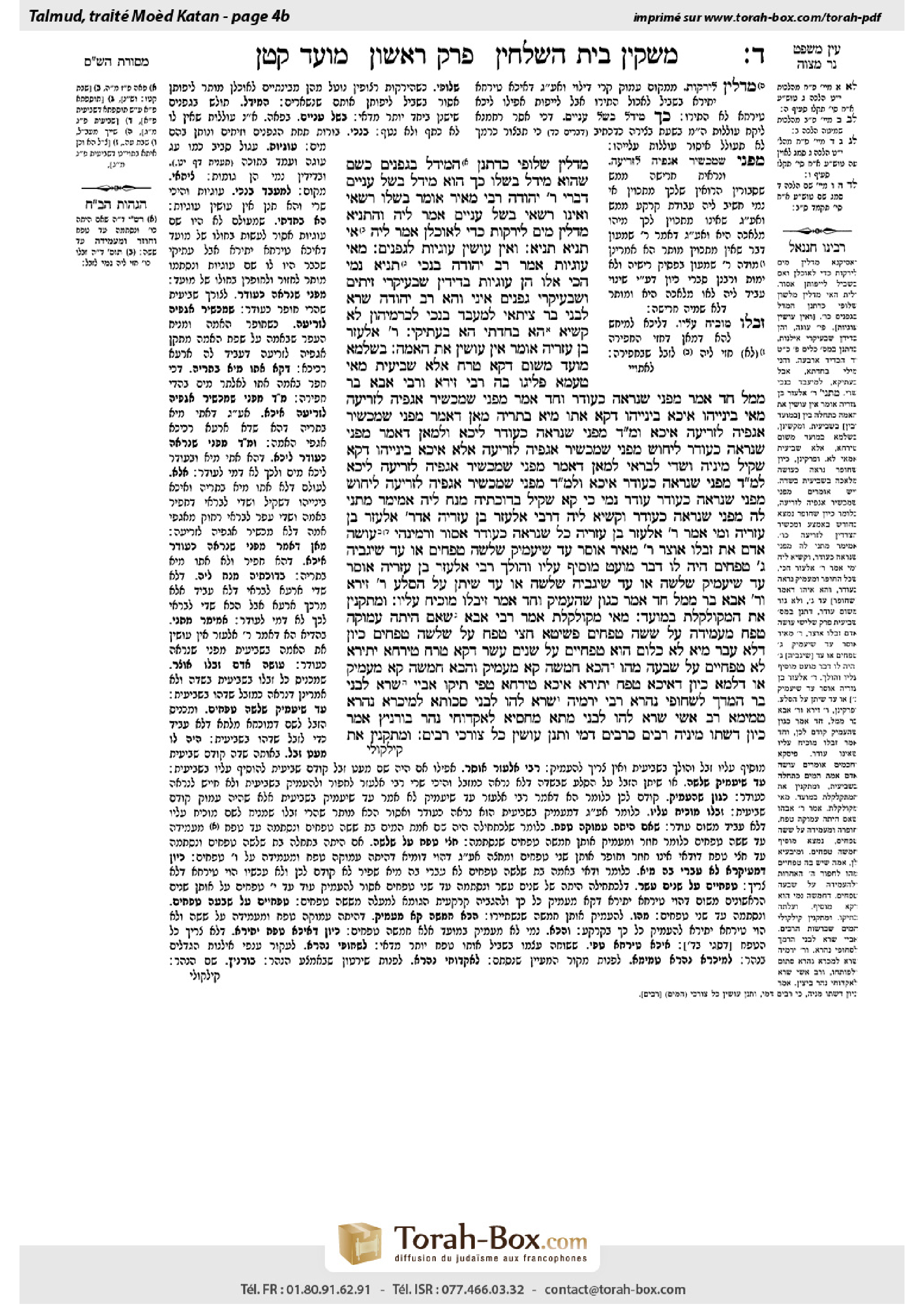
Moed Katan 4b: Talmud study for Daf Yomi
Daf Yomi is the daily study of one Talmud folio. Explore 37 tractates with scans, Hebrew text, Sefaria English and AI-generated French translations where annotated.
Passage selection and English or AI-generated French translation are available where the scan has annotations. Daf Study is independent of Torah-Box and Sefaria.
Browse Moed Katan · מועד קטן · All tractatesMoed Katan 4b text and translations
This page of Moed Katan includes the Aramaic text, an English translation and an AI-generated French translation, alongside the scan above.
מועד קטן ד׳ ב · Aramaic and Hebrew text
״מַדְלִין״ — שַׁלּוֹפֵי. כְּדִתְנַן: הַמֵּידֵל בַּגְּפָנִים, כְּשֵׁם שֶׁהוּא מֵידֵל בְּשֶׁלּוֹ — כָּךְ הוּא מֵידֵל בְּשֶׁל עֲנִיִּים, דִּבְרֵי רַבִּי יְהוּדָה. רַבִּי מֵאִיר אוֹמֵר: בְּשֶׁלּוֹ רַשַּׁאי, וְאֵינוֹ רַשַּׁאי בְּשֶׁל עֲנִיִּים.
אֲמַר לֵיהּ, וְהָתַנְיָא: מַדְלִין מַיִם לִירָקוֹת כְּדֵי לְאוֹכְלָן! אֲמַר לֵיהּ: אִי תַּנְיָא — תַּנְיָא.
וְאֵין עוֹשִׂין עוּגִיּוֹת לַגְּפָנִים. מַאי עוּגִיּוֹת? אָמַר רַב יְהוּדָה: בַּנְכֵּי. תַּנְיָא נָמֵי הָכִי: אֵלּוּ הֵן עוּגִיּוֹת — בְּדִידִין שֶׁבְּעִיקָּרֵי זֵיתִים וְשֶׁבְּעִיקָּרֵי גְפָנִים.
אִינִי? וְהָא רַב יְהוּדָה שְׁרָא לִבְנֵי בַּר צֵיתַאי לְמֶעְבַּד בַּנְכֵּי לְכַרְמֵיהוֹן! לָא קַשְׁיָא הָא בְּחַדְתֵי, הָא בְּעַתִּיקֵי.
רַבִּי אֶלְעָזָר בֶּן עֲזַרְיָה אוֹמֵר: אֵין עוֹשִׂין אֶת הָאַמָּה. בִּשְׁלָמָא מוֹעֵד — מִשּׁוּם דְּקָא טָרַח, אֶלָּא שְׁבִיעִית מַאי טַעְמָא?
פְּלִיגוּ בַּהּ רַבִּי זֵירָא וְרַבִּי אַבָּא בַּר מֶמֶל. חַד אָמַר: מִפְּנֵי שֶׁנִּרְאֶה כְּעוֹדֵר. וְחַד אָמַר: מִפְּנֵי שֶׁמַּכְשִׁיר אֲגַפֶּיהָ לִזְרִיעָה.
מַאי בֵּינַיְיהוּ? אִיכָּא בֵּינַיְיהוּ דְּקָא אָתוּ מַיָּא בָּתְרֵיהּ. מַאן דְּאָמַר מִפְּנֵי שֶׁמַּכְשִׁיר אֲגַפֶּיהָ לִזְרִיעָה — אִיכָּא, וּמַאן דְּאָמַר מִפְּנֵי שֶׁנִּרְאֶה כְּעוֹדֵר — לֵיכָּא.
וּלְמַאן דְּאָמַר מִפְּנֵי שֶׁנִּרְאֶה כְּעוֹדֵר, לֵיחוּשׁ מִפְּנֵי שֶׁמַּכְשִׁיר אֲגַפֶּיהָ לִזְרִיעָה? אֶלָּא, אִיכָּא בֵּינַיְיהוּ דְּקָא שָׁקֵיל מִינֵּיהּ וְשָׁדֵי לְבָרַאי. לְמַאן דְּאָמַר מִפְּנֵי שֶׁמַּכְשִׁיר אֲגַפֶּיהָ לִזְרִיעָה — לֵיכָּא. לְמַאן דְּאָמַר מִפְּנֵי שֶׁנִּרְאֶה כְּעוֹדֵר — אִיכָּא.
וּלְמַאן דְּאָמַר מִפְּנֵי שֶׁמַּכְשִׁיר אֲגַפֶּיהָ לִזְרִיעָה, לֵיחוּשׁ מִפְּנֵי שֶׁנִּרְאֶה כְּעוֹדֵר! עוֹדֵר נָמֵי, כִּי קָא שָׁקֵיל, בְּדוּכְתֵּיהּ מַנַּח לֵיהּ.
אַמֵּימָר מַתְנֵי לַהּ מִפְּנֵי שֶׁנִּרְאֶה כְּעוֹדֵר, וְקַשְׁיָא לֵיהּ דְּרַבִּי אֶלְעָזָר בֶּן עֲזַרְיָה אַדְּרַבִּי אֶלְעָזָר בֶּן עֲזַרְיָה: וּמִי אָמַר רַבִּי אֶלְעָזָר בֶּן עֲזַרְיָה כׇּל שֶׁנִּרְאֶה כְּעוֹדֵר אָסוּר?
וּרְמִינְהִי: עוֹשֶׂה אָדָם אֶת זִבְלוֹ אוֹצָר. רַבִּי מֵאִיר אוֹסֵר, עַד שֶׁיַּעֲמִיק שְׁלֹשָׁה טְפָחִים, אוֹ עַד שֶׁיַּגְבִּיהַּ שְׁלֹשָׁה טְפָחִים. הָיָה לוֹ דָּבָר מוּעָט — מוֹסִיף עָלָיו וְהוֹלֵךְ.
רַבִּי אֶלְעָזָר בֶּן עֲזַרְיָה אוֹסֵר עַד שֶׁיַּעְמִיק שְׁלֹשָׁה אוֹ עַד שֶׁיַּגְבִּיהַּ שְׁלֹשָׁה, אוֹ עַד שֶׁיִּתֵּן עַל הַסֶּלַע!
רַבִּי זֵירָא וְרַבִּי אַבָּא בַּר מֶמֶל, חַד אָמַר: כְּגוֹן שֶׁהֶעֱמִיק, וְחַד אָמַר: זִיבְלוֹ מוֹכִיחַ עָלָיו.
וּמְתַקְּנִין אֶת הַמְקוּלְקֶלֶת בַּמּוֹעֵד. מַאי מְקוּלְקֶלֶת? אָמַר רַבִּי אַבָּא: שֶׁאִם הָיְתָה עֲמוּקָּה טֶפַח — מַעֲמִידָהּ עַל שִׁשָּׁה טְפָחִים.
פְּשִׁיטָא, חֲצִי טֶפַח עַל שְׁלֹשָׁה טְפָחִים, כֵּיוָן דְּלָא עָבַר מַיָּא — לָא כְּלוּם הוּא. טִפְחַיִים עַל שְׁנֵים עָשָׂר, דְּקָא טָרַח טִירְחָא יַתִּירָא — לָא.
טִפְחַיִים עַל שִׁבְעָה מַהוּ? הָכָא חֲמִשָּׁה קָא מַעֲמֵיק, וְהָכָא חֲמִשָּׁה קָא מַעֲמֵיק, אוֹ דִלְמָא: כֵּיוָן דְּאִיכָּא טֶפַח יַתִּירָא — אִיכָּא טִירְחָא טְפֵי? תֵּיקוּ.
אַבָּיֵי שְׁרָא לִבְנֵי בַּר הַמְדָּךְ לְשַׁחוֹפֵי נַהֲרָא. רַבִּי יִרְמְיָה שְׁרָא לְהוּ לִבְנֵי סָכוּתָא לְמִיכְרֵא נַהֲרָא טְמִימָא. רַב אָשֵׁי שְׁרָא לְהוּ לִבְנֵי מָתָא מַחְסֵיָא לְאַקְדּוֹחֵי נְהַר בּוּרְנִיץ. אֲמַר: כֵּיוָן דְּשָׁתוּ מִינֵּיהּ רַבִּים — כְּרַבִּים דָּמֵי, וּתְנַן: עוֹשִׂין כׇּל צוֹרְכֵי רַבִּים.
וּמְתַקְּנִין אֶת
Moed Katan 4b · English translation
one may draw is that one may pull out some of the vegetables that are growing densely together. The baraita comes to teach that one is permitted to thin out a garden bed on the intermediate days of a Festival in order to eat on the Festival those that he removes, but he is prohibited to do so in order to enhance the appearance of those that remain. As we learned in a mishna (Pe’a 7:5): One who thins out [meidel] the vines in his vineyard, just as he may thin out his own vines, so too, he may thin out the vines set aside for the poor. Since he is doing it for the sake of the vines, he may also thin out what he leaves for the poor; this is the statement of Rabbi Yehuda. Rabbi Meir disagrees and says: His own vines he is permitted to thin out, but he is not permitted to thin out the vines set aside for the poor. This mishna indicates that the term meidel can be used to mean thinning out and does not refer only to drawing water.
Ravina said to Rabba Tosefa’a: But wasn’t it explicitly taught in a baraita: One may draw water to irrigate vegetables in order to eat them? Rabba Tosefa’a said to him: If it is taught explicitly in a baraita, the halakha is as it is taught, and I retract my statement.
§ It was taught in the mishna: And one may not construct circular ditches [ugiyyot] around the bases of grapevines on the intermediate days of a Festival. The Gemara asks: What are ugiyyot? Rav Yehuda said: They are what are called in Aramaic binkei, circular ditches around vines. The Gemara notes that this is also taught in a baraita: These are ugiyyot: Bedidin, circular ditches around the bases of olive trees and around the bases of grapevines.
The Gemara asks: Is that so? Is it prohibited to dig circular ditches on the intermediate days of the Festival? Didn’t Rav Yehuda permit the family of bar Tzitai to construct circular ditches for their vineyards on the intermediate days of a Festival? The Gemara answers: This is not difficult. This source, i.e., the mishna that renders the practice prohibited, is referring to digging new ditches. That other source, i.e., Rav Yehuda’s ruling that permits the digging of such ditches, is referring to old ones, which merely need to be cleared.
§ It was taught in the next clause of the mishna that Rabbi Elazar ben Azarya says: One may not construct a new water channel during the intermediate days of a Festival or during the Sabbatical Year. The Gemara asks: Granted, it is prohibited for him to do so on the intermediate days of a Festival, because in so doing he excessively exerts himself on the Festival. But what is the reason that this is prohibited during the Sabbatical Year, when only labors that enhance the growth of plants are prohibited?
The Gemara answers: Rabbi Zeira and Rabbi Abba bar Memel disagreed with regard to this issue. One of them said: It is prohibited because it appears to others as if he were hoeing his field. As onlookers do not know that he is merely digging a water channel, they suspect him of working his land during the Sabbatical Year. And the other one said: It is prohibited because he thereby prepares the channel’s banks for planting, for when he digs out the channel, he piles the fresh soil that is fit for planting on its two banks.
The Gemara asks: What is the practical halakhic difference between them? The Gemara answers: There is a practical halakhic difference between them in a case where water comes into the channel immediately after he digs it out. According to the one who said that digging a water channel is prohibited because he thereby prepares its banks for planting, there is still a prohibition, as here too, he piles the fresh soil on the channel’s banks. But according to the one who said it is prohibited because it appears as if he were hoeing, there is no prohibition here, as the immediate entry of water makes it obvious that he is digging a water channel.
The Gemara asks: But according to the one who said that digging a water channel is prohibited because it appears as if he were hoeing, let him be concerned that the digger thereby prepares the channel’s banks for planting and render digging prohibited in this case as well. Rather, the matter must be explained differently, such that there is a practical difference between them in a case where he takes the earth that he excavates from the channel and throws it a considerable distance outside. According to the one who said that it is prohibited because he thereby prepares the channel’s banks for planting, there is no prohibition here, as he does not prepare them for planting. But according to the one who said it is prohibited because it appears as if he were hoeing, there is a prohibition here, as here too, it appears as if he were hoeing.
The Gemara asks: But according to the one who said that digging a water channel is prohibited because he thereby prepares its banks for planting, let him be concerned that the digger appears as if he were hoeing. The Gemara answers that this is not a concern, because it is also true of one who hoes that when he takes up a clump of earth, he puts it down again in its place. Consequently, since one throws the dug-up earth far away, it is immediately apparent that he is not engaged in hoeing but is rather digging a water channel.
Ameimar would teach this mishna as stating explicitly that Rabbi Elazar ben Azarya says that one may not dig a new water channel during the Sabbatical Year because it appears as if he were hoeing his field, and he therefore found a difficulty between this statement of Rabbi Elazar ben Azarya and another statement of Rabbi Elazar ben Azarya. The difficulty is as follows: Did Rabbi Elazar ben Azarya actually say that any action that causes him to appear as if he were hoeing is prohibited?
One may raise a contradiction to this assertion from a mishna (Shevi’it 3:3) that states: A person may pile his manure in his field during the Sabbatical Year so that it becomes a storage heap, and there is no cause for concern that it may appear as if he were fertilizing his field. Rabbi Meir prohibits this unless he deepens the storage area for the manure three handbreadths below the ground or raises it three handbreadths above the surface of the ground, so that it does not appear as if he were fertilizing his field. If he already had a small amount of manure in that heap from before the Sabbatical Year, he may continue to add to it, and there is no need for concern.
Rabbi Elazar ben Azarya prohibits piling his manure in his field unless he deepens the storage area for the manure three handbreadths below the surface of the ground, or he raises it three handbreadths above the surface, or he places it on a rock. In any event, it seems that according to Rabbi Elazar ben Azarya, it is permitted for him to dig a hole in the ground in order to deposit his manure there, even though he might appear to be hoeing the ground.
Rabbi Zeira and Rabbi Abba bar Memel both offered resolutions to this difficulty: One of them said: The case in this second mishna is one where he had already deepened the three-handbreadth pit during the sixth year. And the other one said: His pile of manure is proof that he intends merely to bury the manure and not to hoe the field.
§ It was taught in the mishna that the Rabbis say: One may repair a damaged water channel during the intermediate days of a Festival. What is meant by a damaged water channel? Rabbi Abba said that if it was now a handbreadth deep because it had become filled with sediment, he may dredge it out until he sets it at its original depth of six handbreadths.
Based on this ruling, the Gemara clarifies several practical issues: It is obvious that if the channel is half a handbreadth deep and he wants to restore it to a depth of three handbreadths, since water does not flow through a three-handbreadth-deep channel in sufficient quantity, it is nothing at all and it is certainly prohibited to exert oneself with work that provides insignificant benefit. So too, if the channel is two handbreadths deep and he wants to deepen it to twelve handbreadths, even though he preserves the same ratio as in Rabbi Abba’s case, since it involves excessive exertion, no, this is also not permitted.
However, in a case where the channel is two handbreadths deep and he wants to deepen it to seven handbreadths, what is the halakha? The Gemara explains the two sides of the question of whether this can be compared to the case in the mishna: Here, in the case of dredging a one-handbreadth-deep channel to restore its depth of six handbreadths, he deepens the channel by five handbreadths, and similarly here, in the case of deepening the channel from two to seven handbreadths, he likewise wants to deepen it by five handbreadths, and therefore it should be permitted. Or perhaps, since there is an extra handbreadth of depth, then bending over to dig that additional handbreadth involves greater effort, which is unnecessary, and so possibly it should be prohibited. The Gemara states that the dilemma shall stand unresolved.
It was related that Abaye permitted the people of Bar Hamdakh to remove the branches of the trees from the river on the intermediate days of a Festival. Rabbi Yirmeya permitted the people of Sekhavta to dredge out a river that had become blocked. Rav Ashi permitted his townsmen, the people of Mata Meḥasya, to clean out the nearby Burnitz River. He said: Since the public drinks from it, it is considered like a public need, and we learned in the mishna that one may tend to all other public needs on the intermediate days of a Festival.
§ It was taught in the mishna: During the intermediate days of a Festival one may repair
Moed Katan 4b · Traduction française (IA)
… que l’on peut arracher certains des légumes qui poussent trop serrés les uns contre les autres. La baraïta vient enseigner qu’il est permis d’éclaircir une planche de jardin pendant les jours intermédiaires de la fête afin de manger pendant la fête les légumes que l’on enlève, mais qu’il est interdit de le faire pour améliorer l’aspect de ceux qui restent. Comme nous l’avons appris dans une Michna (Pe’a 7:5) : Celui qui éclaircit [meidel] les vignes de son vignoble peut éclaircir aussi bien ses propres vignes que celles réservées aux pauvres. Puisqu’il le fait dans l’intérêt des vignes, il peut également éclaircir celles qu’il laisse aux pauvres ; telle est la déclaration de Rabbi Yehouda. Rabbi Meïr n’est pas d’accord et dit : Il lui est permis d’éclaircir ses propres vignes, mais il ne lui est pas permis d’éclaircir celles qui sont réservées aux pauvres. Cette Michna indique que le terme meidel peut désigner l’éclaircissage et ne signifie pas seulement puiser de l’eau.
Ravina dit à Rabba Tosefa’a : Mais n’a-t-on pas enseigné explicitement dans une baraïta : « On peut puiser de l’eau pour irriguer des légumes afin de les manger » ? Rabba Tosefa’a lui répondit : Si cela est enseigné explicitement dans une baraïta, la halakha est conforme à ce qui y est enseigné, et je retire ce que j’ai dit.
§ Il a été enseigné dans la Michna : On ne peut pas creuser des cuvettes circulaires [ugiyyot] autour des pieds des vignes pendant les jours intermédiaires de la fête. La Guemara demande : Que sont les ugiyyot ? Rav Yehouda dit : Ce que l’on appelle en araméen binkei, des cuvettes circulaires autour des vignes. La Guemara relève que cela est également enseigné dans une baraïta : Les ugiyyot sont les bedidin, des cuvettes circulaires autour des pieds des oliviers et des vignes.
La Guemara demande : Est-ce bien le cas ? Est-il interdit de creuser des cuvettes circulaires pendant les jours intermédiaires de la fête ? Rav Yehouda n’a-t-il pas permis à la famille de bar Tzitai de creuser des cuvettes circulaires pour ses vignobles pendant les jours intermédiaires de la fête ? La Guemara répond : Il n’y a pas de difficulté. Cette source, c’est-à-dire la Michna qui interdit cette pratique, parle de creuser de nouvelles cuvettes. L’autre source, c’est-à-dire la décision de Rav Yehouda qui permet de creuser de telles cuvettes, parle de cuvettes anciennes qu’il suffit de dégager.
§ Il a été enseigné dans la clause suivante de la Michna que Rabbi Elazar ben Azarya dit : On ne peut pas creuser un nouveau canal d’irrigation pendant les jours intermédiaires de la fête ni pendant l’année sabbatique. Il est compréhensible que cela soit interdit pendant les jours intermédiaires de la fête, car on s’y épuise excessivement pendant la fête. Mais pourquoi cela est-il interdit pendant l’année sabbatique, alors que seules les tâches qui favorisent la croissance des plantes sont interdites ?
La Guemara répond : Rabbi Zeïra et Rabbi Abba bar Memel sont en désaccord à ce sujet. L’un d’eux dit : C’est interdit parce qu’aux yeux des autres, cela donne l’impression qu’il bêche son champ. Les passants, qui ne savent pas qu’il ne fait que creuser un canal d’irrigation, le soupçonnent de travailler sa terre pendant l’année sabbatique. L’autre dit : C’est interdit parce qu’il prépare ainsi les berges du canal pour les plantations ; en creusant le canal, il entasse sur ses deux berges la terre fraîche qui convient aux plantations.
La Guemara demande : Quelle est la différence pratique entre ces deux avis ? La Guemara répond : La différence pratique se présente dans le cas où l’eau s’écoule dans le canal immédiatement après qu’il l’a creusé. Selon celui qui dit que creuser un canal d’irrigation est interdit parce qu’il prépare ainsi ses berges pour les plantations, cela reste interdit, car ici aussi, il entasse la terre fraîche sur les berges du canal. Mais selon celui qui dit que c’est interdit parce que cela donne l’impression qu’il bêche, il n’y a pas d’interdiction dans ce cas, car l’arrivée immédiate de l’eau montre clairement qu’il creuse un canal d’irrigation.
La Guemara demande : Mais selon celui qui dit que creuser un canal d’irrigation est interdit parce que cela donne l’impression qu’il bêche, qu’il craigne que celui qui creuse ne prépare ainsi les berges du canal pour les plantations, et qu’il interdise aussi de creuser dans ce cas. Il faut plutôt expliquer les choses autrement : la différence pratique entre ces deux avis se présente dans le cas où il prend la terre qu’il a extraite du canal et la jette très loin. Selon celui qui dit que c’est interdit parce qu’il prépare ainsi les berges du canal pour les plantations, il n’y a pas d’interdiction dans ce cas, puisqu’il ne les prépare pas pour les plantations. Mais selon celui qui dit que c’est interdit parce que cela donne l’impression qu’il bêche, il y a ici une interdiction, car cela donne aussi l’impression qu’il bêche.
La Guemara demande : Mais selon celui qui dit que creuser un canal d’irrigation est interdit parce qu’il prépare ainsi ses berges pour les plantations, qu’il craigne que celui qui creuse ne donne l’impression de bêcher. La Guemara répond que cela ne pose pas de problème, car même celui qui bêche, lorsqu’il soulève une motte de terre, la repose à son emplacement. Par conséquent, dès lors qu’il jette au loin la terre excavée, il est immédiatement évident qu’il ne bêche pas, mais qu’il creuse plutôt un canal d’irrigation.
Ameimar enseignait cette Michna comme affirmant explicitement que Rabbi Elazar ben Azarya dit qu’on ne peut pas creuser un nouveau canal d’irrigation pendant l’année sabbatique parce que cela donne l’impression qu’il bêche son champ ; il a donc relevé une difficulté entre cette déclaration de Rabbi Elazar ben Azarya et une autre déclaration de Rabbi Elazar ben Azarya. La difficulté est la suivante : Rabbi Elazar ben Azarya a-t-il vraiment dit que toute action qui donne l’impression que l’on bêche est interdite ?
On peut opposer à cette affirmation une Michna (Shevi’it 3:3) qui enseigne : Une personne peut entasser son fumier dans son champ pendant l’année sabbatique, de sorte qu’il forme un tas de stockage, et il n’y a pas lieu de craindre que cela donne l’impression qu’elle amende son champ. Rabbi Meïr l’interdit, à moins qu’elle ne creuse l’emplacement du fumier à trois palmes sous le niveau du sol ou qu’elle ne l’élève à trois palmes au-dessus de la surface du sol, afin que cela ne donne pas l’impression qu’elle amende son champ. Si elle avait déjà une petite quantité de fumier dans ce tas avant l’année sabbatique, elle peut continuer à en ajouter, sans qu’il y ait lieu de s’inquiéter.
Rabbi Elazar ben Azarya interdit d’entasser son fumier dans son champ, à moins que l’on ne creuse l’emplacement du fumier à trois palmes sous la surface du sol, qu’on ne l’élève à trois palmes au-dessus de la surface ou qu’on ne le place sur un rocher. Quoi qu’il en soit, il semble que, selon Rabbi Elazar ben Azarya, il lui est permis de creuser un trou dans le sol pour y déposer son fumier, même s’il risque ainsi de donner l’impression qu’il bêche la terre.
Rabbi Zeïra et Rabbi Abba bar Memel ont tous deux proposé des solutions à cette difficulté. L’un d’eux dit : Le cas de cette seconde Michna est celui où il avait déjà creusé la fosse de trois palmes pendant la sixième année. L’autre dit : Son tas de fumier prouve qu’il a simplement l’intention d’enfouir le fumier et non de bêcher le champ.
§ Il a été enseigné dans la Michna que les Sages disent : On peut réparer un canal d’irrigation endommagé pendant les jours intermédiaires de la fête. Qu’entend-on par un canal d’irrigation endommagé ? Rabbi Abba dit que s’il n’a plus qu’une palme de profondeur parce qu’il s’est rempli de sédiments, on peut le draguer jusqu’à lui rendre sa profondeur initiale de six palmes.
Sur la base de cette décision, la Guemara précise plusieurs questions pratiques : Il est évident que si le canal n’a qu’une demi-palme de profondeur et qu’il veut lui rendre une profondeur de trois palmes, comme l’eau ne s’écoule pas en quantité suffisante dans un canal profond de trois palmes, cela ne sert à rien du tout ; il est donc certainement interdit de s’épuiser à un travail qui n’apporte qu’un bénéfice négligeable. De même, si le canal a deux palmes de profondeur et qu’il veut l’approfondir jusqu’à douze palmes, même s’il conserve le même rapport que dans le cas de Rabbi Abba, cela non plus n’est pas permis, puisqu’il s’agit d’un effort excessif.
Cependant, quel est le statut dans le cas où le canal a deux palmes de profondeur et qu’il veut l’approfondir jusqu’à sept palmes ? La Guemara expose les deux aspects de la question de savoir si l’on peut comparer ce cas à celui de la Michna : ici, lorsqu’on drague un canal d’une palme de profondeur pour lui rendre ses six palmes de profondeur, on l’approfondit de cinq palmes. De même, ici, lorsqu’on l’approfondit de deux à sept palmes, on veut également l’approfondir de cinq palmes, et cela devrait donc être permis. Ou peut-être que, puisqu’il y a une palme de profondeur supplémentaire, il faut se pencher pour creuser cette palme additionnelle, ce qui demande un effort plus important et qui est inutile ; il faudrait donc peut-être l’interdire. La Guemara déclare que la question reste sans réponse.
On rapporte qu’Abayé a permis aux habitants de Bar Hamdakh d’enlever les branches des arbres du fleuve pendant les jours intermédiaires de la fête. Rabbi Yirmeya a permis aux habitants de Sekhavta de draguer un fleuve qui s’était obstrué. Rav Ashi a permis à ses concitoyens, les habitants de Mata Meḥasya, de nettoyer le fleuve Burnitz, situé à proximité. Il a dit : Puisque le public y puise de l’eau potable, cela est considéré comme un besoin collectif, et nous avons appris dans la Michna que l’on peut s’occuper de tous les autres besoins collectifs pendant les jours intermédiaires de la fête.
§ Il a été enseigné dans la Michna : Pendant les jours intermédiaires de la fête, on peut réparer
Traduction française générée par IA à partir de l’édition anglaise de Sefaria. Vérifie toujours un passage avec le texte source.
Text from Sefaria: William Davidson Edition - Vocalized Aramaic (CC BY NC); William Davidson Edition - English (CC BY NC).