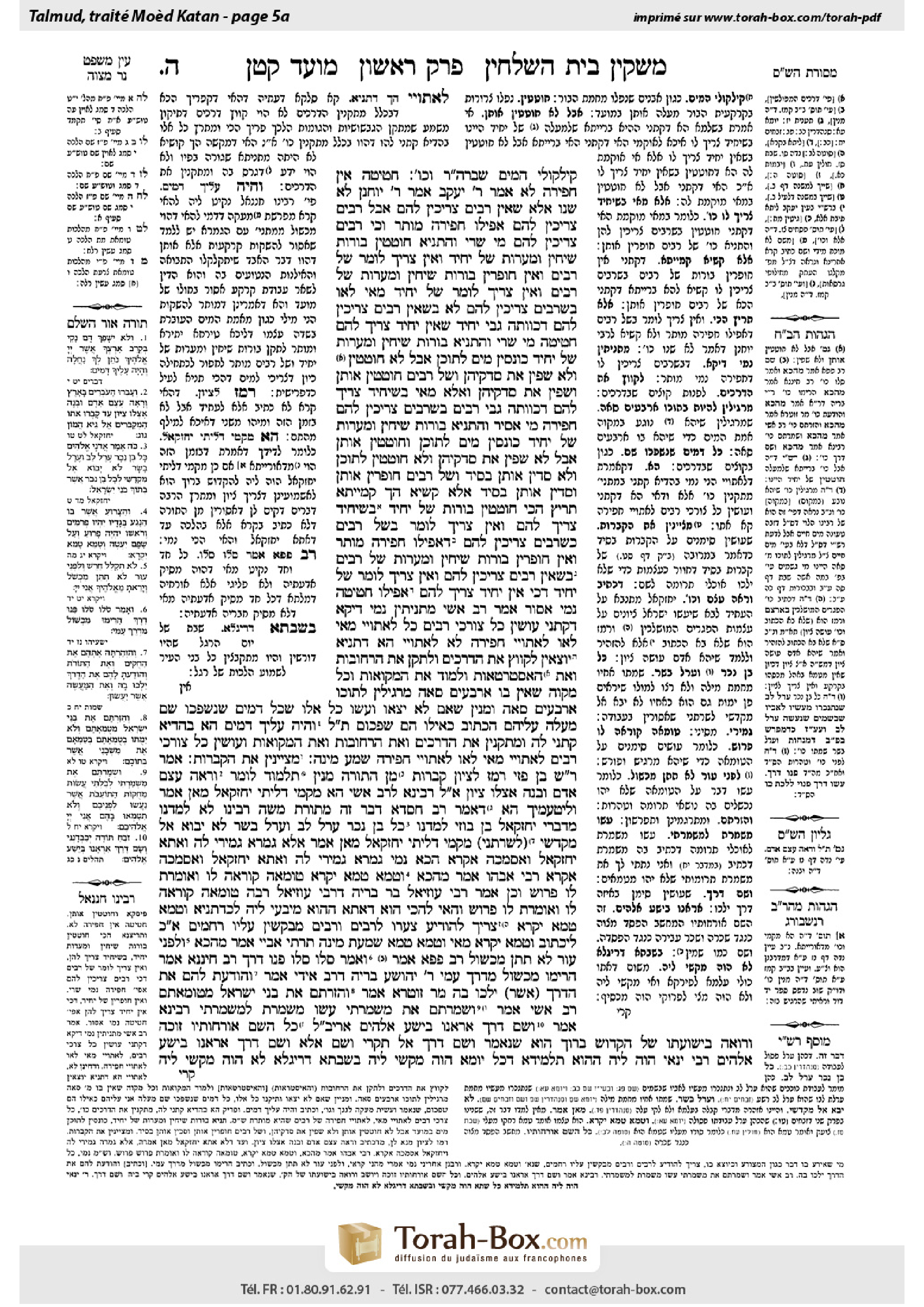
Moed Katan 5a: Talmud study for Daf Yomi
Daf Yomi is the daily study of one Talmud folio. Explore 37 tractates with scans, Hebrew text, Sefaria English and AI-generated French translations where annotated.
Passage selection and English or AI-generated French translation are available where the scan has annotations. Daf Study is independent of Torah-Box and Sefaria.
Browse Moed Katan · מועד קטן · All tractatesMoed Katan 5a text and translations
This page of Moed Katan includes the Aramaic text, an English translation and an AI-generated French translation, alongside the scan above.
מועד קטן ה׳ א · Aramaic and Hebrew text
קִילְקוּלֵי הַמַּיִם שֶׁבִּרְשׁוּת הָרַבִּים וְכוּ׳. חֲטִיטָה — אִין, חֲפִירָה — לָא.
אָמַר רַבִּי יַעֲקֹב אָמַר רַבִּי יוֹחָנָן: לֹא שָׁנוּ אֶלָּא שֶׁאֵין רַבִּים צְרִיכִין לָהֶם, אֲבָל רַבִּים צְרִיכִין לָהֶם — אֲפִילּוּ חֲפִירָה מוּתָּר.
וְכִי רַבִּים צְרִיכִין לָהֶם מִי שְׁרֵי? וְהָתַנְיָא: חוֹטְטִין בּוֹרוֹת שִׁיחִין וּמְעָרוֹת שֶׁל יָחִיד, וְאֵין צָרִיךְ לוֹמַר שֶׁל רַבִּים, וְאֵין חוֹפְרִין בּוֹרוֹת שִׁיחִין וּמְעָרוֹת שֶׁל רַבִּים, וְאֵין צָרִיךְ לוֹמַר שֶׁל יָחִיד. מַאי לָאו, בְּשֶׁרַבִּים צְרִיכִין לָהֶם?!
לָא, בְּשֶׁאֵין רַבִּים צְרִיכִין לָהֶם.
דִּכְווֹתַהּ גַּבֵּי יָחִיד, שֶׁאֵין יָחִיד צָרִיךְ לָהֶם, חֲטִיטָה מִי שְׁרֵי? וְהָתַנְיָא: בּוֹרוֹת שִׁיחִין וּמְעָרוֹת שֶׁל יָחִיד — כּוֹנְסִין מַיִם לְתוֹכָן, אֲבָל לֹא חוֹטְטִין וְלֹא שָׁפִין אֶת סִדְקֵיהֶן. וְשֶׁל רַבִּים — חוֹטְטִין אוֹתָן וְשָׁפִין אֶת סִדְקֵיהֶן.
וְאֶלָּא מַאי — בְּשֶׁיָּחִיד צָרִיךְ לָהֶם? דִּכְווֹתַהּ גַּבֵּי רַבִּים, בְּשֶׁרַבִּים צְרִיכִין לָהֶם, חֲפִירָה מִי אֲסִיר? וְהָתַנְיָא: בּוֹרוֹת שִׁיחִין וּמְעָרוֹת שֶׁל יָחִיד — כּוֹנְסִין מַיִם לְתוֹכָן וְחוֹטְטִין אוֹתָן, אֲבָל לֹא שָׁפִין אֶת סִדְקֵיהֶן, וְלֹא חוֹטְטִין לְתוֹכָן, וְלֹא סָדִין אוֹתָן בְּסִיד. וְשֶׁל רַבִּים — חוֹפְרִין אוֹתָן, וְסָדִין אוֹתָן בְּסִיד!
אֶלָּא קַשְׁיָא הָךְ קַמַּיְיתָא! תָּרֵיץ הָכִי: חוֹטְטִין בּוֹרוֹת שֶׁל יָחִיד בְּשֶׁיָּחִיד צָרִיךְ לָהֶם, וְאֵין צָרִיךְ לוֹמַר בְּשֶׁל רַבִּים כְּשֶׁרַבִּים צְרִיכִין לָהֶם, דַּאֲפִילּוּ חֲפִירָה מוּתָּר.
וְאֵין חוֹפְרִין בּוֹרוֹת שִׁיחִין וּמְעָרוֹת שֶׁל רַבִּים — בְּשֶׁאֵין רַבִּים צְרִיכִין לָהֶם, וְאֵין צָרִיךְ לוֹמַר שֶׁל יָחִיד, דְּכִי אֵין יָחִיד צָרִיךְ לָהֶם — אֲפִילּוּ חֲטִיטָה נָמֵי אָסוּר.
אָמַר רַב אָשֵׁי: מַתְנִיתִין נָמֵי דַּיְקָא, דְּקָתָנֵי: עוֹשִׂין כׇּל צוֹרְכֵי רַבִּים, ״כׇּל״ לְאֵתוֹיֵי מַאי — לָאו לְאֵתוֹיֵי חֲפִירָה?
לָא, לְאֵתוֹיֵי הָא דְּתַנְיָא: יוֹצְאִין לְקַוֵּוץ אֶת הַדְּרָכִים, וּלְתַקֵּן אֶת הָרְחוֹבוֹת וְאֶת הָאִסְטְרָטָאוֹת, וְלָמוֹד אֶת הַמִּקְוָאוֹת. וְכׇל מִקְוֶה שֶׁאֵין בּוֹ אַרְבָּעִים סְאָה מַרְגִּילִין לְתוֹכוֹ, אַרְבָּעִים סְאָה.
וּמִנַּיִן שֶׁאִם לֹא יָצְאוּ וְעָשׂוּ כׇּל אֵלּוּ, שֶׁכׇּל דָּמִים שֶׁנִּשְׁפְּכוּ שָׁם מַעֲלֶה עֲלֵיהֶם הַכָּתוּב כְּאִילּוּ הֵם שְׁפָכוּם — תַּלְמוּד לוֹמַר: ״וְהָיָה עָלֶיךָ דָּמִים״.
הָא בְּהֶדְיָא קָתָנֵי לַהּ: וּמְתַקְּנִין אֶת הַדְּרָכִים וְאֶת הָרְחוֹבוֹת וְאֶת הַמִּקְוָאוֹת. וְעוֹשִׂין כׇּל צוֹרְכֵי רַבִּים לְאֵתוֹיֵי מַאי — לָאו לְאֵתוֹיֵי חֲפִירָה? שְׁמַע מִינַּהּ.
מְצַיְּנִין אֶת הַקְּבָרוֹת. אָמַר רַבִּי שִׁמְעוֹן בֶּן פַּזִּי: רֶמֶז לְצִיּוּן קְבָרוֹת מִן הַתּוֹרָה מִנַּיִן, תַּלְמוּד לוֹמַר: ״וְרָאָה עֶצֶם אָדָם וּבָנָה אֶצְלוֹ צִיּוּן״.
אֲמַר לֵיהּ רָבִינָא לְרַב אָשֵׁי: הָא מִקַּמֵּי דְּלֵיתֵי יְחֶזְקֵאל, מַאן אֲמַר? וְלִיטַעְמָיךְ, הָא דְּאָמַר רַב חִסְדָּא: דָּבָר זֶה, מִתּוֹרַת מֹשֶׁה רַבֵּינוּ לֹא לָמַדְנוּ, מִדִּבְרֵי יְחֶזְקֵאל בֶּן בּוּזִי לָמַדְנוּ: ״כׇּל בֶּן נֵכָר עֶרֶל לֵב וְעֶרֶל בָּשָׂר לֹא יָבֹא אֶל מִקְדָּשִׁי לְשָׁרְתֵנִי״ —
מִקַּמֵּי דְּלֵיתֵי יְחֶזְקֵאל, מַאן אֲמַר? אֶלָּא גְּמָרָא גְּמִירִי לַהּ וַאֲתָא יְחֶזְקֵאל וְאַסְמְכַהּ אַקְּרָא, הָכָא נָמֵי: גְּמָרָא גְּמִירִי לַהּ, וַאֲתָא יְחֶזְקֵאל וְאַסְמְכַהּ אַקְּרָא.
רַבִּי אֲבָהוּ אָמַר, מֵהָכָא: ״וְטָמֵא טָמֵא יִקְרָא״ — טוּמְאָה קוֹרְאָה לוֹ וְאוֹמֶרֶת לוֹ ״פְּרוֹשׁ״. וְכֵן אָמַר רַבִּי עוּזִּיאֵל בַּר בְּרֵיהּ דְּרַבִּי עוּזִּיאֵל רַבָּה: טוּמְאָה קוֹרְאָהּ לוֹ וְאוֹמֶרֶת לוֹ ״פְּרוֹשׁ״.
וְהַאי לְהָכִי הוּא דַּאֲתָא? הַהוּא מִיבְּעֵי לֵיהּ לְכִדְתַנְיָא: ״וְטָמֵא טָמֵא יִקְרָא״. צָרִיךְ לְהוֹדִיעַ צַעֲרוֹ לְרַבִּים, וְרַבִּים מְבַקְּשִׁין עָלָיו רַחֲמִים!
אִם כֵּן, לִיכְתּוֹב: ״וְטָמֵא יִקְרָא״, מַאי ״וְטָמֵא טָמֵא״ — שָׁמְעַתְּ מִינַּהּ תַּרְתֵּי.
אַבָּיֵי אָמַר, מֵהָכָא: ״וְלִפְנֵי עִוֵּר לֹא תִתֵּן מִכְשׁוֹל״. רַב פָּפָּא אָמַר: ״וְאָמַר סֹלּוּ סֹלּוּ פַּנּוּ דָרֶךְ״.
רַב חִינָּנָא אָמַר: ״הָרִימוּ מִכְשׁוֹל מִדֶּרֶךְ עַמִּי״. רַבִּי יְהוֹשֻׁעַ בְּרֵיהּ דְּרַב אִידִי אָמַר: ״וְהוֹדַעְתָּ לָהֶם אֶת הַדֶּרֶךְ אֲשֶׁר יֵלְכוּ בָהּ״.
מָר זוּטְרָא אָמַר: ״וְהִזַּרְתֶּם אֶת בְּנֵי יִשְׂרָאֵל מִטּוּמְאָתָם״. רַב אָשֵׁי אָמַר: ״וּשְׁמַרְתֶּם אֶת מִשְׁמַרְתִּי״ — עֲשׂוּ מִשְׁמֶרֶת לְמִשְׁמַרְתִּי.
רָבִינָא אָמַר: ״וְשָׂם דֶּרֶךְ אַרְאֶנּוּ בְּיֵשַׁע אֱלֹהִים״.
אָמַר רַבִּי יְהוֹשֻׁעַ בֶּן לֵוִי: כׇּל הַשָּׁם אוֹרְחוֹתָיו — זוֹכֶה וְרוֹאֶה בִּישׁוּעָתוֹ שֶׁל הַקָּדוֹשׁ בָּרוּךְ הוּא, שֶׁנֶּאֱמַר: ״וְשָׂם דֶּרֶךְ״, אַל תִּקְרֵי ״וְשָׂם״, אֶלָּא: ״וְשָׁם דֶּרֶךְ״ — ״אַרְאֶנּוּ בְּיֵשַׁע אֱלֹהִים״.
רַבִּי יַנַּאי הֲוָה לֵיהּ הָהוּא תַּלְמִידָא דְּכׇל יוֹמָא הֲוָה מַקְשֵׁי לֵיהּ, בְּשַׁבְּתָא דְרִיגְלָא לָא הֲוָה מַקְשֵׁי לֵיהּ,
Moed Katan 5a · English translation
damaged water cisterns in the public domain and clean them out by removing the dirt and sediment that has accumulated in them. The Gemara infers: Cleaning out the cisterns of dirt and sediment during the intermediate days of a Festival is indeed permitted, but digging a new cistern is not permitted.
Rabbi Ya’akov said that Rabbi Yoḥanan said: They taught that it is prohibited to dig new cisterns only when the public does not need them; but if the public needs them, even digging new cisterns is permitted.
The Gemara asks: And when the public needs them, is digging really permitted? But isn’t it taught in a baraita: One may clean out cisterns, ditches, and caves of an individual during the intermediate days of a Festival, and, needless to say, one may clean out those of the public. But one may not dig new cisterns, ditches, or caves of the public during the intermediate days of a Festival, and, needless to say, one may not dig those of an individual. What, is it not so that this baraita is referring to a case where the public needs them, but nevertheless digging new cisterns, ditches, and caves is prohibited?
The Gemara rejects this opinion: No, this baraita is referring to a case where the public does not need them.
The Gemara raises a difficulty: It would follow that in the corresponding situation with regard to the cisterns of an individual, the baraita is referring to a case where the individual does not need them. But in that case, is cleaning them out really permitted? Isn’t it taught in a baraita: One may gather water into the cisterns, ditches, and caves of an individual, but one may not clean them out or plaster their cracks; but for those of the public, one may indeed clean out and plaster their cracks? This indicates that on the intermediate days of a Festival, unneeded cisterns belonging to an individual may not even be cleaned out.
The Gemara rejects this difficulty: Rather, to what case does the first baraita refer? Is it referring to a case where the individual needs the cisterns? If so, then in the corresponding situation with regard to cisterns of the public, the baraita would be referring to a case where the public needs them. But in that case, is digging new cisterns really prohibited? Isn’t it taught in yet another baraita: One may gather water into cisterns, ditches, and caves of an individual, and one may clean them out, but one may not plaster their cracks, clear earth into them in order to fill in the cracks, or lime them with lime so that they hold water. But with regard to those of the public, one may even dig them out and lime them with lime. Therefore, in a case where the public needs them, it is permitted to dig out public cisterns.
But if so, the first baraita, which states that one may not dig new cisterns even for the public, is difficult, as it is contradicted by this last baraita. The Gemara explains: Answer the difficulty and explain the first baraita as follows: One may clean out cisterns, ditches, and caves of an individual during the intermediate days of a Festival when the individual needs them; and needless to say, one may clean out those of the public when the public needs them, as even digging new cisterns is permitted when the public needs them.
But one may not dig cisterns, ditches and caves for the public when the public does not need them. And needless to say, one may not dig them for an individual, as when an individual does not need the cisterns on the intermediate days of a Festival, even cleaning them out is prohibited. In this way all of the seemingly contradictory sources can be reconciled.
Rav Ashi said: The wording of the mishna is also precise, indicating that when there is a public need for such cisterns, they may be dug even on the intermediate days of a Festival. As it teaches: One may tend to all other public needs. What does the word all come to add that was not stated explicitly? Does it not come to add the digging of cisterns, which is permitted?
The Gemara rejects this opinion: No, the word all comes to add that which is taught in the following baraita: On the intermediate days of a Festival, agents of the court go out to clear thorns from the road, and to repair the city streets and highways [isterata’ot], and to measure the ritual baths to ascertain that they have the requisite quantity of water. And if any ritual bath does not contain forty se’a, the minimal measure for ritual purification, they direct [margilin] a stream of water into it, such that it flows over the ground before entering the bath, so as not to disqualify the water as drawn water until it holds forty se’a of water.
And from where is it derived that if agents of the court did not go out and do all these repairs, that with regard to any blood that is shed there on account of their negligence, the verse ascribes to them guilt as if they had shed it? The verse states with regard to the cities of refuge that offer protection to someone who committed inadvertent manslaughter: “That innocent blood be not shed in your land, which the Lord your God gives you for an inheritance, and so blood be upon you” (Deuteronomy 19:10). The Gemara maintains that the mishna uses the word all to allude to the cases mentioned in this baraita, and not to the digging of public cisterns.
The Gemara questions this: But these additional cases are explicitly taught in the mishna: One may repair the roads, streets, and ritual baths, and one may tend to all other public needs. What does this last phrase come to add? Does it not come to add the digging of cisterns needed by the public? The Gemara agrees: Conclude from this that the mishna means to permit the digging of new cisterns when they are needed by the public.
§ It was taught in the mishna: One may mark graves on the intermediate days of a Festival so that passersby will know to avoid them and not become ritually impure. Rabbi Shimon ben Pazi said: Where is there an allusion in the Torah to the marking of graves? The verse states: “And when they that pass through shall pass through the land, and any see a man’s bone, then shall he set up a sign by it” (Ezekiel 39:15). Ezekiel prophesies that at some future time, the Jewish people will erect signs over the strewn remains of the dead so that others will know to avoid ritual impurity.
Ravina said to Rav Ashi: Before the prophet Ezekiel came and alluded to this obligation, who said that graves must be marked? Even before the time of Ezekiel, people were careful with regard to ritual impurity. Rav Ashi responded: And according to your reasoning, that Ezekiel was introducing a new halakha, the same question can be raised with regard to this statement that Rav Ḥisda said. As Rav Ḥisda said with regard to the halakha that one who is uncircumcised or an apostate may not serve in the Temple: This matter we did not learn from the Torah of Moses our teacher, but rather, we learned it from the words of the prophet Ezekiel ben Buzi, who said of such individuals: “No stranger, uncircumcised in heart, or uncircumcised in flesh, shall enter into My Sanctuary to serve Me” (Ezekiel 44:9).
Here too, one can ask: Before Ezekiel came, who said that such individuals cannot serve in the Temple? Rather, you must say that originally they learned it as a tradition and it was an accepted halakha for generations, and then Ezekiel came and based it on a verse. Here too, with regard to the obligation to mark graves, they originally learned it as a tradition, and then Ezekiel came and based it on a verse.
Rabbi Abbahu said: An allusion to the marking of graves may be derived from here: “And the leper in whom the plague is, his clothes shall be rent, and the hair of his head shall go loose, and he shall cover his upper lip, and shall cry: Impure, impure” (Leviticus 13:45). This verse teaches that impurity cries out to the passerby and tells him: Remove yourself. The leper must inform others of his status so that they know not to come into contact with him and thereby maintain their ritual purity. So too, in our case, graves must be marked so that others will know to avoid them and prevent contracting ritual impurity. And similarly, Rabbi Uzziel, grandson of Rabbi Uzziel the Great, said: Impurity cries out to the passerby and tells him: Remove yourself.
The Gemara asks: But with regard to this verse, does it come to teach this idea? That verse is needed for that which is taught in the following baraita: “And he shall cry: Impure, impure”; this teaches that the leper must inform the public of his distress, and the public will pray for mercy on his behalf.
The Gemara answers: If it is so that the verse comes to teach only one idea, let it write: And he shall cry: Impure. What is to be derived the repetition of impure, impure? Learn from this reiteration two ideas: First, that the leper must inform the public of his pain so that others will pray on his behalf, and second, that he must warn the public to stay away so that they avoid coming into contact with him and contracting ritual impurity.
Abaye said: An allusion to the marking of graves may be learned from here, as it is written: “You shall not put a stumbling block before the blind” (Leviticus 19:14). Rav Pappa said the obligation is alluded to in the verse: “And He will say: Pave, pave, clear the way, take up the stumbling block out of the way of My people” (Isaiah 57:14), which indicates that roads must be cleared of all obstacles and hazards.
Rav Ḥinnana said: This may be derived from the end of that very same verse: “Take up the stumbling block from the way of My people” (Isaiah 57:14). Rabbi Yehoshua, son of Rav Idi, said: This may be derived from the verse: “And you shall show them the way in which they must walk” (Exodus 18:20), i.e., you must properly repair the roads, which includes marking graves.
Mar Zutra said that an allusion to this obligation is found in the verse “Thus you shall separate the children of Israel from their impurity” (Leviticus 15:31), which indicates that people must be warned to stay away from that which could cause them to become ritually impure. Rav Ashi said it is derived from the verse: “And you shall keep My charge” (Leviticus 18:30), which means that you must establish a safeguard for My charge, i.e., protective measures must be enacted to prevent people from transgressing halakha, a task that includes distancing people from ritual impurity by marking off graves, so that they not come to convey ritual impurity to teruma or other consecrated items.
And finally, Ravina said: This obligation is alluded to by the verse “And to him who orders his way, I will show the salvation of God” (Psalms 50:23), meaning that one must mark the pathways that are ritually pure and upon which it is appropriate to walk.
With regard to the verse from Psalms cited above, Rabbi Yehoshua ben Levi said: Whoever appraises his ways in this world and contemplates how to act in the most appropriate way possible merits seeing the salvation of the Holy One, Blessed be He, as it is stated: “And to him who orders his way.” Do not read it as vesam, who orders; rather, read it as vesham, and appraises. With this reading, the verse indicates that one who appraises his ways, him will I show the salvation of God.
Rabbi Yannai had a certain student who would raise difficulties with his teachings every day as they were learning. On Shabbat of a Festival, when the broader public would come to hear the lesson, the student would not raise any difficulties, lest Rabbi Yannai lack an immediate answer and suffer embarrassment.
Moed Katan 5a · Traduction française (IA)
…les citernes endommagées du domaine public et les nettoyer en retirant la terre et les sédiments qui s’y sont accumulés. La Guemara en déduit que nettoyer les citernes de leur terre et de leurs sédiments pendant les jours intermédiaires de la fête est effectivement permis, mais qu’en creuser de nouvelles ne l’est pas.
Rabbi Ya’akov a dit au nom de Rabbi Yoḥanan : Ils ont enseigné qu’il est interdit de creuser de nouvelles citernes uniquement lorsque le public n’en a pas besoin ; mais si le public en a besoin, il est même permis d’en creuser de nouvelles.
La Guemara demande : Lorsque le public en a besoin, est-il vraiment permis de creuser ? N’est-il pas enseigné dans une baraïta : Pendant les jours intermédiaires de la fête, on peut nettoyer les citernes, les fossés et les grottes d’un particulier et, à plus forte raison, ceux du public. Mais on ne peut pas creuser de nouvelles citernes, de nouveaux fossés ou de nouvelles grottes pour le public pendant les jours intermédiaires de la fête et, à plus forte raison, on ne peut pas en creuser pour un particulier. N’est-ce pas que cette baraïta parle d’un cas où le public en a besoin, mais où, malgré cela, il est interdit de creuser de nouvelles citernes, de nouveaux fossés et de nouvelles grottes ?
La Guemara rejette cette interprétation : Non, cette baraïta parle d’un cas où le public n’en a pas besoin.
La Guemara soulève une difficulté : Il s’ensuivrait que, dans la situation correspondante concernant les citernes d’un particulier, la baraïta parle d’un cas où celui-ci n’en a pas besoin. Mais, dans ce cas, est-il vraiment permis de les nettoyer ? N’est-il pas enseigné dans une baraïta : On peut recueillir de l’eau dans les citernes, les fossés et les grottes d’un particulier, mais on ne peut ni les nettoyer ni enduire leurs fissures ; en revanche, pour ceux du public, on peut effectivement les nettoyer et enduire leurs fissures. Cela indique que, pendant les jours intermédiaires de la fête, on ne peut même pas nettoyer les citernes inutiles appartenant à un particulier.
La Guemara rejette cette difficulté : Alors, à quel cas la première baraïta se rapporte-t-elle ? À un cas où le particulier a besoin de ses citernes ? Dans ce cas, la baraïta parlerait, dans la situation correspondante concernant les citernes du public, d’un cas où le public en a besoin. Mais alors, est-il vraiment interdit de creuser de nouvelles citernes ? N’est-il pas enseigné dans une autre baraïta : On peut recueillir de l’eau dans les citernes, les fossés et les grottes d’un particulier, et on peut les nettoyer, mais on ne peut ni enduire leurs fissures, ni y déverser de la terre afin de les combler, ni les chauler pour qu’elles retiennent l’eau. En revanche, pour celles du public, on peut même les curer et les chauler. Par conséquent, lorsque le public en a besoin, il est permis de curer les citernes publiques.
Mais alors, la première baraïta, qui affirme qu’on ne peut pas creuser de nouvelles citernes, même pour le public, pose problème, car elle est contredite par cette dernière baraïta. La Guemara explique : Résous la difficulté en interprétant ainsi la première baraïta : Pendant les jours intermédiaires de la fête, on peut nettoyer les citernes, les fossés et les grottes d’un particulier lorsque celui-ci en a besoin ; et, à plus forte raison, on peut nettoyer ceux du public lorsque celui-ci en a besoin, puisque même le creusement de nouvelles citernes est permis quand le public en a besoin.
Mais on ne peut pas creuser de citernes, de fossés et de grottes pour le public lorsque celui-ci n’en a pas besoin. Et, à plus forte raison, on ne peut pas en creuser pour un particulier, car, lorsqu’un particulier n’a pas besoin de ses citernes pendant les jours intermédiaires de la fête, même les nettoyer est interdit. Ainsi, toutes les sources apparemment contradictoires peuvent être conciliées.
Rav Ashi a dit : La formulation de la Michna est également précise et indique que, lorsqu’il existe un besoin public de telles citernes, on peut les creuser même pendant les jours intermédiaires de la fête. En effet, elle enseigne : « On peut s’occuper de tous les autres besoins publics. » Qu’ajoute le mot « tous » qui n’ait pas été explicitement énoncé ? N’ajoute-t-il pas le creusement des citernes, qui est permis ?
La Guemara rejette cette interprétation : Non, le mot « tous » ajoute ce qui est enseigné dans la baraïta suivante : Pendant les jours intermédiaires de la fête, des agents du tribunal sortent pour retirer les épines de la route, réparer les rues de la ville et les grandes routes [isterata’ot], et mesurer les bains rituels afin de vérifier qu’ils contiennent la quantité d’eau requise. Si un bain rituel ne contient pas quarante séa, la mesure minimale pour la purification rituelle, ils y dirigent [margilin] un cours d’eau, de telle sorte qu’il s’écoule sur le sol avant d’entrer dans le bain, afin qu’il ne soit pas disqualifié comme eau puisée avant que le bain ne contienne quarante séa d’eau.
Et d’où apprend-on que si les agents du tribunal ne sortent pas pour effectuer toutes ces réparations, le verset leur impute la responsabilité de tout sang versé là en raison de leur négligence, comme s’ils l’avaient eux-mêmes versé ? Le verset dit au sujet des villes de refuge, qui protègent celui qui a commis un homicide involontaire : « Afin que le sang innocent ne soit pas versé dans le pays que l’Éternel, ton Dieu, te donne en héritage, et que le sang ne soit pas sur toi » (Deutéronome 19:10). La Guemara considère que, par le mot « tous », la Michna fait allusion aux cas mentionnés dans cette baraïta, et non au creusement de citernes publiques.
La Guemara objecte : Mais ces cas supplémentaires sont explicitement enseignés dans la Michna : « On peut réparer les routes, les rues et les bains rituels, et on peut s’occuper de tous les autres besoins publics. » Qu’ajoute cette dernière expression ? N’ajoute-t-elle pas le creusement des citernes dont le public a besoin ? La Guemara acquiesce : Conclus-en que la Michna entend autoriser le creusement de nouvelles citernes lorsque le public en a besoin.
§ Il a été enseigné dans la Michna : Pendant les jours intermédiaires de la fête, on peut baliser les tombes afin que les passants sachent les éviter et ne deviennent pas rituellement impurs. Rabbi Shimon ben Pazi a dit : Où trouve-t-on dans la Torah une allusion au balisage des tombes ? Le verset dit : « Et quand ceux qui traverseront le pays le parcourront, si l’un d’eux voit un ossement humain, il placera un signe à côté » (Ézéchiel 39:15). Ézéchiel prophétise qu’à l’avenir, le peuple juif placera des signes au-dessus des restes humains éparpillés, afin que les autres sachent les éviter et ne deviennent pas rituellement impurs.
Ravina dit à Rav Ashi : Avant que le prophète Ézéchiel ne vienne faire allusion à cette obligation, qui avait dit qu’il fallait baliser les tombes ? Même avant l’époque d’Ézéchiel, les gens prenaient garde à l’impureté rituelle. Rav Ashi répondit : Selon ton raisonnement, si Ézéchiel introduisait une halakha nouvelle, on peut poser la même question au sujet de cette déclaration de Rav Ḥisda. En effet, Rav Ḥisda a dit à propos de la halakha selon laquelle un incirconcis ou un apostat ne peut pas officier au Temple : « Cette règle, nous ne l’avons pas apprise de la Torah de Moïse, notre maître, mais plutôt des paroles du prophète Ézéchiel ben Buzi, qui a dit au sujet de ces personnes : “Aucun étranger, incirconcis de cœur ou incirconcis de chair, n’entrera dans Mon sanctuaire pour Me servir” » (Ézéchiel 44:9).
Ici aussi, on peut demander : Avant qu’Ézéchiel ne vienne, qui avait dit que ces personnes ne pouvaient pas officier au Temple ? Il faut plutôt dire qu’à l’origine, ils l’avaient appris par tradition et que cette halakha était acceptée depuis des générations ; puis Ézéchiel est venu et l’a fondée sur un verset. De même ici, concernant l’obligation de baliser les tombes, ils l’avaient d’abord apprise par tradition, puis Ézéchiel est venu et l’a fondée sur un verset.
Rabbi Abbahu a dit : On peut tirer d’ici une allusion au balisage des tombes : « Le lépreux atteint de la plaie déchirera ses vêtements, laissera flotter les cheveux de sa tête, se couvrira la lèvre supérieure et criera : Impur ! Impur ! » (Lévitique 13:45). Ce verset enseigne que l’impureté crie au passant et lui dit : « Éloigne-toi. » Le lépreux doit informer les autres de son état, afin qu’ils sachent ne pas entrer en contact avec lui et préserver ainsi leur pureté rituelle. De même, dans notre cas, les tombes doivent être balisées pour que les autres sachent les éviter et ne contractent pas l’impureté rituelle. De même, Rabbi Uzziel, petit-fils de Rabbi Uzziel le Grand, a dit : L’impureté crie au passant et lui dit : « Éloigne-toi. »
La Guemara demande : Mais ce verset vient-il enseigner cette idée ? Il est nécessaire pour ce qui est enseigné dans la baraïta suivante : « Et il criera : Impur ! Impur ! » Cela enseigne que le lépreux doit faire connaître sa détresse au public, afin que celui-ci prie pour que la miséricorde divine lui soit accordée.
La Guemara répond : S’il en est ainsi, et que le verset ne vient enseigner qu’une seule idée, qu’il dise : « Et il criera : Impur. » Que faut-il déduire de la répétition « Impur ! Impur ! » ? Déduis de cette répétition deux idées : premièrement, le lépreux doit faire connaître sa souffrance au public afin que les autres prient pour lui ; deuxièmement, il doit avertir le public de s’éloigner, afin que les gens évitent tout contact avec lui et ne contractent pas l’impureté rituelle.
Abaye a dit : On peut tirer d’ici une allusion au balisage des tombes, car il est écrit : « Tu ne mettras pas d’obstacle devant un aveugle » (Lévitique 19:14). Rav Pappa a dit que l’obligation est suggérée par le verset : « Il dira : Frayez, frayez la route, dégagez le chemin, ôtez l’obstacle du chemin de Mon peuple » (Isaïe 57:14), ce qui indique que les routes doivent être débarrassées de tout obstacle et de tout danger.
Rav Ḥinnana a dit : On peut le déduire de la fin de ce même verset : « Ôtez l’obstacle du chemin de Mon peuple » (Isaïe 57:14). Rabbi Yehoshua, fils de Rav Idi, a dit : On peut le déduire du verset : « Tu leur montreras le chemin qu’ils doivent suivre » (Exode 18:20), c’est-à-dire qu’il faut réparer convenablement les routes, ce qui comprend le balisage des tombes.
Mar Zutra a dit qu’une allusion à cette obligation se trouve dans le verset : « Vous séparerez les enfants d’Israël de leur impureté » (Lévitique 15:31), ce qui indique qu’il faut avertir les gens de se tenir à l’écart de ce qui pourrait les rendre rituellement impurs. Rav Ashi a dit qu’elle se déduit du verset : « Vous observerez Mes prescriptions » (Lévitique 18:30), ce qui signifie qu’il faut établir une protection autour de Mes prescriptions, c’est-à-dire prendre des mesures de précaution pour empêcher les gens de transgresser la halakha. Cette tâche comprend le fait d’éloigner les gens de l’impureté rituelle en balisant les tombes, afin qu’ils ne transmettent pas l’impureté rituelle à la terouma ou à d’autres objets consacrés.
Enfin, Ravina a dit que cette obligation est évoquée par le verset : « À celui qui ordonne sa voie, Je ferai voir le salut de Dieu » (Psaumes 50:23), ce qui signifie qu’il faut baliser les chemins rituellement purs, sur lesquels il convient de marcher.
À propos du verset des Psaumes cité plus haut, Rabbi Yehoshua ben Levi a dit : Quiconque évalue ses voies dans ce monde et réfléchit à la manière d’agir de la façon la plus appropriée possible mérite de voir le salut du Saint, béni soit-Il, comme il est dit : « À celui qui ordonne sa voie. » Ne lis pas vesam, « qui ordonne » ; lis plutôt vesham, « qui évalue ». Selon cette lecture, le verset indique que celui qui évalue ses voies, à lui Je ferai voir le salut de Dieu.
Rabbi Yannai avait un certain élève qui soulevait chaque jour des difficultés à propos de ses enseignements pendant leur étude. Le Chabbat d’une fête, lorsque le grand public venait écouter le cours, l’élève ne soulevait aucune difficulté, de peur que Rabbi Yannai ne trouve pas immédiatement de réponse et n’en éprouve de l’embarras.
Traduction française générée par IA à partir de l’édition anglaise de Sefaria. Vérifie toujours un passage avec le texte source.
Text from Sefaria: William Davidson Edition - Vocalized Aramaic (CC BY NC); William Davidson Edition - English (CC BY NC).