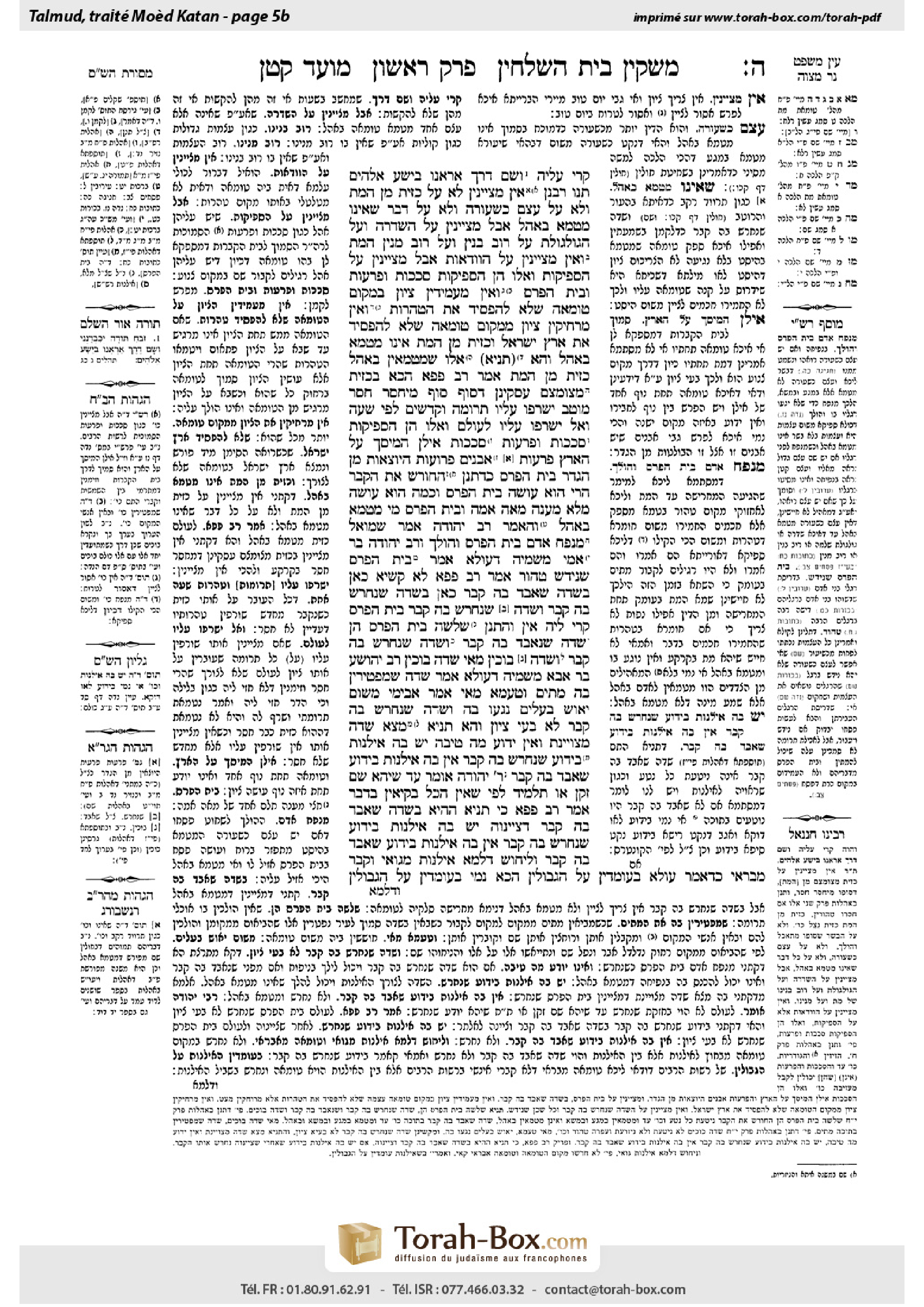
Moed Katan 5b: Talmud study for Daf Yomi
Daf Yomi is the daily study of one Talmud folio. Explore 37 tractates with scans, Hebrew text, Sefaria English and AI-generated French translations where annotated.
Passage selection and English or AI-generated French translation are available where the scan has annotations. Daf Study is independent of Torah-Box and Sefaria.
Browse Moed Katan · מועד קטן · All tractatesMoed Katan 5b text and translations
This page of Moed Katan includes the Aramaic text, an English translation and an AI-generated French translation, alongside the scan above.
מועד קטן ה׳ ב · Aramaic and Hebrew text
קָרֵי עֲלֵיהּ: ״וְשָׂם דֶּרֶךְ אַרְאֶנּוּ בְּיֵשַׁע אֱלֹהִים״.
תָּנוּ רַבָּנַן: אֵין מְצַיְּנִין לֹא עַל כַּזַּיִת מִן הַמֵּת, וְלֹא עַל עֶצֶם כִּשְׂעוֹרָה, וְלֹא עַל דָּבָר שֶׁאֵינוֹ מְטַמֵּא בְּאֹהֶל. אֲבָל מְצַיְּנִין עַל הַשִּׁדְרָה, וְעַל הַגּוּלְגּוֹלֶת, עַל רוֹב בִּנְיַן, וְעַל רוֹב מִנְיַן הַמֵּת.
וְאֵין מְצַיְּנִין עַל הַוַּודָּאוֹת, אֲבָל מְצַיְּנִין עַל הַסְּפֵיקוֹת. וְאֵלּוּ הֵן הַסְּפֵיקוֹת: סְכָכוֹת וּפְרָעוֹת וּבֵית הַפְּרָס. וְאֵין מַעֲמִידִין צִיּוּן בִּמְקוֹם טוּמְאָה, שֶׁלֹּא לְהַפְסִיד אֶת הַטְּהָרוֹת. וְאֵין מַרְחִיקִין צִיּוּן מִמְּקוֹם טוּמְאָה, שֶׁלֹּא לְהַפְסִיד אֶת אֶרֶץ יִשְׂרָאֵל.
וּכְזַיִת מִן הַמֵּת אֵינוֹ מְטַמֵּא בְּאֹהֶל? וְהָא תְּנַן: אֵלּוּ שֶׁמְּטַמְּאִין בְּאֹהֶל — כְּזַיִת מִן הַמֵּת!
אָמַר רַב פָּפָּא: הָכָא בִּכְזַיִת מְצוּמְצָם עָסְקִינַן, דְּסוֹף סוֹף מִיחְסָר חָסַר. מוּטָב יִשָּׂרְפוּ עָלָיו תְּרוּמָה וְקׇדָשִׁים לְפִי שָׁעָה, וְאַל יִשָּׂרְפוּ עָלָיו לְעוֹלָם.
וְאֵלּוּ הֵן הַסְּפֵיקוֹת: סְכָכוֹת וּפְרָעוֹת.
סְכָכוֹת — אִילָן הַמֵּיסֵךְ עַל הָאָרֶץ.
פְּרָעוֹת — אֲבָנִים פְּרוּעוֹת הַיּוֹצְאוֹת מִן הַגָּדֵר.
בֵּית הַפְּרָס, כְּדִתְנַן: הַחוֹרֵשׁ אֶת הַקֶּבֶר הֲרֵי הוּא עוֹשֶׂה בֵּית הַפְּרָס, וְכַמָּה הוּא עוֹשֶׂה — מְלֹא מַעֲנֶה מֵאָה אַמָּה.
וּבֵית הַפְּרָס מִי מְטַמֵּא בְּאֹהֶל? וְהָאָמַר רַב יְהוּדָה אָמַר שְׁמוּאֵל: מְנַפֵּחַ אָדָם בֵּית הַפְּרָס וְהוֹלֵךְ.
וְרַב יְהוּדָה בַּר אַמֵּי מִשְּׁמֵיהּ דְּעוּלָּא אָמַר: בֵּית הַפְּרָס שֶׁנִּידַּשׁ — טָהוֹר!
אָמַר רַב פָּפָּא, לָא קַשְׁיָא: כָּאן בְּשָׂדֶה שֶׁאָבַד בָּהּ קֶבֶר, כָּאן בְּשָׂדֶה שֶׁנֶּחְרַשׁ בָּהּ קֶבֶר.
וְשָׂדֶה שֶׁנֶּחְרַשׁ בָּהּ קֶבֶר, בֵּית הַפְּרָס קָרֵי לֵיהּ? אִין, וְהָתְנַן: שְׁלֹשָׁה בֵּית הַפְּרָס הֵן: שָׂדֶה שֶׁנֶּאֱבַד בָּהּ קֶבֶר, וְשָׂדֶה שֶׁנֶּחְרַשׁ בָּהּ קֶבֶר, וּשְׂדֵה בוֹכִין.
מַאי ״שְׂדֵה בוֹכִין״? רַב יְהוֹשֻׁעַ בַּר אַבָּא מִשְּׁמֵיהּ דְּעוּלָּא אָמַר: שָׂדֶה שֶׁמַּפְטִירִין בָּהּ מֵתִים.
וְטַעְמָא מַאי, אָמַר אֲבִימִי: מִשּׁוּם יֵאוּשׁ בְּעָלִים נָגְעוּ בָּהּ.
וּשְׂדֵה שֶׁנֶּחְרַשׁ בָּהּ קֶבֶר לָא בָּעֵי צִיּוּן? וְהָא תַּנְיָא: מָצָא שָׂדֶה מְצוּיֶּנֶת וְאֵין יָדוּעַ מָה טִיבָהּ, יֵשׁ בָּהּ אִילָנוֹת — בְּיָדוּעַ שֶׁנֶּחְרַשׁ בָּהּ קֶבֶר. אֵין בָּהּ אִילָנוֹת — בְּיָדוּעַ שֶׁאָבַד בָּהּ קֶבֶר.
רַבִּי יְהוּדָה אוֹמֵר: עַד שֶׁיְּהֵא שָׁם זָקֵן אוֹ תַּלְמִיד, לְפִי שֶׁאֵין הַכֹּל בְּקִיאִין בַּדָּבָר!
אָמַר רַב פָּפָּא: כִּי תַּנְיָא הָהִיא, בְּשָׂדֶה שֶׁאָבַד בָּהּ קֶבֶר דְּצַיְּינוּהָ. יֵשׁ בָּהּ אִילָנוֹת — בְּיָדוּעַ שֶׁנֶּחְרַשׁ בָּהּ קֶבֶר, אֵין בָּהּ אִילָנוֹת — בְּיָדוּעַ שֶׁאָבַד בָּהּ קֶבֶר.
וְלֵיחוּשׁ דִּלְמָא אִילָנוֹת מִגַּוַּאי וְקֶבֶר מִבָּרַאי?
כִּדְאָמַר עוּלָּא: בְּעוֹמְדִין עַל הַגְּבוּלִין, הָכָא נָמֵי: בְּעוֹמְדִין עַל הַגְּבוּלִין.
Moed Katan 5b · English translation
Rabbi Yannai read this verse about him: “And to him who orders his way, I will show the salvation of God” (Psalms 50:23), for he considered his conduct and determined when it was inappropriate to challenge his master.
§ With regard to the halakhot of marking graves, the Sages taught the following baraita: The courts do not mark the area of an olive-bulk of a corpse; nor of a bone that is the size of a barleygrain-bulk; nor of any item that imparts impurity only through physical contact but does not impart ritual impurity by means of a tent to an individual or object that it overshadows, or that is overshadowed by it, or that is found together with it under the same structure. But they do mark the area of the spine of a corpse, the skull, or the bones that comprise the majority of the skeletal structure or the majority of the number of bones in the body.
And furthermore, they do not mark the area of certain ritual impurity, i.e., a place that is known to all as ritually impure, but they do mark a place of uncertain ritual impurity. And these are the places of uncertain ritual impurity: Overhanging boughs, protrusions, and a beit haperas. And they do not erect the marker directly over the site of the ritual impurity, so as not to cause a loss of ritually pure food items, as one who is carrying such food might inadvertently walk up to the site of ritual impurity and only then notice the marker, after the food has already contracted impurity. Similarly, they do not distance the marker from the actual site of ritual impurity, so as not to cause a loss of Eretz Yisrael, i.e., so as not to increase the area into which individuals refrain from entering.
The Gemara begins to analyze this baraita by asking: Is it really so that an olive-bulk of a corpse does not impart ritual impurity by means of a tent? But didn’t we learn in a mishna (Oholot 2:1): These are the items that impart ritual impurity by means of a tent, and among other items this list includes an olive-bulk of a corpse?
Rav Pappa said: Here, we are dealing with a case where the piece of flesh is exactly an olive-bulk, which, as it decays, will ultimately diminish in size to less than an olive-bulk. Accordingly, it is preferable that teruma and consecrated items be burned because of it for the time being, in a case where one inadvertently encounters this impurity because it was not marked and consequently one must burn any teruma or consecrated items that became ritually impure, and not be burned because of it forever afterward. After some time the piece of flesh will be less than an olive-bulk, yet if the area is marked, people will continue to burn teruma or consecrated items because of it, as, due to the marking, they will assume that ritual impurity was imparted by means of a tent.
The Gemara continues to explicate the baraita: And these are the places of uncertain ritual impurity: Overhanging boughs, and protrusions, and a beit haperas.
The Gemara explains: Overhanging boughs is referring to a tree that hangs over the ground next to a cemetery, and under one of its branches there might be a corpse. If there is a corpse there, the branch overhanging it creates a tent and therefore imparts ritual impurity to anyone who passes underneath it.
Protrusions is referring to protruding stones that jut out from a wall and are not flush with it, under which there might be a corpse. Once again, if the stones protrude over a corpse, they create a tent and impart ritual impurity to anyone who passes underneath.
The definition of a beit haperas is as we learned elsewhere in a mishna (Oholot 17:1): One who plows a field containing a grave, thereby raising concern that bones may have become strewn throughout the field, renders the field a beit haperas. And how much of the field does he render a beit haperas? The full length of a furrow, which is a hundred cubits.
The Gemara asks: Does a beit haperas really impart ritual impurity by means of a tent? But didn’t Rav Yehuda say that Shmuel said: If a person is carrying ritually pure items or wishes to remain ritually pure so that he may consume consecrated items, yet he must cross a beit haperas, he may blow upon the earth in the beit haperas before each step to clear away any small bones that may have become strewn across the field and proceed to walk across the area, thereby remaining ritually pure. This indicates that there is no concern about contracting ritual impurity by means of a tent in a beit haperas; otherwise, it would be prohibited to cross in this way, as it is possible that in the course of blowing one may already have contracted ritual impurity by leaning over the bones or by passing over bones that are buried beneath the surface.
Similarly, Rav Yehuda bar Ami said in the name of Ulla: A beit haperas that was trampled, i.e., a well-trodden beit haperas, is ritually pure, as passersby have certainly cleared away any bones with their feet. If a beit haperas were to impart ritual impurity by means of a tent, there should be a concern that the bones may have been trampled upon and buried in the ground. Both these sources prove that a beit haperas does not impart impurity by means of tent, posing a contradiction to the mishna.
Rav Pappa said: It is not difficult, as a distinction can be made between different types of beit haperas: Here, where the baraita states that a beit haperas must be marked because it imparts tent impurity, it is referring to a field in which a grave was lost, i.e., a field that was known with certainty to contain a grave, though its precise location can no longer be recalled. There, where it ruled that a beit haperas does not convey tent impurity, it is a case of a field where a grave was plowed and it is not at all clear whether there are bones strewn across the field. In that case ritual impurity is not imparted by means of a tent, and so it need not be marked.
The Gemara asks: But is a field where a grave was plowed called a beit haperas, such that one must be concerned about its ritual impurity? The Gemara answers: Yes, and so we learned in a mishna (Oholot 18:2–4): There are three types of beit haperas through which those who eat teruma and consecrated items are prohibited to walk: A field in which a grave was lost and its precise location is no longer known, a field in which a grave was plowed and bones may have been scattered about, and a weepers’ field.
The Gemara asks: What is meant by a weepers’ field? Rav Yehoshua bar Abba said in the name of Ulla: A field where those escorting the deceased would take leave of the deceased, handing the corpse over to those who would perform the actual interment.
And what is the reason that one must be concerned about ritual impurity in a weepers’ field? Avimi said: It is due to the possible despair by the owners of recovering bones that the Sages touched upon it. There is a concern that in transporting the deceased from far away, a loose limb may have fallen from the corpse into the field, and unseen by those transporting the deceased, it was abandoned there. Since over time many corpses passed through this weepers’ field, it is assumed that ritual impurity might be found in many places throughout the field.
The Gemara asks: And does a field in which a grave was plowed not require marking? But isn’t it taught in a baraita: If one encountered a field that was marked due to ritual impurity, and it is no longer known what the nature of the ritual impurity was, if there are trees in the field, it is known that a grave was plowed in it, as it is permitted for one to plant trees in such a field. If there are no trees in the field, it is known that a grave was lost in it, as it is prohibited for one to plant trees in such a field. If a field is suitable for planting trees and yet there are none, clearly it is because a grave was lost in it.
Rabbi Yehuda says: We do not rely on these signs unless there is an Elder or a rabbinic scholar who can testify about the subject, as not all are experts in this matter, and perhaps the field was not plowed at all. In any case, this baraita teaches that a field in which a grave was plowed is also marked.
The Gemara answers: Rav Pappa said: When that baraita concerning a marked field is taught, it is taught with regard to a field where a grave was certainly lost and they immediately marked it. However, if there are trees in the field, it is known that a grave was later plowed in it, i.e., it was forgotten that a grave had been lost in the field and so it was inappropriately plowed and prepared for planting. But if there are no trees in the field, we know that a grave was lost in it and it was not later plowed.
The Gemara raises a question about this ruling: But let us be concerned that perhaps the trees were located inside the field and the grave was located outside of it, and the actual site of the grave was never plowed but simply lost? How then can one rely on the presence of trees to indicate that the grave had been plowed in the field?
The Gemara answers: It is as Ulla said elsewhere. This is a case where the trees are standing along the field’s boundaries, next to a public domain, as the grave is certainly not outside the trees in the public domain, since people do not bury a corpse in the public thoroughfare. Rather, the grave must be between the trees, and was therefore plowed. Here too, then, this is a case where the trees are standing along the borders.
Moed Katan 5b · Traduction française (IA)
Rabbi Yannai appliquait à son sujet ce verset : « À celui qui règle sa conduite, Je ferai voir le salut de Dieu » (Psaumes 50:23), car il examinait sa conduite et déterminait à quel moment il ne convenait pas de contester son maître.
§ À propos des halakhot concernant le marquage des tombes, les Sages ont enseigné la baraïta suivante : Les tribunaux ne marquent pas l’emplacement d’un volume équivalant à une olive provenant d’un cadavre, ni celui d’un os de la taille d’un grain d’orge, ni celui d’un élément qui ne transmet l’impureté que par contact physique, mais ne transmet pas l’impureté rituelle par tente à une personne ou à un objet qu’il surplombe, qui le surplombe ou qui se trouve avec lui sous la même structure. En revanche, ils marquent l’emplacement de la colonne vertébrale d’un cadavre, de son crâne, ou des os qui constituent la majorité de la structure osseuse ou la majorité du nombre d’os du corps.
De plus, ils ne marquent pas l’emplacement d’une impureté rituelle certaine, c’est-à-dire un lieu que tous savent être rituellement impur, mais ils marquent celui d’une impureté rituelle incertaine. Voici les lieux où l’impureté rituelle est incertaine : des branches en surplomb, des saillies et un beit haperas. Ils ne placent pas la borne directement au-dessus de l’endroit rituellement impur, afin de ne pas entraîner la perte d’aliments rituellement purs : en effet, celui qui transporte de tels aliments pourrait s’approcher par inadvertance du lieu impur et ne remarquer la borne qu’à ce moment-là, après que les aliments ont déjà contracté l’impureté. De même, ils n’éloignent pas la borne de l’endroit réellement impur, afin de ne pas entraîner une perte de la terre d’Eretz Israël, c’est-à-dire afin de ne pas agrandir la zone dans laquelle les gens s’abstiennent d’entrer.
La Guemara commence à analyser cette baraïta en demandant : Est-il vraiment vrai qu’un volume équivalant à une olive provenant d’un cadavre ne transmet pas l’impureté rituelle par tente ? Mais n’avons-nous pas appris dans une Michna (Oholot 2:1) : « Voici les éléments qui transmettent l’impureté rituelle par tente », et cette liste comprend, entre autres, un volume équivalant à une olive provenant d’un cadavre ?
Rav Pappa a dit : Ici, nous avons affaire à un cas où le morceau de chair équivaut exactement à un volume d’olive et où, en se décomposant, il finira par diminuer jusqu’à être inférieur à un volume d’olive. Il est donc préférable que la terouma et les objets consacrés soient brûlés à cause de lui pour le moment, si quelqu’un rencontre cette impureté par inadvertance parce qu’elle n’a pas été signalée et doit donc brûler toute terouma ou tout objet consacré qui a contracté l’impureté rituelle, plutôt que d’être brûlés à cause de lui indéfiniment. Au bout d’un certain temps, le morceau de chair sera inférieur à un volume d’olive ; pourtant, si l’endroit est signalé, les gens continueront à brûler la terouma ou les objets consacrés à cause de lui, car la borne leur fera supposer que l’impureté rituelle est transmise par tente.
La Guemara poursuit l’explication de la baraïta : « Voici les lieux où l’impureté rituelle est incertaine : des branches en surplomb, des saillies et un beit haperas. »
La Guemara explique : Les branches en surplomb désignent un arbre qui s’étend au-dessus du sol près d’un cimetière, et il se peut qu’un cadavre se trouve sous l’une de ses branches. S’il y a effectivement un cadavre à cet endroit, la branche qui le surplombe forme une tente et transmet donc l’impureté rituelle à quiconque passe en dessous.
Les saillies désignent des pierres qui dépassent d’un mur sans être dans son alignement et sous lesquelles il pourrait y avoir un cadavre. Là encore, si les pierres surplombent un cadavre, elles forment une tente et transmettent l’impureté rituelle à quiconque passe en dessous.
La définition d’un beit haperas est celle que nous avons apprise ailleurs dans une Michna (Oholot 17:1) : Celui qui laboure un champ contenant une tombe, faisant ainsi craindre que des os aient été dispersés dans tout le champ, transforme celui-ci en beit haperas. Quelle partie du champ devient un beit haperas ? Toute la longueur d’un sillon, soit cent coudées.
La Guemara demande : Un beit haperas transmet-il vraiment l’impureté rituelle par tente ? Mais Rav Yehouda n’a-t-il pas dit au nom de Chmouel : Si une personne transporte des objets rituellement purs ou souhaite rester rituellement pure afin de pouvoir consommer des objets consacrés, mais doit traverser un beit haperas, elle peut souffler sur la terre du beit haperas avant chaque pas pour écarter les petits os qui pourraient avoir été dispersés dans le champ, puis continuer à traverser l’endroit et ainsi rester rituellement pure. Cela indique qu’il n’y a aucune crainte de contracter l’impureté rituelle par tente dans un beit haperas ; sinon, il serait interdit de le traverser de cette manière, car il est possible qu’en soufflant, on ait déjà contracté l’impureté rituelle en se penchant au-dessus des os ou en passant au-dessus d’os enfouis sous la surface.
De même, Rav Yehouda bar Ami a dit au nom d’Oulla : Un beit haperas qui a été piétiné, c’est-à-dire un beit haperas très fréquenté, est rituellement pur, car les passants ont certainement écarté tous les os avec leurs pieds. Si un beit haperas transmettait l’impureté rituelle par tente, il faudrait craindre que les os aient été piétinés et enfouis dans le sol. Ces deux sources prouvent qu’un beit haperas ne transmet pas l’impureté par tente, ce qui contredit la Michna.
Rav Pappa a dit : Il n’y a pas de difficulté, car on peut distinguer différents types de beit haperas. Ici, lorsque la baraïta dit qu’un beit haperas doit être marqué parce qu’il transmet l’impureté par tente, il s’agit d’un champ où une tombe a été perdue, c’est-à-dire d’un champ dont on savait avec certitude qu’il contenait une tombe, bien que son emplacement précis ne soit plus connu. Là, lorsqu’il est dit qu’un beit haperas ne transmet pas l’impureté par tente, il s’agit d’un champ où une tombe a été labourée et où l’on ne sait absolument pas si des os sont dispersés dans le champ. Dans ce cas, l’impureté rituelle n’est pas transmise par tente ; il n’est donc pas nécessaire de le marquer.
La Guemara demande : Mais un champ où une tombe a été labourée est-il appelé beit haperas, de sorte qu’il faille craindre son impureté rituelle ? La Guemara répond : Oui, et nous avons ainsi appris dans une Michna (Oholot 18:2–4) : Il existe trois types de beit haperas que les personnes qui consomment de la terouma et des objets consacrés n’ont pas le droit de traverser : un champ où une tombe a été perdue et dont l’emplacement précis n’est plus connu, un champ où une tombe a été labourée et où des os ont pu être dispersés, et un champ des pleureurs.
La Guemara demande : Qu’entend-on par « champ des pleureurs » ? Rav Yehochoua bar Abba a dit au nom d’Oulla : Un champ où ceux qui accompagnaient le défunt prenaient congé de lui, remettant le cadavre à ceux qui procéderaient à l’inhumation proprement dite.
Et pourquoi faut-il craindre l’impureté rituelle dans un champ des pleureurs ? Avimi a dit : C’est parce que les propriétaires ont pu renoncer à retrouver les os que les Sages en ont parlé. On craint qu’en transportant le défunt depuis un lieu éloigné, un membre détaché soit tombé du cadavre dans le champ et y ait été abandonné sans que ceux qui transportaient le défunt s’en aperçoivent. Comme de nombreux cadavres ont traversé ce champ des pleureurs au fil du temps, on suppose que l’impureté rituelle peut se trouver en de nombreux endroits du champ.
La Guemara demande : Et un champ où une tombe a été labourée n’a-t-il pas besoin d’être marqué ? Mais n’est-il pas enseigné dans une baraïta : Si quelqu’un rencontre un champ marqué en raison d’une impureté rituelle, et que l’on ne sait plus de quelle nature était cette impureté, s’il y a des arbres dans le champ, on sait qu’une tombe y a été labourée, car il est permis d’y planter des arbres. S’il n’y a pas d’arbres dans le champ, on sait qu’une tombe y a été perdue, car il est interdit d’y planter des arbres. Si le champ se prête à la plantation d’arbres et qu’il n’y en a pourtant aucun, c’est manifestement parce qu’une tombe y a été perdue.
Rabbi Yehouda dit : Nous ne nous fions pas à ces signes à moins qu’un ancien ou un érudit rabbinique puisse témoigner à ce sujet, car tous ne sont pas experts en la matière et il se peut que le champ n’ait pas du tout été labouré. Quoi qu’il en soit, cette baraïta enseigne qu’un champ où une tombe a été labourée est lui aussi marqué.
La Guemara répond : Rav Pappa a dit : Lorsque cette baraïta au sujet d’un champ marqué est enseignée, elle concerne un champ où une tombe a certainement été perdue et où l’on a immédiatement placé une borne. Toutefois, s’il y a des arbres dans le champ, on sait qu’une tombe y a été labourée par la suite, c’est-à-dire qu’on a oublié qu’une tombe y avait été perdue et que le champ a donc été labouré à tort et préparé pour la plantation. Mais s’il n’y a pas d’arbres dans le champ, nous savons qu’une tombe y a été perdue et que le champ n’a pas été labouré par la suite.
La Guemara soulève une question au sujet de cette décision : Mais ne faut-il pas craindre que les arbres se soient trouvés à l’intérieur du champ et la tombe à l’extérieur, de sorte que l’emplacement réel de la tombe n’ait jamais été labouré, mais ait simplement été perdu ? Comment peut-on alors se fier à la présence d’arbres pour indiquer que la tombe a été labourée dans le champ ?
La Guemara répond : C’est comme l’a dit Oulla ailleurs. Il s’agit d’un cas où les arbres se trouvent le long des limites du champ, près d’un domaine public, car il est certain que la tombe ne se trouve pas au-delà des arbres, dans le domaine public, puisque les gens n’enterrent pas de cadavre sur la voie publique. La tombe doit donc se trouver entre les arbres et a par conséquent été labourée. Ici aussi, il s’agit donc d’un cas où les arbres se trouvent le long des limites.
Traduction française générée par IA à partir de l’édition anglaise de Sefaria. Vérifie toujours un passage avec le texte source.
Text from Sefaria: William Davidson Edition - Vocalized Aramaic (CC BY NC); William Davidson Edition - English (CC BY NC).