Moed Katan 6a: Talmud study for Daf Yomi
Daf Yomi is the daily study of one Talmud folio. Explore 37 tractates with scans, Hebrew text, Sefaria English and AI-generated French translations where annotated.
Passage selection and English or AI-generated French translation are available where the scan has annotations. Daf Study is independent of Torah-Box and Sefaria.
Browse Moed Katan · מועד קטן · All tractatesMoed Katan 6a text and translations
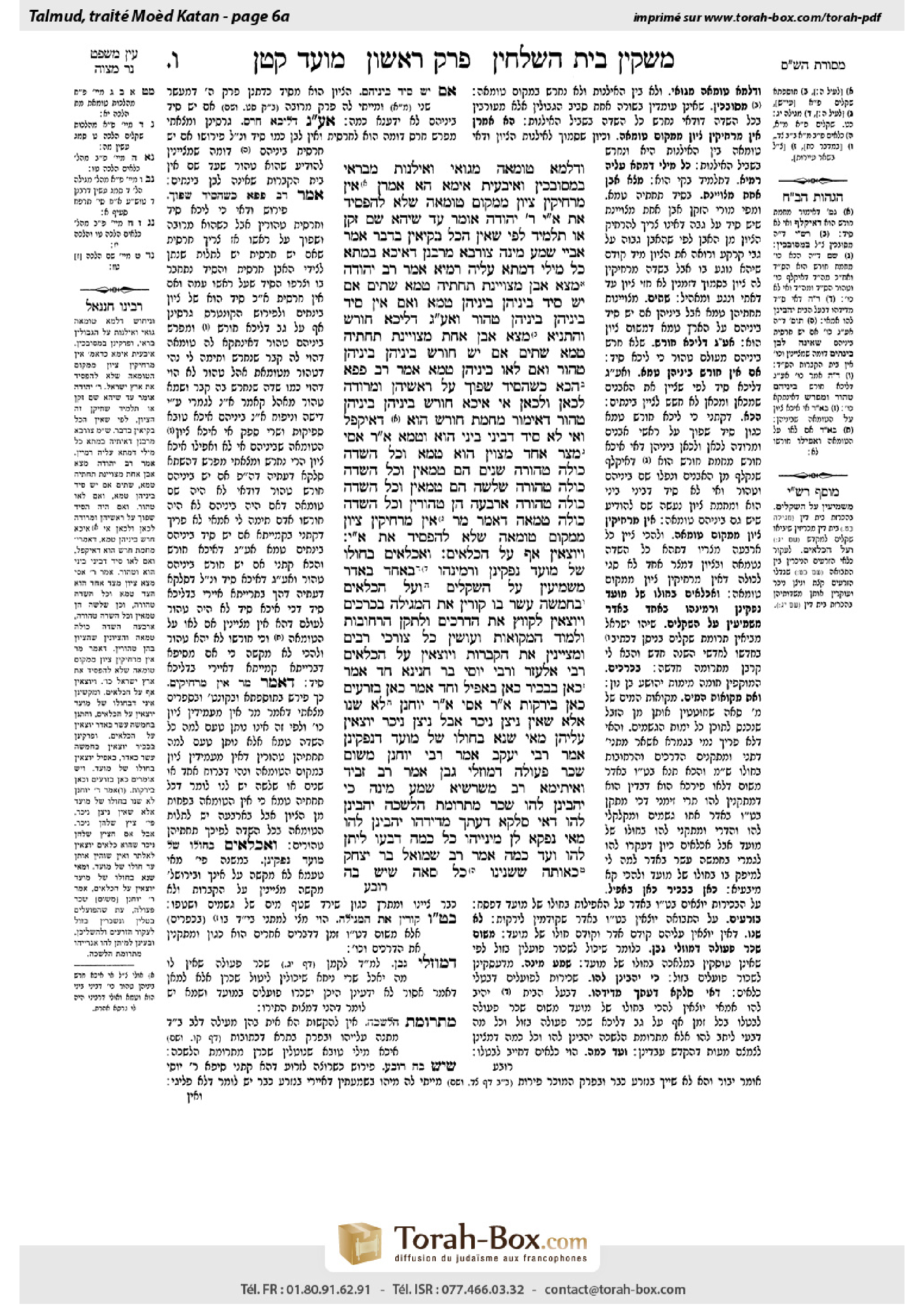
This page of Moed Katan includes the Aramaic text, an English translation and an AI-generated French translation, alongside the scan above.
מועד קטן ו׳ א · Aramaic and Hebrew text
וְדִלְמָא טוּמְאָה מִגַּוַּאי וְאִילָנוֹת מִבָּרַאי?
בִּמְסוּבָּכִין. וְאִיבָּעֵית אֵימָא, הָא אֲמַרַן: אֵין מַרְחִיקִין צִיּוּן מִמְּקוֹם טוּמְאָה שֶׁלֹּא לְהַפְסִיד אֶת אֶרֶץ יִשְׂרָאֵל.
רַבִּי יְהוּדָה אוֹמֵר: עַד שֶׁיְּהֵא שָׁם זָקֵן אוֹ תַּלְמִיד, לְפִי שֶׁאֵין הַכֹּל בְּקִיאִין בַּדָּבָר. אָמַר אַבָּיֵי: שְׁמַע מִינַּהּ צוּרְבָּא מֵרַבָּנַן דְּאִיכָּא בְּמָתָא — כׇּל מִילֵּי דְמָתָא עֲלֵיהּ רַמְיָא.
אָמַר רַב יְהוּדָה: מָצָא אֶבֶן מְצוּיֶּנֶת — תַּחְתֶּיהָ טָמֵא. שְׁתַּיִם, אִם יֵשׁ סִיד בֵּינֵיהֶן — בֵּינֵיהֶן טָמֵא, וְאִם אֵין סִיד בֵּינֵיהֶן — בֵּינֵיהֶן טָהוֹר.
וְאַף עַל גַּב דְּלֵיכָּא חוֹרֶשׁ? וְהָתַנְיָא: מָצָא אֶבֶן אַחַת מְצוּיֶּנֶת — תַּחְתֶּיהָ טָמֵא. שְׁתַּיִם, אִם יֵשׁ חוֹרֶשׁ בֵּינֵיהֶן — בֵּינֵיהֶן טָהוֹר, וְאִם לָאו — בֵּינֵיהֶן טָמֵא!
אָמַר רַב פָּפָּא: הָכָא כְּשֶׁהַסִּיד שָׁפוּךְ עַל רָאשֵׁיהֶן וּמְרוּדֶּה לְכָאן וּלְכָאן. אִי אִיכָּא חוֹרֶשׁ בֵּינֵיהֶן — בֵּינֵיהֶן טָהוֹר, דְּאֵימוֹר מֵחֲמַת חוֹרֶשׁ הוּא דְּאִיקְּפַל, וְאִי לָא, סִיד דְּבֵינֵי בֵּינֵי הוּא וְטָמֵא.
אָמַר רַבִּי אַסִּי מֶצֶר אֶחָד מְצוּיָּן — הוּא טָמֵא, וְכׇל הַשָּׂדֶה כּוּלָּהּ טְהוֹרָה. שְׁנַיִם — הֵם טְמֵאִין, וְכׇל הַשָּׂדֶה כּוּלָּהּ טְהוֹרָה. שְׁלֹשָׁה — הֵם טְמֵאִין, וְכׇל הַשָּׂדֶה כּוּלָּהּ טְהוֹרָה. אַרְבָּעָה — הֵן טְהוֹרִין, וְכׇל הַשָּׂדֶה כּוּלָּהּ טְמֵאָה.
דְּאָמַר מָר: אֵין מַרְחִיקִין צִיּוּן מִמְּקוֹם טוּמְאָה, שֶׁלֹּא לְהַפְסִיד אֶת אֶרֶץ יִשְׂרָאֵל.
וְיוֹצְאִין אַף עַל הַכִּלְאַיִם.
וְאַכִּלְאַיִם בְּחוּלּוֹ שֶׁל מוֹעֵד נָפְקִינַן? וּרְמִינְהוּ: בְּאֶחָד בַּאֲדָר מַשְׁמִיעִין עַל הַשְּׁקָלִים וְעַל הַכִּלְאַיִם.
בַּחֲמִשָּׁה עָשָׂר בּוֹ קוֹרִין אֶת הַמְּגִילָּה בַּכְּרַכִּים, וְיוֹצְאִין לְקַוֵּוץ אֶת הַדְּרָכִים, וּלְתַקֵּן הָרְחוֹבוֹת, וְלָמוֹד הַמִּקְוָאוֹת. וְעוֹשִׂין כׇּל צוֹרְכֵי רַבִּים, וּמְצַיְּנִין אֶת הַקְּבָרוֹת, וְיוֹצְאִין עַל הַכִּלְאַיִם.
רַבִּי אֶלְעָזָר וְרַבִּי יוֹסֵי בַּר חֲנִינָא, חַד אָמַר: כָּאן בְּבַכִּיר, כָּאן בְּאָפִיל. וְחַד אָמַר: כָּאן בִּזְרָעִים, כָּאן בִּירָקוֹת.
אָמַר רַבִּי אַסִּי אָמַר רַבִּי יוֹחָנָן: לֹא שָׁנוּ אֶלָּא שֶׁאֵין נִיצָּן נִיכָּר, אֲבָל נִיצָּן נִיכָּר — יוֹצְאִין עֲלֵיהֶן.
מַאי שְׁנָא בְּחוּלּוֹ שֶׁל מוֹעֵד דְּנָפְקִינַן? אָמַר רַבִּי יַעֲקֹב אָמַר רַבִּי יוֹחָנָן: מִשּׁוּם שְׂכַר פְּעוּלָה דְּמוֹזְלִי גַּבַּן.
אָמַר רַב זְבִיד וְאִיתֵּימָא רַב מְשַׁרְשְׁיָא: שְׁמַע מִינַּהּ, כִּי יָהֲבִינַן לְהוּ שָׂכָר — מִתְּרוּמַת הַלִּשְׁכָּה יָהֲבִינַן לְהוּ. דְּאִי סָלְקָא דַעְתָּךְ מִדִּידְהוּ יָהֲבִינַן לְהוּ — מַאי נָפְקָא לַן מִינַּיְיהוּ? כֹּל כַּמָּה דְּבָעוּ לִיתֵּן לְהוּ!
וְעַד כַּמָּה? אָמַר רַב שְׁמוּאֵל בַּר יִצְחָק, כְּאוֹתָהּ שֶׁשָּׁנִינוּ: כׇּל סְאָה שֶׁיֵּשׁ בָּהּ
Moed Katan 6a · English translation
The Gemara asks: But perhaps the ritual impurity was on the inside and the trees were on the outside, and only the area between the trees was plowed, while the inner portion of the field with the grave was not plowed?
The Gemara answers: The case is where the trees are scattered throughout the entire field, so that it is likely that the entire field was plowed. And if you wish, say instead: This is not a concern, as we said earlier that one does not distance the marker too far from the actual site of ritual impurity, so as not to cause a loss of Eretz Yisrael. As the marker is located near the trees, presumably the trees are close to the actual site of the grave, and the site of the grave was plowed.
It is taught in the baraita that Rabbi Yehuda says: One relies on these signs only when there is an Elder or a rabbinic scholar who can testify about the matter, as not all are well versed in this matter, and perhaps the field was not plowed at all. Abaye said: Learn from this statement of Rabbi Yehuda that when there is a Torah scholar in the city, all affairs of the city are thrust upon him, i.e., are his responsibility. Consequently, he is expected to know what has happened in the city.
§ The Gemara continues its discussion of marking graves. Rav Yehuda said: If one found a single marked stone, this indicates that the ground underneath it is ritually impure. If he found two marked stones, the following distinction applies: If there is lime on the ground between them, this indicates that the area between them is ritually impure and the two stones mark the boundaries of the impure area; and if there is no lime on the ground between them, this indicates that the area between them is ritually pure and each stone marks a separate area of ritual impurity.
The Gemara asks: And is the area between them deemed ritually pure even though there is no sign of plowing having taken place between the stones? But isn’t it taught otherwise in a baraita as follows: If one found a single marked stone, this indicates that the ground underneath it is ritually impure. If he found two marked stones, then the following distinction applies: If there is evidence of plowing having taken place between them, the area between the two stones is ritually pure; and if not, the area between them is ritually impure.
Rav Pappa said: The contradiction can be resolved by explaining that here, in the baraita, the case is where the lime used as a marker of ritual impurity had been poured on top of the stones, and it is spread thinly this way and that. In this case, if there is evidence of plowing having taken place between the stones, the area between them is ritually pure, as one can say that the lime was peeled off from the stones due to the plowing; originally the lime was only on top of the stones, to indicate that there is ritual impurity underneath them, but then fell into the area between them during the plowing. But if there is no evidence of a plow having passed between them, then it is most likely that the lime was meant to mark the ground between the stones, and the entire area between them is ritually impure.
Rabbi Asi said: If only one border of a field is marked, it is assumed that the border itself is ritually impure while the entire rest of the field is ritually pure. If two borders are marked, it is assumed that they are both ritually impure while the entire rest of the field is ritually pure. If three borders are marked, it is assumed that the three of them are ritually impure while the entire rest of the field is ritually pure. If all four borders are marked, the borders themselves are ritually pure, while the entire field enclosed by the borders is ritually impure.
As the Master said in the baraita: One does not distance the marker from the actual site of ritual impurity, so as not to cause a loss of Eretz Yisrael, i.e., not to increase the area into which people refrain from entering. Consequently, they marked all of the borders to indicate that the entire field is ritually impure.
§ It is taught in the mishna: And inspectors even go out on the intermediate days of a Festival to uproot the shoots of prohibited diverse kinds [kilayim] that grew in the fields during the rainy season.
The Gemara asks: Do they go out to uproot diverse kinds during the intermediate days of a Festival? The Gemara raises a contradiction from another mishna (Shekalim 1:1), which states: On the first of Adar the court issues a proclamation concerning the collection of the shekels, i.e., the yearly half-shekel contribution to the Temple treasury made by each adult male for the purpose of buying communal offerings. And the court also issues a proclamation with regard to the obligation to uproot diverse kinds from the fields.
On the fifteenth of Adar the Megilla, the Scroll of Esther, is read in the walled cities, and they go out to clear thorns from the roads, to repair the city streets, and to measure the ritual baths to ascertain that they have the requisite quantity of water. And they tend to all other public needs, and they mark graves with lime, and they go out to uproot the shoots of diverse kinds. If they already went out in Adar to uproot the diverse kinds, why would they go out again on the intermediate days of the festival of Passover?
Rabbi Elazar and Rabbi Yosei bar Ḥanina disagreed about this issue: One said: Here, in the mishna that states that they go out on the fifteenth of Adar, it is referring to the early crop, while there, in the mishna that states that they go out on the intermediate days of the Festival, it is referring to the late crop, which isn’t clearly recognizable until the intermediate days of Passover. And one said: Here, in the mishna that states that they go out on the fifteenth of Adar, it is referring to grains that are sown in the winter and have already grown tall by Adar, while there, in the mishna that states that they go out on the intermediate days of the Festival, it is referring to vegetables, which only grow later in the season.
Rabbi Asi said that Rabbi Yoḥanan said: They taught that court messengers go out to uproot diverse kinds in the middle of the month of Adar only in a case where the blossom was not yet recognizable at an earlier date, so it was still impossible to determine whether or not the seedling was from diverse kinds of seeds. But if the blossom was already recognizable at an earlier date, they go out at that time to uproot the shoots of diverse kinds of seeds.
The Gemara asks: What is different about the intermediate days of a Festival that we specifically go out to uproot shoots of diverse kinds of seeds during that week? Rabbi Ya’akov said that Rabbi Yoḥanan said: It is due to the wages paid to the workers hired by the court to uproot the diverse kinds. On the intermediate days of the Festival it is prohibited for them to perform ordinary labor, and so they reduce their rates for us, i.e., for public works, as otherwise they would have no income at all.
Rav Zevid said, and some say that it was Rav Mesharshiyya who said: Learn from this explanation that when we give the workers who uproot the diverse kinds their wages, we give it to them from the funds of the collection of the Temple treasury chamber. Since they are paid with consecrated money, an attempt is made to minimize the expenses. As, if it enters your mind that we pay them from theirs, i.e., the court forces the owners of the fields where the diverse kinds are found to pay the workers who uproot them, what benefit would we derive from saving the expense? However much the workers desire, they should pay them.
Concerning the issue of uprooting diverse kinds, the Gemara asks: And how much of another species must be mixed in with a crop in order to be considered diverse kinds that must be uprooted by these workers? Rav Shmuel bar Yitzḥak said: The amount is like that which we learned in the mishna (Kilayim 2:1): Any se’a of seeds that contains
Moed Katan 6a · Traduction française (IA)
La Guemara demande : Mais peut-être l’impureté rituelle se trouvait-elle à l’intérieur et les arbres à l’extérieur, et seule la zone entre les arbres a-t-elle été labourée, tandis que la partie intérieure du champ, où se trouvait la tombe, ne l’a pas été ?
La Guemara répond : Il s’agit d’un cas où les arbres sont dispersés dans tout le champ, de sorte qu’il est probable que le champ entier ait été labouré. Et si tu veux, dis plutôt : cela ne pose pas de problème, puisque nous avons dit précédemment qu’on ne place pas le repère trop loin du lieu même de l’impureté rituelle, afin de ne pas faire perdre de terres à Eretz Israël. Puisque le repère se trouve près des arbres, on peut supposer que ceux-ci sont proches du lieu même de la tombe et que celui-ci a été labouré.
Il est enseigné dans la baraïta que Rabbi Yehuda dit : On ne se fie à ces signes que lorsqu’un ancien ou un érudit en Torah peut témoigner à ce sujet, car tous ne sont pas versés dans cette matière et le champ n’a peut-être pas été labouré du tout. Abaye dit : Déduis de cette déclaration de Rabbi Yehuda que lorsqu’un érudit en Torah se trouve dans la ville, toutes les affaires de la ville lui incombent, c’est-à-dire qu’elles relèvent de sa responsabilité. Par conséquent, on s’attend à ce qu’il sache ce qui s’est passé dans la ville.
§ La Guemara poursuit son examen du marquage des tombes. Rav Yehuda dit : Si quelqu’un trouve une seule pierre marquée, cela indique que le sol au-dessous est rituellement impur. S’il trouve deux pierres marquées, la distinction suivante s’applique : s’il y a de la chaux sur le sol entre elles, cela indique que la zone comprise entre elles est rituellement impure et que les deux pierres en délimitent les frontières ; s’il n’y a pas de chaux sur le sol entre elles, cela indique que la zone comprise entre elles est rituellement pure et que chaque pierre marque une zone distincte d’impureté rituelle.
La Guemara demande : La zone comprise entre elles est-elle donc considérée comme rituellement pure même s’il n’y a aucun signe qu’elle ait été labourée ? Pourtant, une baraïta enseigne le contraire : si quelqu’un trouve une seule pierre marquée, cela indique que le sol au-dessous est rituellement impur. S’il trouve deux pierres marquées, la distinction suivante s’applique : s’il existe des traces d’un labour entre elles, la zone comprise entre les deux pierres est rituellement pure ; sinon, elle est rituellement impure.
Rav Pappa dit : On peut résoudre la contradiction en expliquant qu’ici, dans la baraïta, il s’agit d’un cas où la chaux utilisée pour signaler l’impureté rituelle avait été versée sur le dessus des pierres et s’était étalée en couche mince de-ci de-là. Dans ce cas, s’il existe des traces d’un labour entre les pierres, la zone comprise entre elles est rituellement pure, car on peut dire que la chaux s’est détachée des pierres sous l’effet du labour ; à l’origine, la chaux ne se trouvait que sur le dessus des pierres, pour indiquer qu’il y avait une impureté rituelle au-dessous, puis elle est tombée dans la zone comprise entre elles pendant le labour. Mais s’il n’existe aucune trace du passage d’une charrue entre elles, il est très probable que la chaux ait servi à marquer le sol entre les pierres, et toute la zone comprise entre elles est rituellement impure.
Rabbi Asi dit : Si une seule limite d’un champ est marquée, on considère que cette limite elle-même est rituellement impure, tandis que tout le reste du champ est rituellement pur. Si deux limites sont marquées, on considère qu’elles sont toutes deux rituellement impures, tandis que tout le reste du champ est rituellement pur. Si trois limites sont marquées, on considère que toutes trois sont rituellement impures, tandis que tout le reste du champ est rituellement pur. Si les quatre limites sont marquées, les limites elles-mêmes sont rituellement pures, tandis que tout le champ qu’elles délimitent est rituellement impur.
Comme le Maître l’a enseigné dans la baraïta : On ne place pas le repère trop loin du lieu même de l’impureté rituelle, afin de ne pas faire perdre de terres à Eretz Israël, c’est-à-dire de ne pas agrandir la zone dans laquelle les gens s’abstiennent de pénétrer. Par conséquent, ils ont marqué toutes les limites pour indiquer que tout le champ est rituellement impur.
§ La Michna enseigne : Des inspecteurs sortent même pendant les jours intermédiaires d’une fête pour arracher les jeunes pousses de mélanges interdits [kilayim] qui ont poussé dans les champs pendant la saison des pluies.
La Guemara demande : Sortent-ils arracher les mélanges interdits pendant les jours intermédiaires d’une fête ? La Guemara soulève une contradiction à partir d’une autre Michna (Shekalim 1:1), qui enseigne : Le premier jour d’Adar, le tribunal proclame la collecte des shekels, c’est-à-dire la contribution annuelle d’un demi-shekel versée par chaque homme adulte au trésor du Temple afin d’acheter les sacrifices communautaires. Le tribunal proclame également l’obligation d’arracher les mélanges interdits des champs.
Le quinze Adar, on lit la Meguila, le rouleau d’Esther, dans les villes fortifiées, et l’on sort pour enlever les épines des routes, réparer les rues de la ville et mesurer les bassins rituels afin de vérifier qu’ils contiennent la quantité d’eau requise. On s’occupe aussi de tous les autres besoins publics, on marque les tombes à la chaux et l’on sort arracher les jeunes pousses de mélanges interdits. S’ils sont déjà sortis en Adar pour arracher les mélanges interdits, pourquoi sortiraient-ils de nouveau pendant les jours intermédiaires de la fête de Pessa’h ?
Rabbi Elazar et Rabbi Yosei bar Ḥanina sont en désaccord sur cette question : l’un dit : ici, dans la Michna qui enseigne qu’ils sortent le quinze Adar, il s’agit de la récolte précoce, tandis que là, dans la Michna qui enseigne qu’ils sortent pendant les jours intermédiaires de la fête, il s’agit de la récolte tardive, qui n’est clairement reconnaissable que pendant les jours intermédiaires de Pessa’h. Et l’autre dit : ici, dans la Michna qui enseigne qu’ils sortent le quinze Adar, il s’agit des céréales semées en hiver et qui ont déjà beaucoup poussé en Adar, tandis que là, dans la Michna qui enseigne qu’ils sortent pendant les jours intermédiaires de la fête, il s’agit des légumes, qui ne poussent que plus tard dans la saison.
Rabbi Asi dit au nom de Rabbi Yoḥanan : Ils ont enseigné que les messagers du tribunal sortent au milieu du mois d’Adar pour arracher les mélanges interdits uniquement lorsque la floraison n’était pas encore reconnaissable à une date antérieure, de sorte qu’il était encore impossible de déterminer si la jeune pousse provenait ou non d’un mélange de semences. Mais si la floraison était déjà reconnaissable à une date antérieure, ils sortent alors arracher les jeunes pousses de mélanges interdits.
La Guemara demande : Qu’est-ce qui distingue les jours intermédiaires d’une fête, pour qu’on sorte précisément durant cette semaine arracher les jeunes pousses de mélanges interdits ? Rabbi Ya’akov dit au nom de Rabbi Yoḥanan : C’est en raison du salaire des ouvriers engagés par le tribunal pour arracher les mélanges interdits. Pendant les jours intermédiaires de la fête, il leur est interdit d’effectuer un travail ordinaire ; ils baissent donc leurs tarifs pour nous, c’est-à-dire pour les travaux publics, car autrement ils n’auraient aucun revenu.
Rav Zevid dit, et certains disent que c’est Rav Mesharshiyya qui l’a dit : Déduis de cette explication que, lorsque nous payons les ouvriers qui arrachent les mélanges interdits, nous les payons avec les fonds de la collecte destinée à la chambre du trésor du Temple. Puisqu’ils sont payés avec de l’argent consacré, on cherche à réduire les dépenses. En effet, si tu es porté à penser que nous les payons avec les fonds des propriétaires, c’est-à-dire que le tribunal oblige les propriétaires des champs où l’on trouve des mélanges interdits à payer les ouvriers qui les arrachent, quel avantage tirerions-nous à économiser cette dépense ? Quel que soit le salaire demandé par les ouvriers, les propriétaires devraient le leur payer.
À propos de l’arrachage des mélanges interdits, la Guemara demande : Quelle quantité d’une autre espèce doit être mélangée à une récolte pour que celle-ci soit considérée comme un mélange interdit que ces ouvriers doivent arracher ? Rav Shmuel bar Yitzḥak dit : La quantité est celle que nous avons apprise dans la Michna (Kilayim 2:1) : toute séa de semences qui contient
Traduction française générée par IA à partir de l’édition anglaise de Sefaria. Vérifie toujours un passage avec le texte source.
Text from Sefaria: William Davidson Edition - Vocalized Aramaic (CC BY NC); William Davidson Edition - English (CC BY NC).