Moed Katan 6b: Talmud study for Daf Yomi
Daf Yomi is the daily study of one Talmud folio. Explore 37 tractates with scans, Hebrew text, Sefaria English and AI-generated French translations where annotated.
Passage selection and English or AI-generated French translation are available where the scan has annotations. Daf Study is independent of Torah-Box and Sefaria.
Browse Moed Katan · מועד קטן · All tractatesMoed Katan 6b text and translations
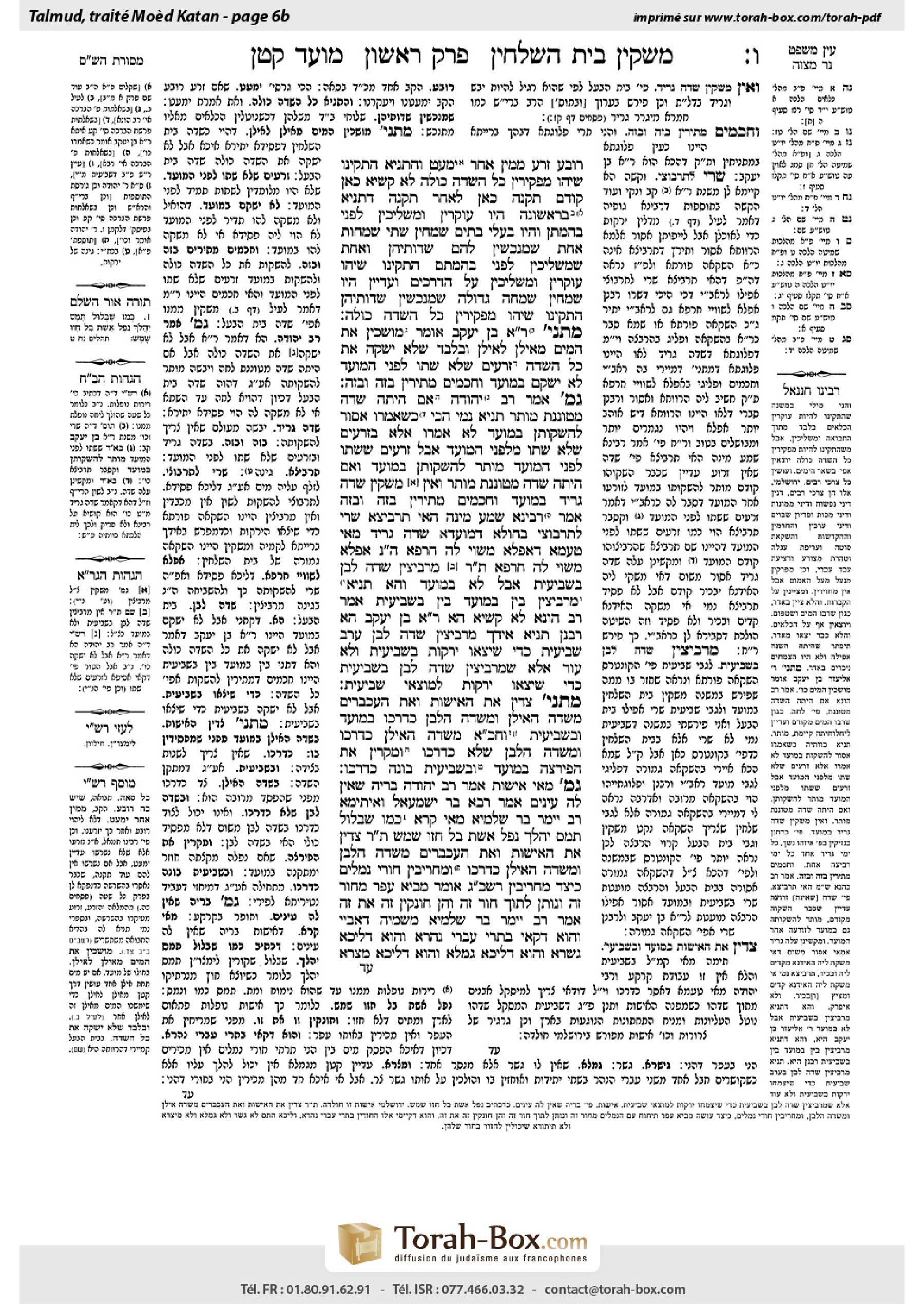
This page of Moed Katan includes the Aramaic text, an English translation and an AI-generated French translation, alongside the scan above.
מועד קטן ו׳ ב · Aramaic and Hebrew text
רוֹבַע זֶרַע מִמִּין אַחֵר — יְמַעֵט.
וְהָתַנְיָא: הִתְקִינוּ שֶׁיְּהוּ מַפְקִירִין כׇּל הַשָּׂדֶה כּוּלָּהּ! לָא קַשְׁיָא: כָּאן קוֹדֶם תַּקָּנָה, כָּאן לְאַחַר תַּקָּנָה.
דְּתַנְיָא: בָּרִאשׁוֹנָה הָיוּ עוֹקְרִין וּמַשְׁלִיכִין לִפְנֵי בְּהֶמְתָּן, וְהָיוּ בַּעֲלֵי בָּתִּים שְׂמֵחִין שְׁתֵּי שְׂמָחוֹת: אַחַת שֶׁמְּנַכְּשִׁין לָהֶם שְׂדוֹתֵיהֶן, וְאַחַת שֶׁמַּשְׁלִיכִין לִפְנֵי בְּהֶמְתָּם,
הִתְקִינוּ שֶׁיְּהוּ עוֹקְרִין וּמַשְׁלִיכִין עַל הַדְּרָכִים. וַעֲדַיִין הָיוּ שְׂמֵחִין שִׂמְחָה גְּדוֹלָה שֶׁמְּנַכְּשִׁין שְׂדוֹתֵיהֶן, הִתְקִינוּ שֶׁיְּהוּ מַפְקִירִין כׇּל הַשָּׂדֶה כּוּלָּהּ.
מַתְנִי׳ רַבִּי אֱלִיעֶזֶר בֶּן יַעֲקֹב אוֹמֵר: מוֹשְׁכִין אֶת הַמַּיִם מֵאִילָן לְאִילָן, וּבִלְבַד שֶׁלֹּא יַשְׁקֶה אֶת כׇּל הַשָּׂדֶה. זְרָעִים שֶׁלֹּא שָׁתוּ לִפְנֵי הַמּוֹעֵד — לָא יַשְׁקֵם בַּמּוֹעֵד. וַחֲכָמִים מַתִּירִין בָּזֶה וּבָזֶה.
גְּמָ׳ אָמַר רַב יְהוּדָה: אִם הָיְתָה שָׂדֶה מְטוּנֶּנֶת — מוּתָּר. תַּנְיָא נָמֵי הָכִי: כְּשֶׁאָמְרוּ אָסוּר לְהַשְׁקוֹתָן בַּמּוֹעֵד, לֹא אָמְרוּ אֶלָּא בִּזְרָעִים שֶׁלֹּא שָׁתוּ מִלִּפְנֵי הַמּוֹעֵד, אֲבָל זְרָעִים שֶׁשָּׁתוּ לִפְנֵי הַמּוֹעֵד — מוּתָּר לְהַשְׁקוֹתָן בַּמּוֹעֵד.
וְאִם הָיְתָה שָׂדֶה מְטוּנֶּנֶת — מוּתָּר. וְאֵין מַשְׁקִין שְׂדֵה גָרִיד בַּמּוֹעֵד, וַחֲכָמִים מַתִּירִין בָּזֶה וּבָזֶה.
אָמַר רָבִינָא: שְׁמַע מִינַּהּ הַאי תַּרְבִּיצָא שְׁרֵי לְתַרְבּוֹצֵי בְּחוּלָּא דְמוֹעֲדָא. שְׂדֵה גָרִיד מַאי טַעְמָא — דְּאַפְלָא מְשַׁוֵּי לַהּ חָרְפָא, הָכָא נָמֵי — אַפְלָא מְשַׁוֵּי לָהּ חָרְפָא.
תָּנוּ רַבָּנַן: מַרְבִּיצִין שְׂדֵה לָבָן בַּשְּׁבִיעִית, אֲבָל לֹא בַּמּוֹעֵד.
וְהָא תַּנְיָא: מַרְבִּיצִין בֵּין בַּמּוֹעֵד בֵּין בַּשְּׁבִיעִית! אָמַר רַב הוּנָא, לָא קַשְׁיָא: הָא רַבִּי אֱלִיעֶזֶר בֶּן יַעֲקֹב, הָא רַבָּנַן.
תַּנְיָא אִידַּךְ: מַרְבִּיצִין שְׂדֵה לָבָן עֶרֶב שְׁבִיעִית כְּדֵי שֶׁיֵּצְאוּ יְרָקוֹת בַּשְּׁבִיעִית, וְלֹא עוֹד אֶלָּא שֶׁמַּרְבִּיצִין שְׂדֵה לָבָן בַּשְּׁבִיעִית כְּדֵי שֶׁיֵּצְאוּ יְרָקוֹת לְמוֹצָאֵי שְׁבִיעִית.
מַתְנִי׳ צָדִין אֶת הָאִישׁוּת וְאֶת הָעַכְבָּרִים מִשְּׂדֵה הָאִילָן וּמִשְּׂדֵה הַלָּבָן כְּדַרְכּוֹ בַּמּוֹעֵד וּבִשְׁבִיעִית. וַחֲכָמִים אוֹמְרִים: מִשְּׂדֵה הָאִילָן — כְּדַרְכּוֹ, וּמִשְּׂדֵה הַלָּבָן — שֶׁלֹּא כְּדַרְכּוֹ.
וּמְקָרִין אֶת הַפִּירְצָה בַּמּוֹעֵד, וּבַשְּׁבִיעִית בּוֹנֶה כְּדַרְכּוֹ.
גְּמָ׳ מַאי אִישׁוּת? אָמַר רַב יְהוּדָה: בְּרִיָּה שֶׁאֵין לָהּ עֵינַיִם. אָמַר רָבָא בַּר יִשְׁמָעֵאל וְאִיתֵּימָא רַב יֵימַר בַּר שֶׁלֶמְיָא: מַאי קְרָא? ״כְּמוֹ שַׁבְּלוּל תֶּמֶס יַהֲלֹךְ נֵפֶל אֵשֶׁת בַּל חָזוּ שָׁמֶשׁ״.
תָּנוּ רַבָּנַן: צָדִין אֶת הָאִישׁוּת וְאֶת הָעַכְבָּרִים מִשְּׂדֵה הַלָּבָן וּמִשְּׂדֵה הָאִילָן כְּדַרְכּוֹ, וּמַחְרִיבִין חוֹרֵי נְמָלִים. כֵּיצַד מַחְרִיבִין? רַבָּן שִׁמְעוֹן בֶּן גַּמְלִיאֵל אוֹמֵר: מֵבִיא עָפָר מֵחוֹר זֶה וְנוֹתֵן לְתוֹךְ חוֹר זֶה, וְהֵן חוֹנְקִין זֶה אֶת זֶה.
אָמַר רַב יֵימַר בַּר שֶׁלֶמְיָא מִשְּׁמֵיהּ דְּאַבָּיֵי: וְהוּא דְּקָאֵי בִּתְרֵי עֶבְרֵי נַהֲרָא, וְהוּא דְּלֵיכָּא גִּשְׁרָא, וְהוּא דְּלֵיכָּא גַּמְלָא, וְהוּא דְּלֵיכָּא מִצְרָא.
Moed Katan 6b · English translation
a quarter-kav or more of seeds of a different type, i.e., one twenty-fourth of the mixture is a type of seed other than the main type, one must reduce the other type of seeds in the mixture by uprooting the shoots.
With regard to the halakha that inspectors must go out and uproot the shoots of diverse kinds of seeds that grew in the fields, the Gemara asks: But isn’t it taught in a baraita that the Sages ordained that they should pronounce the crop of the entire field in which diverse kinds was found ownerless, rather than uprooting the diverse kinds? The Gemara responds: This is not difficult. Here, in the mishna, where it says that the inspectors go out and uproot the diverse kinds, it is referring to the time before the institution of the new ordinance; there, in the baraita, where it says that the entire field is pronounced ownerless, it is referring to the time after the institution of that ordinance.
The Gemara explains this ordinance as it is taught in another baraita: At first, the agents of the court would uproot the diverse kinds and cast them before the livestock belonging to the owners of the fields. However, the property holders would rejoice for two reasons: One, that the agents of the court weeded their fields for them when they uprooted the plants of the other type; and another one, that they cast the diverse kinds before their livestock, thereby saving them from having to feed them. Accordingly, the field owners took no steps to keep their fields free of diverse kinds of seeds.
The Sages, therefore, ordained that the agents of the court should uproot the diverse kinds and cast them on the roads. Yet the property holders would still greatly rejoice that the agents of the court weeded their fields free of charge. Finally, the Sages ordained that they should pronounce the crop of the entire field in which diverse kinds was found ownerless.
MISHNA: Rabbi Eliezer ben Ya’akov says: In a field that is filled with trees, one may draw water via channels from one tree to another tree on the intermediate days of a Festival because trees are in dire need of water. And this is permitted provided that in doing so he does not water the entire field. With regard to plants that were not watered prior to the Festival, one may not water them on the intermediate days of the Festival because they do not need the water. But the Rabbis permit watering in this case, i.e., trees, and that case, i.e., plants.
GEMARA: Rav Yehuda said: If the field was moist [metunenet] before the Festival but in the meantime it dried up, it is permitted to water the entire field even according to Rabbi Eliezer ben Ya’akov. That ruling is also taught in a baraita: When they said that it is prohibited to water them on the intermediate days of a Festival, they said this only with regard to plants that were not watered at all before the Festival. However, with regard to plants that were already watered before the Festival and had begun to grow, it is permitted to water them on the intermediate days of the Festival because failure to water them would lead to substantial financial loss.
And if the field was moist before the Festival, it is permitted to water it even if the field had not been watered prior to the Festival. And one may not water a dry field on the intermediate days of a Festival. But the Rabbis permit watering this and that, i.e., plants that were not watered before the Festival and a dry field.
Ravina said: Learn from here that one is permitted to sprinkle a garden [tarbitza] with water on the intermediate days of a Festival. Ravina explains how he arrived at this conclusion: What is the reason that the Rabbis permit one to water a dry field despite the fact that the plants will not die from a lack of moisture? This is because watering the field in advance turns a late crop into an early crop. It can be understood from this that the late ripening of a crop is considered a substantial financial loss that serves as a reason to permit labor that would otherwise be prohibited on the intermediate days of a Festival. Here too, in the case of a garden, sprinkling it with water turns a late crop into an early crop, and so it is permitted on the intermediate days of a Festival.
The Sages taught the following baraita: One may sprinkle water in a field of grain during the Sabbatical Year, but not on the intermediate days of a Festival.
The Gemara asks: But isn’t it taught in another baraita: One may sprinkle water in a field of grain both on the intermediate days of a Festival and during the Sabbatical Year? Rav Huna said: This is not difficult. This baraita that prohibits sprinkling water in a field of grain on the intermediate days of a Festival is in accordance with the opinion of Rabbi Eliezer ben Ya’akov, who prohibits watering an entire field. That baraita that permits it is in accordance with the more lenient opinion of the Rabbis.
It is taught in another baraita: One may sprinkle water in a white field on the eve of the Sabbatical Year so that vegetables will sprout during the Sabbatical Year; and not only that, but one may sprinkle water in a field of grain even during the Sabbatical Year itself, so that vegetables will sprout upon the conclusion of the Sabbatical Year. Since sprinkling water is not regarded as full-fledged agricultural labor, it is permitted as long as the sprinkling and the sprouting of the vegetables do not both occur during the Sabbatical Year itself.
MISHNA: One may trap moles [ishut] and mice in an orchard and in a field of grain in his usual manner, i.e., as he would trap them all year round, both on the intermediate days of a Festival and during the Sabbatical Year. But the Rabbis say: In an orchard he may trap them in his usual manner, but in a field of grain, where there is no danger of substantial financial loss, he may only trap them in a way that is not his usual manner.
And one may seal a breach in the wall of his garden on the intermediate days of a Festival, and during the Sabbatical Year one may even build a wall in his usual manner, as this is not considered an agricultural labor. Consequently, despite the fact that this benefits the garden by offering it protection, it is not prohibited during the Sabbatical Year.
GEMARA: The Gemara asks: What is meant by the term ishut? Rav Yehuda said: An ishut is a creature that has no eyes, a rodent that digs holes in the ground and can cause damage to roots and vegetables. Rava bar Yishmael said, and some say that it was Rav Yeimar bar Shelamya who said: What is the verse that indicates the identity of the ishut? “As a snail that melts and disappears; like the fall of a young mole [eshet] that has not seen the sun” (Psalms 58:9). It is understood that this creature has not seen the sun because it does not have eyes.
The Gemara expands upon the halakha recorded in the mishna. The Sages taught the following baraita: One may trap moles and mice in a field of grain and in an orchard in his usual manner, and one may destroy ant holes so that the ants will cause no damage. How does one destroy ant holes? Rabban Shimon ben Gamliel says: One brings soil from this ant hole and places it in that ant hole, and since the ants from the two nests are not familiar with each other, they strangle each other.
Rav Yeimar bar Shelamya said in the name of Abaye: And this advice works only in certain circumstances: When the ant holes are located on two opposite sides of a river, when there is no bridge connecting the two sides, when there is not even a plank bridge over the water, and when there is not even a rope stretched taut across the river. If there is any connection whatsoever between the two sides of the river, the ants from the two nests are likely to recognize each other and not fight.
Moed Katan 6b · Traduction française (IA)
un quart de kav ou davantage de semences d’une autre espèce, c’est-à-dire si un vingt-quatrième du mélange est constitué d’une espèce de semence autre que l’espèce principale, il faut réduire la proportion de ces semences dans le mélange en arrachant les pousses.
À propos de la halakha selon laquelle des inspecteurs doivent se rendre sur place et arracher les pousses d’espèces mélangées qui ont poussé dans les champs, la Guemara demande : Mais n’est-il pas enseigné dans une baraïta que les Sages ont décrété que la récolte de tout champ où l’on avait trouvé des espèces mélangées serait déclarée sans propriétaire, plutôt que d’arracher ces espèces mélangées ? La Guemara répond : Il n’y a pas de contradiction. Ici, dans la Michna, où il est dit que les inspecteurs se rendent sur place pour arracher les espèces mélangées, il s’agit de la période antérieure à l’instauration de la nouvelle ordonnance ; là, dans la baraïta, où il est dit que tout le champ est déclaré sans propriétaire, il s’agit de la période postérieure à cette ordonnance.
La Guemara explique cette ordonnance, comme il est enseigné dans une autre baraïta : Au début, les agents du tribunal arrachaient les espèces mélangées et les jetaient aux animaux appartenant aux propriétaires des champs. Or, les propriétaires se réjouissaient pour deux raisons : premièrement, les agents du tribunal désherbaient leurs champs en arrachant les plantes de l’autre espèce ; deuxièmement, ils jetaient les espèces mélangées à leurs animaux, leur évitant ainsi d’avoir à les nourrir. Par conséquent, les propriétaires des champs ne prenaient aucune mesure pour empêcher la présence d’espèces mélangées dans leurs champs.
Les Sages décrétèrent donc que les agents du tribunal arracheraient les espèces mélangées et les jetteraient sur les routes. Pourtant, les propriétaires se réjouissaient encore beaucoup que les agents du tribunal désherbent leurs champs gratuitement. Enfin, les Sages décrétèrent que la récolte de tout champ où l’on avait trouvé des espèces mélangées serait déclarée sans propriétaire.
MICHNA : Rabbi Eliezer ben Ya’akov dit : Dans un champ rempli d’arbres, on peut faire couler de l’eau par des rigoles d’un arbre à l’autre pendant les jours intermédiaires de la fête, car les arbres ont un besoin urgent d’eau. Cela est permis à condition de ne pas arroser tout le champ. Quant aux plantes qui n’ont pas été arrosées avant la fête, on ne peut pas les arroser pendant les jours intermédiaires de la fête, car elles n’ont pas besoin d’eau. Mais les Sages permettent d’arroser dans ce cas, c’est-à-dire les arbres, et dans cet autre cas, c’est-à-dire les plantes.
GUEMARA : Rav Yehouda dit : Si le champ était humide [metunenet] avant la fête, mais qu’il a séché entre-temps, il est permis d’arroser tout le champ, même selon Rabbi Eliezer ben Ya’akov. Cette règle est également enseignée dans une baraïta : Lorsqu’ils ont dit qu’il est interdit d’arroser les plantes pendant les jours intermédiaires de la fête, ils ne l’ont dit qu’à propos des plantes qui n’avaient pas été arrosées du tout avant la fête. En revanche, il est permis d’arroser pendant les jours intermédiaires de la fête les plantes qui avaient déjà été arrosées avant la fête et avaient commencé à pousser, car ne pas les arroser entraînerait une perte financière considérable.
Et si le champ était humide avant la fête, il est permis de l’arroser même s’il n’avait pas été arrosé avant la fête. On ne peut toutefois pas arroser un champ sec pendant les jours intermédiaires de la fête. Mais les Sages permettent d’arroser dans les deux cas, c’est-à-dire les plantes qui n’ont pas été arrosées avant la fête et un champ sec.
Ravina dit : On peut déduire d’ici qu’il est permis d’asperger un jardin [tarbitza] d’eau pendant les jours intermédiaires de la fête. Ravina explique comment il est parvenu à cette conclusion : Pour quelle raison les Sages permettent-ils d’arroser un champ sec, bien que les plantes ne meurent pas faute d’humidité ? Parce qu’arroser le champ à l’avance transforme une récolte tardive en récolte précoce. On peut en déduire qu’une maturation tardive de la récolte est considérée comme une perte financière considérable, qui justifie d’autoriser un travail autrement interdit pendant les jours intermédiaires de la fête. De même, dans le cas d’un jardin, l’asperger d’eau transforme une récolte tardive en récolte précoce ; cela est donc permis pendant les jours intermédiaires de la fête.
Les Sages ont enseigné dans la baraïta suivante : On peut asperger d’eau un champ de céréales pendant l’année de la Chemita, mais pas pendant les jours intermédiaires de la fête.
La Guemara demande : Mais n’est-il pas enseigné dans une autre baraïta qu’on peut asperger d’eau un champ de céréales aussi bien pendant les jours intermédiaires de la fête que pendant l’année de la Chemita ? Rav Houna dit : Il n’y a pas de contradiction. Cette baraïta, qui interdit d’asperger d’eau un champ de céréales pendant les jours intermédiaires de la fête, suit l’opinion de Rabbi Eliezer ben Ya’akov, qui interdit d’arroser tout un champ. L’autre baraïta, qui l’autorise, suit l’opinion plus indulgente des Sages.
Il est enseigné dans une autre baraïta : On peut asperger d’eau un champ blanc à la veille de l’année de la Chemita afin que des légumes y poussent pendant l’année de la Chemita. Et non seulement cela, mais on peut asperger d’eau un champ de céréales même pendant l’année de la Chemita elle-même, afin que des légumes y poussent à la fin de l’année de la Chemita. Puisque l’aspersion d’eau n’est pas considérée comme un véritable travail agricole, elle est permise à condition que l’aspersion et la pousse des légumes n’aient pas lieu toutes deux pendant l’année de la Chemita elle-même.
MICHNA : On peut piéger les taupes [ishut] et les souris dans un verger et dans un champ de céréales de la manière habituelle, c’est-à-dire comme on le ferait tout au long de l’année, aussi bien pendant les jours intermédiaires de la fête que pendant l’année de la Chemita. Mais les Sages disent : Dans un verger, on peut les piéger de la manière habituelle ; dans un champ de céréales, où il n’y a pas de risque de perte financière considérable, on ne peut les piéger que d’une manière inhabituelle.
On peut boucher une brèche dans le mur de son jardin pendant les jours intermédiaires de la fête ; pendant l’année de la Chemita, on peut même construire un mur de la manière habituelle, car cela n’est pas considéré comme un travail agricole. Par conséquent, bien que cela protège le jardin et lui soit bénéfique, cette construction n’est pas interdite pendant l’année de la Chemita.
GUEMARA : La Guemara demande : Que désigne le terme ishut ? Rav Yehouda dit : Un ishut est une créature sans yeux, un rongeur qui creuse des trous dans le sol et peut endommager les racines et les légumes. Rava bar Yishmael dit — et certains disent que c’est Rav Yeimar bar Shelamya qui l’a dit : Quel verset indique l’identité de l’ishut ? « Comme une limace qui fond et disparaît ; comme la chute d’une jeune taupe [eshet] qui n’a pas vu le soleil » (Psaumes 58:9). On comprend que cette créature n’a pas vu le soleil parce qu’elle n’a pas d’yeux.
La Guemara développe la halakha consignée dans la Michna. Les Sages ont enseigné dans la baraïta suivante : On peut piéger les taupes et les souris dans un champ de céréales et dans un verger de la manière habituelle, et l’on peut détruire des fourmilières afin que les fourmis ne causent aucun dégât. Comment détruit-on les fourmilières ? Rabban Shimon ben Gamliel dit : On prend de la terre dans cette fourmilière et on la dépose dans cette autre fourmilière ; comme les fourmis des deux nids ne se connaissent pas, elles s’étranglent mutuellement.
Rav Yeimar bar Shelamya dit au nom d’Abaye : Cette méthode ne fonctionne que dans certaines circonstances : lorsque les fourmilières se trouvent de part et d’autre d’un fleuve, qu’aucun pont ne relie les deux rives, qu’il n’y a même pas de passerelle constituée d’une planche au-dessus de l’eau et qu’il n’y a même pas de corde tendue en travers du fleuve. S’il existe le moindre lien entre les deux rives, les fourmis des deux nids risquent de se reconnaître et de ne pas se battre.
Traduction française générée par IA à partir de l’édition anglaise de Sefaria. Vérifie toujours un passage avec le texte source.
Text from Sefaria: William Davidson Edition - Vocalized Aramaic (CC BY NC); William Davidson Edition - English (CC BY NC).