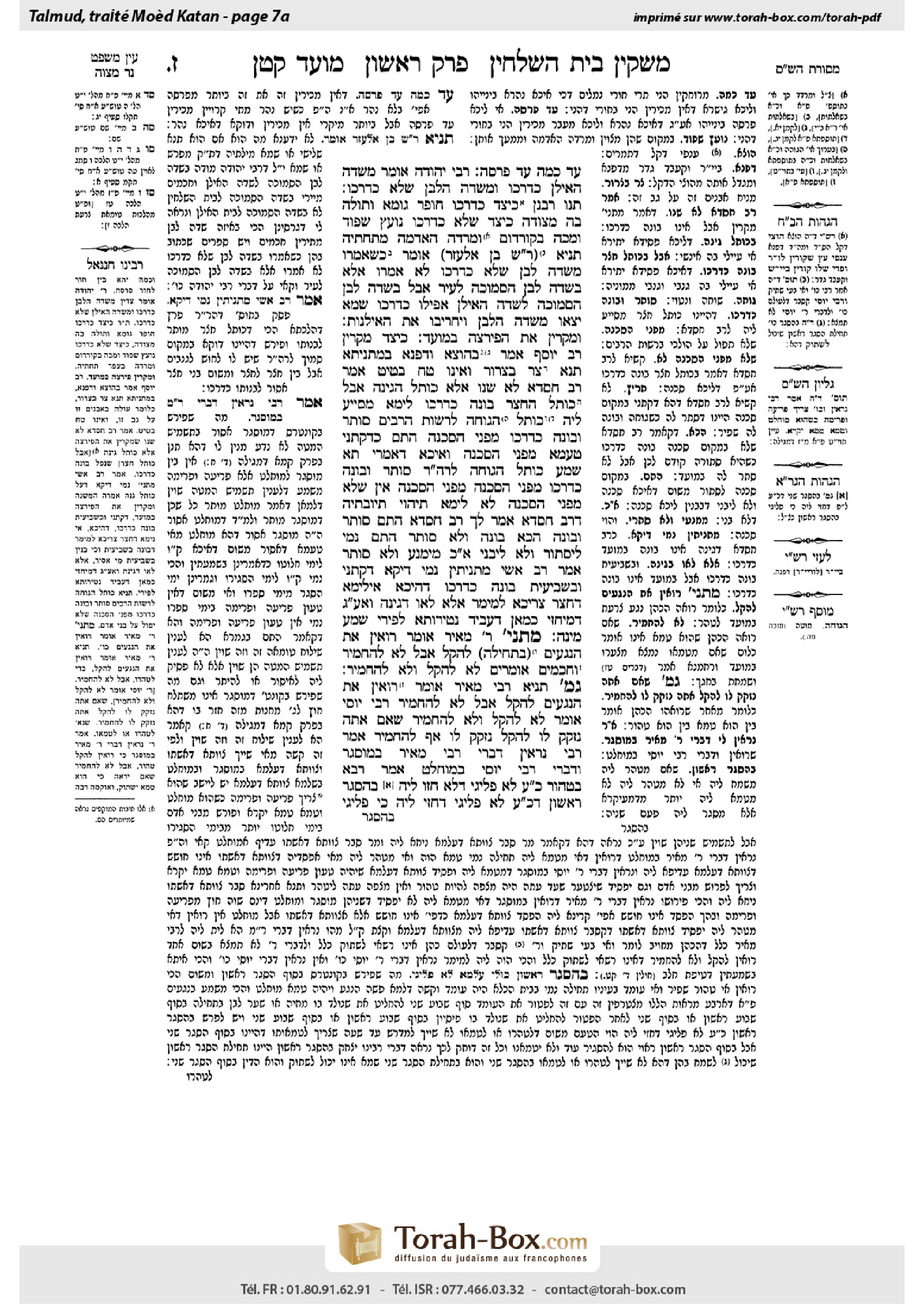
Moed Katan 7a: Talmud study for Daf Yomi
Daf Yomi is the daily study of one Talmud folio. Explore 37 tractates with scans, Hebrew text, Sefaria English and AI-generated French translations where annotated.
Passage selection and English or AI-generated French translation are available where the scan has annotations. Daf Study is independent of Torah-Box and Sefaria.
Browse Moed Katan · מועד קטן · All tractatesMoed Katan 7a text and translations
This page of Moed Katan includes the Aramaic text, an English translation and an AI-generated French translation, alongside the scan above.
מועד קטן ז׳ א · Aramaic and Hebrew text
עַד כַּמָּה — עַד פַּרְסָה.
רַבִּי יְהוּדָה אוֹמֵר: מִשְּׂדֵה הָאִילָן כְּדַרְכּוֹ, וּמִשְּׂדֵה הַלָּבָן שֶׁלֹּא כְּדַרְכּוֹ. תָּנוּ רַבָּנַן: כֵּיצַד כְּדַרְכּוֹ? חוֹפֵר גּוּמָּא וְתוֹלֶה בָּהּ מְצוּדָה. כֵּיצַד שֶׁלֹּא כְּדַרְכּוֹ? נוֹעֵץ שַׁפּוּד וּמַכֶּה בְּקוּרְדּוֹם וּמְרַדֶּה הָאֲדָמָה מִתַּחְתֶּיהָ.
תַּנְיָא, רַבִּי שִׁמְעוֹן בֶּן אֶלְעָזָר אוֹמֵר: כְּשֶׁאָמְרוּ מִשְּׂדֵה לָבָן שֶׁלֹּא כְּדַרְכּוֹ, לֹא אָמְרוּ אֶלָּא בִּשְׂדֵה לָבָן הַסְּמוּכָה לָעִיר, אֲבָל בִּשְׂדֵה לָבָן הַסְּמוּכָה לִשְׂדֵה הָאִילָן — אֲפִילּוּ כְּדַרְכּוֹ, שֶׁמָּא יֵצְאוּ מִשְּׂדֵה הַלָּבָן וְיַחְרִיבוּ אֶת הָאִילָנוֹת.
וּמְקָרִין אֶת הַפִּירְצָה בַּמּוֹעֵד. כֵּיצַד מְקָרִין? רַב יוֹסֵף אָמַר: בְּהוּצָא וְדַפְנָא.
בְּמַתְנִיתָא תָּנָא: צָר בִּצְרוֹר, וְאֵינוֹ טָח בְּטִיט. אָמַר רַב חִסְדָּא: לֹא שָׁנוּ אֶלָּא כּוֹתֶל הַגִּינָה, אֲבָל כּוֹתֶל הֶחָצֵר — בּוֹנֶה כְּדַרְכּוֹ.
לֵימָא מְסַיַּיע לֵיהּ: כּוֹתֶל הַגּוֹחֶה לִרְשׁוּת הָרַבִּים — סוֹתֵר וּבוֹנֶה כְּדַרְכּוֹ מִפְּנֵי הַסַּכָּנָה. הָתָם כִּדְקָתָנֵי טַעְמָא — מִפְּנֵי הַסַּכָּנָה.
וְאִיכָּא דְּאָמְרִי, תָּא שְׁמַע: כּוֹתֶל הַגּוֹחֶה לִרְשׁוּת הָרַבִּים — סוֹתֵר וּבוֹנֶה כְּדַרְכּוֹ מִפְּנֵי הַסַּכָּנָה. מִפְּנֵי הַסַּכָּנָה — אִין, שֶׁלֹּא מִפְּנֵי הַסַּכָּנָה — לָא. לֵימָא תֶּיהְוֵי תְּיוּבְתֵּיהּ דְּרַב חִסְדָּא?
אָמַר לְךָ רַב חִסְדָּא: הָתָם סוֹתֵר וּבוֹנֶה, הָכָא בּוֹנֶה וְלֹא סוֹתֵר.
הָתָם נָמֵי, לִיסְתּוֹר וְלָא לִיבְנֵי! אִם כֵּן, מִימְּנַע וְלָא סוֹתַר.
אָמַר רַב אָשֵׁי: מַתְנִיתִין נָמֵי דַּיְקָא, דְּקָתָנֵי: וּבַשְּׁבִיעִית בּוֹנֶה כְּדַרְכּוֹ.
דְּהֵיכָא? אִילֵּימָא דְּחָצֵר, צְרִיכָא לְמֵימַר? אֶלָּא לָאו, דְּגִינָּה. וְאַף עַל גַּב דְּמִיחֲזֵי כְּמַאן דְּעָבֵיד נְטִירוּתָא לְפֵירֵי. שְׁמַע מִינַּהּ.
מַתְנִי׳ רַבִּי מֵאִיר אוֹמֵר: רוֹאִין אֶת הַנְּגָעִים בַּתְּחִילָּה לְהָקֵל, אֲבָל לֹא לְהַחְמִיר. וַחֲכָמִים אוֹמְרִים: לֹא לְהָקֵל וְלֹא לְהַחְמִיר.
גְּמָ׳ תַּנְיָא, רַבִּי מֵאִיר אוֹמֵר: רוֹאִין אֶת הַנְּגָעִים לְהָקֵל, אֲבָל לֹא לְהַחְמִיר. רַבִּי יוֹסֵי אוֹמֵר: לֹא לְהָקֵל וְלֹא לְהַחְמִיר. שֶׁאִם אַתָּה נִזְקָק לוֹ לְהָקֵל — [אַתָּה] נִזְקָק לוֹ אַף לְהַחְמִיר.
אָמַר רַבִּי: נִרְאִין דִּבְרֵי רַבִּי מֵאִיר בְּמוּסְגָּר, וְדִבְרֵי רַבִּי יוֹסֵי בְּמוּחְלָט.
אָמַר רָבָא: בְּטָהוֹר כּוּלֵּי עָלְמָא לָא פְּלִיגִי דְּלָא חָזוּ לֵיהּ. בְּהֶסְגֵּר רִאשׁוֹן דְּכוּלֵּי עָלְמָא לָא פְּלִיגִי דְּחָזֵי לֵיהּ. כִּי פְּלִיגִי,
Moed Katan 7a · English translation
Up to what distance are the ant holes considered to be adjacent such that a river is required in order to separate between them? Up to a parasang [parsa].
§ We learned in the mishna that Rabbi Yehuda says: In an orchard one may trap moles and mice in his usual manner, but in a field of grain, he may trap them only in a way that is not his usual manner. The Sages taught the following baraita: How does one trap in his usual manner? He digs a hole in the ground and hangs a trap in it. How does one trap in a way that is not his usual manner? He inserts a spit into the ground where the rodents are suspected of hiding, strikes it with a spade, and removes the earth from beneath it until he finds and kills the rodents.
It is taught in a baraita that Rabbi Shimon ben Elazar says: When they said that one may trap moles and mice in a field of grain on the intermediate days of a Festival only in a way that is not his usual manner, they spoke only with regard to a field of grain that is adjacent to the city, where the damage is limited to that field and is not extensive. But in a field of grain that is adjacent to an orchard, one may trap even in his usual manner, lest the moles and mice leave the field of grain and destroy the trees in the adjacent orchard, causing great damage.
§ It is taught in the mishna: And one may seal a breach in the wall of his garden on the intermediate days of a Festival. The Gemara asks: How does one seal such a breach? Rav Yosef said: With palm branches [hutza] and the branches of a bay tree [dafna], which do not create a significant partition, but simply a temporary barrier.
It was taught in a baraita: One fills in the breach with stone, but he does not plaster the stones with clay. Rav Ḥisda said: They taught that he may seal a breach but not build a wall in his usual manner only with regard to the wall of a garden, as no significant loss will be suffered if he delays building until after the Festival. However, with regard to the wall of a courtyard, which prevents the entry of strangers who are likely to steal from him, he may build a wall in his usual manner even on the intermediate days of a Festival.
The Gemara suggests: Let us say that the following baraita supports Rav Ḥisda’s statement: With regard to a wall that is leaning [goḥeh] toward the public domain and is likely to fall, one may demolish and rebuild it in his usual manner on the intermediate days of a Festival, due to the danger that it poses to passersby. The Gemara rejects this opinion: There, the reason is as the baraita explicitly teaches, i.e., it is due to the danger that the wall poses to passersby, and not due to the protection that it affords the courtyard.
And some say that this baraita was cited not to support Rav Ḥisda’s opinion but in order to refute it, as follows: Come and hear that which is taught in a baraita: With regard to a wall that is leaning toward the public domain and is likely to fall, one may demolish and rebuild it in his usual manner, due to the danger that it poses to passersby. The Gemara explains: The baraita indicates that if the need to build the wall is due to the danger that it poses, yes, he is permitted to rebuild the wall, but if the reason is not due to the danger, no, he is not permitted to do so. Shall we say that this is a conclusive refutation of the opinion of Rav Ḥisda, who says that one may build the wall of his courtyard in his usual manner, even if no danger is present?
The Gemara answers: Rav Ḥisda could have said to you: There, in the case where the existing wall poses a danger, he is even permitted to demolish the wall and build it from scratch. Here, in the case of an ordinary wall enclosing a courtyard, he is permitted to build the breached wall in the usual manner, but not to demolish it.
The Gemara asks: There too, in the case of the leaning wall, let us say that he is permitted to demolish it and thereby remove the danger, but not to rebuild it until after the Festival. The Gemara answers: If so, he might refrain even from demolishing it, as demolishing the wall would leave his courtyard unprotected. Therefore, to eliminate the danger posed by the leaning wall, he is permitted not only to demolish it, but to rebuild it as well.
Rav Ashi said: The wording of the mishna is also precise and indicates that it is referring to the wall of a garden, as understood by Rav Ḥisda, as it teaches: During the Sabbatical Year one may even build in his usual manner.
The Gemara clarifies: Where is the wall to which the mishna refers? If we say that the mishna is referring to the wall of a courtyard, need it be said that it may be built during the Sabbatical Year? Only agricultural labors are prohibited during the Sabbatical Year, but construction is permitted. Rather, is it not referring to the wall of a garden, and it was necessary to state that this wall may be built during the Sabbatical Year to indicate that even though he appears as one who is building a protection for his produce, he is nevertheless permitted to do so. This proves that the mishna’s discussion pertains to building the wall of a garden. The Gemara concludes: Learn from this that Rav Ḥisda’s interpretation is indeed the correct understanding of the mishna.
MISHNA: When symptoms of leprosy appear, they must be examined by a priest, who determines whether or not the symptoms qualify as leprosy. Rabbi Meir says: A priest may initially examine an individual showing symptoms of leprosy on the intermediate days of a Festival in order to be lenient, i.e., he may pronounce the individual to be free of leprosy, but not in order to be stringent; he may not pronounce the individual to be impure. The individual does not become ritually impure until the priest pronounces him to have leprosy, and therefore the priest may remain silent and thereby prevent causing the afflicted individual distress during the Festival. And the Rabbis say: The priest may not examine the symptoms in order to be lenient or in order to be stringent.
GEMARA: It is taught in a baraita: Rabbi Meir says: A priest may examine an individual showing symptoms of leprosy on the intermediate days of a Festival in order to be lenient, but not in order to be stringent. Rabbi Yosei says: The priest may not examine the symptoms to be lenient or to be stringent. The reasoning behind Rabbi Yosei’s opinion is that if you attend to the individual with the symptoms of leprosy to be lenient, you must attend to him even to be stringent. If the priest sees that the symptom is in fact leprosy, he must declare the affected person ritually impure rather than remain silent. Consequently, in order to avoid declaring that he has leprosy on the Festival, the priest should not examine him at all.
Rabbi Yehuda HaNasi said: The statement of Rabbi Meir appears to be correct with regard to the case of a quarantined leper. In this case, the priest may reexamine him at the end of the week even on the intermediate days of a Festival, because if he declares the individual to be pure, he will cause him to rejoice, and if he declares that the individual must be quarantined for another week, his situation is no worse than it was previously. On the other hand, the statement of Rabbi Yosei appears to be correct with regard to the case of a confirmed leper, one who has already been declared conclusively impure by a priest. The Gemara (7b) will explain the reason for this statement.
Rava said: With regard to an individual with symptoms of leprosy who is still ritually pure, i.e., who has not yet been examined by a priest, everyone agrees that the priest does not examine him, as his status can only worsen due to the examination. With regard to a suspected leper who is in his first week of quarantine, everyone agrees that the priest examines him, as the priest may declare him pure if his symptoms have subsided, and even if his symptoms remained as they were, he will simply be quarantined for another week. When they disagree
Moed Katan 7a · Traduction française (IA)
Jusqu’à quelle distance les trous de fourmis sont-ils considérés comme contigus, de sorte qu’une rivière soit nécessaire pour les séparer ? Jusqu’à une parasange [parsa].
§ Nous avons appris dans la Michna que Rabbi Yehouda dit : Dans un verger, on peut piéger les taupes et les souris de la manière habituelle, mais dans un champ de céréales, on ne peut les piéger que d’une manière inhabituelle. Les Sages ont enseigné la baraïta suivante : Comment les piège-t-on de la manière habituelle ? On creuse un trou dans le sol et on y suspend un piège. Comment les piège-t-on d’une manière inhabituelle ? On enfonce une broche dans le sol à l’endroit où l’on soupçonne les rongeurs de se cacher, on la frappe avec une bêche et on retire la terre qui se trouve dessous jusqu’à ce qu’on les trouve et qu’on les tue.
Il est enseigné dans une baraïta que Rabbi Shimon ben Elazar dit : Lorsqu’ils ont dit que, pendant les jours intermédiaires d’une fête, on ne peut piéger les taupes et les souris dans un champ de céréales que d’une manière inhabituelle, ils ne parlaient que d’un champ de céréales jouxtant la ville, où les dégâts se limitent à ce champ et ne sont pas considérables. Mais dans un champ de céréales jouxtant un verger, on peut les piéger même de la manière habituelle, de peur que les taupes et les souris ne quittent le champ de céréales et ne détruisent les arbres du verger voisin, causant ainsi de grands dégâts.
§ La Michna enseigne : On peut colmater une brèche dans le mur de son jardin pendant les jours intermédiaires d’une fête. La Guemara demande : Comment colmate-t-on une telle brèche ? Rav Yossef dit : Avec des branches de palmier [hutza] et des branches de laurier [dafna], qui ne forment pas une cloison importante, mais simplement une barrière temporaire.
Il a été enseigné dans une baraïta : On comble la brèche avec des pierres, mais on n’enduit pas celles-ci d’argile. Rav Ḥisda dit : Ils ont enseigné qu’on peut colmater une brèche, mais non construire un mur de la manière habituelle, uniquement à propos du mur d’un jardin, car il n’y aura pas de perte importante à attendre la fin de la fête pour le construire. En revanche, pour le mur d’une cour, qui empêche l’entrée d’étrangers susceptibles de le voler, on peut construire le mur de la manière habituelle, même pendant les jours intermédiaires d’une fête.
La Guemara propose : Disons que la baraïta suivante vient étayer la déclaration de Rav Ḥisda : Si un mur penche [goḥeh] vers le domaine public et risque de s’effondrer, on peut le démolir et le reconstruire de la manière habituelle pendant les jours intermédiaires d’une fête, en raison du danger qu’il représente pour les passants. La Guemara rejette cette interprétation : Dans ce cas, la raison est, comme l’enseigne explicitement la baraïta, le danger que le mur représente pour les passants, et non la protection qu’il assure à la cour.
Certains disent que cette baraïta a été citée non pour étayer l’opinion de Rav Ḥisda, mais pour la réfuter, comme suit : Viens et entends ce qui est enseigné dans une baraïta : Si un mur penche vers le domaine public et risque de s’effondrer, on peut le démolir et le reconstruire de la manière habituelle, en raison du danger qu’il représente pour les passants. La Guemara explique : La baraïta indique que si la nécessité de construire le mur est due au danger qu’il représente, alors oui, il est permis de le reconstruire ; mais si la raison n’est pas le danger, alors non, cela ne lui est pas permis. Faut-il donc dire que cela constitue une réfutation définitive de l’opinion de Rav Ḥisda, qui dit qu’on peut construire le mur de sa cour de la manière habituelle, même en l’absence de tout danger ?
La Guemara répond : Rav Ḥisda aurait pu te dire : Dans ce cas, où le mur existant représente un danger, on est même autorisé à le démolir et à le reconstruire entièrement. Ici, dans le cas d’un mur ordinaire qui entoure une cour, on est autorisé à construire la partie du mur située à l’endroit de la brèche de la manière habituelle, mais pas à démolir le mur.
La Guemara demande : Dans ce cas également, celui du mur qui penche, disons qu’on est autorisé à le démolir afin d’écarter le danger, mais pas à le reconstruire avant la fin de la fête. La Guemara répond : Dans ce cas, il pourrait s’abstenir même de le démolir, car la démolition du mur laisserait sa cour sans protection. Par conséquent, pour éliminer le danger que représente le mur qui penche, il est autorisé non seulement à le démolir, mais aussi à le reconstruire.
Rav Ashi dit : La formulation de la Michna est elle aussi précise et indique qu’il s’agit du mur d’un jardin, comme l’a compris Rav Ḥisda, puisqu’elle enseigne : Pendant l’année sabbatique, on peut même construire de la manière habituelle.
La Guemara précise : De quel mur la Michna parle-t-elle ? Si nous disons qu’elle parle du mur d’une cour, est-il nécessaire de préciser qu’on peut le construire pendant l’année sabbatique ? Seuls les travaux agricoles sont interdits pendant l’année sabbatique, mais la construction est permise. Ne parle-t-elle pas plutôt du mur d’un jardin ? Il était nécessaire de préciser qu’on peut construire ce mur pendant l’année sabbatique, pour indiquer que, même s’il semble construire une protection pour ses produits, cela lui est néanmoins permis. Cela prouve que la discussion de la Michna porte sur la construction du mur d’un jardin. La Guemara conclut : Déduis-en que l’interprétation de Rav Ḥisda est bien la bonne compréhension de la Michna.
MICHNA : Lorsque des signes de lèpre apparaissent, ils doivent être examinés par un prêtre, qui détermine s’ils constituent ou non une lèpre. Rabbi Meïr dit : Pendant les jours intermédiaires d’une fête, un prêtre peut examiner une personne présentant des signes de lèpre afin de se montrer indulgent, c’est-à-dire qu’il peut déclarer cette personne exempte de lèpre, mais non afin de se montrer rigoureux ; il ne peut pas la déclarer impure. La personne ne devient rituellement impure que lorsque le prêtre déclare qu’elle est atteinte de lèpre ; le prêtre peut donc garder le silence et éviter ainsi de causer de la détresse à la personne atteinte pendant la fête. Et les Sages disent : Le prêtre ne peut examiner les signes ni pour se montrer indulgent ni pour se montrer rigoureux.
GUEMARA : Il est enseigné dans une baraïta : Rabbi Meïr dit : Pendant les jours intermédiaires d’une fête, un prêtre peut examiner une personne présentant des signes de lèpre afin de se montrer indulgent, mais non afin de se montrer rigoureux. Rabbi Yossi dit : Le prêtre ne peut examiner les signes ni pour se montrer indulgent ni pour se montrer rigoureux. La raison de l’opinion de Rabbi Yossi est que si l’on examine la personne présentant des signes de lèpre pour se montrer indulgent, il faut aussi l’examiner pour se montrer rigoureux. Si le prêtre constate que le signe est bien une lèpre, il doit déclarer la personne atteinte rituellement impure au lieu de garder le silence. Par conséquent, afin d’éviter de déclarer qu’elle est atteinte de lèpre pendant la fête, le prêtre ne doit pas l’examiner du tout.
Rabbi Yehouda HaNassi dit : La déclaration de Rabbi Meïr semble juste dans le cas d’un lépreux placé en quarantaine. Dans ce cas, le prêtre peut le réexaminer à la fin de la semaine, même pendant les jours intermédiaires d’une fête, car s’il déclare cette personne pure, il la réjouira ; et s’il déclare qu’elle doit être mise en quarantaine une semaine supplémentaire, sa situation ne sera pas pire qu’auparavant. En revanche, la déclaration de Rabbi Yossi semble juste dans le cas d’un lépreux confirmé, c’est-à-dire d’une personne qu’un prêtre a déjà déclarée impure de manière définitive. La Guemara (7b) expliquera la raison de cette déclaration.
Rava dit : En ce qui concerne une personne présentant des signes de lèpre qui est encore rituellement pure, c’est-à-dire qui n’a pas encore été examinée par un prêtre, tous conviennent que le prêtre ne l’examine pas, car l’examen ne peut que détériorer sa situation. En ce qui concerne une personne suspectée de lèpre qui se trouve dans sa première semaine de quarantaine, tous conviennent que le prêtre l’examine, car il peut la déclarer pure si ses signes ont disparu ; et même si ses signes sont restés inchangés, elle sera simplement mise en quarantaine une semaine supplémentaire. Leur désaccord porte sur
Traduction française générée par IA à partir de l’édition anglaise de Sefaria. Vérifie toujours un passage avec le texte source.
Text from Sefaria: William Davidson Edition - Vocalized Aramaic (CC BY NC); William Davidson Edition - English (CC BY NC).