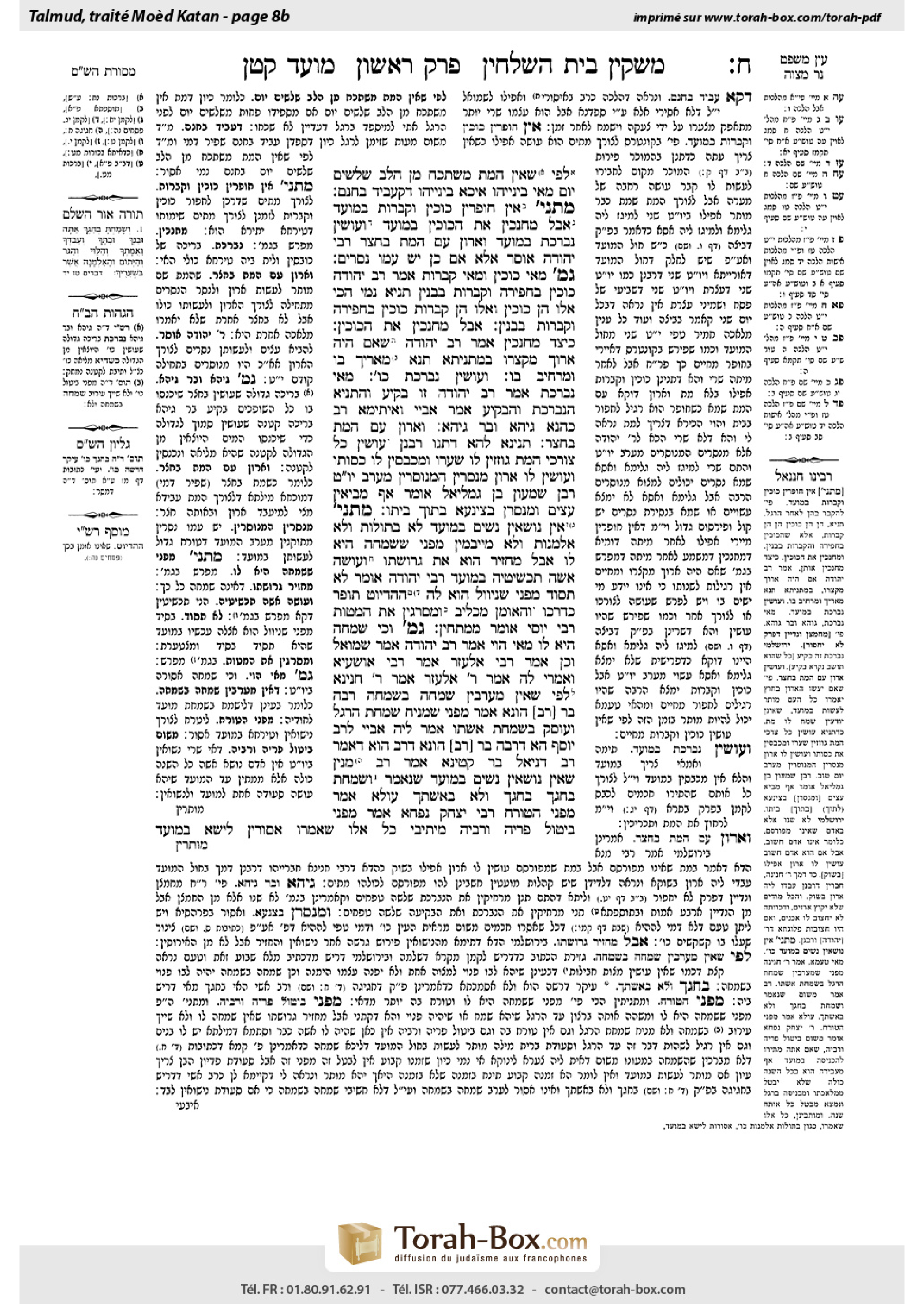
Moed Katan 8b: Talmud study for Daf Yomi
Daf Yomi is the daily study of one Talmud folio. Explore 37 tractates with scans, Hebrew text, Sefaria English and AI-generated French translations where annotated.
Passage selection and English or AI-generated French translation are available where the scan has annotations. Daf Study is independent of Torah-Box and Sefaria.
Browse Moed Katan · מועד קטן · All tractatesMoed Katan 8b text and translations
This page of Moed Katan includes the Aramaic text, an English translation and an AI-generated French translation, alongside the scan above.
מועד קטן ח׳ ב · Aramaic and Hebrew text
לְפִי שֶׁאֵין הַמֵּת מִשְׁתַּכֵּחַ מִן הַלֵּב שְׁלֹשִׁים יוֹם. מַאי בֵּינַיְיהוּ? אִיכָּא בֵּינַיְיהוּ דְּקָעָבֵיד בְּחִנָּם.
מַתְנִי׳ אֵין חוֹפְרִין כּוּכִין וּקְבָרוֹת בַּמּוֹעֵד, אֲבָל מְחַנְּכִין אֶת הַכּוּכִין בַּמּוֹעֵד. וְעוֹשִׂין נִבְרֶכֶת בַּמּוֹעֵד, וְאָרוֹן עִם הַמֵּת בֶּחָצֵר. רַבִּי יְהוּדָה אוֹסֵר אֶלָּא אִם כֵּן יֵשׁ עִמּוֹ נְסָרִים.
גְּמָ׳ מַאי כּוּכִין וּמַאי קְבָרוֹת? אָמַר רַב יְהוּדָה: כּוּכִין בַּחֲפִירָה, וּקְבָרוֹת בְּבִנְיָן. תַּנְיָא נָמֵי הָכִי: אֵלּוּ הֵן כּוּכִין וְאֵלּוּ הֵן קְבָרוֹת, כּוּכִין בַּחֲפִירָה, וּקְבָרוֹת בְּבִנְיָן.
אֲבָל מְחַנְּכִין אֶת הַכּוּכִין. כֵּיצַד מְחַנְּכִין? אָמַר רַב יְהוּדָה: שֶׁאִם הָיָה אָרוֹךְ — מְקַצְּרוֹ. בְּמַתְנִיתָא תָּנָא: מַאֲרִיךְ בּוֹ, וּמַרְחִיב בּוֹ.
וְעוֹשִׂין נִבְרֶכֶת כּוּ׳. מַאי נִבְרֶכֶת? אָמַר רַב יְהוּדָה: זוֹ בָּקִיעַ. וְהָתַנְיָא: הַנִּבְרֶכֶת וְהַבָּקִיעַ! אָמַר אַבָּיֵי וְאִיתֵּימָא רַב כָּהֲנָא: גִּיהָא וּבַר גִּיהָא.
וְאָרוֹן עִם הַמֵּת בֶּחָצֵר. תְּנֵינָא לְהָא דְּתָנוּ רַבָּנַן: עוֹשִׂין כׇּל צוֹרְכֵי הַמֵּת. גּוֹזְזִין לוֹ שְׂעָרוֹ, וּמְכַבְּסִין לוֹ כְּסוּתוֹ, וְעוֹשִׂין לוֹ אָרוֹן מִנְּסָרִין הַמְנוּסָּרִין מֵעֶרֶב יוֹם טוֹב. רַבָּן שִׁמְעוֹן בֶּן גַּמְלִיאֵל אוֹמֵר: אַף מְבִיאִין עֵצִים וּמְנַסְּרָן בְּצִינְעָא בְּתוֹךְ בֵּיתוֹ.
מַתְנִי׳ אֵין נוֹשְׂאִין נָשִׁים בַּמּוֹעֵד, לֹא בְּתוּלוֹת וְלֹא אַלְמָנוֹת, וְלֹא מְיַיבְּמִין — מִפְּנֵי שֶׁשִּׂמְחָה הִיא לוֹ. אֲבָל מַחְזִיר הוּא אֶת גְּרוּשָׁתוֹ.
וְעוֹשָׂה אִשָּׁה תַּכְשִׁיטֶיהָ בַּמּוֹעֵד. רַבִּי יְהוּדָה אוֹמֵר: לֹא תָּסוּד, מִפְּנֵי שֶׁנִּיוּוּל הוּא לָהּ. הַהֶדְיוֹט תּוֹפֵר כְּדַרְכּוֹ, וְהָאוּמָּן מַכְלִיב. וּמְסָרְגִין אֶת הַמִּטּוֹת, רַבִּי יוֹסֵי אוֹמֵר: מְמַתְּחִין.
גְּמָ׳ וְכִי שִׂמְחָה הִיא לוֹ, מַאי הָוֵי? אָמַר רַב יְהוּדָה אָמַר שְׁמוּאֵל, וְכֵן אָמַר רַבִּי אֶלְעָזָר אָמַר רַבִּי אוֹשַׁעְיָא, וְאָמְרִי לַהּ: אָמַר רַבִּי אֶלְעָזָר אָמַר רַבִּי חֲנִינָא: לְפִי שֶׁאֵין מְעָרְבִין שִׂמְחָה בְּשִׂמְחָה. רַבָּה בַּר [רַב] הוּנָא אָמַר: מִפְּנֵי שֶׁמַּנִּיחַ שִׂמְחַת הָרֶגֶל וְעוֹסֵק בְּשִׂמְחַת אִשְׁתּוֹ.
אֲמַר לֵיהּ אַבָּיֵי לְרַב יוֹסֵף: הָא דְּרַבָּה בַּר [רַב] הוּנָא — דְּרַב הוּא. דְּאָמַר רַב דָּנִיאֵל בַּר קַטִּינָא אָמַר רַב: מִנַּיִן שֶׁאֵין נוֹשְׂאִין נָשִׁים בַּמּוֹעֵד, שֶׁנֶּאֱמַר: ״וְשָׂמַחְתָּ בְּחַגֶּךָ״, ״בְּחַגֶּךָ״ — וְלֹא בְּאִשְׁתֶּךָ.
עוּלָּא אָמַר: מִפְּנֵי הַטּוֹרַח. רַבִּי יִצְחָק נַפָּחָא אָמַר: מִפְּנֵי בִּיטּוּל פְּרִיָּה וּרְבִיָּה.
מֵיתִיבִי: כׇּל אֵלּוּ שֶׁאָמְרוּ אֲסוּרִין לִישָּׂא בַּמּוֹעֵד —
Moed Katan 8b · English translation
It is because the dead is not forgotten from the heart and put out of mind for thirty days, and therefore, when one laments the loss of a deceased relative within thirty days before a Festival, the pain is still remembered on the Festival. The Gemara asks: What is the practical difference between the two reasons? The practical difference between them is in a case where the eulogizer performs the eulogy free of charge. In that case there is no worry that money that had been set aside for the Festival will be spent, but there is still room for concern about the lingering pain that will be felt on the Festival.
MISHNA: One may not dig crypts or graves on the intermediate days of a Festival in preparation for those who are still alive, but one may adjust previously dug crypts on the intermediate days of a Festival in order to receive a particular corpse. And one may also construct a laundry pond on the intermediate days of a Festival as it does not involve excessive effort. And one may also prepare a coffin if he is together with the corpse in the same courtyard, as in that case everyone knows that he is preparing the coffin for the deceased. Rabbi Yehuda prohibits making the coffin unless one has wooden boards with him that had already been cut before the Festival and that need only to be attached.
GEMARA: The Gemara asks: What are crypts and what are graves, and what is the difference between them? Rav Yehuda said: Crypts are constructed by digging and graves are constructed by building. The Gemara adds: That is also taught in the following baraita: These are crypts and these are graves: Crypts are constructed by digging and graves are constructed by building.
It is taught in the mishna: But one may adjust previously dug crypts on the intermediate days of a Festival. The Gemara asks: How does one adjust a crypt? Rav Yehuda said: If the crypt was longer than the corpse, he shortens it. With regard to this issue it was taught in a baraita: He lengthens the crypt and widens it to make it the right size for the particular corpse.
It was further taught in the mishna: And one may also construct a laundry pond on the intermediate days of a Festival. The Gemara asks: What is a laundry pond? Rav Yehuda said: This is a ditch dug in the ground for washing clothes. The Gemara raises a difficulty: Isn’t it taught in a baraita: A laundry pond and a laundry ditch, which indicates that they are different from one another? Abaye said, and some say that it was Rav Kahana who said: A pond and a small pond, i.e., the only difference between them is their size; a laundry pond is larger than a laundry ditch.
It was taught in the mishna: And one may also prepare a coffin on the intermediate days of a Festival if he is together with the corpse in the same courtyard. The Gemara comments: We already learned this, as the Sages taught in the following baraita: One may tend to all the needs of the deceased on the intermediate days of a Festival: One may cut the deceased’s hair for him if it was too long, and one may wash his clothing, i.e., his shrouds, for him, and one may construct a coffin for him from boards that had already been cut from the eve of the Festival. Rabban Shimon ben Gamliel says: One may even bring timber and discreetly cut it into boards in the privacy of his house.
MISHNA: One may not marry a woman on the intermediate days of a Festival, not virgins and not widows, and one may not perform levirate marriage with his sister-in-law, if his brother died childless, because it is a joyous occasion for him. However, one may remarry his divorced wife on the intermediate days of a Festival, as this is not as great a joy for him.
And a woman may engage in all her usual cosmetic treatments to enhance her physical appearance on the intermediate days of a Festival. Rabbi Yehuda says: She may not apply lime to her skin because it is temporarily a disgrace to her, as she is unattractive before the lime is peeled off and will therefore be distressed during the Festival. The mishna continues: A layman, who is not a skilled tailor, may sew in his usual manner if necessary for the Festival, whereas a craftsman may form only temporary stitches. And one may interweave the cords attached to the frames of beds upon which a mattress is placed. Rabbi Yosei says: One may only tighten the cords but not interweave them.
GEMARA: It was taught in the mishna that one may not marry a woman on the intermediate days of a Festival, because it is a source of joy for him. The Gemara asks: And if it is a source of joy for him, what of it? Isn’t there is a mitzva to rejoice on a Festival? Rav Yehuda said that Shmuel said, and, so too, Rabbi Elazar said that Rabbi Oshaya said, and some say that Rabbi Elazar said that Rabbi Ḥanina said: The reason that one may not get married on the intermediate days of a Festival is because one may not mix one joy with another joy, as each requires its own celebration. Rabba bar Rav Huna said: The reason is because he forsakes the rejoicing of the pilgrimage Festival and occupies himself with rejoicing with his wife.
Abaye said to Rav Yosef: This statement of Rabba bar Rav Huna is actually a statement of Rav, as Rav Daniel bar Ketina said that Rav said: From where is it derived that one may not marry a woman on the intermediate days of a Festival? As it is stated: “And you shall rejoice in your Festival” (Deuteronomy 16:14). This verse emphasizes that you must rejoice in your Festival and not in your wife.
Ulla said: The reason one may not marry on the intermediate days of a Festival is due to the excessive exertion that the wedding preparations demand, which is prohibited during the Festival. Rabbi Yitzḥak Nappaḥa said: The reason is due to the neglect of the mitzva to be fruitful and multiply. If it were permissible to get married during the intermediate days of a Festival, people would delay getting married until then in order to save money by avoiding the necessity of preparing separate feasts for the Festival and for the wedding. In the meantime they would neglect the mitzva of procreation.
The Gemara raises an objection from the following baraita: All those whom the Sages said are prohibited to marry on the intermediate days of a Festival
Moed Katan 8b · Traduction française (IA)
C’est parce que le mort n’est pas oublié et ne disparaît pas des pensées pendant trente jours. Par conséquent, lorsqu’on fait l’éloge d’un parent décédé dans les trente jours précédant une fête, la douleur reste présente à l’esprit pendant la fête. La Guemara demande : Quelle différence pratique y a-t-il entre ces deux raisons ? La différence se manifeste dans le cas où celui qui prononce l’éloge le fait gratuitement. Dans ce cas, on ne craint pas que l’argent mis de côté pour la fête soit dépensé, mais on peut toujours craindre que la douleur persistante se fasse sentir pendant la fête.
MICHNA : Il est interdit de creuser des caveaux ou des tombes pendant les jours intermédiaires d’une fête en prévision de personnes encore en vie, mais on peut aménager des caveaux déjà creusés pendant les jours intermédiaires d’une fête afin d’accueillir un défunt particulier. On peut également construire un bassin de lavage pendant les jours intermédiaires d’une fête, car cela ne demande pas un effort excessif. On peut aussi préparer un cercueil si l’on se trouve dans la même cour que le défunt, car dans ce cas, tout le monde sait qu’on prépare le cercueil pour lui. Rabbi Yehouda interdit de fabriquer le cercueil, sauf si l’on a avec soi des planches de bois qui avaient déjà été coupées avant la fête et qu’il ne reste qu’à assembler.
GUEMARA : La Guemara demande : Que sont les caveaux et que sont les tombes, et quelle différence y a-t-il entre eux ? Rav Yehouda dit : Les caveaux sont creusés, tandis que les tombes sont construites. La Guemara ajoute : Cela est également enseigné dans la baraïta suivante : Voici les caveaux et voici les tombes : les caveaux sont creusés, tandis que les tombes sont construites.
La Michna enseigne : Mais on peut aménager des caveaux déjà creusés pendant les jours intermédiaires d’une fête. La Guemara demande : Comment aménage-t-on un caveau ? Rav Yehouda dit : Si le caveau est plus long que le défunt, on le raccourcit. À ce propos, une baraïta enseigne : On allonge le caveau et on l’élargit pour l’adapter à la taille du défunt concerné.
La Michna enseigne également : On peut aussi construire un bassin de lavage pendant les jours intermédiaires d’une fête. La Guemara demande : Qu’est-ce qu’un bassin de lavage ? Rav Yehouda dit : C’est un fossé creusé dans le sol pour laver le linge. La Guemara soulève une difficulté : N’est-il pas enseigné dans une baraïta : « Un bassin de lavage et un fossé de lavage », ce qui indique qu’ils sont différents l’un de l’autre ? Abayé dit, et certains disent que c’est Rav Kahana qui l’a dit : Un bassin et un petit bassin, c’est-à-dire qu’ils ne diffèrent que par leur taille ; un bassin de lavage est plus grand qu’un fossé de lavage.
La Michna enseigne : On peut aussi préparer un cercueil pendant les jours intermédiaires d’une fête si l’on se trouve dans la même cour que le défunt. La Guemara fait remarquer : Nous avons déjà appris cela, car les Sages enseignent dans la baraïta suivante : On peut pourvoir à tous les besoins du défunt pendant les jours intermédiaires d’une fête : on peut lui couper les cheveux s’ils sont trop longs, on peut laver ses vêtements, c’est-à-dire ses linceuls, et on peut lui construire un cercueil avec des planches qui avaient déjà été coupées la veille de la fête. Rabban Chimon ben Gamliel dit : On peut même apporter du bois et le débiter discrètement en planches dans l’intimité de sa maison.
MICHNA : Il est interdit d’épouser une femme pendant les jours intermédiaires d’une fête, qu’il s’agisse d’une vierge ou d’une veuve, et il est interdit de contracter un mariage léviratique avec sa belle-sœur si son frère est mort sans enfant, car c’est pour lui une occasion de réjouissance. En revanche, on peut se remarier avec son ex-femme pendant les jours intermédiaires d’une fête, car cela ne constitue pas pour lui une joie aussi grande.
Une femme peut effectuer tous ses soins cosmétiques habituels pour embellir son apparence physique pendant les jours intermédiaires d’une fête. Rabbi Yehouda dit : Elle ne peut pas s’enduire de chaux, car cela la défigure temporairement : elle est laide avant que la chaux ne soit retirée et elle en sera donc contrariée pendant la fête. La Michna poursuit : Un profane, qui n’est pas un tailleur habile, peut coudre comme à son habitude si cela est nécessaire pour la fête, tandis qu’un artisan ne peut faire que des points provisoires. On peut entrelacer les cordes fixées aux cadres des lits sur lesquels on pose un matelas. Rabbi Yossé dit : On peut seulement tendre les cordes, mais pas les entrelacer.
GUEMARA : La Michna enseigne qu’il est interdit d’épouser une femme pendant les jours intermédiaires d’une fête, car cela est pour lui une source de joie. La Guemara demande : Et si cela est pour lui une source de joie, en quoi cela pose-t-il problème ? N’est-il pas une mitsva de se réjouir pendant une fête ? Rav Yehouda a dit au nom de Chmouel, et de même Rabbi Elazar a dit au nom de Rabbi Ochaya ; certains disent que Rabbi Elazar a dit au nom de Rabbi Ḥanina : La raison pour laquelle il est interdit de se marier pendant les jours intermédiaires d’une fête est qu’on ne mêle pas une joie à une autre, chacune exigeant sa propre célébration. Rabba bar Rav Houna dit : La raison est qu’il délaisse la réjouissance de la fête de pèlerinage et s’occupe de se réjouir avec sa femme.
Abayé dit à Rav Yossef : Cette déclaration de Rabba bar Rav Houna est en réalité une déclaration de Rav, car Rav Daniel bar Ketina a dit au nom de Rav : D’où apprend-on qu’il est interdit d’épouser une femme pendant les jours intermédiaires d’une fête ? Comme il est dit : « Tu te réjouiras pendant ta fête » (Deutéronome 16,14). Ce verset souligne que tu dois te réjouir pendant ta fête, et non avec ta femme.
Oulla dit : La raison pour laquelle il est interdit de se marier pendant les jours intermédiaires d’une fête tient à l’effort excessif qu’exigent les préparatifs du mariage, effort interdit pendant la fête. Rabbi Yitzḥak Nappaḥa dit : La raison tient à la négligence de la mitsva de procréer. S’il était permis de se marier pendant les jours intermédiaires d’une fête, les gens retarderaient leur mariage jusque-là afin d’économiser de l’argent en évitant d’avoir à préparer des festins distincts pour la fête et pour le mariage. Entre-temps, ils négligeraient la mitsva de procréer.
La Guemara soulève une objection à partir de la baraïta suivante : Tous ceux au sujet desquels les Sages ont dit qu’il est interdit de se marier pendant les jours intermédiaires d’une fête
Traduction française générée par IA à partir de l’édition anglaise de Sefaria. Vérifie toujours un passage avec le texte source.
Text from Sefaria: William Davidson Edition - Vocalized Aramaic (CC BY NC); William Davidson Edition - English (CC BY NC).