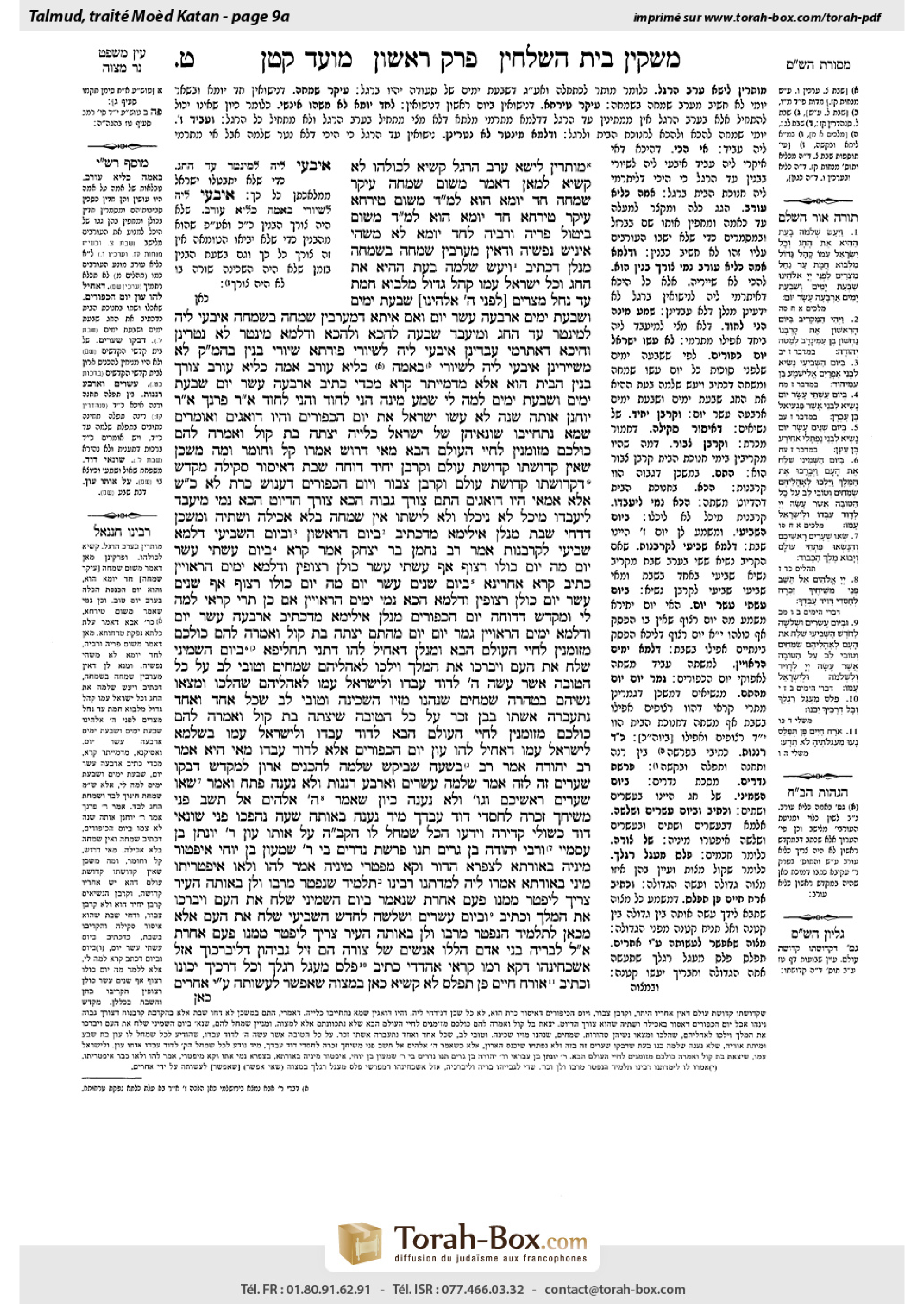
Moed Katan 9a: Talmud study for Daf Yomi
Daf Yomi is the daily study of one Talmud folio. Explore 37 tractates with scans, Hebrew text, Sefaria English and AI-generated French translations where annotated.
Passage selection and English or AI-generated French translation are available where the scan has annotations. Daf Study is independent of Torah-Box and Sefaria.
Browse Moed Katan · מועד קטן · All tractatesMoed Katan 9a text and translations
This page of Moed Katan includes the Aramaic text, an English translation and an AI-generated French translation, alongside the scan above.
מועד קטן ט׳ א · Aramaic and Hebrew text
מוּתָּרִין לִישָּׂא עֶרֶב הָרֶגֶל, קַשְׁיָא לְכוּלְּהוּ.
לָא קַשְׁיָא לְמַאן דְּאָמַר מִשּׁוּם שִׂמְחָה — עִיקַּר שִׂמְחָה חַד יוֹמָא הוּא.
לְמַאן דְּאָמַר מִשּׁוּם טִירְחָא — עִיקַּר טִירְחָא חַד יוֹמָא הוּא. לְמַאן דְּאָמַר מִשּׁוּם בִּיטּוּל פְּרִיָּה וּרְבִיָּה, לְחַד יוֹמָא לָא מַשְׁהֵי אִינִישׁ נַפְשֵׁיהּ.
וּדְאֵין מְעָרְבִין שִׂמְחָה בְּשִׂמְחָה מְנָלַן? דִּכְתִיב: ״וַיַּעַשׂ שְׁלֹמֹה בָעֵת הַהִיא אֶת הֶחָג וְכׇל יִשְׂרָאֵל עִמּוֹ קָהָל גָּדוֹל מִלְּבוֹא חֲמָת עַד נַחַל מִצְרַיִם [לִפְנֵי ה׳ אֱלֹהֵינוּ] שִׁבְעַת יָמִים וְשִׁבְעַת יָמִים אַרְבָּעָה עָשָׂר יוֹם״. וְאִם אִיתָא דִּמְעָרְבִין שִׂמְחָה בְּשִׂמְחָה — אִיבְּעִי לֵיהּ לְמִינְטַר עַד הֶחָג, וּמִיעְבַּד שִׁבְעָה לְהָכָא וּלְהָכָא.
וְדִלְמָא מִינְטָר לָא נָטְרִינַן, וְהֵיכָא דְּאִתְרְמִי — עָבְדִינַן! אִיבְּעִי לֵיהּ לְשַׁיּוֹרֵי פּוּרְתָּא.
שַׁיּוֹרֵי בִּנְיַן בֵּית הַמִּקְדָּשׁ לָא מְשַׁיְּירִינַן. אִיבְּעִי לֵיהּ לְשַׁיּוֹרֵי בְּאַמָּה כָּלְיָא עוֹרֵב.
אַמָּה כָּלְיָא עוֹרֵב צוֹרֶךְ בִּנְיַן הַבַּיִת הוּא. אֶלָּא מִדִּמְיַיתַּר קְרָא, מִכְּדֵי כְּתִיב ״אַרְבְּעָה עָשָׂר יוֹם״, ״שִׁבְעַת יָמִים וְשִׁבְעַת יָמִים״ לְמָה לִי? שְׁמַע מִינַּהּ הָנֵי לְחוֹד וְהָנֵי לְחוֹד.
אָמַר רַבִּי פַּרְנָךְ אָמַר רַבִּי יוֹחָנָן: אוֹתָהּ שָׁנָה לֹא עָשׂוּ יִשְׂרָאֵל אֶת יוֹם הַכִּפּוּרִים. וְהָיוּ דּוֹאֲגִים וְאוֹמְרִים: שֶׁמָּא נִתְחַיְּיבוּ שׂוֹנְאֵיהֶן שֶׁל יִשְׂרָאֵל כְּלָיָיה, יָצְתָה בַּת קוֹל וְאָמְרָה לָהֶם: כּוּלְּכֶם מְזוּמָּנִין לְחַיֵּי הָעוֹלָם הַבָּא.
מַאי דְּרוּשׁ? אָמְרוּ, קַל וָחוֹמֶר: וּמָה מִשְׁכָּן, שֶׁאֵין קְדוּשָּׁתוֹ קְדוּשַּׁת עוֹלָם — וְקׇרְבַּן יָחִיד דּוֹחֶה שַׁבָּת דְּאִיסּוּר סְקִילָה, מִקְדָּשׁ, דִּקְדוּשָּׁתוֹ קְדוּשַּׁת עוֹלָם, וְקׇרְבַּן צִבּוּר, וְיוֹם הַכִּפּוּרִים דְּעָנוּשׁ כָּרֵת — לֹא כׇּל שֶׁכֵּן?!
אֶלָּא, אַמַּאי הָיוּ דּוֹאֲגִים? הָתָם צוֹרֶךְ גָּבוֹהַּ, הָכָא צוֹרֶךְ הֶדְיוֹט. הָכָא נָמֵי: מֶיעְבָּד לִיעְבְּדוּ, מֵיכָל לָא נֵיכְלוּ וְלָא לִישְׁתּוֹ! אֵין שִׂמְחָה בְּלֹא אֲכִילָה וּשְׁתִיָּה.
וּמִשְׁכָּן דְּדָחֵי שַׁבָּת מְנָלַן? אִילֵּימָא מִדִּכְתִיב: ״בַּיּוֹם הָרִאשׁוֹן, וּבַיּוֹם הַשְּׁבִיעִי״, דִּלְמָא שְׁבִיעִי לְקׇרְבָּנוֹת! אָמַר רַב נַחְמָן בַּר יִצְחָק, אָמַר קְרָא: ״בְּיוֹם עַשְׁתֵּי עָשָׂר יוֹם״. מָה יוֹם כּוּלּוֹ רָצוּף, אַף עַשְׁתֵּי עָשָׂר כּוּלָּן רְצוּפִין.
וְדִלְמָא יָמִים הָרְאוּיִין? כְּתִיב קְרָא אַחֲרִינָא: ״בְּיוֹם שְׁנֵים עָשָׂר יוֹם״. מָה יוֹם כּוּלּוֹ רָצוּף, אַף שְׁנֵים עָשָׂר יוֹם כּוּלָּן רְצוּפִין.
וְדִלְמָא הָכָא נָמֵי יָמִים הָרְאוּיִין! אִם כֵּן, תְּרֵי קְרָאֵי לְמָה לִי?
וּמִקְדָּשׁ דְּדוֹחֶה יוֹם הַכִּפּוּרִים, מְנָלַן? אִילֵּימָא מִדִּכְתִיב: ״אַרְבָּעָה עָשָׂר יוֹם״, וְדִלְמָא יָמִים הָרְאוּיִין! גָּמַר ״יוֹם״ ״יוֹם״ מֵהָתָם.
יָצְתָה בַּת קוֹל וְאָמְרָה לָהֶם: כּוּלְּכֶם מְזוּמָּנִין לְחַיֵּי הָעוֹלָם הַבָּא. וּמְנָלַן דְּאַחֵיל לְהוּ? דְּתָנֵי תַּחְלִיפָא: ״בַּיּוֹם הַשְּׁמִינִי שִׁלַּח אֶת הָעָם וַיְבָרְכוּ אֶת הַמֶּלֶךְ וַיֵּלְכוּ לְאׇהֳלֵיהֶם שְׂמֵחִים וְטוֹבֵי לֵב עַל כׇּל הַטּוֹבָה אֲשֶׁר עָשָׂה ה׳ לְדָוִד עַבְדּוֹ וּלְיִשְׂרָאֵל עַמּוֹ״.
״לְאׇהֳלֵיהֶם״ — שֶׁהָלְכוּ וּמָצְאוּ נָשֵׁיהֶם בְּטָהֳרָה, ״שְׂמֵחִים״ — שֶׁנֶּהֱנוּ מִזִּיו הַשְּׁכִינָה, ״וְטוֹבֵי לֵב״ — שֶׁכׇּל אֶחָד וְאֶחָד נִתְעַבְּרָה אִשְׁתּוֹ בְּבֵן זָכָר, ״עַל כׇּל הַטּוֹבָה״ — שֶׁיָּצְתָה בַּת קוֹל וְאָמְרָה לָהֶם: כּוּלְּכֶם מְזוּמָּנִין לְחַיֵּי הָעוֹלָם הַבָּא.
״לְדָוִד עַבְדּוֹ וּלְיִשְׂרָאֵל עַמּוֹ״. בִּשְׁלָמָא ״לְיִשְׂרָאֵל עַמּוֹ״ — דְּאַחֵיל לְהוּ עֲוֹן יוֹם הַכִּפּוּרִים, אֶלָּא ״לְדָוִד עַבְדּוֹ״ מַאי הִיא?
אָמַר רַב יְהוּדָה אָמַר רַב: בְּשָׁעָה שֶׁבִּיקֵּשׁ שְׁלֹמֹה לְהַכְנִיס אָרוֹן לַמִּקְדָּשׁ דָּבְקוּ שְׁעָרִים זֶה לָזֶה. אָמַר שְׁלֹמֹה עֶשְׂרִים וְאַרְבַּע רְנָנוֹת וְלֹא נַעֲנָה, פָּתַח וְאָמַר ״שְׂאוּ שְׁעָרִים רָאשֵׁיכֶם וְגוֹ׳״ וְלֹא נַעֲנָה,
כֵּיוָן שֶׁאָמַר ״ה׳ אֱלֹהִים אַל תָּשֵׁב פְּנֵי מְשִׁיחֶךָ זׇכְרָה לְחַסְדֵי דָּוִד עַבְדֶּךָ״ — מִיָּד נַעֲנָה. בְּאוֹתָהּ שָׁעָה נֶהְפְּכוּ פְּנֵי שׂוֹנְאֵי דָוִד כְּשׁוּלֵי קְדֵירָה, וְיָדְעוּ הַכֹּל שֶׁמָּחַל לוֹ הַקָּדוֹשׁ בָּרוּךְ הוּא עַל אוֹתוֹ עָוֹן.
רַבִּי יוֹנָתָן בֶּן עַסְמַיי וְרַבִּי יְהוּדָה בֶּן גֵּרִים תָּנוּ פָּרָשַׁת נְדָרִים בֵּי רַבִּי שִׁמְעוֹן בֶּן יוֹחַי, אִיפְּטוּר מִינֵּיהּ בְּאוּרְתָּא. לְצַפְרָא הֲדוּר וְקָא מִפַּטְרִי מִינֵּיהּ. אֲמַר לְהוּ: וְלָאו אִיפַּטְרִיתוּ מִינַּי בְּאוּרְתָּא?
אֲמַרוּ לֵיהּ: לִמַּדְתָּנוּ רַבֵּינוּ תַּלְמִיד שֶׁנִּפְטָר מֵרַבּוֹ וְלָן בְּאוֹתָהּ הָעִיר, צָרִיךְ לִיפָּטֵר מִמֶּנּוּ פַּעַם אַחֶרֶת, שֶׁנֶּאֱמַר: ״בַּיּוֹם הַשְּׁמִינִי שִׁלַּח אֶת הָעָם וַיְבָרֲכוּ אֶת הַמֶּלֶךְ״, וּכְתִיב: ״וּבְיוֹם עֶשְׂרִים וּשְׁלֹשָׁה לַחֹדֶשׁ הַשְּׁבִיעִי שִׁלַּח אֶת הָעָם״!
אֶלָּא, מִכָּאן לְתַלְמִיד הַנִּפְטָר מֵרַבּוֹ וְלָן בְּאוֹתָהּ הָעִיר, צָרִיךְ לִיפָּטֵר מִמֶּנּוּ פַּעַם אַחֶרֶת.
אֲמַר לֵיהּ לִבְרֵיהּ: בְּנֵי אָדָם הַלָּלוּ אֲנָשִׁים שֶׁל צוּרָה הֵם, זִיל גַּבֵּיהוֹן דְּלִיבָרְכוּךְ. אֲזַל, אַשְׁכְּחִינְהוּ דְּקָא רָמוּ קְרָאֵי אַהֲדָדֵי. כְּתִיב: ״פַּלֵּס מַעְגַּל רַגְלֶךָ וְכׇל דְּרָכֶיךָ יִכּוֹנוּ״, וּכְתִיב: ״אוֹרַח חַיִּים פֶּן תְּפַלֵּס״.
לָא קַשְׁיָא: כָּאן בְּמִצְוָה שֶׁאֶפְשָׁר לַעֲשׂוֹתָהּ עַל יְדֵי אֲחֵרִים,
Moed Katan 9a · English translation
are permitted to marry on the eve of the pilgrimage Festival. This poses a difficulty to all of the opinions, as a wedding celebration ordinarily extends for seven days, and the majority of the celebration will coincide with the Festival.
The Gemara answers: This is not difficult, as this baraita can be reconciled with all of the opinions. According to the one who said that one may not get married on the intermediate days of a Festival because of joy, i.e., because one must not mix one joy with another, or because one may not put aside the rejoicing of the Festival and occupy himself with rejoicing with his wife, this is not difficult, as the primary joy of a wedding is only one day, and after that, the joy of the wedding will not affect the joy of the Festival.
And according to the one who said that one may not marry on the intermediate days of a Festival due to the excessive exertion that the wedding preparations demand, it is not difficult, as the primary exertion is only one day. After the wedding, excessive exertion is not required. And according to the one who said that the reason is due to the neglect of the mitzva to be fruitful and multiply, there is no room for concern: Since there is only one day, the eve of the Festival, when he can get married and save money on the feast, a man will not delay his wedding in order to get married then, lest some unforeseen circumstance arise that will prevent him from getting married on that day. Therefore, according to all the reasons offered, there is no need to prohibit weddings on the eve of a Festival.
§ The Gemara asks: With regard to the principle that one may not mix one joy with another joy, from where do we derive it? The Gemara explains that the source is as it is written with regard to the dedication of the Temple: “So Solomon held the feast at that time, and all Israel with him, a great congregation, from the entrance of Hamath to the Brook of Egypt, before the Lord our God, seven days and seven days, fourteen days” (I Kings 8:65). And if it is so that one may in fact mix one joy with another joy, he should have waited until the festival of Sukkot, which was the second set of seven days, and made a feast of seven days for this and for that, i.e., for the dedication of the Temple and for the festival of Sukkot together. The fact that he did not do so indicates that one must not mix one joy with another.
The Gemara raises a question: Perhaps, however, it may be derived from here only that we may not delay a wedding to be on a Festival, just as King Solomon did not delay the Temple dedication to be on the Festival, but nevertheless, where it happens to occur that way, we may indeed prepare a feast to celebrate both occasions together. The Gemara answers: If this were permitted, Solomon should have left a small part of the Temple unfinished until the Festival, and thereby arranged for a joint celebration of the dedication of the Temple and the festival of Sukkot.
The Gemara responds: One may not leave any part of the building of the Temple undone, as a mitzva should be completed as quickly as possible. The Gemara modifies its previous opinion: Solomon should have left the cubit-wide plates with spikes, which were designed to eliminate the ravens, unfinished. The roof of the Temple was fitted with sharp metal spikes to deter the ravens, who were attracted by the smell of the sacrificial meat, from perching there. Although this was not considered a part of the building itself, delaying its installation would have allowed Solomon to delay the celebration of the Temple dedication.
The Gemara rejects this opinion as well: The cubit-wide plates with spikes to eliminate the ravens was a necessary element in the building of the Temple, and consequently Solomon could not delay its construction either. Rather, the proof is from the redundancy in the verse. Since it is written “fourteen days,” why do I need the verse to specify “seven days and seven days”? Learn from it that these seven days of celebrating the Temple dedication must be discrete, and similarly, these seven days of celebrating the Festival must be discrete, due to the principle that one may not mix one joy with another.
§ Apropos the discussion of the celebration at Solomon’s dedication of the Temple, the Gemara relates that Rabbi Parnakh said that Rabbi Yoḥanan said: That year, the Jewish people did not observe Yom Kippur, as the seven-day celebration of the dedication of the Temple coincided with Yom Kippur and all seven days were celebrated with feasting. And the people were worried and said: Perhaps the enemies of the Jewish people, a euphemism for the Jewish people themselves, have become liable to be destroyed for the transgression of eating on Yom Kippur, which is punishable by karet. A Divine Voice issued forth and said to them: All of you are designated for life in the World-to-Come.
The Gemara asks: What derivation led them to conclude that it was permitted for them to eat on Yom Kippur? The Gemara explains that they based their ruling on an a fortiori inference: If at the dedication of the Tabernacle, whose sanctity is not a permanent sanctity, an individual’s offering, i.e., an offering of one of the tribal princes, overrides the prohibition of Shabbat, as the princes’ offerings were brought every day including Shabbat despite the attendant transgression of a prohibition that is punishable by stoning; then with regard to the dedication of the Temple, whose sanctity is a permanent sanctity and the offerings brought there were communal offerings, is it not all the more so clear that the dedication of the Temple overrides the prohibition of Yom Kippur, a violation that is punishable by the less severe punishment of karet?
The Gemara asks: But if they had firm basis for their behavior, why were they worried? The Gemara answers that one can refute this a fortiori inference as follows: There, at the dedication of the Tabernacle, Shabbat was desecrated only for the necessities of the Temple service to God on High, i.e., by sacrificing offerings. Here, at the dedication of the Temple, they desecrated Yom Kippur by eating and drinking, which was for the need of common mortals. Based on this distinction the Gemara suggests: Here too, at the dedication of the Temple they should have performed the rites of the sacrificial offerings and they should not have eaten or drunk. The Gemara answers: There is no complete rejoicing without eating and drinking.
With regard to the proof itself, the Gemara asks: And from where do we derive that the offerings brought at the dedication of the Tabernacle overrode Shabbat? If we say it is as it is written with regard to the offerings brought by the tribal princes: “On the first day” (Numbers 7:12) and “on the seventh day” (Numbers 7:48), this is not a conclusive proof, as perhaps this refers not to the seventh day of the week but to the seventh day of sacrificial offerings. Perhaps they skipped Shabbat and did not sacrifice offerings connected to the dedication of the Tabernacle on that day. Rav Naḥman bar Yitzḥak said: The verse also states: “On the day of the eleventh day” (Numbers 7:72). The repetition of the word day indicates that just as a day is all one continuous period of time, so too, the eleven days were all one continuous period of time, with no break in the middle, even for Shabbat.
The Gemara asks: But perhaps this refers only to days that are fit for an individual’s offerings, i.e., the offerings were sacrificed on eleven consecutive days that were suitable for sacrificing the offerings of an individual, but not on Shabbat. The Gemara answers: In another verse it is written: “On the day of the twelfth day” (Numbers 7:78), indicating that just as a day is all one continuous period of time, so too, the twelve days were all one continuous period of time.
The Gemara asks again: But perhaps here too this is referring to days that are fit for sacrificing the offerings of an individual? The Gemara rejects this opinion: If so, why do I need two verses, the verse with regard to the eleventh day and the verse with regard to the twelfth day, to teach the same principle? The fact that the Torah uses repetitive phraseology in both verses indicates that all the days were consecutive, without a break for Shabbat.
The Gemara asks: And from where do we derive that the feasting at the time of the dedication of the Temple overrides Yom Kippur, so that the people did not have to fast? If we say it is derived from that which is written: Fourteen days, perhaps this is referring to days that are fit for feasting, to the exclusion of Yom Kippur. The Gemara answers: This is derived by means of a verbal analogy between the word “day” mentioned in this context and the word “day” mentioned there, with regard to the dedication of the Tabernacle. Just as there the days were consecutive, without a break for Shabbat, so too here, the days were consecutive, without a break for Yom Kippur.
It was stated above that a Divine Voice issued forth and said to them: All of you are designated for life in the World-to-Come. The Gemara asks: And from where do we derive that God pardoned them for this sin? The Gemara answers: The Sage Taḥlifa taught in a baraita that the verse states: “On the eighth day he sent the people away, and they blessed the king, and went to their tents joyful and glad of heart for all the goodness that the Lord had done for David His servant and for Israel His people” (I Kings 8:66).
This verse may be expounded as follows: The words “to their tents” indicate that they went and found their wives in a state of purity, as the terms tent and house often denote one’s wife. The term “joyful” is referring to the fact they had enjoyed the splendor of the Divine Presence, as there was a revelation of the Divine Presence when the offerings were sacrificed in the Temple. The phrase “and glad of heart” refers to the fact that each of their wives conceived a male child. The words “for all the goodness” indicate that a Divine Voice issued forth and said to them: All of you are designated for life in the World-to-Come, which is the ultimate good.
The aforementioned verse stated: “For all the goodness that the Lord had done for David His servant and for Israel His people.” The Gemara asks: Granted, when the verse mentions the goodness that God did for Israel His people, this is referring to the fact that He pardoned them the sin of eating on Yom Kippur that year; but what is the goodness that God performed for David His servant?
Rav Yehuda said that Rav said: When Solomon sought to bring the Ark into the Temple the gates clung together and could not be opened. Solomon uttered twenty-four songs of praise, and his prayer was not answered. He began and said: “Lift up your heads, O you gates, and be lifted up, you everlasting doors; and the King of glory shall come in” (Psalms 24:7), but once again his prayer was not answered, and the Temple gates remained closed.
Once he said: “Now therefore arise, O Lord God, into your resting place, You, and the Ark of Your strength; Let your priests, O Lord God, be clothed with victory and let Your pious ones rejoice in goodness. O Lord God, do not turn away the face of Your anointed; remember the faithful love of David Your servant” (II Chronicles 6:41–42), he was immediately answered. At that moment the faces of David’s enemies turned dark like the charred bottom of a pot, and all knew that the Holy One, Blessed be He, forgave him for that sin involving Bathsheba, as they saw that it was only in his merit that the gates of the Temple opened.
The Gemara relates that Rabbi Yonatan ben Asmai and Rabbi Yehuda, son of converts, studied the portion dealing with oaths in the study hall of Rabbi Shimon ben Yoḥai. After completing their studies, the disciples took leave of their master in the evening, but did not yet leave the city. In the morning they went back and took leave of him a second time. He said to them: Did you not already take leave of me yesterday in the evening?
They said to him: You have taught us, our teacher, that a disciple who takes leave of his teacher and then stays overnight in the same city must take leave of him an additional time, as it is stated at the conclusion of the dedication of the Temple: “On the eighth day he sent the people away, and they blessed the king” (I Kings 8:66), and elsewhere it is written: “And on the twenty-third day of the seventh month he sent the people away” (II Chronicles 7:10). The eighth day in the verse is referring to the Eighth Day of Assembly, the twenty-second of the month of Tishrei, yet it says that he sent the people away on the next day, the twenty-third of the month.
Rather, it can be derived from here that a disciple who takes leave of his teacher and then stays overnight in the same city must take leave of him an additional time, just as the Jewish people took leave of Solomon an additional time on the day after the Festival, on the twenty-third of Tishrei.
Rabbi Shimon ben Yoḥai said to his son: These two people, Rabbi Yonatan ben Asmai and Rabbi Yehuda, son of converts, are men of noble form [tzura] i.e., wise and learned individuals; go to them so that they will bless you. He went and found them deep in discussion, raising apparent contradictions between verses as follows: It is written: “Make level the path of your feet, and let all your ways be established” (Proverbs 4:26), indicating that when one has the opportunity to perform more than one mitzva, he must evaluate which of them is most important. And elsewhere it is written: “Lest you level out the path of life,” (Proverbs 5:6), indicating that one must perform each mitzva as the opportunity arises, without considering its relative importance.
They explained that it is not difficult: Here, in the first verse cited above, it is discussing a mitzva that can be done by others, and therefore one must consider what is most worthwhile for him to perform himself and what he will leave to others.
Moed Katan 9a · Traduction française (IA)
peuvent se marier la veille de la fête de pèlerinage. Cela pose une difficulté à toutes les opinions, car les festivités du mariage durent habituellement sept jours, et la majeure partie de ces festivités coïnciderait avec la fête.
La Guemara répond : Cela ne pose pas de difficulté, car cette baraïta peut être conciliée avec toutes les opinions. Selon celui qui affirme qu’on ne peut pas se marier pendant les jours intermédiaires d’une fête en raison de la joie — c’est-à-dire parce qu’il ne faut pas mêler une joie à une autre, ou parce qu’on ne doit pas délaisser les réjouissances de la fête pour se consacrer à celles de son épouse —, cela ne pose pas de difficulté : la joie principale du mariage ne dure qu’un jour, et ensuite, la joie du mariage n’affecte plus celle de la fête.
Et selon celui qui affirme qu’on ne peut pas se marier pendant les jours intermédiaires d’une fête en raison des efforts excessifs qu’exige la préparation du mariage, cela ne pose pas de difficulté, car l’essentiel de ces efforts ne dure qu’un jour. Après le mariage, aucun effort excessif n’est nécessaire. Et selon celui qui affirme que la raison est la négligence de la mitsva de procréer, il n’y a pas lieu de s’inquiéter : puisqu’il n’y a qu’un seul jour, la veille de la fête, où l’homme peut se marier et économiser sur le festin, il ne retardera pas son mariage dans le but de se marier ce jour-là, de peur qu’un imprévu ne l’empêche de se marier à cette date. Par conséquent, quelle que soit la raison invoquée, il n’est pas nécessaire d’interdire les mariages la veille d’une fête.
§ La Guemara demande : D’où déduisons-nous le principe selon lequel on ne peut pas mêler une joie à une autre ? La Guemara explique que la source se trouve dans ce qui est écrit au sujet de l’inauguration du Temple : « Salomon tint alors la fête, et tout Israël avec lui, une grande assemblée, depuis l’entrée de Hamat jusqu’au torrent d’Égypte, devant le Seigneur notre Dieu, sept jours et sept jours, quatorze jours » (I Rois 8:65). Or, s’il était permis de mêler une joie à une autre, il aurait dû attendre la fête de Soukkot, qui correspondait à la seconde période de sept jours, et donner un festin de sept jours pour les deux occasions, c’est-à-dire à la fois pour l’inauguration du Temple et pour la fête de Soukkot. Le fait qu’il ne l’ait pas fait indique qu’on ne doit pas mêler une joie à une autre.
La Guemara soulève une question : Peut-être peut-on seulement déduire de là qu’il ne faut pas retarder un mariage afin qu’il ait lieu pendant une fête, de même que le roi Salomon n’a pas retardé l’inauguration du Temple pour qu’elle ait lieu pendant la fête ; néanmoins, si les deux occasions coïncident, peut-on bel et bien préparer un festin pour les célébrer ensemble ? La Guemara répond : Si cela était permis, Salomon aurait dû laisser une petite partie du Temple inachevée jusqu’à la fête, et organiser ainsi une célébration commune de l’inauguration du Temple et de la fête de Soukkot.
La Guemara répond : On ne doit laisser inachevée aucune partie de la construction du Temple, car une mitsva doit être accomplie aussi rapidement que possible. La Guemara modifie alors la proposition précédente : Salomon aurait dû laisser inachevées les plaques d’une coudée munies de pointes, destinées à éloigner les corbeaux. Le toit du Temple était équipé de pointes métalliques acérées afin d’empêcher les corbeaux, attirés par l’odeur de la viande sacrificielle, de s’y poser. Bien que ces pointes ne fussent pas considérées comme une partie de l’édifice lui-même, en retarder la pose aurait permis à Salomon de différer la célébration de l’inauguration du Temple.
La Guemara rejette également cette proposition : les plaques d’une coudée munies de pointes destinées à éloigner les corbeaux étaient un élément nécessaire de la construction du Temple, et Salomon ne pouvait donc pas non plus en retarder la pose. La preuve vient plutôt de la répétition dans le verset. Puisqu’il est écrit « quatorze jours », pourquoi le verset doit-il préciser « sept jours et sept jours » ? Il faut en déduire que ces sept jours de célébration de l’inauguration du Temple devaient être distincts et que, de même, ces sept jours de célébration de la fête devaient être distincts, conformément au principe selon lequel on ne peut pas mêler une joie à une autre.
§ À propos de la célébration de l’inauguration du Temple par Salomon, la Guemara rapporte que Rabbi Parnakh a dit au nom de Rabbi Yoḥanan : cette année-là, le peuple juif n’observa pas Yom Kippour, car les sept jours de célébration de l’inauguration du Temple coïncidèrent avec Yom Kippour et furent tous marqués par des festins. Le peuple s’inquiéta et se dit : Peut-être les ennemis du peuple juif — expression euphémistique désignant le peuple juif lui-même — sont-ils passibles d’être exterminés pour avoir transgressé l’interdiction de manger à Yom Kippour, faute passible de karet. Une Voix céleste se fit entendre et leur dit : Vous êtes tous destinés à la vie dans le Monde à venir.
La Guemara demande : Quelle déduction les conduisit à conclure qu’il leur était permis de manger à Yom Kippour ? La Guemara explique qu’ils fondèrent leur décision sur un raisonnement a fortiori : si, lors de l’inauguration du Tabernacle, dont la sainteté n’est pas permanente, le sacrifice d’un particulier — c’est-à-dire l’offrande de l’un des princes des tribus — l’emporte sur l’interdiction du Chabbat, puisque les offrandes des princes furent apportées chaque jour, y compris le Chabbat, malgré la transgression d’une interdiction passible de lapidation, alors, à plus forte raison, l’inauguration du Temple, dont la sainteté est permanente et où les sacrifices apportés étaient des sacrifices communautaires, l’emporte-t-elle sur l’interdiction de Yom Kippour, dont la transgression est passible d’une peine moins sévère, le karet ?
La Guemara demande : Mais s’ils avaient de solides fondements pour agir ainsi, pourquoi s’inquiétèrent-ils ? La Guemara répond que l’on peut réfuter ce raisonnement a fortiori de la façon suivante : là-bas, lors de l’inauguration du Tabernacle, le Chabbat ne fut profané que pour les besoins du service rendu à Dieu dans le Temple, c’est-à-dire par l’offrande des sacrifices. Ici, lors de l’inauguration du Temple, ils profanèrent Yom Kippour en mangeant et en buvant, ce qui répondait aux besoins de simples mortels. Sur la base de cette distinction, la Guemara propose : ici aussi, lors de l’inauguration du Temple, ils auraient dû accomplir les rites sacrificiels sans manger ni boire. La Guemara répond : il n’y a pas de joie complète sans manger ni boire.
Au sujet de la preuve elle-même, la Guemara demande : Et d’où déduisons-nous que les sacrifices apportés lors de l’inauguration du Tabernacle l’emportèrent sur le Chabbat ? Si l’on dit que cela ressort de ce qui est écrit au sujet des sacrifices apportés par les princes des tribus : « Le premier jour » (Nombres 7:12) et « le septième jour » (Nombres 7:48), ce n’est pas une preuve concluante, car peut-être ne s’agit-il pas du septième jour de la semaine, mais du septième jour des sacrifices. Peut-être sautèrent-ils le Chabbat et n’apportèrent-ils pas ce jour-là les sacrifices liés à l’inauguration du Tabernacle. Rav Naḥman bar Yitzḥak dit : le verset précise aussi : « Le jour du onzième jour » (Nombres 7:72). La répétition du mot « jour » indique que, de même qu’un jour forme une période continue, les onze jours formèrent eux aussi une période continue, sans interruption, même pour le Chabbat.
La Guemara demande : Mais peut-être s’agit-il uniquement des jours où les sacrifices d’un particulier peuvent être offerts, c’est-à-dire que les sacrifices furent apportés pendant onze jours consécutifs où l’on pouvait offrir les sacrifices d’un particulier, mais pas le Chabbat. La Guemara répond : Un autre verset dit : « Le jour du douzième jour » (Nombres 7:78), indiquant que, de même qu’un jour forme une période continue, les douze jours formèrent eux aussi une période continue.
La Guemara demande encore : Mais peut-être s’agit-il ici aussi de jours où l’on pouvait offrir les sacrifices d’un particulier ? La Guemara rejette cette proposition : dans ce cas, pourquoi aurait-on besoin de deux versets, l’un concernant le onzième jour et l’autre concernant le douzième jour, pour enseigner le même principe ? Le fait que la Torah emploie une formulation répétitive dans les deux versets indique que tous les jours se succédèrent sans interruption pour le Chabbat.
La Guemara demande : Et d’où déduisons-nous que les festins organisés lors de l’inauguration du Temple l’emportèrent sur Yom Kippour, de sorte que le peuple n’eut pas à jeûner ? Si l’on dit que cela se déduit de la mention de « quatorze jours », peut-être s’agit-il de jours propices aux festins, à l’exclusion de Yom Kippour. La Guemara répond : cela se déduit par analogie verbale entre le mot « jour » mentionné dans ce contexte et le mot « jour » mentionné là-bas, au sujet de l’inauguration du Tabernacle. De même que là-bas les jours se succédèrent sans interruption pour le Chabbat, de même ici, ils se succédèrent sans interruption pour Yom Kippour.
Il a été dit plus haut qu’une Voix céleste se fit entendre et leur dit : Vous êtes tous destinés à la vie dans le Monde à venir. La Guemara demande : Et d’où déduisons-nous que Dieu leur pardonna cette faute ? La Guemara répond : Le sage Taḥlifa enseigna dans une baraïta que le verset dit : « Le huitième jour, il renvoya le peuple, et ils bénirent le roi et regagnèrent leurs tentes, joyeux et le cœur content de tout le bien que le Seigneur avait fait à David, son serviteur, et à Israël, son peuple » (I Rois 8:66).
On peut interpréter ce verset comme suit : les mots « regagnèrent leurs tentes » indiquent qu’ils rentrèrent et trouvèrent leurs épouses en état de pureté, car les termes « tente » et « maison » désignent souvent l’épouse. Le terme « joyeux » fait référence au fait qu’ils avaient joui de l’éclat de la Présence divine, car celle-ci se manifesta lorsque les sacrifices furent offerts dans le Temple. L’expression « le cœur content » fait référence au fait que chacune de leurs épouses conçut un garçon. Les mots « de tout le bien » indiquent qu’une Voix céleste se fit entendre et leur dit : Vous êtes tous destinés à la vie dans le Monde à venir, qui est le bien suprême.
Le verset cité plus haut disait : « De tout le bien que le Seigneur avait fait à David, son serviteur, et à Israël, son peuple. » La Guemara demande : Certes, lorsque le verset mentionne le bien que Dieu fit à Israël, son peuple, cela fait référence au fait qu’Il leur pardonna d’avoir mangé à Yom Kippour cette année-là ; mais quel est le bien que Dieu fit à David, son serviteur ?
Rav Yehuda a dit au nom de Rav : lorsque Salomon voulut faire entrer l’Arche dans le Temple, les portes se collèrent l’une à l’autre et ne purent être ouvertes. Salomon récita vingt-quatre chants de louange, mais sa prière ne fut pas exaucée. Il commença alors par dire : « Levez vos têtes, ô portes, élevez-vous, portes éternelles, et que le Roi de gloire fasse son entrée » (Psaumes 24:7), mais, une fois encore, sa prière ne fut pas exaucée et les portes du Temple restèrent fermées.
Lorsqu’il dit : « Maintenant donc, lève-toi, Seigneur Dieu, vers ton lieu de repos, toi et l’Arche de ta puissance ; que tes prêtres, Seigneur Dieu, soient revêtus de victoire, et que tes fidèles se réjouissent dans le bien. Seigneur Dieu, ne repousse pas ton oint ; souviens-toi de l’amour fidèle que tu as témoigné à David, ton serviteur » (II Chroniques 6:41–42), il fut immédiatement exaucé. À cet instant, les visages des ennemis de David s’assombrirent comme le fond calciné d’une marmite, et tous comprirent que le Saint, béni soit-Il, avait pardonné à David la faute liée à Bethsabée, car ils virent que les portes du Temple ne s’étaient ouvertes que grâce à son mérite.
La Guemara rapporte que Rabbi Yonatan ben Asmai et Rabbi Yehuda, fils de convertis, étudièrent la section consacrée aux serments dans la maison d’étude de Rabbi Shimon ben Yoḥai. Après avoir terminé leur étude, les disciples prirent congé de leur maître le soir, mais ne quittèrent pas encore la ville. Le lendemain matin, ils revinrent prendre congé de lui une seconde fois. Il leur dit : Ne m’avez-vous pas déjà quitté hier soir ?
Ils lui dirent : Vous nous avez enseigné, notre maître, qu’un disciple qui prend congé de son maître puis passe la nuit dans la même ville doit prendre congé de lui une nouvelle fois, comme il est dit à la fin du récit de l’inauguration du Temple : « Le huitième jour, il renvoya le peuple, et ils bénirent le roi » (I Rois 8:66), et comme il est écrit ailleurs : « Le vingt-troisième jour du septième mois, il renvoya le peuple » (II Chroniques 7:10). Le huitième jour mentionné dans le verset fait référence au Huitième Jour d’Assemblée, le vingt-deuxième du mois de Tishrei ; pourtant, il est dit qu’il renvoya le peuple le lendemain, le vingt-troisième du mois.
Il faut plutôt en déduire qu’un disciple qui prend congé de son maître puis passe la nuit dans la même ville doit prendre congé de lui une nouvelle fois, de même que le peuple juif prit congé de Salomon une nouvelle fois le lendemain de la fête, le vingt-troisième de Tishrei.
Rabbi Shimon ben Yoḥai dit à son fils : Ces deux hommes, Rabbi Yonatan ben Asmai et Rabbi Yehuda, fils de convertis, sont des hommes de noble stature [tzura], c’est-à-dire des individus sages et instruits ; va auprès d’eux afin qu’ils te bénissent. Il alla les trouver en pleine discussion ; ils soulevaient les contradictions apparentes entre les versets suivantes : Il est écrit : « Aplanis le sentier de tes pieds, et que toutes tes voies soient bien établies » (Proverbes 4:26), ce qui indique que, lorsqu’on a l’occasion d’accomplir plusieurs mitsvot, on doit évaluer laquelle est la plus importante. Mais il est écrit ailleurs : « De peur que tu n’aplanisses le sentier de la vie » (Proverbes 5:6), ce qui indique qu’on doit accomplir chaque mitsva dès que l’occasion se présente, sans considérer son importance relative.
Ils expliquèrent que cela ne pose pas de difficulté : dans le premier verset cité plus haut, il s’agit d’une mitsva que d’autres peuvent accomplir ; il faut donc évaluer ce qu’il est préférable d’accomplir soi-même et ce que l’on laissera aux autres.
Traduction française générée par IA à partir de l’édition anglaise de Sefaria. Vérifie toujours un passage avec le texte source.
Text from Sefaria: William Davidson Edition - Vocalized Aramaic (CC BY NC); William Davidson Edition - English (CC BY NC).