Moed Katan 9b: Talmud study for Daf Yomi
Daf Yomi is the daily study of one Talmud folio. Explore 37 tractates with scans, Hebrew text, Sefaria English and AI-generated French translations where annotated.
Passage selection and English or AI-generated French translation are available where the scan has annotations. Daf Study is independent of Torah-Box and Sefaria.
Browse Moed Katan · מועד קטן · All tractatesMoed Katan 9b text and translations
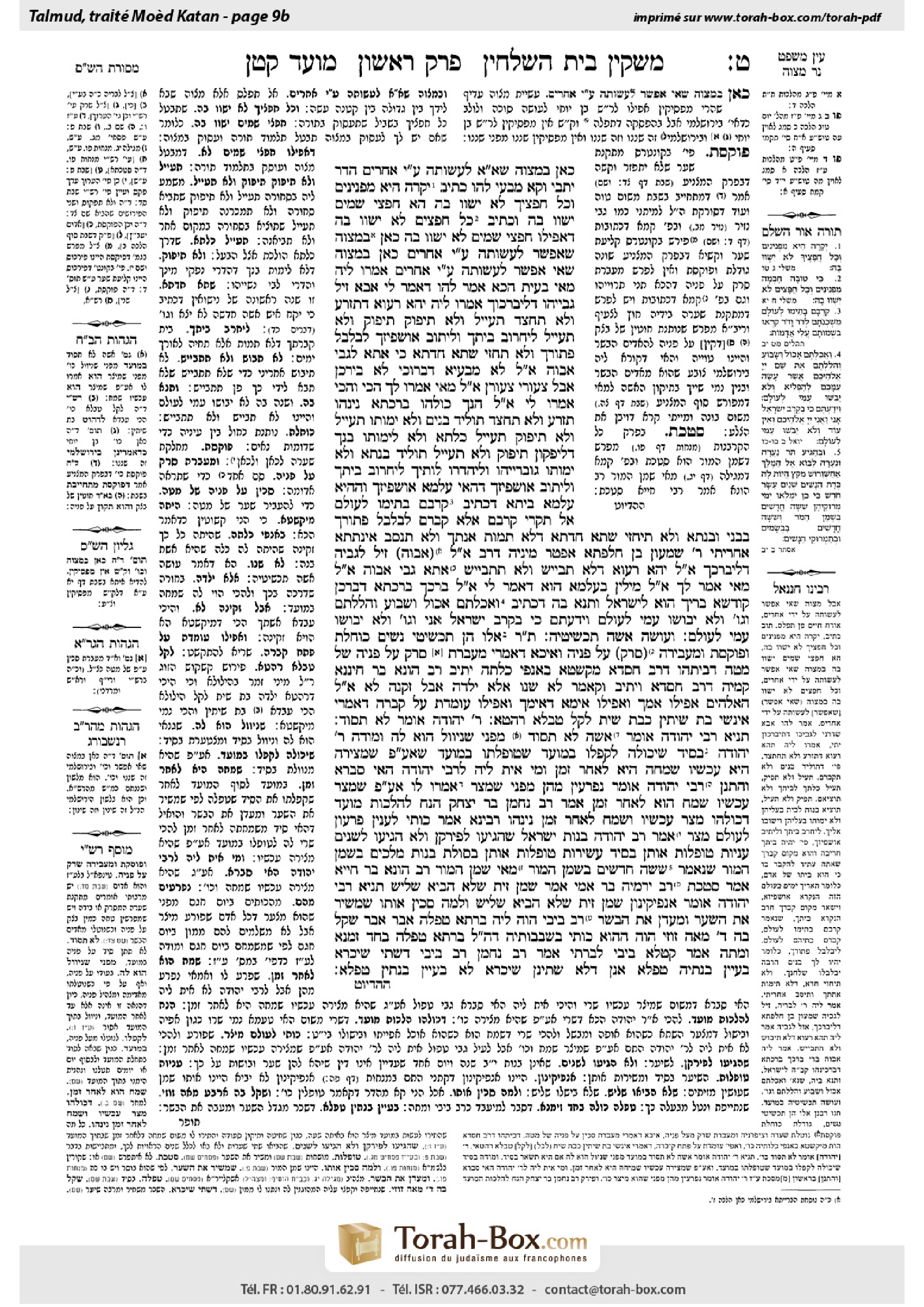
This page of Moed Katan includes the Aramaic text, an English translation and an AI-generated French translation, alongside the scan above.
מועד קטן ט׳ ב · Aramaic and Hebrew text
כָּאן בְּמִצְוָה שֶׁאִי אֶפְשָׁר לַעֲשׂוֹתָהּ עַל יְדֵי אֲחֵרִים.
הֲדַר יָתְבִי וְקָא מִבְּעֵי לְהוּ, כְּתִיב: ״יְקָרָה הִיא מִפְּנִינִים וְכׇל חֲפָצֶיךָ לֹא יִשְׁווּ בָהּ״ — הָא חֶפְצֵי שָׁמַיִם יִשְׁווּ בָהּ, וּכְתִיב: ״כׇּל חֲפָצִים לֹא יִשְׁווּ בָהּ״ — דַּאֲפִילּוּ חֶפְצֵי שָׁמַיִם לֹא יִשְׁווּ בָהּ!
כָּאן בְּמִצְוָה שֶׁאֶפְשָׁר לַעֲשׂוֹתָהּ עַל יְדֵי אֲחֵרִים, כָּאן בְּמִצְוָה שֶׁאִי אֶפְשָׁר לַעֲשׂוֹתָהּ עַל יְדֵי אֲחֵרִים.
אֲמַרוּ לֵיהּ: מַאי בָּעֵית הָכָא? אֲמַר לְהוּ, דַּאֲמַר לִי אַבָּא: זִיל גַּבַּיְיהוּ דְּלִיבָרְכוּךְ. אֲמַרוּ לֵיהּ: יְהֵא רַעֲוָא דְּתִזְרַע וְלָא תֶּחְצַד, תְּעַיֵּיל וְלָא תַּיפֵּוק, תַּיפֵּוק וְלָא תְּעַיֵּיל, לִיחְרוֹב בֵּיתָךְ וְלִיתּוֹב אוּשְׁפִּיזָךְ, לִבַּלְבַּל פָּתוּרָךְ, וְלָא תִּחְזֵי שַׁתָּא חַדְתָּא.
כִּי אֲתָא לְגַבֵּי אֲבוּהּ, אֲמַר לֵיהּ: לָא מִבַּעְיָא דְּבָרוֹכֵי לָא בָּירְכֻן אֲבָל צַעוֹרֵי צַעֲורֻן. אֲמַר לֵיהּ: מַאי אֲמַרוּ לָךְ? הָכִי וְהָכִי אֲמַרוּ לִי. אֲמַר לֵיהּ: הָנָךְ כּוּלְּהוּ בִּרְכָתָא נִינְהוּ. תִּזְרַע וְלָא תֶּחְצַד: תּוֹלִיד בָּנִים וְלָא יְמוּתוּ. תְּעַיֵּיל וְלָא תַּיפֵּוק: תְּעַיֵּיל כַּלְּתָא וְלָא לֵימוּתוּ בְּנָךְ דְּלִיפְּקוּן. תַּיפֵּוק וְלָא תְּעַיֵּיל: תּוֹלִיד בְּנָתָא וְלָא יְמוּתוּ גּוּבְרַיְיהוּ וְלִיהְדְּרוּ לְוָתָיךְ.
לִיחְרוֹב בֵּיתָךְ וְלִיתּוֹב אוּשְׁפִּיזָךְ — דְּהַאי עָלְמָא אוּשְׁפִּיזָךְ, וְהָהֻיא עָלְמָא בֵּיתָא, דִּכְתִיב: ״קִרְבָּם בָּתֵּימוֹ לְעוֹלָם״. אַל תִּקְרֵי ״קִרְבָּם״, אֶלָּא ״קִבְרָם״.
לִבַּלְבַּל פָּתוּרָךְ: בִּבְנֵי וּבְנָתָא. וְלָא תִּיחְזֵי שַׁתָּא חַדְתָּא: דְּלָא תְּמוּת אִתְּתָךְ וְלָא תִּנְסַב אִינְתְּתָא אַחֲרִיתִי.
רַבִּי שִׁמְעוֹן בֶּן חֲלַפְתָּא אִפְּטַר מִינֵּיהּ דְּרַב, אֲמַר לֵיהּ אֲבוּהּ: זִיל לְגַבֵּיהּ דְּלִיבָרְכָךְ. אֲמַר לֵיהּ: יְהֵא רַעֲוָא דְּלָא תְּבַיֵּישׁ וְלָא תִּתְבַּיַּישׁ. אֲתָא גַּבֵּי אֲבוּהּ. אָמַר לֵיהּ: מַאי אֲמַר לָךְ? אֲמַר לֵיהּ: מִילִּין בְּעָלְמָא הוּא דְּאָמַר לִי.
אֲמַר לֵיהּ: בָּרְכָךְ בִּרְכְּתָא דְּבֵרְכָן קוּדְשָׁא בְּרִיךְ הוּא לְיִשְׂרָאֵל וּתְנָא בַּהּ, דִּכְתִיב: ״וַאֲכַלְתֶּם אָכוֹל וְשָׂבוֹעַ וְהִלַּלְתֶּם וְגוֹ׳ וְלֹא יֵבוֹשׁוּ עַמִּי לְעוֹלָם. וִידַעְתֶּם כִּי בְקֶרֶב יִשְׂרָאֵל אֲנִי וְגוֹ׳ וְלֹא יֵבוֹשׁוּ עַמִּי לְעוֹלָם״.
וְעוֹשָׂה אִשָּׁה תַּכְשִׁיטֶיהָ. תָּנוּ רַבָּנַן, אֵלּוּ הֵן תַּכְשִׁיטֵי נָשִׁים: כּוֹחֶלֶת וּפוֹקֶסֶת וּמַעֲבִירָה סְרָק עַל פָּנֶיהָ. וְאִיכָּא דְּאָמְרִי מַעֲבֶרֶת סְרָק עַל פָּנֶיהָ שֶׁל מַטָּה.
דְּבֵיתְהוּ דְּרַב חִסְדָּא מִקַּשְּׁטָא בְּאַנְפֵּי כַּלְּתַהּ. יָתֵיב רַב הוּנָא בַּר חִינָּנָא קַמֵּיהּ דְּרַב חִסְדָּא וְיָתֵיב וְקָאָמַר: לֹא שָׁנוּ אֶלָּא יַלְדָּה, אֲבָל זְקֵנָה — לֹא.
אֲמַר לֵיהּ: הָאֱלֹהִים! אֲפִילּוּ אִמָּךָ וַאֲפִילּוּ אִימָּא דְאִימָּךְ, וַאֲפִילּוּ עוֹמֶדֶת עַל קִבְרָהּ. דְּאָמְרִי אִינָשֵׁי: בַּת שִׁיתִּין כְּבַת שֵׁית, לְקָל טַבְלָא רָהֲטָא.
רַבִּי יְהוּדָה אוֹמֵר: לֹא תָּסוּד. תַּנְיָא, רַבִּי יְהוּדָה אוֹמֵר: אִשָּׁה לֹא תָּסוּד מִפְּנֵי שֶׁנִּיוּוּל הוּא לָהּ. וּמוֹדֶה רַבִּי יְהוּדָה בְּסִיד שֶׁיְּכוֹלָה לְקַפְּלוֹ בַּמּוֹעֵד, שֶׁטּוֹפַלְתּוֹ בַּמּוֹעֵד. שֶׁאַף עַל פִּי שֶׁמְּצֵירָה הִיא עַכְשָׁיו — שְׂמֵחָה הִיא לְאַחַר זְמַן.
וּמִי אִית לֵיהּ לְרַבִּי יְהוּדָה הַאי סְבָרָא? וְהָתְנַן:
רַבִּי יְהוּדָה אוֹמֵר: נִפְרָעִין מֵהֶן מִפְּנֵי שֶׁמֵּצֵר. אָמְרוּ לוֹ: אַף עַל פִּי שֶׁמֵּצֵר עַכְשָׁיו — שָׂמֵחַ הוּא לְאַחַר זְמַן!
אָמַר רַב נַחְמָן בַּר יִצְחָק: הַנַּח לְהִלְכוֹת מוֹעֵד, דְּכוּלְּהוּ מֵצֵר עַכְשָׁיו וְשָׂמֵחַ לְאַחַר זְמַן נִינְהוּ.
רָבִינָא אָמַר: גּוֹי לְעִנְיַן פֵּרָעוֹן לְעוֹלָם מֵצֵר.
אָמַר רַב יְהוּדָה: בְּנוֹת יִשְׂרָאֵל שֶׁהִגִּיעוּ לְפִירְקָן וְלֹא הִגִּיעוּ לְשָׁנִים, עֲנִיּוֹת טוֹפְלוֹת אוֹתָן בְּסִיד, עֲשִׁירוֹת טוֹפְלוֹת אוֹתָן בְּסוֹלֶת, בְּנוֹת מְלָכִים בְּשֶׁמֶן הַמּוֹר, שֶׁנֶּאֱמַר: ״שִׁשָּׁה חֳדָשִׁים בְּשֶׁמֶן הַמּוֹר״.
מַאי ״שֶׁמֶן הַמּוֹר״? רַב הוּנָא בַּר חִיָּיא אָמַר: סְטָכַת, רַב יִרְמְיָה בַּר אַמֵּי אָמַר: שֶׁמֶן זַיִת שֶׁלֹּא הֵבִיא שְׁלִישׁ.
תַּנְיָא, רַבִּי יְהוּדָה אוֹמֵר: אַנְפִּיקִינוּן — שֶׁמֶן זַיִת שֶׁלֹּא הֵבִיא שְׁלִישׁ. וְלָמָּה סָכִין אוֹתוֹ? שֶׁמַּשִּׁיר אֶת הַשֵּׂעָר וּמְעַדֵּן אֶת הַבָּשָׂר.
רַב בִּיבִי הֲוָה לֵיהּ בְּרַתָּא, טַפְלַהּ אֵבֶר אֵבֶר. שְׁקַל בַּהּ אַרְבַּע מֵאָה זוּזֵי. הֲוָה הָהוּא גּוֹי בְּשִׁבָבוּתֵיהּ דַּהֲוָה לֵיהּ בְּרַתָּא. טַפְלַהּ בְּחַד זִמְנָא וּמִתָה, אֲמַר: קַטְלַהּ בִּיבִי לִבְרַתִּי. אָמַר רַב נַחְמָן: רַב בִּיבִי דְּשָׁתֵי שִׁיכְרָא — בָּעֲיָין בְּנָתֵיהּ טִפְלָא, אֲנַן דְּלָא שָׁתֵינַן שִׁיכְרָא — לָא בָּעֲיָין בְּנָתִין טִפְלָא.
Moed Katan 9b · English translation
There, in the other verse, it is referring to a mitzva that cannot be done by others, and therefore, one must not consider its relative importance, but rather do it immediately.
The two scholars, Rabbi Yonatan ben Asmai and Rabbi Yehuda, son of converts, once again sat and raised the following dilemma: In one place it is written in praise of the Torah: “She is more precious than rubies; and all of your desires are not to be compared to her” (Proverbs 3:15). One can infer from here that all human desires cannot be compared to the Torah, but the desires of Heaven, i.e., mitzvot, can indeed be compared to her. And elsewhere it is written: “For wisdom is better than rubies; and all the things that may be desired are not to be compared to it” (Proverbs 8:11), which indicates that even mitzvot cannot be compared to the Torah.
They resolved this contradiction by stating that here, in the second verse, it is discussing a mitzva that can be done by others. In that case, even mitzvot cannot be compared to the Torah, and accordingly, one who is engaged in Torah study should not interrupt his studies in order to perform another mitzva. However, there, in the first verse, it is discussing a mitzva that cannot be done by others. In that case Torah study is not more important than the mitzva, and one should interrupt his studies in order to perform the mitzva.
When Rabbi Yonatan ben Asmai and Rabbi Yehuda, son of converts, noticed Rabbi Shimon ben Yoḥai’s son, they said to him: What do you want here? He said to them: Father told me: Go to them so that they should bless you. They said to him as follows: May it be God’s will that you should sow and not reap, that you should bring in and not take out, that you should take out and not bring in, that your house should be destroyed and your lodging place should be inhabited, that your table should become confused, and that you should not see a new year.
When he came back to his father, he said to him: Not only did they not bless me, but they even caused me pain with their negative words. His father said to him: What exactly did they say to you? He answered: They said to me such and such. Rabbi Shimon ben Yoḥai said to his son: These are all blessings, uttered in a cryptic manner, and this is what they meant: When they said that you should sow and not reap they meant that you should bear sons and they should not die. Their statement that you should bring in and not take out means that you should bring in brides for your sons and your sons should not die, which would cause their wives to leave. When they said you should take out and not bring in they meant that you should have daughters and their husbands should not die, which would cause your daughters to return to you.
When they said that your house should be destroyed and your lodging place should be inhabited, this should be interpreted allegorically. As this world is compared to your lodging place, and the World-to-Come is compared to your house, as it is written: “Their inward thought [kirbam], is that their houses shall continue forever” (Psalms 49:12), and the Sages said: Do not read it as “their inward thought [kirbam]”; rather read it as their graves [kivram]. According to this reading, one’s grave is considered his permanent house. The Sages gave Rabbi Shimon ben Yoḥai’s son a blessing that he should dwell in his temporary home rather than his permanent home, i.e., he should live a long life.
When they said that your table should become confused, they meant that you should be blessed with many sons and daughters, so that there will be noise and confusion at your table. When they said that you should not see a new year, they meant your wife should not die and as a result you should not have to marry another woman, about which it says: “When a man has taken a new wife, he shall not go out to war, neither shall he be charged with any business; he shall be free at home for one year” (Deuteronomy 24:5).
Apropos a blessing with an obscure meaning, the Gemara relates: Rabbi Shimon ben Ḥalafta took leave of Rav. His father said to him: Go to him so that he should bless you. When Rabbi Shimon ben Ḥalafta returned to him for a blessing, Rav said to him: May it be God’s will that you should not shame others and that you should not feel ashamed. He came home to his father, who said to him: What did he say to you? He said to him: Mere words he said to me, i.e., he did not say anything of significance.
After Rabbi Shimon ben Ḥalafta repeated what Rav had said, his father said to him: He blessed you with the blessing with which the Holy One, Blessed be He, blessed Israel and then repeated the blessing, indicating that is a very great blessing, as it is written: “And you shall eat in plenty, and be satisfied, and praise the Name of the Lord your God, who has dealt wondrously with you; and My people shall never be ashamed. And you shall know that I am in the midst of Israel, and that I am the Lord your God, and there is none else; and My people shall never be ashamed” (Joel 2:26–27).
§ It was taught in the mishna: And a woman may engage in all of her usual cosmetic treatments on the intermediate days of a Festival. The Sages taught in a baraita: These are the cosmetic treatments of women that are permitted: She may paint her eyelids, she may remove unwanted hair [pokeset], and she may put rouge on her face. And some say: She may pass a comb over her lower face, i.e., she may remove the hair from her pubic area.
The Gemara relates that Rav Ḥisda’s wife would adorn herself on the intermediate days of a Festival in the presence of her daughter-in-law, i.e., when she already had a married son. Rav Huna bar Ḥinnana sat before Rav Ḥisda, and he sat and said: They taught only that a woman is permitted to engage in cosmetic treatments on the intermediate days of a Festival only with regard to a young woman, as such treatments bring her joy, but in the case of an old woman, no, the treatments are not permitted, as she does not need them.
Rav Ḥisda said to him: By God! Even your mother, and even your mother’s mother, and even a woman so old that she is standing at the edge of her grave are all permitted to adorn themselves. As people say in the popular adage: A woman of sixty years, like one of six, runs at the sound of the timbrel [tavla], implying that women of all ages are young in spirit; since they all take pleasure in their adornments, they are allowed to adorn themselves, regardless of age.
§ It was taught in the mishna that Rabbi Yehuda says: She may not apply lime to her skin because it renders her temporarily unattractive and she will be distressed during the Festival. It is taught in a baraita: Rabbi Yehuda says: A woman may not apply lime to her skin on the intermediate days of a Festival because it is temporarily a disgrace to her, as she appears unattractive until it is peeled off. But Rabbi Yehuda concedes that with regard to lime that she can peel off during the Festival, she may apply it on the intermediate days of the Festival, as even though she is distressed now, as the lime renders her appearance unattractive, she will be happy afterward, when the lime is removed and she sees the results.
The Gemara asks: But does Rabbi Yehuda accept this reasoning that it is permitted, despite the fact that it causes distress, because it will cause joy later? Didn’t we learn elsewhere in a mishna (Avoda Zara 2a): On the three days before the holidays of idolaters, it is prohibited to do business with them, so as not to cause them to thank their idols for their success. Similarly, it is prohibited on these days to lend to them, to borrow from them, to repay a debt to them, or even to collect a debt from them.
Rabbi Yehuda says: One may collect a debt from them during this period, due to the fact that the gentile is distressed when he makes the payment. The Rabbis said to him: Even though he is distressed now, he will be happy afterward, as he is relieved of the debt, and therefore, it is prohibited to collect a debt from him during the three days before his holiday. In this mishna, Rabbi Yehuda considers only the immediate distress and does not consider the joy that will be experienced after some time.
Rav Naḥman bar Yitzḥak said: Leave aside the halakhot governing a Festival, which cannot be compared to other areas, as all of the labors that are permitted on a Festival are permitted because even though one is distressed by them now, he will be happy about them afterward. For example, cooking and baking are permitted even though preparing food involves effort and trouble, because eating the food after it is prepared provides pleasure and enjoyment.
Ravina said a different explanation: According to Rabbi Yehuda, with regard to repaying a debt, a gentile is always distressed, even after he repays a debt. However, in general, even Rabbi Yehuda accepts the principle of taking into account the joy that will be experienced at a later time.
With regard to applying lime to one’s body, Rav Yehuda said: The daughters of Israel who reached physical maturity, but had not yet reached the age of majority, i.e., girls that were less than twelve years of age, and therefore embarrassed by their precocious physical development, would seek to remove the excess hair from their bodies. The poor among them would smear their skin with lime in order to remove the hair. The wealthy ones would smear themselves with fine flour for this purpose, and the daughters of kings would smear themselves with shemen hamor. As it is stated with regard to the women who were brought to King Ahasuerus: “Six months with shemen hamor” (Esther 2:12).
The Gemara asks: What is shemen hamor? Rav Huna bar Ḥiyya said: This is the perfume called setaket. Rav Yirmeya bar Ami said: It is olive oil extracted from an olive that has not yet reached one-third of its growth; the acidic oil is effective as a depilatory.
It is taught in a baraita that Rabbi Yehuda says: Wherever the Mishna mentions anpikinon, it is referring to olive oil from an olive that has not yet reached one-third of its growth. And why do women spread it on the body? It is due to the fact that it removes the hair and pampers the skin.
It was related that Rav Beivai had a daughter, and he spread lime on her limb by limb, which caused her hair to fall out and her skin to whiten. She became so beautiful that when marrying her off, he took four hundred dinars for her. There was a certain gentile in his neighborhood who also had a daughter and wanted to do this as well. He spread her entire body with lime all at once, and she died. That gentile said: Beivai killed my daughter. Rav Naḥman said: Rav Beivai, who regularly drinks beer, his daughters require that they be smeared with lime, as beer causes hair growth, but we who do not drink beer, our daughters do not require that they be smeared with lime, as they have little hair even without this treatment.
Moed Katan 9b · Traduction française (IA)
Là, dans l’autre verset, il s’agit d’une mitsva que d’autres ne peuvent pas accomplir ; il ne faut donc pas en évaluer l’importance relative, mais l’accomplir immédiatement.
Les deux sages, Rabbi Yonatan ben Asmaï et Rabbi Yehouda, fils de convertis, s’assirent de nouveau et soulevèrent le dilemme suivant : À un endroit, il est écrit à la louange de la Torah : « Elle est plus précieuse que les rubis, et tous tes désirs ne peuvent lui être comparés » (Proverbes 3,15). On peut en déduire qu’aucun désir humain ne peut être comparé à la Torah, mais que les désirs du Ciel, c’est-à-dire les mitsvot, peuvent l’être. Ailleurs, il est écrit : « La sagesse est meilleure que les rubis, et toutes les choses désirables ne peuvent lui être comparées » (Proverbes 8,11), ce qui indique que même les mitsvot ne peuvent être comparées à la Torah.
Ils résolurent cette contradiction en disant qu’ici, dans le second verset, il s’agit d’une mitsva que d’autres peuvent accomplir. Dans ce cas, même les mitsvot ne peuvent être comparées à la Torah ; par conséquent, celui qui se consacre à l’étude de la Torah ne doit pas interrompre son étude pour accomplir une autre mitsva. En revanche, là, dans le premier verset, il s’agit d’une mitsva que d’autres ne peuvent pas accomplir. Dans ce cas, l’étude de la Torah n’est pas plus importante que la mitsva, et l’on doit interrompre son étude pour accomplir celle-ci.
Lorsque Rabbi Yonatan ben Asmaï et Rabbi Yehouda, fils de convertis, aperçurent le fils de Rabbi Shimon ben Yo’haï, ils lui demandèrent : « Que viens-tu faire ici ? » Il leur répondit : « Mon père m’a dit d’aller vous voir afin que vous me bénissiez. » Ils lui dirent alors : « Que ce soit la volonté de Dieu que tu sèmes sans moissonner, que tu fasses entrer sans faire sortir, que tu fasses sortir sans faire entrer, que ta maison soit détruite et que ton lieu de séjour soit habité, que ta table soit dans la confusion et que tu ne voies pas une nouvelle année. »
Lorsqu’il revint auprès de son père, il lui dit : « Non seulement ils ne m’ont pas béni, mais ils m’ont même peiné par leurs paroles négatives. » Son père lui demanda : « Qu’est-ce qu’ils t’ont exactement dit ? » Il répondit : « Ils m’ont dit ceci et cela. » Rabbi Shimon ben Yo’haï dit à son fils : « Ce sont toutes des bénédictions, formulées de manière énigmatique. Voici ce qu’ils voulaient dire : lorsqu’ils ont dit que tu sèmerais sans moissonner, ils voulaient dire que tu aurais des fils et qu’ils ne mourraient pas. Lorsqu’ils ont dit que tu ferais entrer sans faire sortir, cela signifie que tu ferais entrer des épouses pour tes fils et que ceux-ci ne mourraient pas, ce qui ferait partir leurs femmes. Lorsqu’ils ont dit que tu ferais sortir sans faire entrer, ils voulaient dire que tu aurais des filles et que leurs maris ne mourraient pas, ce qui ferait revenir tes filles chez toi. »
Lorsqu’ils ont dit que ta maison serait détruite et que ton lieu de séjour serait habité, il faut l’interpréter de manière allégorique. Ce monde est comparé à ton lieu de séjour, et le Monde à venir à ta maison, comme il est écrit : « Leur pensée intime [kirbam] est que leurs maisons dureront éternellement » (Psaumes 49,12). Or les Sages ont dit : « Ne lis pas “leur pensée intime [kirbam]”, mais “leurs tombeaux [kivram]”. » Selon cette lecture, la tombe est considérée comme la demeure permanente d’une personne. Les Sages bénirent le fils de Rabbi Shimon ben Yo’haï en souhaitant qu’il habite sa demeure temporaire plutôt que sa demeure permanente, c’est-à-dire qu’il vive longtemps.
Lorsqu’ils ont dit que ta table serait dans la confusion, ils voulaient dire que tu serais béni de nombreux fils et filles, de sorte qu’il y aurait du bruit et de l’agitation à ta table. Lorsqu’ils ont dit que tu ne verrais pas une nouvelle année, ils voulaient dire que ta femme ne mourrait pas et que tu n’aurais donc pas à épouser une autre femme, au sujet de laquelle il est dit : « Lorsqu’un homme aura pris une nouvelle épouse, il ne partira pas à la guerre et ne sera chargé d’aucune affaire ; il restera libre dans sa maison pendant un an » (Deutéronome 24,5).
À propos d’une bénédiction au sens obscur, la Guemara rapporte : Rabbi Shimon ben Ḥalafta prit congé de Rav. Son père lui dit : « Va le voir afin qu’il te bénisse. » Lorsque Rabbi Shimon ben Ḥalafta revint auprès de lui pour recevoir une bénédiction, Rav lui dit : « Que ce soit la volonté de Dieu que tu ne fasses honte à personne et que tu n’aies pas honte. » Il rentra chez son père, qui lui demanda : « Qu’est-ce qu’il t’a dit ? » Il répondit : « Il ne m’a dit que de simples paroles », c’est-à-dire qu’il n’avait rien dit d’important.
Après que Rabbi Shimon ben Ḥalafta eut répété les paroles de Rav, son père lui dit : « Il t’a béni de la bénédiction par laquelle le Saint, béni soit-Il, a béni Israël, et il a répété cette bénédiction, montrant ainsi qu’il s’agit d’une très grande bénédiction », comme il est écrit : « Vous mangerez abondamment, vous serez rassasiés et vous louerez le Nom de l’Éternel, votre Dieu, qui a agi merveilleusement envers vous ; mon peuple ne sera plus jamais couvert de honte. Vous saurez que je suis au milieu d’Israël, que je suis l’Éternel, votre Dieu, et qu’il n’y en a pas d’autre ; mon peuple ne sera plus jamais couvert de honte » (Joël 2,26-27).
§ Il a été enseigné dans la Michna : Une femme peut effectuer tous ses soins cosmétiques habituels pendant les jours intermédiaires d’une fête. Les Sages ont enseigné dans une baraïta : Voici les soins cosmétiques autorisés aux femmes : elle peut se farder les paupières, s’épiler [pokeset] et se mettre du rouge sur le visage. Certains disent : elle peut passer un peigne sur le bas de son visage, c’est-à-dire épiler sa région pubienne.
La Guemara rapporte que la femme de Rav Ḥisda se faisait belle pendant les jours intermédiaires d’une fête en présence de sa belle-fille, c’est-à-dire alors qu’elle avait déjà un fils marié. Rav Huna bar Ḥinnana était assis devant Rav Ḥisda et déclara : « Ils ont enseigné que les soins cosmétiques sont autorisés à une femme pendant les jours intermédiaires d’une fête uniquement dans le cas d’une jeune femme, car ces soins lui procurent de la joie ; mais dans le cas d’une femme âgée, non, ces soins ne sont pas autorisés, car elle n’en a pas besoin. »
Rav Ḥisda lui dit : « Par Dieu ! Même ta mère, même la mère de ta mère et même une femme si âgée qu’elle se tient au bord de sa tombe ont toutes le droit de se faire belles. » Comme le dit le proverbe : « Une femme de soixante ans, tout comme une femme de six ans, se met à courir au son du tambourin [tavla] », ce qui signifie que les femmes de tout âge gardent un esprit jeune ; puisqu’elles prennent toutes plaisir à se parer, elles ont le droit de le faire, quel que soit leur âge.
§ Il a été enseigné dans la Michna que Rabbi Yehouda dit : Elle ne peut pas s’appliquer de la chaux sur la peau, car cela la rend temporairement peu attirante et elle en serait contrariée pendant la fête. Une baraïta enseigne : Rabbi Yehouda dit qu’une femme ne peut pas s’appliquer de la chaux sur la peau pendant les jours intermédiaires d’une fête, car cela la défigure temporairement : elle paraît peu attirante jusqu’à ce que la chaux soit enlevée. Cependant, Rabbi Yehouda reconnaît que, si elle peut enlever la chaux pendant la fête, elle peut se l’appliquer durant les jours intermédiaires de la fête ; même si elle est contrariée sur le moment, parce que la chaux rend son apparence peu attirante, elle sera ensuite heureuse lorsque la chaux aura été enlevée et qu’elle verra le résultat.
La Guemara demande : Rabbi Yehouda accepte-t-il donc ce raisonnement, selon lequel cela est permis malgré la contrariété que cela provoque, parce que cela procurera de la joie par la suite ? N’avons-nous pas appris ailleurs dans une Michna (Avoda Zara 2a) : Durant les trois jours précédant les fêtes des idolâtres, il est interdit de faire des affaires avec eux, afin de ne pas les amener à remercier leurs idoles de leur réussite. Il est également interdit, pendant ces jours, de leur prêter ou de leur emprunter, de leur rembourser une dette ou même de recouvrer une dette auprès d’eux.
Rabbi Yehouda dit : On peut recouvrer une dette auprès d’eux pendant cette période, parce que le non-Juif est contrarié lorsqu’il effectue le paiement. Les Sages lui dirent : « Même s’il est contrarié sur le moment, il sera heureux ensuite, puisqu’il est libéré de sa dette » ; il est donc interdit de recouvrer une dette auprès de lui durant les trois jours précédant sa fête. Dans cette Michna, Rabbi Yehouda ne tient compte que de la contrariété immédiate et ne prend pas en considération la joie qui sera éprouvée quelque temps plus tard.
Rav Naḥman bar Yitzḥak dit : « Laissons de côté les halakhot relatives à une fête, qui ne sont pas comparables aux autres domaines : tous les travaux permis pendant une fête le sont parce que, même si l’on en est contrarié sur le moment, on en sera heureux par la suite. » Par exemple, la cuisson et la pâtisserie sont permises, bien que préparer la nourriture demande des efforts et occasionne des désagréments, car manger les aliments une fois préparés procure du plaisir et de la satisfaction.
Ravina donna une autre explication : selon Rabbi Yehouda, lorsqu’il s’agit de rembourser une dette, le non-Juif est toujours contrarié, même après avoir remboursé sa dette. Cependant, de manière générale, même Rabbi Yehouda accepte le principe consistant à prendre en compte la joie qui sera éprouvée ultérieurement.
Concernant l’application de chaux sur le corps, Rav Yehouda dit : Les filles d’Israël qui avaient atteint la maturité physique sans avoir encore atteint l’âge de la majorité, c’est-à-dire les filles de moins de douze ans, et qui étaient gênées par leur développement physique précoce, cherchaient à éliminer l’excès de poils de leur corps. Les pauvres s’enduisaient la peau de chaux afin d’enlever les poils. Les riches s’enduisaient de farine fine à cette fin, et les filles des rois s’enduisaient de shemen hamor. Comme il est dit au sujet des femmes amenées auprès du roi Assuérus : « Six mois avec du shemen hamor » (Esther 2,12).
La Guemara demande : Qu’est-ce que le shemen hamor ? Rav Huna bar Ḥiyya dit : C’est le parfum appelé setaket. Rav Yirmeya bar Ami dit : C’est de l’huile d’olive extraite d’une olive qui n’a pas encore atteint le tiers de sa croissance ; cette huile acide est efficace comme dépilatoire.
Une baraïta enseigne que Rabbi Yehouda dit : Partout où la Michna mentionne anpikinon, il s’agit d’huile d’olive provenant d’une olive qui n’a pas encore atteint le tiers de sa croissance. Pourquoi les femmes s’en enduisent-elles le corps ? Parce que cette huile élimine les poils et adoucit la peau.
On rapporte que Rav Beivai avait une fille et qu’il lui appliqua de la chaux membre après membre, ce qui fit tomber ses poils et blanchit sa peau. Elle devint si belle qu’au moment de la marier, il reçut quatre cents dinars pour elle. Un non-Juif du voisinage avait lui aussi une fille et voulut faire de même. Il lui enduisit tout le corps de chaux en une seule fois, et elle mourut. Ce non-Juif dit : « Beivai a tué ma fille. » Rav Naḥman dit : « Les filles de Rav Beivai, qui boit régulièrement de la bière, ont besoin qu’on les enduise de chaux, car la bière favorise la pousse des poils. Mais nous, qui ne buvons pas de bière, nos filles n’ont pas besoin qu’on les enduise de chaux, car elles ont peu de poils même sans ce traitement. »
Traduction française générée par IA à partir de l’édition anglaise de Sefaria. Vérifie toujours un passage avec le texte source.
Text from Sefaria: William Davidson Edition - Vocalized Aramaic (CC BY NC); William Davidson Edition - English (CC BY NC).