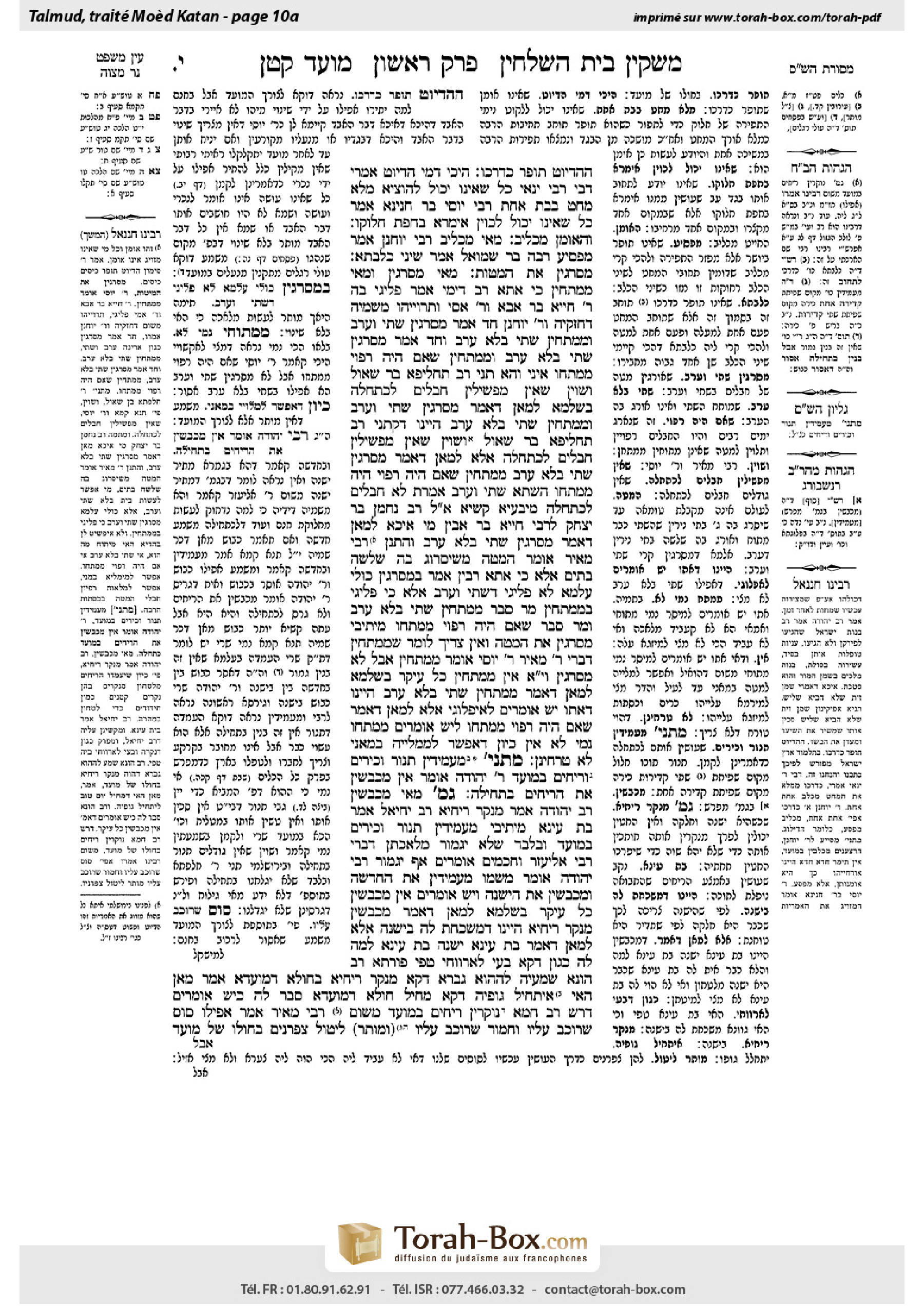
Moed Katan 10a: Talmud study for Daf Yomi
Daf Yomi is the daily study of one Talmud folio. Explore 37 tractates with scans, Hebrew text, Sefaria English and AI-generated French translations where annotated.
Passage selection and English or AI-generated French translation are available where the scan has annotations. Daf Study is independent of Torah-Box and Sefaria.
Browse Moed Katan · מועד קטן · All tractatesMoed Katan 10a text and translations
This page of Moed Katan includes the Aramaic text, an English translation and an AI-generated French translation, alongside the scan above.
מועד קטן י׳ א · Aramaic and Hebrew text
הַהֶדְיוֹט תּוֹפֵר כְּדַרְכּוֹ. הֵיכִי דָּמֵי הֶדְיוֹט? אָמְרִי דְּבֵי רַבִּי יַנַּאי: כֹּל שֶׁאֵינוֹ יָכוֹל לְהוֹצִיא מְלֹא מַחַט בְּבַת אַחַת. רַבִּי יוֹסֵי בַּר חֲנִינָא אָמַר: כֹּל שֶׁאֵינוֹ יָכוֹל לְכַוֵּין אִימְרָא בְּחֵפֶת חֲלוּקוֹ.
וְהָאוּמָּן מַכְלִיב. מַאי מַכְלִיב? רַבִּי יוֹחָנָן אָמַר: מַפְסִיעַ. רַבָּה בַּר שְׁמוּאֵל אֲמַר: שִׁינֵּי כַלְבְּתָא.
מְסָרְגִין אֶת הַמִּטּוֹת. מַאי ״מְסָרְגִין״ וּמַאי ״מְמַתְּחִין״? כִּי אֲתָא רַב דִּימִי אָמַר: פְּלִיגִי בַּהּ רַבִּי חִיָּיא בַּר אַבָּא וְרַבִּי אַסִּי, וְתַרְוַיְיהוּ מִשְּׁמֵיהּ דְּחִזְקִיָּה וְרַבִּי יוֹחָנָן חַד אָמַר: מְסָרְגִין — שְׁתִי וָעֵרֶב, וּמְמַתְּחִין — שְׁתִי בְּלֹא עֵרֶב. וְחַד אָמַר: מְסָרְגִין — שְׁתִי בְּלֹא עֵרֶב, וּמְמַתְּחִין — שֶׁאִם הָיָה רָפוּי, מְמַתְּחוֹ.
אִינִי? וְהָא תָּנֵי רַב תַּחְלִיפָא בַּר שָׁאוּל: וְשָׁוִין שֶׁאֵין מַפְשִׁילִין חֲבָלִים לְכַתְּחִלָּה. בִּשְׁלָמָא לְמַאן דְּאָמַר מְסָרְגִין — שְׁתִי וָעֵרֶב, וּמְמַתְּחִין — שְׁתִי בְּלֹא עֵרֶב, הַיְינוּ דְּקָתָנֵי רַב תַּחְלִיפָא בַּר שָׁאוּל: וְשָׁוִין שֶׁאֵין מַפְשִׁילִין חֲבָלִים לְכַתְּחִלָּה.
אֶלָּא לְמַאן דְּאָמַר מְסָרְגִין — שְׁתִי בְּלֹא עֵרֶב, מְמַתְּחִין — שֶׁאִם הָיָה רָפוּי הָיָה מְמַתְּחוֹ. הַשְׁתָּא שְׁתִי וָעֵרֶב אָמְרַתְּ לָא — חֲבָלִים לְכַתְּחִלָּה מִיבַּעְיָא?! קַשְׁיָא.
אֲמַר לֵיהּ רַב נַחְמָן בַּר יִצְחָק לְרַבִּי חִיָּיא בַּר אָבִין: מִי אִיכָּא לְמַאן דְּאָמַר מְסָרְגִין — שְׁתִי בְּלֹא עֵרֶב? וְהָתְנַן, רַבִּי מֵאִיר אוֹמֵר: הַמִּטָּה מִשֶּׁיְּסָרֵג בָּהּ שְׁלֹשָׁה בָּתִּים!
אֶלָּא, כִּי אֲתָא רָבִין אָמַר: בִּמְסָרְגִין כּוּלֵּי עָלְמָא לָא פְּלִיגִי דִּשְׁתִי וָעֵרֶב, אֶלָּא כִּי פְּלִיגִי בִּמְמַתְּחִין. מָר סָבַר מְמַתְּחִין — שְׁתִי בְּלֹא עֵרֶב, וּמָר סָבַר: שֶׁאִם הָיָה רָפוּי מְמַתְּחוֹ.
מֵיתִיבִי: מְסָרְגִין אֶת הַמִּטָּה, וְאֵין צָרִיךְ לוֹמַר שֶׁמְּמַתְּחִין, דִּבְרֵי רַבִּי מֵאִיר. רַבִּי יוֹסֵי אוֹמֵר: מְמַתְּחִין, אֲבָל לֹא מְסָרְגִין. וְיֵשׁ אוֹמְרִים: אֵין מְמַתְּחִין כׇּל עִיקָּר.
בִּשְׁלָמָא לְמַאן דְּאָמַר מְמַתְּחִין שְׁתִי בְּלֹא עֵרֶב, הַיְינוּ דְּאָתוּ יֵשׁ אוֹמְרִים לְאִיפְּלוֹגֵי. אֶלָּא לְמַאן דְּאָמַר שֶׁאִם הָיָה רָפוּי מְמַתְּחוֹ, לְיֵשׁ אוֹמְרִים מְמַתְּחוֹ נָמֵי לָא?
אִין, כֵּיוָן דְּאֶפְשָׁר לְמִמְלְיֵיהּ בְּמָאנֵי — לָא טָרְחִינַן.
מַתְנִי׳ מַעֲמִידִין תַּנּוּר וְכִירַיִם וְרֵיחַיִם בַּמּוֹעֵד. רַבִּי יְהוּדָה אוֹמֵר: אֵין מְכַבְּשִׁין אֶת הָרֵיחַיִם בַּתְּחִילָּה.
גְּמָ׳ מַאי מְכַבְּשִׁין? רַב יְהוּדָה אָמַר: מְנַקַּר רִיחְיָא. רַב יְחִיאֵל אָמַר: בַּת עֵינָא.
מֵיתִיבִי: מַעֲמִידִין תַּנּוּר וְכִירַיִם בַּמּוֹעֵד, וּבִלְבַד שֶׁלֹּא יִגְמוֹר מְלַאכְתָּן, דִּבְרֵי רַבִּי אֱלִיעֶזֶר. וַחֲכָמִים אוֹמְרִים: אַף יִגְמוֹר. רַבִּי יְהוּדָה אוֹמֵר מִשְּׁמוֹ: מַעֲמִידִין אֶת הַחֲדָשָׁה, וּמְכַבְּשִׁין אֶת הַיְּשָׁנָה. וְיֵשׁ אוֹמְרִים: אֵין מְכַבְּשִׁין כׇּל עִיקָּר.
בִּשְׁלָמָא לְמַאן דְּאָמַר מְכַבְּשִׁין מְנַקַּר רִיחְיָא — הַיְינוּ דְּמַשְׁכַּחַתְּ לַהּ בִּישָׁנָה, אֶלָּא לְמַאן דְּאָמַר בַּת עֵינָא יְשָׁנָה — בַּת עֵינָא לְמָה לַהּ? כְּגוֹן דְּקָא בָּעֵי לְאַרְווֹחֵי טְפֵי פּוּרְתָּא.
רַב הוּנָא שַׁמְעֵיהּ לְהָהוּא גַּבְרָא דְּקָא מְנַקַּר רִיחְיָא בְּחוּלָּא דְמוֹעֲדָא, אֲמַר: מַאן הַאי? אִיתַּחִיל גּוּפֵיהּ דְּקָא מַחֵיל חוּלָּא דְּמוֹעֲדָא. סָבַר לַהּ כְּיֵשׁ אוֹמְרִים.
דָּרֵשׁ רַב חָמָא: נוֹקְרִין רֵיחַיִם בַּמּוֹעֵד. מִשּׁוּם רַבִּי מֵאִיר אָמַר: אֲפִילּוּ סוּס שֶׁרוֹכֵב עָלָיו וַחֲמוֹר שֶׁרוֹכֵב עָלָיו — מוּתָּר לִיטּוֹל צִפׇּרְנַיִם בְּחוּלּוֹ שֶׁל מוֹעֵד,
Moed Katan 10a · English translation
§ It was taught in the mishna: A layman, who is not a skilled tailor, may sew in his usual manner on the intermediate days of a Festival. The Gemara asks: What are the circumstances in which an individual is considered a layman? The Sages of the school of Rabbi Yannai said: Anyone who cannot deftly pull a full needle of stiches through the fabric at the same time is considered a layman. Rabbi Yosei bar Ḥanina said: Anyone who cannot form a straight seam on the hem [ḥefet] of his shirt is considered a layman.
§ It was further taught in the mishna: A craftsman, however, may form only temporary stitches [makhliv]. The Gemara asks: What is meant by forming temporary stitches? Rabbi Yoḥanan said: He does not sew all the stitches that are necessary, but rather he skips certain stitches in the middle (Rabbeinu Hananel). Rabba bar Shmuel said: He sews stitches that are like the teeth of a dog. He does not sew all the stitches in a straight line, so that they resemble the teeth of a dog, which also are not straight.
§ It was also taught in the mishna: One may interweave the cords attached to the frame of a bed. Rabbi Yosei says: One may only tighten the cords. The Gemara asks: What is meant by interweaving, and what is meant by tightening? When Rav Dimi came from Eretz Yisrael to Babylonia, he said: Rabbi Ḥiyya bar Abba and Rabbi Asi disagree about the matter, and both of them reported their opinions in the name of Ḥizkiyya and Rabbi Yoḥanan. One Sage said: Interweaving involves placing and tying the cords of the bed both lengthwise and widthwise, whereas tightening means arranging the cords only lengthwise and not widthwise. And one Sage said: Interweaving involves arranging the cords only lengthwise and not widthwise, while tightening means that if a cord became loose, he may tighten it but he may not tie any new cords.
The Gemara asks: Is that so? Didn’t Rav Taḥlifa bar Shaul teach the following baraita: And both Rabbi Meir and Rabbi Yosei agree that one may not braid cords anew on the intermediate days of a Festival? Granted, according to the one who said that interweaving means tying the cords lengthwise and widthwise, and tightening means tying them only lengthwise and not widthwise, this explanation is consistent with that which Rav Taḥlifa taught: And they both agree that one may not braid cords anew, as even though one is permitted to arrange the cords of the bed, he is not permitted to produce new cords.
However, according to the one who said that interweaving means tying the cords only lengthwise and not widthwise, while tightening means that if a cord became loose, he may tighten it, there is a difficulty. Now that you said that tying the cords lengthwise and widthwise, no, it is not permitted even though the cords are readily available, is it necessary to say that braiding cords anew is prohibited? The Gemara comments: Indeed it is difficult.
Rav Naḥman bar Yitzḥak said to Rabbi Ḥiyya bar Avin: Is there one who says that interweaving means tying the cords lengthwise, but not widthwise? Didn’t we learn in a mishna (Kelim 16:1) that Rabbi Meir says: A bed is considered a utensil and becomes susceptible to ritual impurity from when one interweaves three rows of meshes in it, i.e., three rows lengthwise and widthwise? It is clear from here that interweaving a bed involves tying its cords lengthwise and widthwise.
Rather, when Ravin came from Eretz Yisrael to Babylonia he stated a different version of the tradition: With regard to interweaving, everyone agrees that it is referring to tying the cords of a bed lengthwise and widthwise. When they disagree it is only about the meaning of tightening. One Sage holds that tightening means arranging the cords only lengthwise and not widthwise. And one Sage holds that it means that if a cord became loose, he may tighten it.
The Gemara raises an objection from the following baraita: One may interweave the cords attached to the frame of a bed on the intermediate days of a Festival, and needless to say one may tighten those cords; this is the statement of Rabbi Meir. Rabbi Yosei says: One may only tighten the ropes but not interweave them. And some say: One may not tighten them at all.
Granted, according to the one who said that tightening means tying the cords only lengthwise and not widthwise, this is why the opinion presented as: Some say, comes to disagree and says that one may not tie the cords at all, even only lengthwise. However, if the cords became loose, all agree that they may be tightened. But according to the one who said that tightening means that if a cord became loose he may tighten it, then according to the opinion presented here as: Some say, may he not even tighten the cords of his bed? How, then, would he be able to sleep on it?
The Gemara answers: Yes, indeed, according to this opinion, it is prohibited even to tighten the cords of one’s bed. Since it is possible for him to fill the depression in his bed with clothing, so that he can sleep there, he may not exert himself during the week of the Festival and fix the bed in a more permanent manner.
MISHNA: One may set up an oven, a stove, and a mill on the intermediate days of a Festival. Rabbi Yehuda says: One may not chisel millstones for the first time on the intermediate days of a Festival.
GEMARA: The Gemara asks: What is meant by chiseling millstones? Rav Yehuda said: Cutting grooves into the millstones. As the millstones wear down over time and become smooth, one must occasionally cut grooves into the stones so that they can grind properly. Rav Yeḥiel said: Cutting out an eyehole in the upper millstone, through which the grain can pass, so that it can be ground between the two millstones.
The Gemara raises an objection from a baraita: One may set up an oven and a stove on the intermediate days of a Festival, provided that he does not fully complete the labor; this is the statement of Rabbi Eliezer. But the Rabbis say: He may even complete the labor. Rabbi Yehuda says in the name of Rabbi Eliezer: One may set up a new millstone and one may chisel an old millstone. And some say: One may not chisel a millstone at all.
Granted, according to the one who said that chiseling a millstone means cutting grooves into the millstones, this is how you can find this activity relevant to an old mill. But according to the one who said it means cutting out an eyehole, why does an old millstone need an eyehole to be cut out? It must have one already. The Gemara answers: This is referring to a case where he wants to widen the hole a little more.
The Gemara relates that Rav Huna once heard a certain man cutting grooves into his millstone on the intermediate days of a Festival. He said: Who is this? May his body be desecrated, for he desecrates the intermediate days of a Festival. The Gemara comments: Rav Huna holds in accordance with the statement cited as: Some say, that one is not permitted to roughen his millstones at all.
Rav Ḥama taught as follows: One may cut grooves into millstones on the intermediate days of a Festival. In the name of Rabbi Meir he said: Even with regard to the horse that one rides upon and the donkey that he rides upon, he is permitted to trim their hooves on the intermediate days of a Festival so that they do not suffer when they walk.
Moed Katan 10a · Traduction française (IA)
§ Il a été enseigné dans la Michna : Un profane, qui n’est pas un tailleur habile, peut coudre comme à son habitude pendant les jours intermédiaires de la fête. La Guemara demande : Dans quelles circonstances considère-t-on quelqu’un comme un profane ? Les Sages de l’école de Rabbi Yannai ont dit : Est considéré comme profane quiconque ne sait pas faire passer habilement dans le tissu, d’un seul coup, une aiguille garnie de plusieurs points. Rabbi Yossei bar Ḥanina a dit : Est considéré comme profane quiconque ne sait pas faire une couture droite sur l’ourlet [ḥefet] de sa chemise.
§ Il a également été enseigné dans la Michna : Un artisan, en revanche, ne peut faire que des points provisoires [makhliv]. La Guemara demande : Que signifie faire des points provisoires ? Rabbi Yoḥanan a dit : Il ne fait pas tous les points nécessaires, mais en saute certains au milieu (Rabbeinu Hananel). Rabba bar Shmuel a dit : Il fait des points qui ressemblent aux dents d’un chien. Il ne fait pas tous les points en ligne droite, de sorte qu’ils ressemblent aux dents d’un chien, qui ne sont pas non plus alignées.
§ Il a aussi été enseigné dans la Michna : On peut entrelacer les cordes attachées au cadre d’un lit. Rabbi Yossei dit : On peut seulement tendre les cordes. La Guemara demande : Que signifient « entrelacer » et « tendre » ? Lorsque Rav Dimi vint d’Eretz Israël en Babylonie, il dit : Rabbi Ḥiyya bar Abba et Rabbi Asi sont en désaccord sur cette question, et tous deux rapportèrent leurs opinions au nom de Ḥizkiyya et de Rabbi Yoḥanan. L’un des Sages a dit : Entrelacer consiste à placer et à nouer les cordes du lit dans le sens de la longueur et de la largeur, tandis que tendre consiste à disposer les cordes uniquement dans le sens de la longueur, et non dans celui de la largeur. L’autre Sage a dit : Entrelacer consiste à disposer les cordes uniquement dans le sens de la longueur, et non dans celui de la largeur, tandis que tendre signifie que, si une corde s’est détendue, on peut la retendre, mais sans nouer de nouvelles cordes.
La Guemara demande : Est-ce bien le cas ? Rav Taḥlifa bar Shaul n’a-t-il pas enseigné la baraïta suivante : Rabbi Meïr et Rabbi Yossei sont tous deux d’accord pour dire qu’on ne peut pas tresser de nouvelles cordes pendant les jours intermédiaires de la fête ? Certes, selon celui qui dit qu’entrelacer signifie nouer les cordes dans le sens de la longueur et de la largeur, tandis que tendre signifie les nouer uniquement dans le sens de la longueur, et non dans celui de la largeur, cette explication concorde avec ce que Rav Taḥlifa a enseigné : Ils sont tous deux d’accord pour dire qu’on ne peut pas tresser de nouvelles cordes ; en effet, même si l’on est autorisé à disposer les cordes du lit, on n’est pas autorisé à en fabriquer de nouvelles.
Toutefois, selon celui qui dit qu’entrelacer signifie nouer les cordes uniquement dans le sens de la longueur, et non dans celui de la largeur, tandis que tendre signifie que, si une corde s’est détendue, on peut la retendre, une difficulté se pose. Puisqu’on a dit qu’il n’est pas permis de nouer les cordes dans le sens de la longueur et de la largeur, même si elles sont à disposition, est-il nécessaire de préciser qu’il est interdit d’en tresser de nouvelles ? La Guemara remarque : En effet, la difficulté demeure.
Rav Naḥman bar Yitzḥak dit à Rabbi Ḥiyya bar Avin : Y a-t-il quelqu’un qui dise qu’entrelacer signifie nouer les cordes dans le sens de la longueur, mais pas dans celui de la largeur ? N’avons-nous pas appris dans une Michna (Kelim 16:1) que Rabbi Meïr dit : Un lit est considéré comme un ustensile et devient susceptible d’impureté rituelle dès qu’on y a entrelacé trois rangées de mailles, c’est-à-dire trois rangées dans le sens de la longueur et de la largeur ? Il ressort clairement de là qu’entrelacer un lit consiste à nouer ses cordes dans le sens de la longueur et de la largeur.
Toutefois, lorsque Ravin vint d’Eretz Israël en Babylonie, il rapporta une autre version de la tradition : concernant l’entrelacement, tous sont d’accord qu’il s’agit de nouer les cordes d’un lit dans le sens de la longueur et de la largeur. Leur désaccord porte uniquement sur le sens de « tendre ». L’un des Sages estime que tendre signifie disposer les cordes uniquement dans le sens de la longueur, et non dans celui de la largeur. L’autre Sage estime que cela signifie que, si une corde s’est détendue, on peut la retendre.
La Guemara soulève une objection à partir de la baraïta suivante : On peut entrelacer les cordes attachées au cadre d’un lit pendant les jours intermédiaires de la fête et, à plus forte raison, on peut tendre ces cordes ; telle est l’opinion de Rabbi Meïr. Rabbi Yossei dit : On peut seulement tendre les cordes, mais pas les entrelacer. Et certains disent : On ne peut pas les tendre du tout.
Certes, selon celui qui dit que tendre signifie nouer les cordes uniquement dans le sens de la longueur, et non dans celui de la largeur, on comprend pourquoi l’opinion rapportée par les mots « certains disent » vient s’y opposer et affirme qu’on ne peut pas du tout nouer les cordes, même uniquement dans le sens de la longueur. Cependant, si les cordes se sont détendues, tous s’accordent à dire qu’on peut les retendre. Mais, selon celui qui dit que tendre signifie que, si une corde s’est détendue, on peut la retendre, alors, selon l’opinion rapportée ici par les mots « certains disent », ne peut-on même pas retendre les cordes de son lit ? Comment pourrait-il alors y dormir ?
La Guemara répond : Oui, selon cette opinion, il est effectivement interdit même de retendre les cordes de son lit. Puisqu’il peut remplir le creux de son lit avec des vêtements afin d’y dormir, il ne peut pas faire d’effort pendant la semaine de la fête pour réparer le lit de manière plus durable.
MICHNA : On peut installer un four, un poêle et un moulin pendant les jours intermédiaires de la fête. Rabbi Yehouda dit : On ne peut pas tailler des meules pour la première fois pendant les jours intermédiaires de la fête.
GUEMARA : La Guemara demande : Que signifie tailler des meules ? Rav Yehouda a dit : Creuser des rainures dans les meules. Comme les meules s’usent avec le temps et deviennent lisses, il faut parfois y creuser des rainures pour qu’elles puissent moudre correctement. Rav Yeḥiel a dit : Percer un trou dans la meule supérieure, par lequel le grain peut passer afin d’être moulu entre les deux meules.
La Guemara soulève une objection à partir d’une baraïta : On peut installer un four et un poêle pendant les jours intermédiaires de la fête, à condition de ne pas achever entièrement le travail ; telle est l’opinion de Rabbi Eliezer. Mais les Sages disent : On peut même achever le travail. Rabbi Yehouda dit au nom de Rabbi Eliezer : On peut installer une meule neuve et tailler une meule ancienne. Et certains disent : On ne peut pas tailler une meule du tout.
Certes, selon celui qui dit que tailler une meule signifie creuser des rainures dans les meules, on comprend en quoi cette opération concerne une meule ancienne. Mais, selon celui qui dit que cela signifie percer un trou, pourquoi faudrait-il percer un trou dans une meule ancienne ? Elle doit déjà en avoir un. La Guemara répond : Il s’agit d’un cas où l’on veut élargir un peu plus le trou.
La Guemara rapporte que Rav Houna entendit un jour un homme creuser des rainures dans sa meule pendant les jours intermédiaires de la fête. Il dit : Qui est cet homme ? Que son corps soit profané, car il profane les jours intermédiaires de la fête. La Guemara remarque : Rav Houna suit l’opinion rapportée par les mots « certains disent », selon laquelle il est interdit de rendre les meules rugueuses.
Rav Ḥama enseigna ainsi : On peut creuser des rainures dans les meules pendant les jours intermédiaires de la fête. Au nom de Rabbi Meïr, il dit : Même pour le cheval que l’on monte et l’âne que l’on monte, il est permis de leur tailler les sabots pendant les jours intermédiaires de la fête, afin qu’ils ne souffrent pas en marchant.
Traduction française générée par IA à partir de l’édition anglaise de Sefaria. Vérifie toujours un passage avec le texte source.
Text from Sefaria: William Davidson Edition - Vocalized Aramaic (CC BY NC); William Davidson Edition - English (CC BY NC).