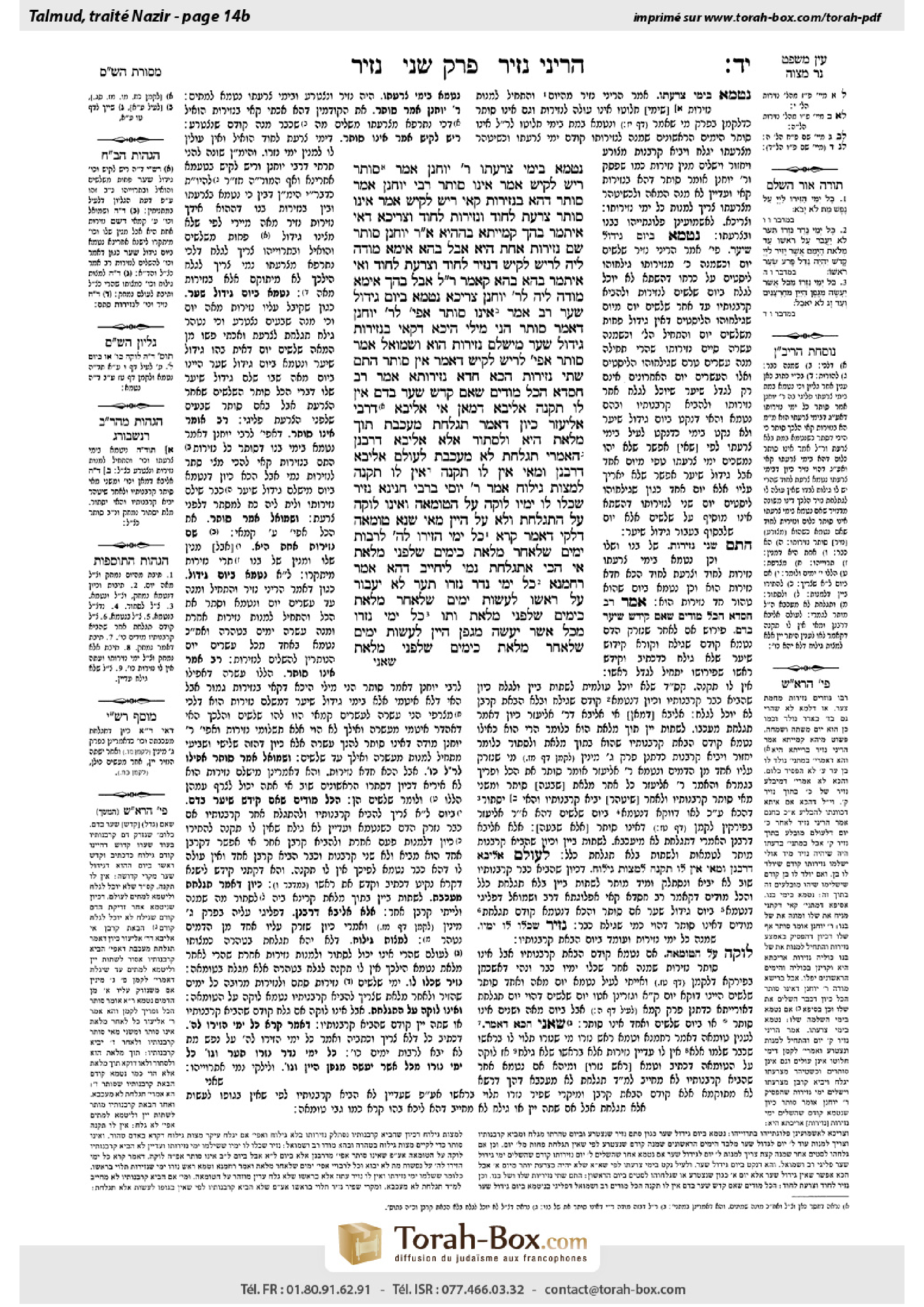
Nazir 14b: Talmud study for Daf Yomi
Daf Yomi is the daily study of one Talmud folio. Explore 37 tractates with scans, Hebrew text, Sefaria English and AI-generated French translations where annotated.
Passage selection and English or AI-generated French translation are available where the scan has annotations. Daf Study is independent of Torah-Box and Sefaria.
Browse Nazir · נזיר · All tractatesNazir 14b text and translations
This page of Nazir includes the Aramaic text, an English translation and an AI-generated French translation, alongside the scan above.
נזיר י״ד ב · Aramaic and Hebrew text
נִטְמָא בִּימֵי צָרַעְתּוֹ — רַבִּי יוֹחָנָן אָמַר: סוֹתֵר. רֵישׁ לָקִישׁ אָמַר: אֵינוֹ סוֹתֵר.
רַבִּי יוֹחָנָן אָמַר סוֹתֵר, דְּהָא בִּנְזִירוּת קָאֵי. רֵישׁ לָקִישׁ אָמַר אֵינוֹ סוֹתֵר — צָרַעַת לְחוּד וּנְזִירוּת לְחוּד.
וּצְרִיכָא, דְּאִי אִיתְּמַר בְּהָךְ קַמַּיְיתָא, בְּהַהִיא אָמַר רַבִּי יוֹחָנָן סוֹתֵר — שֵׁם נְזִירוּת אַחַת הִיא. אֲבָל בְּהָא אֵימָא מוֹדֶה לֵיהּ לְרֵישׁ לָקִישׁ, דְּנָזִיר לְחוּד וְצָרַעַת לְחוּד.
וְאִי אִיתְּמַר בְּהָא, בְּהָא קָאָמַר רֵישׁ לָקִישׁ, אֲבָל בְּהָךְ — אֵימָא מוֹדֶה לֵיהּ לְרַבִּי יוֹחָנָן, צְרִיכָא.
נִטְמָא בְּיוֹם גִּידּוּל שֵׂעָר. רַב אָמַר: אֵינוֹ סוֹתֵר. אֲפִילּוּ לְרַבִּי יוֹחָנָן דְּאָמַר סוֹתֵר — הָנֵי מִילֵּי הֵיכָא דְּקָאֵי בִּנְזִירוּת, גִּידּוּל שֵׂעָר מִישְׁלַם נְזִירוּת הוּא.
וּשְׁמוּאֵל אָמַר: סוֹתֵר. אֲפִילּוּ לְרֵישׁ לָקִישׁ דְּאָמַר אֵין סוֹתֵר — הָתָם שְׁתֵּי נְזִירוּת, הָכָא חֲדָא נְזִירוּתָא.
אָמַר רַב חִסְדָּא: הַכֹּל מוֹדִים שֶׁאִם קִדֵּשׁ שֵׂעָר בַּדָּם — אֵין לוֹ תַּקָּנָה.
אַלִּיבָּא דְּמַאן? אִי אַלִּיבָּא דְּרַבִּי אֱלִיעֶזֶר — כֵּיוָן דְּאָמַר תִּגְלַחַת מְעַכֶּבֶת, תּוֹךְ מְלֹאת הִיא? וְלִסְתּוֹר! אֶלָּא אַלִּיבָּא דְּרַבָּנַן — הָאָמְרִי תִּגְלַחַת לֹא מְעַכֶּבֶת! לְעוֹלָם אַלִּיבָּא דְּרַבָּנַן, וּמַאי ״אֵין לוֹ תַּקָּנָה״ — אֵין לוֹ תַּקָּנָה לְמִצְוַת גִּילּוּחַ.
אָמַר רַבִּי יוֹסֵי בְּרַבִּי חֲנִינָא: נָזִיר שֶׁכָּלוּ לוֹ יָמָיו — לוֹקֶה עַל הַטּוּמְאָה, וְאֵינוֹ לוֹקֶה עַל הַתִּגְלַחַת וְלֹא עַל הַיַּיִן. מַאי שְׁנָא טוּמְאָה דְּלָקֵי — דְּאָמַר קְרָא: ״כׇּל יְמֵי הַזִּירוֹ לַה׳״, לְרַבּוֹת יָמִים שֶׁלְּאַחַר מְלֹאת כְּיָמִים שֶׁלִּפְנֵי מְלֹאת.
אִי הָכִי, אַתִּגְלַחַת נָמֵי לִיחַיַּיב, דְּהָא אָמַר רַחֲמָנָא ״כׇּל יְמֵי נֶדֶר נִזְרוֹ תַּעַר לֹא יַעֲבֹר עַל רֹאשׁוֹ״, לַעֲשׂוֹת יָמִים שֶׁלְּאַחַר מְלֹאת כַּיָּמִים שֶׁלִּפְנֵי מְלֹאת! וְתוּ, ״כֹּל יְמֵי נִזְרוֹ מִכֹּל אֲשֶׁר יֵעָשֶׂה מִגֶּפֶן הַיַּיִן״, לַעֲשׂוֹת יָמִים שֶׁלְּאַחַר מְלֹאת כְּיָמִים שֶׁלִּפְנֵי מְלֹאת?
Nazir 14b · English translation
These two amora’im have a similar dispute in the case of one who contracted leprosy during his naziriteship and became impure by coming into contact with corpse during the days of his leprosy. Although the days of his leprosy do not negate the previous days of his naziriteship, they are not counted as part of his naziriteship either. Rabbi Yoḥanan says: Contraction of impurity from a corpse negates the days of naziriteship observed before his leprosy, which means he must start counting afresh once he is purified of leprosy. Reish Lakish says: It does not negate the days he has observed, and he need observe only the remaining days of his naziriteship after his purification.
The Gemara clarifies their respective approaches. Rabbi Yoḥanan says the impurity from a corpse negates the days he already observed, since he remains in a period of naziriteship even when he is a leper, as his leprosy does not negate his naziriteship. Reish Lakish says it does not negate the days he observed, since he maintains that leprosy is discrete and naziriteship is discrete. One’s time as a leper is not considered part of his naziriteship.
The Gemara comments: And it is necessary to teach this dispute in both cases. As, if it were stated in this first one, with regard to one who became impure during his term of naziriteship for the birth of his son, one might say that it is specifically in that case that Rabbi Yoḥanan said it also negates the days of his standard naziriteship because there is one label of naziriteship that applies to both vows, but in this case, where the leper became impure from a corpse, one might say he concedes to Reish Lakish that it does not negate the days of his naziriteship that he has counted, since a nazirite is discrete and leprosy is discrete.
And conversely, if it were stated only in this case, that of the leper who contracted impurity from a corpse, one might say that it is only in this case that Reish Lakish said it does not negate his days of naziriteship, but in that case, where one became impure while observing the term of naziriteship for his son, one might say he concedes to Rabbi Yoḥanan that it negates the entire period, since they are all days of naziriteship. Therefore, it is necessary for the dispute to be taught in both cases.
In connection with the dispute between Rabbi Yoḥanan and Reish Lakish, the Gemara discusses the case of a nazirite who became impure on the day of his hair growth. The case is that of one who contracted leprosy during his naziriteship and then was purified from his condition and shaved, as required of him. At this point he must wait another thirty days so that his hair can grow enough for him to shave it for the end of his naziriteship. If he became impure during this additional period, Rav said: It does not negate the days he previously counted for his naziriteship. The Gemara explains: Even according to Rabbi Yoḥanan, who says that if one became impure during the days of the term of naziriteship for his son it negates the entire period, this statement applies only where he still remains in a period of naziriteship, but the time of hair growth is an addition to his period of naziriteship and is not considered part of the term itself.
And Shmuel said: It negates the earlier days. The Gemara explains: Even according to Reish Lakish, who says that becoming impure during the naziriteship for his son does not negate the days of his naziriteship, there it is referring to a case of two distinct terms of naziriteship, a standard one for himself and another for his son. But here it is one naziriteship, since the days he observes for the growth of his hair complete his naziriteship.
§ Rav Ḥisda said: All concede that if the hair was consecrated during the sprinkling of the blood, he has no means of remedy. That is, if the nazirite had completed his term and brought his offerings, and the blood of the offerings was sprinkled, and he then became impure before shaving, he has no way to shave or to render wine permitted to himself. It has not been permitted through the offerings he brought because he has become impure, and he cannot bring other offerings for this purpose since one may not bring two sets of offerings for the same term of naziriteship.
The Gemara asks: In accordance with whose opinion did Rav Ḥisda state this halakha? If one says that it is in accordance with the opinion of Rabbi Eliezer, this cannot be, since Rabbi Eliezer said that shaving is indispensable to the completion of naziriteship. The impurity is therefore contracted within the full term of his naziriteship, in which case it would not make sense that he has no remedy; but let it instead negate his days of naziriteship, and he will observe them again, after which he will shave. Rather, perhaps Rav Ḥisda spoke in accordance with the opinion of the Rabbis; didn’t they say that shaving is not indispensable to the completion of naziriteship, which means his impurity occurred when he was no longer a nazirite? The Gemara answers: Actually, Rav Ḥisda ruled in accordance with the opinion of the Rabbis, and what is the meaning of: He has no means of remedy? It means: He has no means of remedy for the mitzva of shaving, i.e., he cannot fulfill the mitzva of shaving in purity as required.
§ Rabbi Yosei, son of Rabbi Ḥanina, said: A nazirite whose days of naziriteship are completed but who has yet to bring his offerings is flogged for the contracting of impurity if he becomes impure from a corpse, like any nazirite who becomes impure, but he is not flogged for the act of shaving, nor for the drinking of wine. The Gemara asks: What is different with regard to impurity that he is flogged for it? It is as the verse states: “All the days that he has consecrated himself unto the Lord he shall not come near to a dead body” (Numbers 6:6). The additional word “all” comes to include the days after the completion of his naziriteship and teaches that they are like the days before its completion with regard to the prohibition against contracting impurity from the dead. Therefore, he is liable to receive lashes.
The Gemara asks: If so, let him also be liable to receive lashes for shaving, since the Merciful One states in the Torah: “All the days of his vow of naziriteship there shall no razor come upon his head” (Numbers 6:5). Here too, the word “all” should render the days after the completion of his naziriteship like the days before its completion. And furthermore, with regard to wine as well, the verse states: “All the days of his naziriteship, from anything that is made of the grapevine, from the pressed grapes even to the grapestone, he shall not eat” (Numbers 6:4). Once again, the word “all” should render the days after the completion of his naziriteship like the days before its completion with regard to drinking wine. What is the reason for the difference in halakha between contracting impurity on the one hand, and shaving and drinking wine on the other?
Nazir 14b · Traduction française (IA)
Ces deux amoraïm sont en désaccord de manière similaire dans le cas d’un homme qui a contracté la lèpre pendant son naziréat et qui est devenu impur au contact d’un cadavre pendant les jours où il était lépreux. Bien que les jours de sa lèpre n’annulent pas les jours de naziréat déjà observés, ils ne sont pas non plus comptés comme faisant partie de son naziréat. Rabbi Yoḥanan dit : L’impureté contractée au contact d’un cadavre annule les jours de naziréat observés avant sa lèpre ; il doit donc recommencer à compter une fois purifié de la lèpre. Reish Lakish dit : Elle n’annule pas les jours déjà observés, et il ne lui reste qu’à observer les jours de naziréat qui lui restent après sa purification.
La Guemara précise leurs positions respectives. Rabbi Yoḥanan affirme que l’impureté contractée au contact d’un cadavre annule les jours déjà observés, car l’homme reste soumis au naziréat même lorsqu’il est lépreux, puisque sa lèpre n’annule pas son naziréat. Reish Lakish affirme qu’elle n’annule pas les jours observés, car, selon lui, la lèpre et le naziréat sont deux domaines distincts. Le temps passé comme lépreux n’est pas considéré comme faisant partie de son naziréat.
La Guemara fait remarquer : Il est nécessaire d’enseigner ce désaccord dans les deux cas. En effet, si seul le premier cas avait été rapporté, celui d’un homme devenu impur pendant sa période de naziréat à l’occasion de la naissance de son fils, on aurait pu dire que Rabbi Yoḥanan a affirmé que, dans ce cas seulement, cela annule également les jours de son naziréat ordinaire, car une même catégorie de naziréat s’applique aux deux vœux. Mais dans le cas présent, où le lépreux est devenu impur au contact d’un cadavre, on aurait pu dire qu’il reconnaît l’avis de Reish Lakish : cela n’annule pas les jours de naziréat qu’il a déjà comptés, puisque le naziréat et la lèpre sont deux domaines distincts.
Inversement, si seul le cas présent avait été rapporté, celui du lépreux qui a contracté l’impureté au contact d’un cadavre, on aurait pu dire que Reish Lakish a affirmé que, dans ce cas seulement, cela n’annule pas ses jours de naziréat. Mais dans l’autre cas, celui de l’homme devenu impur pendant la période de naziréat observée à l’occasion de la naissance de son fils, on aurait pu dire qu’il reconnaît l’avis de Rabbi Yoḥanan : cela annule toute la période, puisque tous ces jours sont des jours de naziréat. Il est donc nécessaire d’enseigner ce désaccord dans les deux cas.
À propos du désaccord entre Rabbi Yoḥanan et Reish Lakish, la Guemara examine le cas d’un nazir devenu impur le jour de la repousse de ses cheveux. Il s’agit d’un homme qui a contracté la lèpre pendant son naziréat, puis a été guéri et s’est rasé, comme il le devait. À ce stade, il doit attendre trente jours supplémentaires pour que ses cheveux repoussent suffisamment afin qu’il puisse les raser à la fin de son naziréat. S’il devient impur pendant cette période supplémentaire, Rav dit : Cela n’annule pas les jours de naziréat qu’il avait déjà comptés. La Guemara explique : Même selon Rabbi Yoḥanan, qui affirme que si un homme devient impur pendant la période de naziréat observée à l’occasion de la naissance de son fils, cela annule toute la période, cette règle ne s’applique que lorsqu’il est encore dans une période de naziréat. Or, le temps nécessaire à la repousse des cheveux s’ajoute à sa période de naziréat et n’est pas considéré comme faisant partie de la période elle-même.
Et Shmuel dit : Cela annule les jours précédents. La Guemara explique : Même selon Reish Lakish, qui affirme que devenir impur pendant le naziréat observé à l’occasion de la naissance de son fils n’annule pas les jours de naziréat, il s’agit là de deux périodes distinctes de naziréat, l’une ordinaire pour lui-même et l’autre pour son fils. Mais ici, il s’agit d’un seul naziréat, puisque les jours qu’il observe pour la repousse de ses cheveux achèvent son naziréat.
§ Rav Ḥisda dit : Tous reconnaissent que si les cheveux sont consacrés au moment de l’aspersion du sang, il n’a aucun moyen de remédier à la situation. Autrement dit, si le nazir a achevé sa période et apporté ses offrandes, que le sang des offrandes a été aspergé, puis qu’il est devenu impur avant de se raser, il n’a aucun moyen de se raser ni de se permettre la consommation de vin. Les offrandes qu’il a apportées ne l’ont pas autorisé à boire du vin, puisqu’il est devenu impur, et il ne peut pas apporter d’autres offrandes à cette fin, car on ne peut pas apporter deux séries d’offrandes pour une même période de naziréat.
La Guemara demande : Selon l’avis de qui Rav Ḥisda a-t-il énoncé cette halakha ? Si l’on répond : selon l’avis de Rabbi Eliezer, cela ne peut pas être, car Rabbi Eliezer a dit que le rasage est indispensable à l’achèvement du naziréat. L’impureté a donc été contractée pendant la période complète de son naziréat ; il ne serait alors pas logique de dire qu’il n’a aucun moyen de remédier à la situation. Cela devrait plutôt annuler ses jours de naziréat, qu’il observerait à nouveau, puis il se raserait. Peut-être Rav Ḥisda s’est-il exprimé selon l’avis des Sages ? N’ont-ils pas dit que le rasage n’est pas indispensable à l’achèvement du naziréat, ce qui signifie qu’il est devenu impur alors qu’il n’était déjà plus nazir ? La Guemara répond : En réalité, Rav Ḥisda a statué selon l’avis des Sages. Que signifie donc : « Il n’a aucun moyen de remédier à la situation » ? Cela signifie qu’il n’a aucun moyen de remédier à la mitsva du rasage, c’est-à-dire qu’il ne peut pas accomplir la mitsva du rasage en état de pureté, comme il le doit.
§ Rabbi Yosei, fils de Rabbi Ḥanina, dit : Un nazir dont les jours de naziréat sont achevés, mais qui n’a pas encore apporté ses offrandes, reçoit des coups s’il contracte l’impureté au contact d’un cadavre, comme tout nazir qui devient impur ; mais il ne reçoit pas de coups pour s’être rasé ni pour avoir bu du vin. La Guemara demande : Pourquoi reçoit-il des coups pour avoir contracté l’impureté ? C’est parce que le verset dit : « Tous les jours où il s’est consacré à l’Éternel, il ne s’approchera pas d’un mort » (Nombres 6:6). Le mot supplémentaire « tous » inclut les jours qui suivent l’achèvement de son naziréat et enseigne qu’ils sont semblables aux jours qui le précèdent en ce qui concerne l’interdiction de contracter l’impureté au contact d’un mort. Il est donc passible de coups.
La Guemara demande : Dans ce cas, ne devrait-il pas également être passible de coups pour s’être rasé, puisque le Miséricordieux dit dans la Torah : « Tous les jours de son vœu de naziréat, le rasoir ne passera pas sur sa tête » (Nombres 6:5) ? Ici aussi, le mot « tous » devrait rendre les jours suivant l’achèvement de son naziréat semblables aux jours qui le précèdent. De plus, pour le vin également, le verset dit : « Tous les jours de son naziréat, il ne mangera rien de ce qui est fait de la vigne, depuis les raisins pressés jusqu’au pépin » (Nombres 6:4). Là encore, le mot « tous » devrait rendre les jours suivant l’achèvement de son naziréat semblables aux jours qui le précèdent en ce qui concerne la consommation de vin. Quelle est la raison de cette différence de halakha entre, d’une part, le fait de contracter l’impureté et, d’autre part, le rasage et la consommation de vin ?
Traduction française générée par IA à partir de l’édition anglaise de Sefaria. Vérifie toujours un passage avec le texte source.
Text from Sefaria: William Davidson Edition - Vocalized Aramaic (CC BY NC); William Davidson Edition - English (CC BY NC).