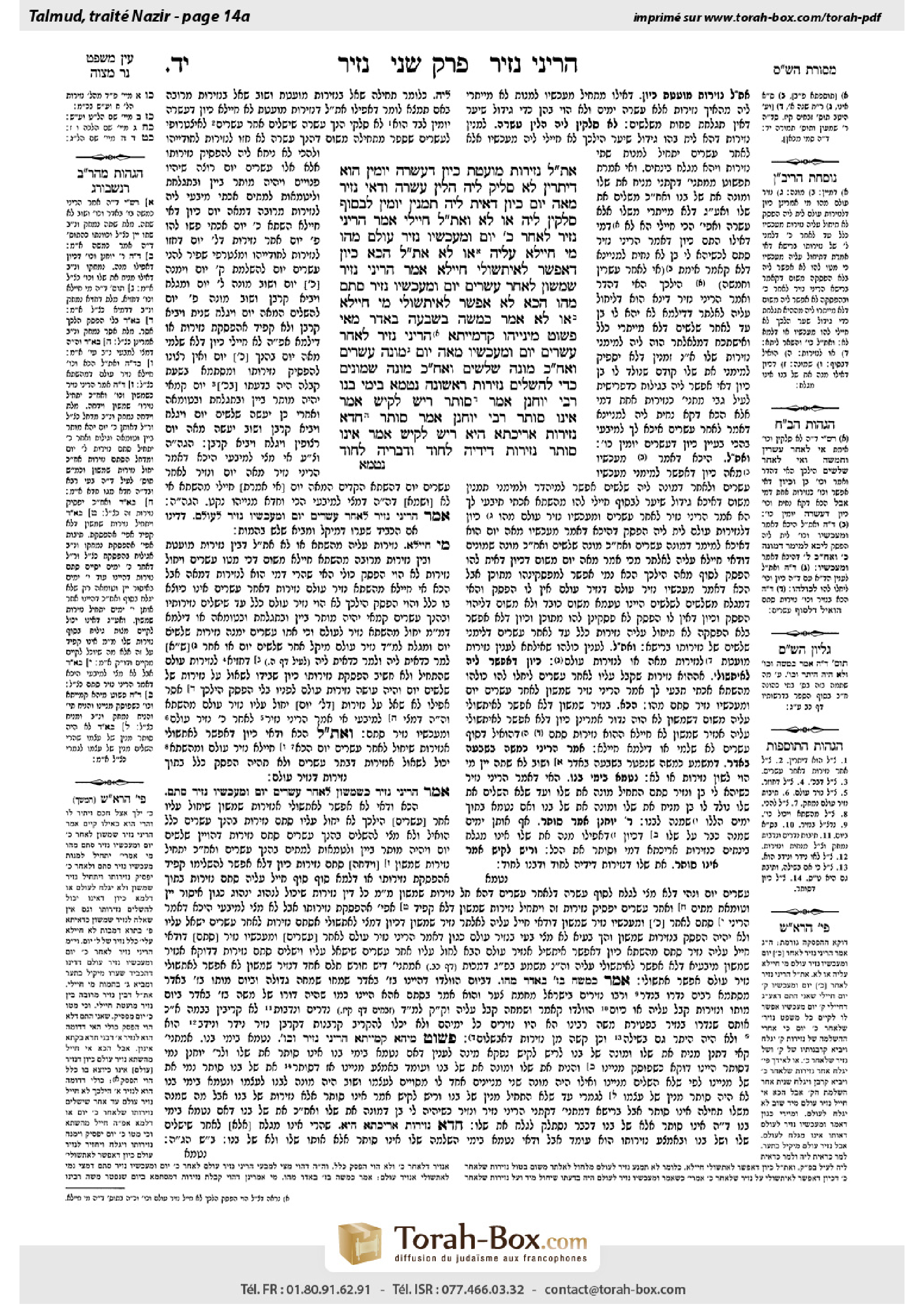
Nazir 14a: Talmud study for Daf Yomi
Daf Yomi is the daily study of one Talmud folio. Explore 37 tractates with scans, Hebrew text, Sefaria English and AI-generated French translations where annotated.
Passage selection and English or AI-generated French translation are available where the scan has annotations. Daf Study is independent of Torah-Box and Sefaria.
Browse Nazir · נזיר · All tractatesNazir 14a text and translations
This page of Nazir includes the Aramaic text, an English translation and an AI-generated French translation, alongside the scan above.
נזיר י״ד א · Aramaic and Hebrew text
אִם תִּמְצֵי לוֹמַר נְזִירוּת מוּעֶטֶת, כֵּיוָן דְּעַשְׂרָה יוֹמִין הוּא דְּיַתִּרִין — לָא סָלֵיק לֵיהּ הָלֵין עֲשָׂרָה, וַדַּאי נְזִיר מֵאָה יוֹם, כֵּיוָן דְּאִית לֵיהּ תְּמָנִין יוֹמִין לְבַסּוֹף, סָלְקִין לֵיהּ, אוֹ לָא?
וְאִם תִּמְצֵי לוֹמַר חָיְילִי: אָמַר ״הֲרֵינִי נָזִיר לְאַחַר עֶשְׂרִים יוֹם וּמֵעַכְשָׁיו נְזִיר עוֹלָם״, מַהוּ? מִי חָיְילָא עֲלֵיהּ, אוֹ לָא?
אִם תִּמְצֵי לוֹמַר: הָכָא כֵּיוָן דְּאֶפְשָׁר לְאִיתְּשׁוֹלֵי חָיְילָא: אָמַר ״הֲרֵינִי נְזִיר שִׁמְשׁוֹן לְאַחַר עֶשְׂרִים יוֹם וּמֵעַכְשָׁיו נָזִיר סְתָם״, מַהוּ? הָכָא לָא אֶפְשָׁר לְאִיתְּשׁוֹלֵי, מִי חָיְילָא, אוֹ לָא? אֲמַר ״כְּמֹשֶׁה בְּשִׁבְעָה בַּאֲדָר״, מַאי?
פְּשׁוֹט מִינַּיְיהוּ קַדְמָיְיתָא: ״הֲרֵינִי נָזִיר לְאַחַר עֶשְׂרִים יוֹם וּמֵעַכְשָׁיו מֵאָה יוֹם״ — מוֹנֶה עֶשְׂרִים, וְאַחַר כָּךְ מוֹנֶה שְׁלֹשִׁים, וְאַחַר כָּךְ מוֹנֶה שְׁמוֹנִים כְּדֵי לְהַשְׁלִים נְזִירוּת רִאשׁוֹנָה.
נִטְמָא בִּימֵי בְּנוֹ, רַבִּי יוֹחָנָן אָמַר: סוֹתֵר. רֵישׁ לָקִישׁ אָמַר: אֵינוֹ סוֹתֵר.
רַבִּי יוֹחָנָן אָמַר סוֹתֵר — חֲדָא נְזִירוּת אֲרִיכְתָּא הִיא, רֵישׁ לָקִישׁ אָמַר אֵינוֹ סוֹתֵר — נְזִירוּת דִּידֵיהּ לְחוּד, וְדִבְרֵיהּ לְחוּד.
Nazir 14a · English translation
If you say that when he accepts naziriteship upon himself after twenty days, and then vows a short term of naziriteship of thirty days starting now, then since, if he pauses from his first term of naziriteship after twenty days, it is only ten days that are left over to complete after the second term of naziriteship, those ten should not be reckoned for him to complete a full term of naziriteship. Ten days are insufficient for hair growth. Therefore, he must observe a full thirty-day term of naziriteship after the second term of naziriteship, which means he is not a nazirite for the first twenty days. With that assumption in mind, the question arose: Certainly if he vows to be a nazirite for one hundred days, since he has a further eighty days at the end, which is sufficient time for his hair to grow, do the first twenty days count for him as part of the one hundred days or not?
This inquiry leads to yet another question: And if you say that the first days of naziriteship take effect, and his term of naziriteship will be completed in the eighty days after the second term of naziriteship, then if he said: I am hereby a nazirite after twenty days, and from now I am a permanent nazirite, what is the halakha? Does the permanent naziriteship take effect for him during those twenty days or not? Since permanent naziriteship is unlimited, he could not have intended to complete its days after the second term of naziriteship, and it is reasonable to assume that he intended for the permanent naziriteship to begin after the second term of naziriteship has been completed.
If you say: Here, with regard to cases of a standard permanent naziriteship after twenty days, since it is possible to request of a halakhic authority to dissolve the vow, which would result in the first term of naziriteship taking full effect, it therefore takes effect during those twenty days, then the following question arises: If one said: I am hereby a nazirite like Samson after twenty days, and from now I am hereby a nazirite without specification, what is the halakha? Since here it is not possible to request of a halakhic authority to dissolve the vow of naziriteship like Samson, and there is no way of completing the first term of naziriteship, does the first naziriteship take effect or not? The Gemara adds another question: If one said: I am hereby like Moses on the seventh day of Adar, what is the halakha? Is this considered an expression of naziriteship in that just as Moses passed away on that date and drank no more wine, so too, the speaker vows to be a nazirite? Alternatively, perhaps this phrase does not indicate the acceptance of naziriteship.
The Gemara comments: At least resolve the first of these questions, the one raised at the beginning of the discussion, as it is stated explicitly in the Tosefta (2:5): If one says: I am hereby a nazirite after twenty days, and I am hereby a nazirite from now for one hundred days, he counts twenty days of his term of naziriteship immediately, after which he counts thirty days for the subsequent term of naziriteship, and afterward he counts eighty days in order to complete his first term of naziriteship.
§ The Gemara returns to its discussion of the statement of the mishna with regard to one who vowed to be a nazirite upon the birth of a son in addition to a standard term of naziriteship. The mishna ruled that he begins his term of naziriteship, and if he has a son during that term, he pauses from that term of naziriteship and starts the term for his son, after which he completes the first term. The Torah states that a nazirite who becomes impure while observing his term of naziriteship must start counting afresh, which leads to the following question: What happens if he became impure during the days of his term of naziriteship for his son? Rabbi Yoḥanan says: This negates all of it, even the days he has counted for his own term of naziriteship, and he must observe two full terms of naziriteship. Reish Lakish says: This does not negate the days he observed for his own term of naziriteship, only those of the term of naziriteship for his son.
The Gemara clarifies the two approaches: Rabbi Yoḥanan says it negates all of it, since he holds that it is one long term of naziriteship. Reish Lakish says it does not negate the days he observed for his own term of naziriteship because his term of naziriteship is a discrete naziriteship, and that for his son is a discrete naziriteship.
Nazir 14a · Traduction française (IA)
Si tu dis que, lorsqu’il accepte le naziréat pour dans vingt jours, puis fait vœu d’un naziréat court de trente jours à compter de maintenant, les dix jours qui lui resteront à accomplir après le second naziréat ne doivent pas être comptés pour compléter une période entière de naziréat, puisque, s’il interrompt sa première période de naziréat au bout de vingt jours, il ne lui restera que ces dix jours à accomplir. Dix jours ne suffisent pas à la repousse des cheveux. Il doit donc observer une période complète de naziréat de trente jours après le second naziréat, ce qui signifie qu’il n’est pas naziréen pendant les vingt premiers jours. Partant de cette hypothèse, la question s’est posée : à plus forte raison, s’il fait vœu d’être naziréen pendant cent jours, puisque les quatre-vingts jours qui lui restent à la fin suffisent à la repousse des cheveux, les vingt premiers jours sont-ils comptés comme faisant partie des cent jours, ou non ?
Cette question en entraîne une autre : si tu dis que les premiers jours de naziréat prennent effet et que sa période de naziréat s’achèvera au cours des quatre-vingts jours suivant le second naziréat, alors, s’il a dit : « Me voici naziréen dans vingt jours, et dès maintenant naziréen à vie », quelle est la halakha ? Le naziréat à vie prend-il effet pour lui pendant ces vingt jours ou non ? Puisque le naziréat à vie n’a pas de limite, il ne pouvait pas avoir l’intention d’en accomplir la période après le second naziréat ; il est donc raisonnable de supposer qu’il voulait que le naziréat à vie commence après l’achèvement du second naziréat.
Si tu dis que, dans le cas d’un naziréat à vie ordinaire prenant effet dans vingt jours, celui-ci prend effet pendant ces vingt jours, puisqu’il est possible de demander à une autorité halakhique de délier le vœu, ce qui permettrait alors à la première période de naziréat de prendre pleinement effet, une autre question se pose : si quelqu’un a dit : « Me voici naziréen comme Samson dans vingt jours, et dès maintenant me voici naziréen sans précision », quelle est la halakha ? Puisqu’il n’est pas possible ici de demander à une autorité halakhique de délier le vœu de naziréat comme Samson, et qu’il n’y a aucun moyen d’accomplir la première période de naziréat, ce premier naziréat prend-il effet ou non ? La Guemara ajoute une autre question : si quelqu’un a dit : « Me voici comme Moïse le septième jour d’Adar », quelle est la halakha ? Est-ce considéré comme une formule de naziréat, au motif que, de même que Moïse est mort à cette date et n’a plus bu de vin, de même celui qui parle fait vœu d’être naziréen ? Ou bien cette expression n’indique-t-elle pas l’acceptation du naziréat ?
La Guemara fait remarquer : résolvons au moins la première de ces questions, celle soulevée au début de la discussion, puisqu’elle est explicitement énoncée dans la Tossefta (2:5) : si quelqu’un dit : « Me voici naziréen dans vingt jours, et dès maintenant me voici naziréen pour cent jours », il compte immédiatement vingt jours de sa période de naziréat, après quoi il compte trente jours pour la période de naziréat suivante, puis quatre-vingts jours afin d’achever sa première période de naziréat.
§ La Guemara revient à son examen de l’énoncé de la Michna concernant celui qui a fait vœu d’être naziréen à la naissance d’un fils, en plus d’une période ordinaire de naziréat. La Michna statue qu’il commence sa période de naziréat et que, si un fils lui naît pendant cette période, il l’interrompt et commence la période due pour son fils, après quoi il achève la première période. La Torah stipule qu’un naziréen qui devient impur pendant sa période de naziréat doit recommencer le compte depuis le début, ce qui soulève la question suivante : que se passe-t-il s’il est devenu impur pendant les jours de sa période de naziréat due pour son fils ? Rabbi Yoḥanan dit : cela annule tout, même les jours qu’il a comptés pour sa propre période de naziréat, et il doit observer deux périodes complètes de naziréat. Reish Lakish dit : cela n’annule pas les jours qu’il a observés pour sa propre période de naziréat, mais seulement ceux de la période de naziréat due pour son fils.
La Guemara précise les deux approches : Rabbi Yoḥanan dit que cela annule tout, car il considère qu’il s’agit d’une seule longue période de naziréat. Reish Lakish dit que cela n’annule pas les jours observés pour sa propre période de naziréat, car sa période de naziréat est distincte, tout comme celle due pour son fils est une période de naziréat distincte.
Traduction française générée par IA à partir de l’édition anglaise de Sefaria. Vérifie toujours un passage avec le texte source.
Text from Sefaria: William Davidson Edition - Vocalized Aramaic (CC BY NC); William Davidson Edition - English (CC BY NC).