Nazir 13b: Talmud study for Daf Yomi
Daf Yomi is the daily study of one Talmud folio. Explore 37 tractates with scans, Hebrew text, Sefaria English and AI-generated French translations where annotated.
Passage selection and English or AI-generated French translation are available where the scan has annotations. Daf Study is independent of Torah-Box and Sefaria.
Browse Nazir · נזיר · All tractatesNazir 13b text and translations
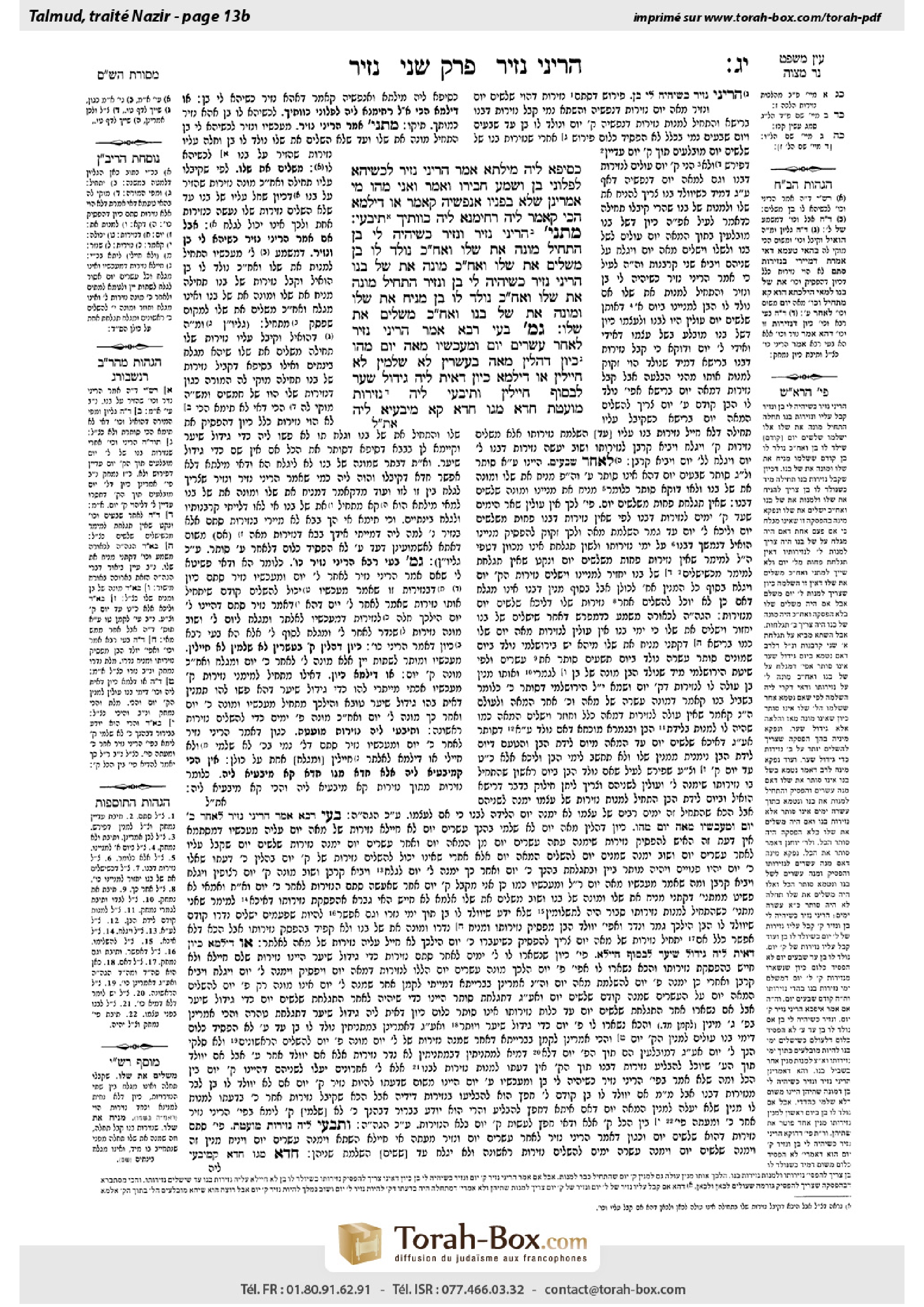
This page of Nazir includes the Aramaic text, an English translation and an AI-generated French translation, alongside the scan above.
נזיר י״ג ב · Aramaic and Hebrew text
כְּסִיפָא לֵיהּ מִילְּתָא, אָמַר ״הֲרֵינִי נָזִיר לִכְשֶׁיְּהֵא לִפְלוֹנִי בֵּן״, וְשָׁמַע חֲבֵירוֹ וְאָמַר ״וַאֲנִי״, מַהוּ? מִי אָמְרִינַן: שֶׁלֹּא בְּפָנָיו, אַנַּפְשֵׁיהּ קָאָמַר, אוֹ דִילְמָא הָכִי קָאָמַר לֵיהּ: רָחֵימְנָא לֵיהּ כְּווֹתָיךְ. תִּיבְּעֵי.
מַתְנִי׳ ״הֲרֵינִי נָזִיר, וְנָזִיר כְּשֶׁיִּהְיֶה לִי בֵּן״, הִתְחִיל מוֹנֶה אֶת שֶׁלּוֹ, וְאַחַר כָּךְ נוֹלַד לוֹ בֵּן — מַשְׁלִים אֶת שֶׁלּוֹ, וְאַחַר כָּךְ מוֹנֶה אֶת שֶׁל בְּנוֹ. ״הֲרֵינִי נָזִיר כְּשֶׁיִּהְיֶה לִי בֵּן, וְנָזִיר״, הִתְחִיל מוֹנֶה אֶת שֶׁלּוֹ וְאַחַר כָּךְ נוֹלַד לוֹ בֵּן — מַנִּיחַ אֶת שֶׁלּוֹ, וּמוֹנֶה אֶת שֶׁל בְּנוֹ, וְאַחַר כָּךְ מַשְׁלִים אֶת שֶׁלּוֹ.
גְּמָ׳ בָּעֵי רָבָא: אָמַר ״הֲרֵינִי נָזִיר לְאַחַר עֶשְׂרִים יוֹם, וּמֵעַכְשָׁיו מֵאָה יוֹם״, מַהוּ? כֵּיוָן דְּהָלֵין מְאָה בְּעֶשְׂרִין לָא שָׁלְמִין — לָא חָיְילִין, אוֹ דִילְמָא: כֵּיוָן דְּאִית לֵיהּ גִּידּוּל שֵׂעָר לְבַסּוֹף — חָיְילִין.
וְתִיבְּעֵי לֵיהּ נְזִירוּת מוּעֶטֶת! חֲדָא מִגּוֹ חֲדָא קָא מִיבַּעְיָא לֵיהּ:
Nazir 13b · English translation
should be understood in light of the fact that the matter is embarrassing for him, the second person is likely to mean that he will become a nazirite upon the birth of a child to the first person, as he will be embarrassed to seem indifferent about the birth of the child to the person standing before him, then the following question arises: If one said: I am hereby a nazirite when so-and-so will have a son, and another heard and said: And I, what is the halakha? Do we say that since the second person did not vow in front of the subject of the first person’s vow, he therefore speaks of himself when he says: And I, meaning that he will be a nazirite when he has a son of his own? Or perhaps this is what he is saying to him: I love him as you do, and I too will be a nazirite when he has a son. As in the previous cases, no answer was found for this question, and the dilemma remains unresolved.
MISHNA: In a case where one said: I am hereby a nazirite now, and I will be a nazirite when I will have a son, and he began counting his own term of naziriteship, i.e., his first vow, and afterward in the middle of this naziriteship period a son was born to him, he first completes his own initial term of naziriteship and afterward he counts the term of naziriteship he vowed on the condition of the birth of his son. However, if he reversed the order and said: I am hereby a nazirite when I will have a son, and I am hereby a nazirite, and he began counting his own term of naziriteship and afterward, during this period, a son was born to him, he sets aside his own term of naziriteship and counts that which he vowed on condition of the birth of his son, and afterward he completes his own term of naziriteship.
GEMARA: In light of the ruling of the mishna, Rava asks: If one said: I am hereby a nazirite for a standard term of thirty days and will begin observing it after twenty days, and I am also a nazirite from now for one hundred days, what is the halakha? Should one say that since these one hundred days of naziriteship are not completed within those first twenty days, it could be said that the one hundred days of naziriteship do not take effect at all until after he has completed the thirty-day naziriteship? Or perhaps, since he still has at least thirty days of hair growth at the end, as after the thirty-day term he could observe an additional eighty days, therefore the one hundred days of naziriteship take effect from now, and he counts twenty days, pauses to observe the other term of naziriteship for thirty days, shaves, and then completes the final eighty days of the long term of naziriteship.
The Gemara asks: And let him raise this dilemma with regard to a short term of naziriteship, when fewer than thirty days would remain if he suspended the first term of naziriteship in order to observe the other. The Gemara answers: He raises one dilemma as a result of the other. In other words, Rava’s question was an outgrowth of a different inquiry, which in turn led to his question. The full discussion is as follows:
Nazir 13b · Traduction française (IA)
Il faut comprendre cela à la lumière du fait que la situation est embarrassante pour lui : le second est susceptible de vouloir dire qu’il deviendra nazir lorsque le premier aura un fils, car il serait gêné de paraître indifférent à la naissance d’un enfant chez la personne qui se tient devant lui. Dès lors se pose la question suivante : si quelqu’un dit : « Me voici nazir lorsque Untel aura un fils », et qu’un autre l’entend et dit : « Moi aussi », quelle est la halakha ? Doit-on dire que, puisque le second n’a pas fait son vœu en présence de la personne concernée par le vœu du premier, il parle de lui-même lorsqu’il dit : « Moi aussi », c’est-à-dire qu’il sera nazir lorsqu’il aura lui-même un fils ? Ou peut-être lui dit-il : « Je l’aime comme toi, et moi aussi je serai nazir lorsqu’il aura un fils. » Comme dans les cas précédents, aucune réponse n’a été trouvée à cette question, et le dilemme demeure sans solution.
MICHNA : Si quelqu’un dit : « Me voici nazir dès maintenant, et je serai nazir lorsque j’aurai un fils », et qu’il commence à compter sa période de naziréat correspondant à son premier vœu, puis qu’un fils lui naît au milieu de cette période, il achève d’abord sa période initiale de naziréat, puis compte la période de naziréat qu’il a vouée à la condition que son fils naisse. En revanche, s’il inverse l’ordre et dit : « Me voici nazir lorsque j’aurai un fils, et me voici nazir », qu’il commence à compter sa période de naziréat, puis qu’un fils lui naît au cours de cette période, il interrompt sa propre période de naziréat et compte celle qu’il a vouée à la condition de la naissance de son fils, puis achève sa propre période de naziréat.
GUEMARA : À la lumière de la décision de la Michna, Rava demande : si quelqu’un dit : « Me voici nazir pour une période ordinaire de trente jours, que je commencerai à observer dans vingt jours, et je suis également nazir dès maintenant pour cent jours », quelle est la halakha ? Doit-on dire que, puisque ces cent jours de naziréat ne peuvent être achevés au cours de ces vingt premiers jours, la période de cent jours de naziréat ne prend effet qu’après qu’il a achevé la période de trente jours ? Ou peut-être que, puisqu’il lui restera au moins trente jours de pousse des cheveux à la fin — car, après la période de trente jours, il pourra observer quatre-vingts jours supplémentaires —, la période de cent jours de naziréat prend effet dès maintenant : il compte vingt jours, interrompt cette période pour observer l’autre période de naziréat pendant trente jours, se rase, puis achève les quatre-vingts derniers jours de la longue période de naziréat.
La Guemara demande : Qu’en est-il si l’on pose ce dilemme au sujet d’une courte période de naziréat, lorsqu’il resterait moins de trente jours s’il suspendait la première période de naziréat pour observer l’autre ? La Guemara répond : il pose un dilemme à la suite d’un autre. Autrement dit, la question de Rava découle d’une autre interrogation, qui, à son tour, l’a conduit à poser sa question. La discussion complète est la suivante :
Traduction française générée par IA à partir de l’édition anglaise de Sefaria. Vérifie toujours un passage avec le texte source.
Text from Sefaria: William Davidson Edition - Vocalized Aramaic (CC BY NC); William Davidson Edition - English (CC BY NC).