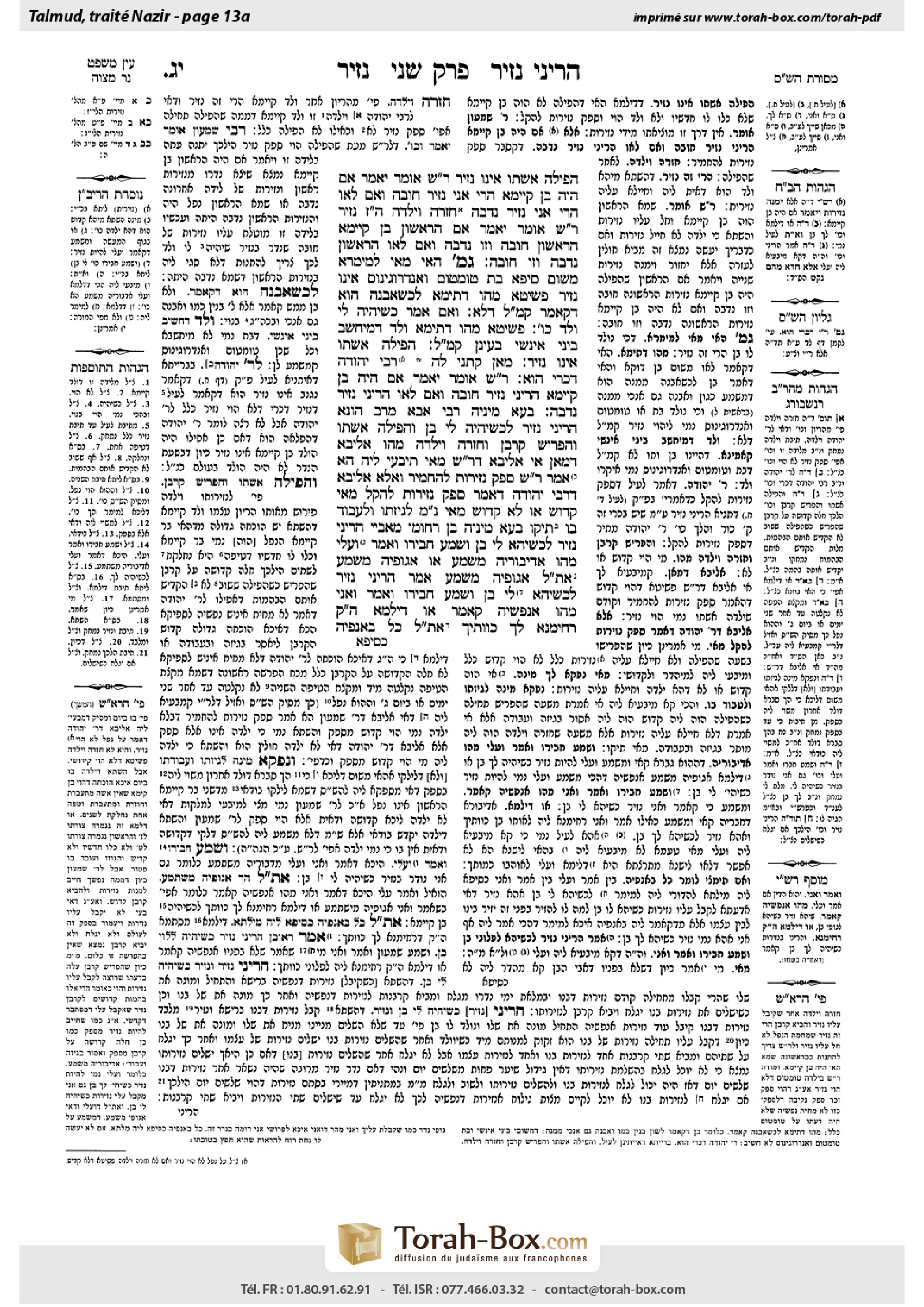
Nazir 13a: Talmud study for Daf Yomi
Daf Yomi is the daily study of one Talmud folio. Explore 37 tractates with scans, Hebrew text, Sefaria English and AI-generated French translations where annotated.
Passage selection and English or AI-generated French translation are available where the scan has annotations. Daf Study is independent of Torah-Box and Sefaria.
Browse Nazir · נזיר · All tractatesNazir 13a text and translations
This page of Nazir includes the Aramaic text, an English translation and an AI-generated French translation, alongside the scan above.
נזיר י״ג א · Aramaic and Hebrew text
הִפִּילָה אִשְׁתּוֹ — אֵינוֹ נָזִיר. רַבִּי שִׁמְעוֹן אוֹמֵר: יֹאמַר ״אִם הָיָה בֶּן קַיָּימָא — הֲרֵי אֲנִי נְזִיר חוֹבָה, וְאִם לָאו — הֲרֵי אֲנִי נְזִיר נְדָבָה״.
חָזְרָה וְיָלְדָה — הֲרֵי זֶה נָזִיר. רַבִּי שִׁמְעוֹן אוֹמֵר: יֹאמַר ״אִם הָרִאשׁוֹן בֶּן קַיָּימָא — הָרִאשׁוֹן חוֹבָה וְזוֹ נְדָבָה. וְאִם לָאו — הָרִאשׁוֹן נְדָבָה וְזוֹ חוֹבָה״.
גְּמָ׳ הַאי מַאי לְמֵימְרָא? מִשּׁוּם סֵיפָא: בַּת, טוּמְטוּם וְאַנְדְּרוֹגִינוֹס — אֵינוֹ נָזִיר. פְּשִׁיטָא! מַהוּ דְּתֵימָא: ״לִכְשֶׁאֶבָּנֶה״ הוּא דְּקָאָמַר, קָא מַשְׁמַע לַן דְּלָא.
וְאִם אָמַר כְּשֶׁיִּהְיֶה לִי וָלָד כּוּ׳. פְּשִׁיטָא! מַהוּ דְּתֵימָא וָלָד דְּמִיחֲשַׁב בֵּינֵי אִינָשֵׁי בָּעִינַן, קָא מַשְׁמַע לַן.
הִפִּילָה אִשְׁתּוֹ — אֵינוֹ נָזִיר. מַאן קָתָנֵי לַהּ? רַבִּי יְהוּדָה דִּכְרִי הוּא.
רַבִּי שִׁמְעוֹן אוֹמֵר: יֹאמַר ״אִם הָיָה בֶּן קַיָּימָא — הֲרֵינִי נְזִיר חוֹבָה, וְאִם לָאו — הֲרֵינִי נְזִיר נְדָבָה״. בְּעָא מִינֵּיהּ רַבִּי אַבָּא מֵרַב הוּנָא: ״הֲרֵינִי נָזִיר לִכְשֶׁיִּהְיֶה לִי בֵּן״, וְהִפִּילָה אִשְׁתּוֹ, וְהִפְרִישׁ קׇרְבָּן, וְחָזְרָה וְיָלְדָה, מַהוּ?
אַלִּיבָּא דְּמַאן? אִי אַלִּיבָּא דְּרַבִּי שִׁמְעוֹן, מַאי תִּיבְּעֵי לֵיהּ? הָא אָמַר רַבִּי שִׁמְעוֹן: סְפֵק נְזִירוּת לְהַחֲמִיר. וְאֶלָּא אַלִּיבָּא דְּרַבִּי יְהוּדָה, דְּאָמַר: סְפֵק נְזִירוּת לְהָקֵל. מַאי: קָדוֹשׁ, אוֹ לָא קָדוֹשׁ?
מַאי נָפְקָא מִינַּהּ! לְגִיזָּתוֹ וְלַעֲבוֹד בּוֹ. תֵּיקוּ.
בְּעָא מִינֵּיהּ בֶּן רְחוּמִי מֵאַבָּיֵי: ״הֲרֵינִי נָזִיר לִכְשֶׁיְּהֵא לִי בֵּן״, וְשָׁמַע חֲבֵירוֹ וְאָמַר ״וְעָלַי״, מַהוּ? אַדִּיבּוּרֵיהּ מַשְׁמַע, אוֹ אַגּוּפֵיהּ מַשְׁמַע?
אִם תִּמְצֵי לוֹמַר אַגּוּפֵיהּ מַשְׁמַע, אָמַר: ״הֲרֵינִי נָזִיר לִכְשֶׁיְּהֵא לִי בֵּן״, וְשָׁמַע חֲבֵירוֹ וְאָמַר ״וַאֲנִי״, מַהוּ? אַנַּפְשֵׁיהּ קָאָמַר, אוֹ דִילְמָא הָכִי קָאָמַר: רָחֵימְנָא לָךְ כְּווֹתָיךְ. אִם תִּמְצֵי לוֹמַר, כֹּל בְּאַנְפֵּיהּ
Nazir 13a · English translation
However, if his wife miscarried he is not a nazirite, since his wife did not give birth to a live child. Rabbi Shimon says: Since it is possible that the fetus was viable, in which case his vow of naziriteship takes effect, he should say the following: If this fetus was viable in terms of its development but died due to other causes, I am hereby an obligatory nazirite in fulfillment of my vow; and if it was not viable, I am hereby a voluntary nazirite. He then proceeds to observe naziriteship.
If, subsequent to this, his wife gave birth again, he is a nazirite, since the unattributed opinion in the mishna holds that the condition of his vow has now been fulfilled. Rabbi Shimon says, following his earlier ruling: He must now accept upon himself an additional naziriteship and he should say: If the first fetus was viable then my naziriteship for the first child was obligatory, and this naziriteship is voluntary; and if the first child was not viable, then the naziriteship for the first one was voluntary and this naziriteship is obligatory.
GEMARA: With regard to the statement of the mishna that one who vowed to be a nazirite when a son is born to him is a nazirite when his son is born, the Gemara asks: What is the purpose of stating this ruling? Of course he is a nazirite. The Gemara answers: This halakha is stated due to the latter clause of that mishna, which states that if a daughter, a tumtum, or a hermaphrodite are born to him, he is not a nazirite. The Gemara questions this, too: Isn’t that obvious, since he specified a son? The Gemara answers: It is necessary lest you say he did not literally mean a son, but rather he meant to say: When I will be built up by means of any child, including the types listed. The mishna therefore teaches us that this is not the case.
The mishna also taught: And if he said: When I have a child, then even if he has a daughter, a tumtum, or a hermaphrodite, his vow takes effect. The Gemara asks: Isn’t it obvious that this is the case? The Gemara answers: It is necessary to state this lest you say that we require a child of the kind that is considered significant by people, and he meant to exclude these other types of children when he vowed. The mishna therefore teaches us that this is not so.
§ The mishna taught that if his wife miscarried he is not a nazirite, even though it may have been a viable child. The Gemara clarifies: According to whose opinion is this taught? The Gemara answers: It is the opinion of Rabbi Yehuda with regard to a heap of wheat. Rabbi Yehuda holds that if one vows to be a nazirite if a heap contains a certain amount of wheat and it is unclear whether or not his condition was fulfilled, the halakha is ruled leniently, and he is not a nazirite.
The mishna further taught that Rabbi Shimon says that the individual should say: If this fetus was viable in terms of its development but died due to other causes, I am hereby an obligatory nazirite in fulfillment of my vow; and if it was not viable, I am hereby a voluntary nazirite. The Gemara relates that Rabbi Abba inquired of Rav Huna: If one said: I am hereby a nazirite when I will have a son, and his wife miscarried, and he separated an offering for his naziriteship but did not sacrifice it, and his wife gave birth again to a son, what is the halakha with regard to the offering he separated?
The Gemara asks: In accordance with whose opinion did Rabbi Abba pose his question? If he asked it in accordance with the opinion of Rabbi Shimon, what dilemma is he raising? Didn’t Rabbi Shimon say: In a case of uncertainty with regard to naziriteship, the ruling is to be stringent? Here too, since the fetus might have been viable, he was required to separate the offerings after she miscarried, and he may not use those offerings for the naziriteship brought about by the later birth. Rather, one should say that the question was in accordance with the opinion of Rabbi Yehuda, who said that in a case of uncertainty with regard to naziriteship, the ruling is to be lenient. The question is as follows: What is the halakha in such a situation? Are the offerings already considered consecrated and need not be consecrated again, or are they not consecrated and therefore he must consecrate them a second time?
The Gemara asks: What difference is there? In any case, he is certainly obligated to observe naziriteship now, and he must separate the offerings. The Gemara answers: The question is referring to the issue of its shearing and its labor. If they are considered consecrated from the initial consecration, it is prohibited to shear their wool and use them for labor, like any other consecrated animal. But if they are not yet consecrated, it is permitted to use them. No answer was found for this question, and the Gemara concludes that the dilemma shall stand unresolved.
§ With regard to one who accepted naziriteship upon himself that would begin upon the birth of his son, the Sage ben Reḥumi inquired of Abaye: If one said: I am hereby a nazirite when I will have a son, and another heard him and said: And it is incumbent upon me, what is the halakha with regard to the second person? Is the implication of his statement a concurrence to the statement of the first one, which would mean that he too accepts naziriteship upon himself when the first has a son, or is the implication of his statement meant to be understood about himself, i.e., that he has vowed to be a nazirite when he has a son of his own?
The Gemara develops the question further: Even if you say that the phrase: And it is incumbent upon me, has the implication of meaning that it is to be understood about himself, what is the halakha if one said: I am hereby a nazirite when I will have a son, and another heard him and said: And I? What is the meaning of the second person’s statement? Is it to be understood that here too, he is speaking of himself, meaning: I shall be a nazirite when I will have a son of my own, or perhaps this is what he is saying: I love you as you love yourself; I would be as happy as you at the birth of your son, and I too will be a nazirite when you have a son. Ben Reḥumi continues: If you say that anything he says to another in front of him
Nazir 13a · Traduction française (IA)
Cependant, si sa femme fait une fausse couche, il n’est pas nazir, puisque sa femme n’a pas donné naissance à un enfant vivant. Rabbi Shimon dit : Puisqu’il est possible que le fœtus ait été viable, auquel cas son vœu de naziréat prend effet, qu’il dise ce qui suit : « Si ce fœtus était viable, mais qu’il est mort pour d’autres raisons, je suis désormais un nazir obligatoire, en accomplissement de mon vœu ; et s’il n’était pas viable, je suis désormais un nazir volontaire. » Il observe alors le naziréat.
Si, par la suite, sa femme donne de nouveau naissance à un enfant, il est nazir, car, selon l’opinion anonyme de la Michna, la condition de son vœu est désormais remplie. Rabbi Shimon dit, conformément à sa décision précédente : Il doit maintenant s’imposer un naziréat supplémentaire et dire : « Si le premier fœtus était viable, alors mon naziréat pour le premier enfant était obligatoire et ce naziréat-ci est volontaire ; et si le premier enfant n’était pas viable, alors le naziréat pour le premier était volontaire et ce naziréat-ci est obligatoire. »
GUEMARA : À propos de l’affirmation de la Michna selon laquelle celui qui a fait vœu d’être nazir à la naissance d’un fils l’est lorsque son fils naît, la Guemara demande : À quoi bon énoncer cette règle ? Il est évident qu’il est nazir. La Guemara répond : Cette halakha est énoncée en raison de la clause suivante de cette Michna, qui enseigne que s’il lui naît une fille, un tumtum ou un androgyne, il n’est pas nazir. La Guemara s’interroge également sur ce point : N’est-ce pas évident, puisqu’il a précisé qu’il s’agissait d’un fils ? La Guemara répond : C’est nécessaire, de peur que tu dises qu’il ne voulait pas dire littéralement « un fils », mais plutôt : « Quand je serai comblé par un enfant », quel qu’il soit, y compris les types énumérés. La Michna nous enseigne donc qu’il n’en est pas ainsi.
La Michna a également enseigné : S’il a dit : « Quand j’aurai un enfant », son vœu prend effet même s’il lui naît une fille, un tumtum ou un androgyne. La Guemara demande : N’est-il pas évident que c’est le cas ? La Guemara répond : Il est nécessaire de le préciser, de peur que tu dises qu’il faut un enfant du type que les gens considèrent comme important, et qu’en faisant son vœu, il entendait exclure ces autres types d’enfants. La Michna nous enseigne donc qu’il n’en est pas ainsi.
§ La Michna a enseigné que si sa femme fait une fausse couche, il n’est pas nazir, même s’il se peut que l’enfant ait été viable. La Guemara précise : Selon l’opinion de qui cet enseignement est-il formulé ? La Guemara répond : C’est l’opinion de Rabbi Yehuda concernant un tas de blé. Rabbi Yehuda soutient que si quelqu’un fait vœu d’être nazir si un tas contient une certaine quantité de blé, et qu’on ne sait pas si la condition de son vœu est remplie, la halakha est tranchée avec indulgence : il n’est pas nazir.
La Michna a ensuite enseigné que Rabbi Shimon dit que l’homme doit dire : « Si ce fœtus était viable, mais qu’il est mort pour d’autres raisons, je suis désormais un nazir obligatoire, en accomplissement de mon vœu ; et s’il n’était pas viable, je suis désormais un nazir volontaire. » La Guemara rapporte que Rabbi Abba demanda à Rav Huna : Si quelqu’un a dit : « Je serai nazir quand j’aurai un fils », que sa femme fait une fausse couche, qu’il met à part une offrande pour son naziréat sans la sacrifier, puis que sa femme donne de nouveau naissance à un fils, quelle est la halakha concernant l’offrande qu’il a mise à part ?
La Guemara demande : Selon l’opinion de qui Rabbi Abba a-t-il posé sa question ? S’il l’a posée selon l’opinion de Rabbi Shimon, quel dilemme soulève-t-il ? Rabbi Shimon n’a-t-il pas dit que, dans un cas d’incertitude concernant le naziréat, la décision doit être stricte ? Ici aussi, puisque le fœtus a pu être viable, il devait mettre les offrandes à part après la fausse couche et ne peut pas les utiliser pour le naziréat provoqué par la naissance ultérieure. Il faut donc plutôt dire que la question est posée selon l’opinion de Rabbi Yehuda, qui a dit que, dans un cas d’incertitude concernant le naziréat, la décision doit être indulgente. La question est la suivante : quelle est la halakha dans une telle situation ? Les offrandes sont-elles déjà considérées comme consacrées, si bien qu’il n’est pas nécessaire de les consacrer à nouveau, ou ne sont-elles pas consacrées et doit-il donc les consacrer une seconde fois ?
La Guemara demande : Quelle différence cela fait-il ? De toute façon, il est certainement tenu d’observer le naziréat à présent et doit mettre les offrandes à part. La Guemara répond : La question porte sur la tonte de leur laine et leur utilisation pour le travail. Si elles sont considérées comme consacrées depuis la consécration initiale, il est interdit de tondre leur laine et de les utiliser pour le travail, comme tout autre animal consacré. Mais si elles ne sont pas encore consacrées, il est permis de les utiliser. Aucune réponse n’a été trouvée à cette question, et la Guemara conclut que le dilemme reste sans solution.
§ À propos de celui qui s’est imposé le naziréat, lequel devait commencer à la naissance de son fils, le Sage ben Reḥumi demanda à Abaye : Si quelqu’un a dit : « Je serai nazir quand j’aurai un fils », et qu’un autre l’a entendu et a dit : « Et moi aussi, je m’y engage », quelle est la halakha concernant la seconde personne ? Sa déclaration signifie-t-elle qu’elle souscrit à celle de la première personne, c’est-à-dire qu’elle s’impose elle aussi le naziréat lorsque le premier aura un fils, ou faut-il comprendre sa déclaration comme la concernant elle-même, c’est-à-dire qu’elle a fait vœu d’être nazir quand elle aura son propre fils ?
La Guemara développe davantage la question : Même si tu dis que la formule « Et moi aussi, je m’y engage » signifie qu’il faut la comprendre à son propre sujet, quelle est la halakha si quelqu’un a dit : « Je serai nazir quand j’aurai un fils », qu’un autre l’a entendu et a dit : « Et moi ? » Quel est le sens de la déclaration de la seconde personne ? Faut-il comprendre qu’ici aussi, elle parle d’elle-même, c’est-à-dire : « Je serai nazir quand j’aurai mon propre fils », ou peut-être veut-elle dire : « Je t’aime comme tu t’aimes toi-même ; je serais aussi heureuse que toi à la naissance de ton fils, et moi aussi, je serai nazir quand tu auras un fils. » Ben Reḥumi poursuit : Si tu dis que tout ce qu’il dit à une autre personne en sa présence
Traduction française générée par IA à partir de l’édition anglaise de Sefaria. Vérifie toujours un passage avec le texte source.
Text from Sefaria: William Davidson Edition - Vocalized Aramaic (CC BY NC); William Davidson Edition - English (CC BY NC).