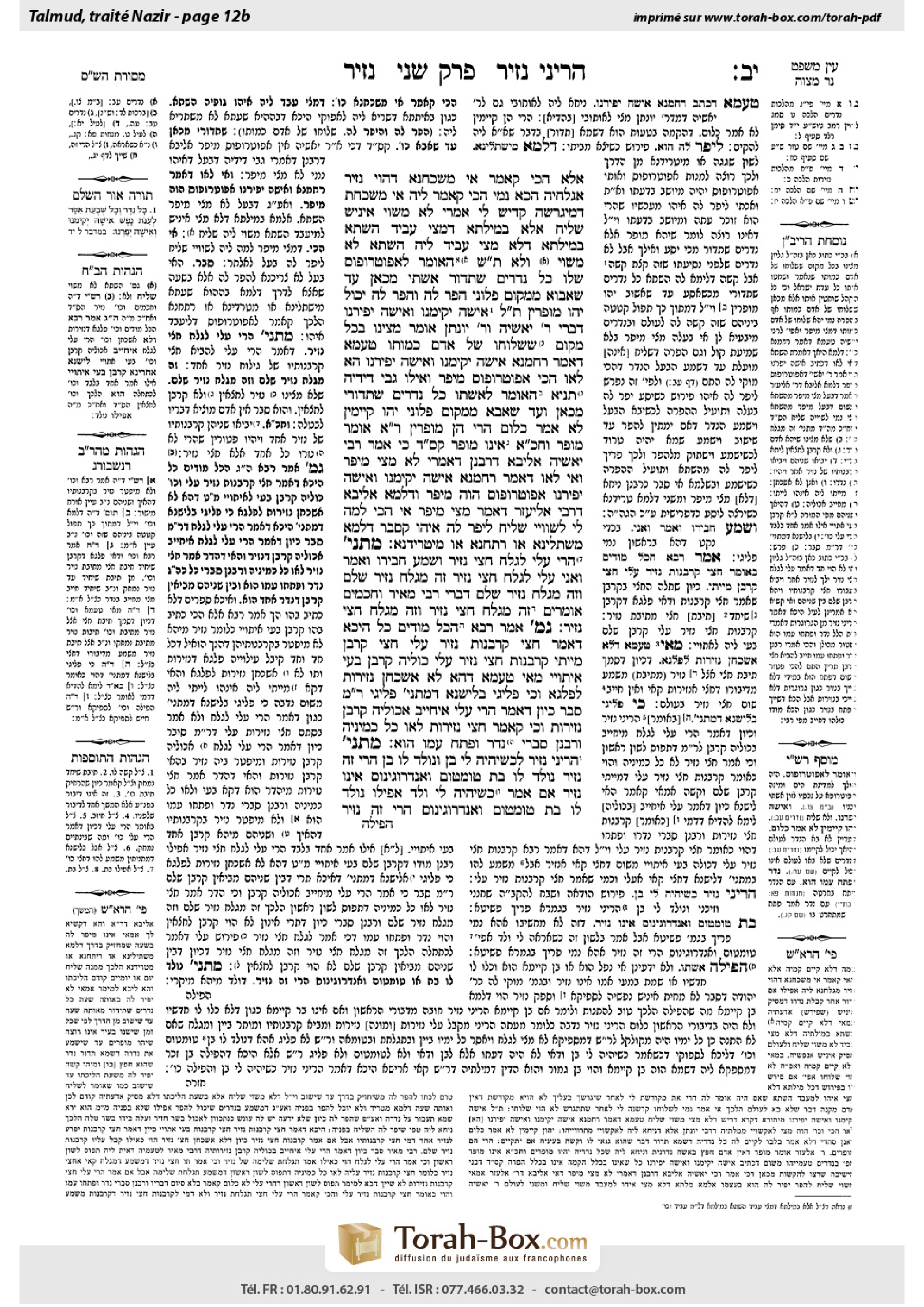
Nazir 12b: Talmud study for Daf Yomi
Daf Yomi is the daily study of one Talmud folio. Explore 37 tractates with scans, Hebrew text, Sefaria English and AI-generated French translations where annotated.
Passage selection and English or AI-generated French translation are available where the scan has annotations. Daf Study is independent of Torah-Box and Sefaria.
Browse Nazir · נזיר · All tractatesNazir 12b text and translations
This page of Nazir includes the Aramaic text, an English translation and an AI-generated French translation, alongside the scan above.
נזיר י״ב ב · Aramaic and Hebrew text
אֶלָּא הָכִי קָאָמַר: אִי מַשְׁכַּחְנָא דְּהָוֵי נָזִיר, אֲגַלְּחֵיהּ. הָכָא נָמֵי, הָכִי קָאָמַר לֵיהּ: אִי מַשְׁכַּחַתְּ דְּמִיגָּרְשָׁה, קַדֵּישׁ לִי.
אָמְרִי: לָא מְשַׁוֵּי אִינִישׁ שָׁלִיחַ אֶלָּא בְּמִילְּתָא דְּמָצֵי עָבֵיד הַשְׁתָּא, בְּמִילְּתָא דְּלָא מָצֵי עָבֵיד לֵיהּ הַשְׁתָּא — לָא מְשַׁוֵּי.
וְלָא? תָּא שְׁמַע, הָאוֹמֵר לְאַפּוֹטְרוֹפּוֹס שֶׁלּוֹ: ״כׇּל נְדָרִים שֶׁתִּדּוֹר אִשְׁתִּי מִכָּאן עַד שֶׁאָבוֹא מִמָּקוֹם פְּלוֹנִי — הָפֵר לָהּ״, וְהֵפֵר לָהּ, יָכוֹל יְהוּ מוּפָרִין — תַּלְמוּד לוֹמַר: ״אִישָׁהּ יְקִימֶנּוּ וְאִישָׁהּ יְפֵרֶנּוּ״, דִּבְרֵי רַבִּי יֹאשִׁיָּה. וְרַבִּי יוֹנָתָן אוֹמֵר: מָצִינוּ בְּכׇל מָקוֹם שֶׁשְּׁלוּחוֹ שֶׁל אָדָם כְּמוֹתוֹ.
טַעְמָא דְּאָמַר רַחֲמָנָא ״אִישָׁהּ יְקִימֶנּוּ וְאִישָׁהּ יְפֵירֶנּוּ״, הָא לָאו הָכִי — אַפּוֹטְרוֹפּוֹס מֵיפֵר. וְאִילּוּ גַּבֵּי דִידֵיהּ תַּנְיָא: הָאוֹמֵר לְאִשְׁתּוֹ ״כׇּל נְדָרִים שֶׁתִּדּוֹרִי מִכָּאן וְעַד שֶׁאָבֹא מִמָּקוֹם פְּלוֹנִי יְהוּ קַיָּימִין״ — לֹא אָמַר כְּלוּם. ״הֲרֵי הֵן מוּפָרִין״, רַבִּי אֱלִיעֶזֶר אוֹמֵר: מוּפָר, וַחֲכָמִים אוֹמְרִים: אֵינוֹ מוּפָר.
קָא סָלְקָא דַּעְתִּין כִּי אָמַר רַבִּי יֹאשִׁיָּה — אַלִּיבָּא דְרַבָּנַן דְּאָמְרִי לָא מָצֵי מֵיפֵר, וְאִי לָאו דְּאָמַר רַחֲמָנָא ״אִישָׁהּ יְקִימֶנּוּ וְאִישָׁהּ יְפֵירֶנּוּ״, אַפּוֹטְרוֹפּוֹס הֲוָה מֵיפַר.
וְדִלְמָא אַלִּיבָּא דְּרַבִּי אֱלִיעֶזֶר, דְּאָמַר מָצֵי מֵיפַר! אִי הָכִי, לְמָה לִי לְשַׁוּוֹיֵי שָׁלִיחַ? לֵיפַר לַהּ אִיהוּ! קָסָבַר דִּלְמָא מִשְׁתְּלֵינָא, אוֹ רָתַחְנָא, אוֹ מִיטְּרִידְנָא.
מַתְנִי׳ ״הֲרֵי עָלַי לְגַלֵּחַ חֲצִי נָזִיר״, וְשָׁמַע חֲבֵירוֹ וְאָמַר ״וַאֲנִי עָלַי לְגַלֵּחַ חֲצִי נָזִיר״ — זֶה מְגַלֵּחַ נָזִיר שָׁלֵם, וְזֶה מְגַלֵּחַ נָזִיר שָׁלֵם, דִּבְרֵי רַבִּי מֵאִיר. וַחֲכָמִים אוֹמְרִים: זֶה מְגַלֵּחַ חֲצִי נָזִיר, וְזֶה מְגַלֵּחַ חֲצִי נָזִיר.
גְּמָ׳ אָמַר רָבָא: הַכֹּל מוֹדִים, כֹּל הֵיכָא דְּאָמַר ״חֲצִי קׇרְבָּנוֹת נָזִיר עָלַי״ — חֲצִי קׇרְבָּן מַיְיתֵי. ״קׇרְבְּנוֹת חֲצִי נָזִיר עָלַי״ — כּוּלֵּיהּ קׇרְבָּן בָּעֵי אֵיתוֹיֵי. מַאי טַעְמָא — דְּהָא לָא אַשְׁכְּחַן נְזִירוּת לְפַלְגָא.
וְכִי פְּלִיגִי, בְּלִישָּׁנָא דְמַתְנִיתִין פְּלִיגִי. רַבִּי מֵאִיר סָבַר: כֵּיוָן דְּאָמַר ״הֲרֵי עָלַי״ — אִיחַיַּיב אַכּוּלֵּיהּ קׇרְבַּן נְזִירוּת, וְכִי קָאָמַר חֲצִי נְזִירוּת — לָאו כֹּל כְּמִינֵּיהּ. וְרַבָּנַן סָבְרִי: נֶדֶר וּפֶתַח עִמּוֹ הוּא.
מַתְנִי׳ ״הֲרֵינִי נָזִיר לִכְשֶׁיִּהְיֶה לִי בֵּן״, וְנוֹלָד לוֹ בֵּן — הֲרֵי זֶה נָזִיר. נוֹלַד לוֹ בַּת, טוּמְטוּם, וְאַנְדְּרוֹגִינוֹס — אֵינוֹ נָזִיר. אִם אָמַר ״כְּשֶׁיִּהְיֶה לִי וָלָד״ — אֲפִילּוּ נוֹלַד לוֹ בַּת, טוּמְטוּם, וְאַנְדְּרוֹגִינוֹס — הֲרֵי זֶה נָזִיר.
Nazir 12b · English translation
Rather, it can be explained that this is what he is saying: If I find someone who becomes a nazirite, I will shave him. Here too, in the case of betrothal, this is what the one who appointed the agent is saying to the agent: Even if the woman you find is married at this moment but when you come to her you discover that she has been divorced in the meantime, betroth her to me. If so, he would be prohibited from marrying her sister, contrary to the ruling of Rava.
The Gemara rejects this comparison: The Sages say that there is a distinction between the two cases: A person appoints an agent only for a matter that he himself can perform now, at the time of the appointment, but for a matter that he cannot perform now, he does not appoint an agent. Consequently, the agent cannot betroth a woman who was married at the time of his appointment. The one who appointed the agent may therefore marry the sister of the recently divorced woman, as stated by Rava.
The Gemara asks another question on the ruling of Rava: And can one not appoint an agent to betroth a woman in this manner? Come and hear a baraita that indicates the contrary: One who says to the steward [apotropos] of his affairs: All vows that my wife will vow from now until I come from such and such a place, nullify for her, and the steward nullified them for her, one might have thought they are nullified. Therefore, the verse states: “Her husband sustains the vow and her husband nullifies the vow” (Numbers 30:14); this is the statement of Rabbi Yoshiya. The repetition of “husband” teaches that it is the husband alone who may nullify his wife’s vows. And Rabbi Yonatan says: We have found in all places that the legal status of a person’s agent is like that of himself. Therefore, a steward, who serves as the husband’s agent, may nullify the wife’s vows.
Even according to Rabbi Yoshiya, who maintains that the steward cannot nullify her vows, the reason is that the Merciful One states in the Torah: “Her husband sustains the vow and her husband nullifies the vow,” but if it were not so, the steward could nullify even the future vows of the wife. However, with regard to the husband himself it is taught in a mishna (Nedarim 75a): One who says to his wife: All vows that you will vow from now until I come from such and such a place shall be ratified, he has not said anything. However, if a husband says: All vows that you will vow from now until I come from such and such a place, they are hereby nullified, Rabbi Eliezer says: It is nullified, and the Rabbis say: It is not nullified.
The Gemara finishes the question: It enters our mind to say that when Rabbi Yoshiya said that the steward cannot nullify the vows, he spoke in accordance with the opinion of the Rabbis, who say that the husband is not able to nullify her vows ahead of time, and yet, even according to their approach, if the Merciful One had not stated in the Torah: “Her husband sustains the vow and her husband nullifies the vow” the steward would be able to nullify such vows. This proves that one can appoint an agent for something he himself cannot do at the time, which contradicts the statement of Rava.
The Gemara rejects this: And perhaps Rabbi Yoshiya spoke in accordance with the opinion of Rabbi Eliezer, who says the husband can nullify the vows ahead of time, and it is for this reason that he can appoint the steward to do the same. The Gemara rejects this: If so, why do I need to make him into an agent; let him nullify the future vows for her before he sets out on his journey. The Gemara answers: He thinks, perhaps I will forget, or become angry, or be occupied with other matters when I am about to set out on my journey. This is why he appoints an agent to nullify the vows on his behalf, and no proof can be derived from this baraita.
MISHNA: If one says: It is incumbent upon me to shave half a nazirite, i.e., he is vowing to pay half the costs of a nazirite’s offerings, and another heard and said: And I, it is incumbent upon me to shave half a nazirite, this one shaves a whole nazirite and that one shaves a whole nazirite, i.e., each pays the full cost of a nazirite’s offerings; this is the statement of Rabbi Meir, since there is no such entity as half a nazirite. And the Rabbis say: This one shaves half a nazirite and that one shaves half a nazirite; they may join together to pay for the offerings of one nazirite.
GEMARA: With regard to this dispute, Rava said: All concede that whenever one said: Half of the offerings of a nazirite are incumbent upon me, he brings half of the offerings, since he vowed to pay only that amount. Also, everyone agrees that if he said: The offerings of half a nazirite are incumbent upon me, he needs to bring all of the offerings of a nazirite. What is the reason that he must bring all of the offerings of a nazirite? It is that we have not found such an entity as half a naziriteship. If one vowed to be half a nazirite, he is a full nazirite.
And when they disagree, it is only in a case of one who used the precise wording of the mishna. Rabbi Meir holds that once he said: It is incumbent upon me, he is obligated in all of the naziriteship offerings, and when he later says: Half a naziriteship, it is not in his power to uproot his first obligation. And the Rabbis hold that it is a vow with its inherent opening. By saying he had only half the offerings of a nazirite in mind from the outset, he has nullified his own vow.
MISHNA: If one said: I am hereby a nazirite when I will have a son, and a son was born to him, he is a nazirite. If a daughter, a tumtum, or a hermaphrodite [androginos] is born to him, he is not a nazirite, since a son was not born to him. However, if he says: I am hereby a nazirite when I will have a child, then even if a daughter, a tumtum, or a hermaphrodite is born to him, he is a nazirite.
Nazir 12b · Traduction française (IA)
On peut plutôt expliquer qu’il dit ceci : « Si je trouve quelqu’un qui devient nazir, je le raserai. » De même ici, dans le cas des fiançailles, celui qui a désigné l’agent lui dit : « Même si la femme que tu trouveras est mariée à ce moment-là, mais que, lorsque tu te rendras auprès d’elle, tu découvres qu’elle a entre-temps été divorcée, fiance-la pour moi. » Dans ce cas, il lui serait interdit d’épouser sa sœur, contrairement à la décision de Rava.
La Guemara rejette cette comparaison : les Sages disent qu’il y a une distinction entre les deux cas. Une personne ne désigne un agent que pour une affaire qu’elle peut accomplir elle-même au moment de la désignation ; pour une affaire qu’elle ne peut pas accomplir à ce moment-là, elle ne désigne pas d’agent. Par conséquent, l’agent ne peut pas fiancer une femme qui était mariée au moment de sa désignation. Celui qui a désigné l’agent peut donc épouser la sœur de la femme récemment divorcée, comme l’a dit Rava.
La Guemara soulève une autre objection à la décision de Rava : ne peut-on donc pas désigner un agent pour fiancer une femme de cette manière ? Viens et entends une baraïta qui indique le contraire : Celui qui dit à l’intendant [apotropos] de ses affaires : « Tous les vœux que ma femme fera d’ici à mon retour de tel ou tel endroit, annule-les pour elle », et l’intendant les annule pour elle, on aurait pu penser qu’ils sont annulés. C’est pourquoi le verset dit : « Son mari maintient le vœu et son mari l’annule » (Nombres 30, 14). Telle est la déclaration de Rabbi Yoshiya. La répétition du mot « mari » enseigne que seul le mari peut annuler les vœux de sa femme. Rabbi Yonatan, lui, dit : « Nous avons établi en tout lieu que le statut juridique de l’agent d’une personne est comme celui de la personne elle-même. » Par conséquent, un intendant qui agit comme agent du mari peut annuler les vœux de la femme.
Même selon Rabbi Yoshiya, qui soutient que l’intendant ne peut pas annuler ses vœux, la raison en est que le Miséricordieux dit dans la Torah : « Son mari maintient le vœu et son mari l’annule. » Mais si ce n’était pas le cas, l’intendant pourrait annuler même les vœux futurs de la femme. Or, au sujet du mari lui-même, une Michna enseigne (Nedarim 75a) : Celui qui dit à sa femme : « Tous les vœux que tu feras d’ici à mon retour de tel ou tel endroit seront ratifiés », n’a rien dit. Mais si un mari dit : « Tous les vœux que tu feras d’ici à mon retour de tel ou tel endroit sont dès à présent annulés », Rabbi Eliezer dit : « Ils sont annulés », et les Sages disent : « Ils ne sont pas annulés. »
La Guemara achève l’objection : On pourrait penser que, lorsque Rabbi Yoshiya a dit que l’intendant ne peut pas annuler les vœux, il s’exprimait selon l’opinion des Sages, qui disent que le mari ne peut pas annuler à l’avance les vœux de sa femme. Pourtant, même selon leur opinion, si le Miséricordieux n’avait pas dit dans la Torah : « Son mari maintient le vœu et son mari l’annule », l’intendant pourrait annuler de tels vœux. Cela prouve qu’on peut désigner un agent pour accomplir quelque chose qu’on ne peut pas faire soi-même à ce moment-là, ce qui contredit la déclaration de Rava.
La Guemara rejette cette objection : Peut-être Rabbi Yoshiya s’exprimait-il selon l’opinion de Rabbi Eliezer, qui dit que le mari peut annuler les vœux à l’avance ; c’est pour cette raison qu’il peut désigner l’intendant pour faire de même. La Guemara rejette cette réponse : Dans ce cas, pourquoi en faire un agent ? Qu’il annule lui-même les vœux futurs de sa femme avant de partir en voyage. La Guemara répond : Il pense peut-être qu’il oubliera, qu’il se mettra en colère ou qu’il sera occupé à d’autres affaires au moment où il s’apprêtera à partir en voyage. C’est pourquoi il désigne un agent pour annuler les vœux en son nom ; on ne peut tirer aucune preuve de cette baraïta.
MICHNA : Si quelqu’un dit : « Il m’incombe de raser la moitié d’un nazir », c’est-à-dire qu’il s’engage à payer la moitié du coût des sacrifices d’un nazir, et qu’un autre l’entend et dit : « Et moi aussi, il m’incombe de raser la moitié d’un nazir », le premier paie le coût complet des sacrifices d’un nazir et le second paie également le coût complet des sacrifices d’un nazir. Telle est la déclaration de Rabbi Meïr, puisqu’il n’existe pas d’entité correspondant à la moitié d’un nazir. Les Sages disent : Le premier paie la moitié du coût des sacrifices d’un nazir et le second en paie la moitié ; ils peuvent s’associer pour financer les sacrifices d’un seul nazir.
GUEMARA : À propos de cette controverse, Rava a dit : Tous reconnaissent que, si quelqu’un dit : « La moitié des sacrifices d’un nazir m’incombe », il apporte la moitié des sacrifices, puisqu’il s’est engagé à payer uniquement cette somme. Tous conviennent également que s’il dit : « Les sacrifices d’un demi-nazir m’incombent », il doit apporter tous les sacrifices d’un nazir. Pourquoi doit-il apporter tous les sacrifices d’un nazir ? Parce qu’il n’existe pas d’entité correspondant à un demi-naziréat. Si quelqu’un s’engage à être nazir pour moitié, il est nazir à part entière.
Leur désaccord ne porte que sur le cas où quelqu’un emploie précisément la formulation de la Michna. Rabbi Meïr estime que, dès lors qu’il a dit : « Cela m’incombe », il est tenu d’apporter tous les sacrifices de naziréat ; lorsqu’il ajoute ensuite : « La moitié d’un naziréat », il n’est plus en son pouvoir d’abolir sa première obligation. Les Sages estiment qu’il s’agit d’un vœu qui contient en lui-même une ouverture permettant de le défaire. En disant qu’il n’avait dès le départ en tête que la moitié des sacrifices d’un nazir, il a annulé son propre vœu.
MICHNA : Si quelqu’un dit : « Je serai nazir lorsque j’aurai un fils », et qu’un fils lui naît, il est nazir. Si une fille, un tumtum ou un androgyne [androginos] lui naît, il n’est pas nazir, puisqu’il ne lui est pas né de fils. Mais s’il dit : « Je serai nazir lorsque j’aurai un enfant », alors, même si une fille, un tumtum ou un androgyne lui naît, il est nazir.
Traduction française générée par IA à partir de l’édition anglaise de Sefaria. Vérifie toujours un passage avec le texte source.
Text from Sefaria: William Davidson Edition - Vocalized Aramaic (CC BY NC); William Davidson Edition - English (CC BY NC).