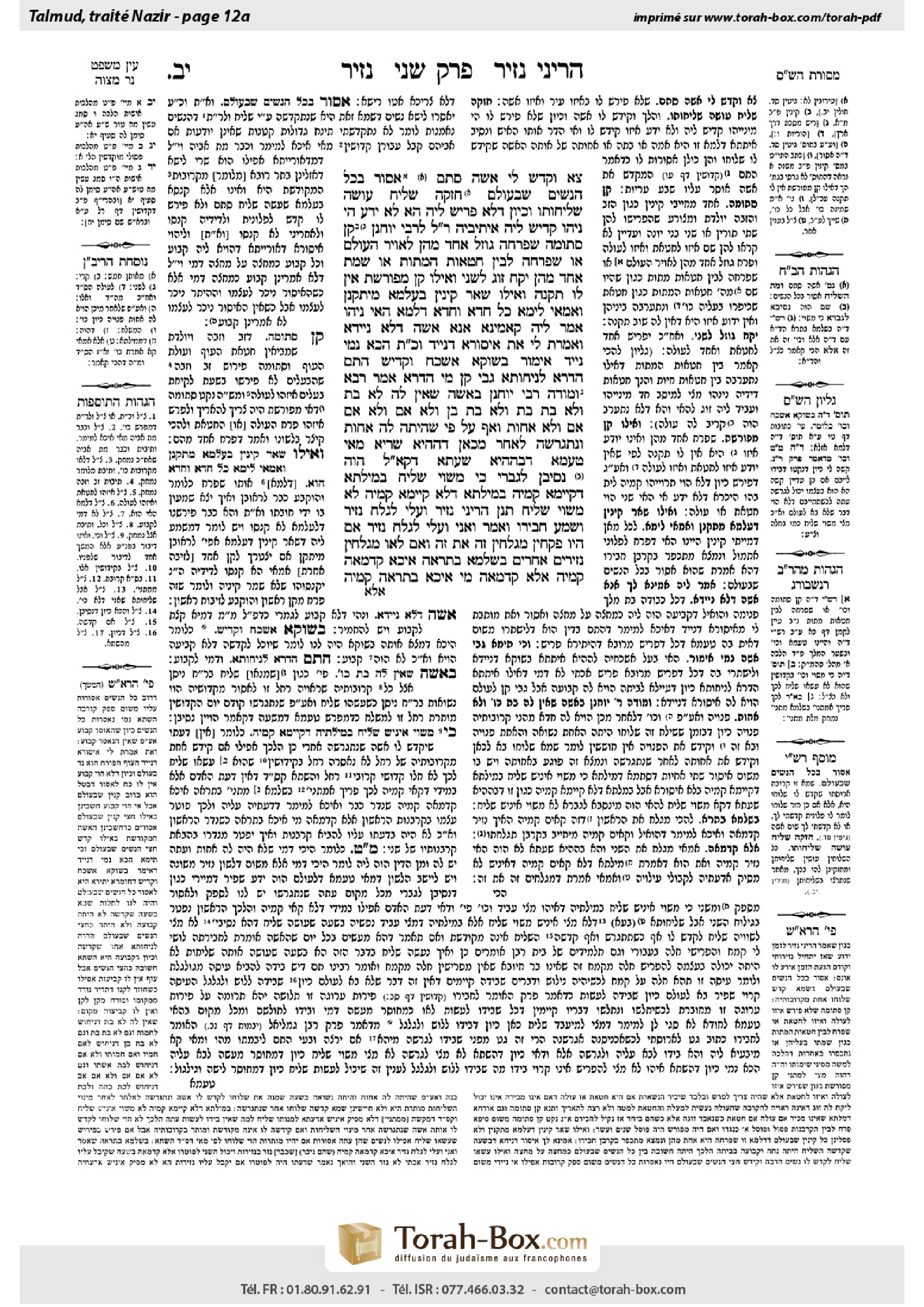
Nazir 12a: Talmud study for Daf Yomi
Daf Yomi is the daily study of one Talmud folio. Explore 37 tractates with scans, Hebrew text, Sefaria English and AI-generated French translations where annotated.
Passage selection and English or AI-generated French translation are available where the scan has annotations. Daf Study is independent of Torah-Box and Sefaria.
Browse Nazir · נזיר · All tractatesNazir 12a text and translations
This page of Nazir includes the Aramaic text, an English translation and an AI-generated French translation, alongside the scan above.
נזיר י״ב א · Aramaic and Hebrew text
״צֵא וְקַדֵּשׁ לִי אִשָּׁה״ סְתָם — אָסוּר בְּכׇל הַנָּשִׁים שֶׁבָּעוֹלָם. חֲזָקָה שָׁלִיחַ עוֹשֶׂה שְׁלִיחוּתוֹ, וְכֵיוָן דְּלָא פָּרֵישׁ לֵיהּ, הָא לָא יָדַע הֵי נִיהוּ קַדֵּישׁ לֵיהּ.
אֵיתִיבֵיהּ רֵישׁ לָקִישׁ לְרַבִּי יוֹחָנָן: קֵן סְתוּמָה שֶׁפָּרְחָה גּוֹזָל אֶחָד מֵהֶן לַאֲוִיר הָעוֹלָם, אוֹ שֶׁפָּרְחָה לְבֵין חַטָּאוֹת הַמֵּתוֹת, אוֹ שֶׁמֵּת אֶחָד מֵהֶן — יִקַּח זוּג לַשֵּׁנִי.
וְאִילּוּ קֵן מְפוֹרֶשֶׁת — אֵין לוֹ תַּקָּנָה.
וְאִילּוּ שְׁאָר קִינִּין בְּעָלְמָא מִיתַּקְּנָן. וְאַמַּאי? לֵימָא כׇּל חֲדָא וַחֲדָא דִּלְמָא הַאי נִיהוּ!
אֲמַר לֵיהּ: קָאָמֵינָא אֲנָא אִשָּׁה דְּלָא נָיְידָא, וְאָמְרַתְּ לִי אַתְּ אִיסּוּרָא דְּנָיֵיד?
וְכִי תֵּימָא: הָכָא נָמֵי נָיֵיד, אֵימוֹר בְּשׁוּקָא אַשְׁכַּח וְקַדֵּישׁ, הָתָם הָדְרָא לְנִיחוּתָא, גַּבֵּי קֵן מִי הָדְרָא?
אָמַר רָבָא: וּמוֹדֶה רַבִּי יוֹחָנָן בְּאִשָּׁה שֶׁאֵין לָהּ לֹא בַּת, וְלֹא בַּת בַּת, וְלֹא בַּת בֵּן, וְלֹא אֵם, וְלֹא אֵם אֵם, וְלֹא אָחוֹת. וְאַף עַל פִּי שֶׁהָיְתָה לָהּ אָחוֹת וְנִתְגָּרְשָׁה לְאַחַר מִכָּאן, דְּהָהִיא שַׁרְיָא.
מַאי טַעְמָא — דִּבְהָהִיא שַׁעְתָּא דְּקָא אָמַר לֵיהּ, הֲוָה נְסִיבָן לְגַבְרֵי. כִּי מְשַׁוֵּי שָׁלִיחַ — בְּמִילְּתָא דְּקָיְימָא קַמֵּיהּ. בְּמִילְּתָא דְּלָא קָיְימָא קַמֵּיהּ — לָא מְשַׁוֵּי שָׁלִיחַ.
תְּנַן: ״הֲרֵינִי נָזִיר וְעָלַי לְגַלֵּחַ נָזִיר״, וְשָׁמַע חֲבֵירוֹ וְאָמַר: ״וַאֲנִי, וְעָלַי לְגַלֵּחַ נָזִיר״, אִם הָיוּ פִּקְחִין — מְגַלְּחִין זֶה אֶת זֶה, וְאִם לָאו — מְגַלְּחִין נְזִירִים אֲחֵרִים. בִּשְׁלָמָא בָּתְרָאָה — אִיכָּא קַדְמָאָה קַמֵּיהּ. אֶלָּא קַדְמָאָה — מִי אִיכָּא בָּתְרָאָה קַמֵּיהּ?
Nazir 12a · English translation
Go out and betroth a woman for me, without specifying a particular woman; from that moment onward the one who appointed the agent is forbidden to all the women in the world until he finds out which woman the agent betrothed. There is a presumption that an agent performs his assigned agency and that he has betrothed a woman for him, and since the agent did not clarify to him which woman he chose, he therefore does not know which woman is the one betrothed to him. If he now betroths another woman, it is possible that she is the daughter, sister, or mother of the one his agent betrothed on his behalf and is therefore forbidden to him.
Reish Lakish raised an objection to Rabbi Yoḥanan from a mishna (Kinnim 2:1): With regard to an impure person who comes to undergo his purification process, and for this purpose set aside an unspecified nest, meaning a pair of turtledoves or pigeons, to use for his offerings. One is to be a burnt-offering and one is to be a sin-offering, and he had not yet specified which bird will be used for which offering. If one fledgling of the pair flew away and escaped to the open air of the world, or if it flew among birds invalidated for sin-offerings that have been left to die, or if one of them died, in each of these cases the owner of the nest purchases a partner for the second, i.e., remaining, bird. At that point he may decide which is for a sin-offering and which is for a burnt-offering.
But if a fledgling flew away or died from a specified nest, after the owner had designated which bird would be used for which offering, and it is not known which bird escaped, it has no means of remedy. This is because he does not know whether the remaining fledgling is for a burnt-offering or a sin-offering.
Reish Lakish infers: But generally, other nests belonging to other people are fit; there is no concern with regard to them. Reish Lakish states his objection to the opinion of Rabbi Yoḥanan: According to your opinion that there is a concern that each woman might be a relative of the woman the agent betrothed, then why should the halakha with regard to nests be so? Let us likewise say with regard to each and every fledgling bird in the world that perhaps this is the one that was consecrated and flew away. How can anyone ever use a bird for their own offering, as it may be the bird that flew away from someone else’s nest?
Rabbi Yoḥanan said to Reish Lakish: I state my opinion that there is a concern for other women only with regard to a woman, who does not move but is fixed in her home. An unidentified item is presumed to have the same legal status as the majority of items like it, and there is no concern that it may be forbidden, even if there are some forbidden items like it. However, if this unidentified item was fixed in its place, there is an equal presumption that it may belong to the class of similar permitted items or to the class of similar forbidden items. Consequently, all women in the world are forbidden to him, as there is an equal presumption that she may or may not be a relative of the woman that the agent betrothed to him. And you speak to me of a prohibition that moves and is not fixed. Since the fledgling bird is not fixed in one spot, the majority is followed and the minority is ignored.
And if you would say: Here too, she moves, since it is possible to say that the agent found the woman in the marketplace and betrothed her there to the one who appointed the agent, so the prohibited woman was not in a fixed location? Nevertheless, there she eventually returns to her place of rest, i.e., her home, and is therefore considered to be fixed. Conversely, with regard to a nest, does the fledgling return to a fixed place? Since it does not, the assumption is that any bird has the status of the majority of birds in the world, which have not been consecrated as offerings.
Rava said: And Rabbi Yoḥanan concedes that with regard to a woman who does not have a daughter, nor a daughter of a daughter, nor a daughter of a son, nor a mother, nor a mother of a mother, nor a sister who was single when he appointed the agent, that the one who appointed the agent may betroth her. There is no concern that the agent might have betrothed a relative that would now render such a woman forbidden. And even though she had, when he appointed the agent, a married sister, or daughter, or other female relative, and she was later divorced, Rabbi Yoḥanan concedes that this woman whom he wishes to now marry is permitted.
What is the reason for this? It is that at that moment, when he told the agent to go betroth a woman on his behalf, these women were married to men. There is a principle that when one appoints an agent, he does so only with regard to a matter present before him. In other words, he instructs his agent to betroth a woman who is available at that time, but he does not appoint an agent with regard to a matter that is not present before him. Consequently, even if the agent betrothed one of the relatives of the woman after they were divorced, the betrothal would not take effect because he was not authorized to betroth them, and therefore the one who appointed the agent is permitted to the woman.
The Gemara now proceeds to raise a difficulty against this last argument from the mishna: We learned in the mishna that if one says: I am hereby a nazirite and it is incumbent upon me to shave a nazirite, and another heard him and said: And I am hereby a nazirite, and it is incumbent upon me to shave a nazirite, if they are perspicacious they shave each other; and if not, they shave other nazirites. According to the reasoning that one takes into account only that which is possible at the time, the following difficulty arises: Granted, the last person has the first one before him and may have had in mind to volunteer to pay for the other’s offerings; but with regard to the first person, is the last one before him? When the first one stated his vow, the other one was not yet a nazirite, and he could not have been taking him into account when he vowed to pay for the offerings of another. How can paying for the offerings of the second nazirite be considered a fulfillment of his vow?
Nazir 12a · Traduction française (IA)
« Va et fiance-moi une femme », sans désigner de femme en particulier. À partir de ce moment, celui qui a nommé l’agent est interdit à toutes les femmes du monde jusqu’à ce qu’il découvre quelle femme l’agent a fiancée. On présume qu’un agent exécute la mission qui lui a été confiée et qu’il lui a fiancé une femme. Puisque l’agent ne lui a pas précisé quelle femme il avait choisie, il ignore donc quelle femme lui a été fiancée. S’il en fiance maintenant une autre, il est possible que celle-ci soit la fille, la sœur ou la mère de la femme que son agent a fiancée pour lui, et elle lui est donc interdite.
Reish Lakish objecta à Rabbi Yoḥanan en s’appuyant sur une Michna (Kinnim 2:1) : une personne impure qui vient accomplir son processus de purification a mis de côté, à cette fin, un nid non désigné, c’est-à-dire un couple de tourterelles ou de pigeons, pour ses offrandes. L’un doit être un holocauste et l’autre un sacrifice expiatoire, mais elle n’a pas encore précisé quel oiseau sera destiné à quelle offrande. Si l’un des oisillons s’envole et disparaît dans le monde extérieur, ou s’il s’envole parmi des oiseaux invalidés comme sacrifices expiatoires et laissés à mourir, ou encore si l’un des deux meurt, dans chacun de ces cas le propriétaire du nid achète un partenaire pour le second oiseau, c’est-à-dire celui qui reste. Il peut alors décider lequel sera le sacrifice expiatoire et lequel sera l’holocauste.
Mais si un oisillon s’est envolé ou est mort d’un nid désigné, après que le propriétaire a déterminé quel oiseau servirait à quelle offrande, et que l’on ignore lequel s’est échappé, il n’y a aucun moyen d’y remédier. En effet, il ignore si l’oisillon restant est destiné à un holocauste ou à un sacrifice expiatoire.
Reish Lakish en déduit que, de manière générale, les autres nids appartenant à d’autres personnes sont valides et qu’il n’y a pas lieu de s’en inquiéter. Il formule ainsi son objection à l’opinion de Rabbi Yoḥanan : selon ton avis, puisqu’il faut craindre que chaque femme soit apparentée à la femme que l’agent a fiancée, pourquoi la halakha concernant les nids serait-elle différente ? Disons de même, au sujet de chacun des oisillons du monde, qu’il est peut-être celui qui a été consacré et s’est envolé. Comment quiconque pourrait-il alors utiliser un oiseau pour sa propre offrande, puisqu’il pourrait s’agir de l’oiseau qui s’est envolé du nid de quelqu’un d’autre ?
Rabbi Yoḥanan dit à Reish Lakish : Je soutiens qu’il faut craindre le cas des autres femmes uniquement parce qu’une femme ne se déplace pas, mais reste chez elle. Un élément non identifié est présumé avoir le statut de la majorité des éléments de même nature, et l’on ne craint pas qu’il soit interdit, même s’il existe des éléments semblables qui sont interdits. Toutefois, si cet élément non identifié est fixe à sa place, il est tout aussi possible qu’il appartienne à la catégorie des éléments semblables permis qu’à celle des éléments semblables interdits. Par conséquent, toutes les femmes du monde lui sont interdites, puisqu’il est tout aussi possible que la femme soit apparentée à celle que son agent lui a fiancée qu’elle ne le soit pas. Mais tu me parles d’une interdiction qui se déplace et n’est pas fixe. Puisque l’oisillon n’est pas fixe en un endroit, on suit la majorité et l’on ne tient pas compte de la minorité.
Et si tu dis : ici aussi, elle se déplace, puisqu’on peut dire que l’agent a trouvé la femme au marché et l’y a fiancée pour celui qui l’a mandaté, de sorte que la femme interdite ne se trouvait pas en un lieu fixe ? Malgré cela, elle retourne finalement à son lieu de résidence, c’est-à-dire chez elle, et est donc considérée comme fixe. En revanche, s’agissant d’un nid, l’oisillon retourne-t-il à un lieu fixe ? Puisqu’il ne le fait pas, on présume que tout oiseau a le statut de la majorité des oiseaux du monde, qui n’ont pas été consacrés comme offrandes.
Rava dit : Rabbi Yoḥanan reconnaît que celui qui a nommé l’agent peut fiancer une femme qui n’a ni fille, ni petite-fille par sa fille, ni petite-fille par son fils, ni mère, ni grand-mère maternelle, ni sœur célibataire au moment où il a nommé l’agent. Il n’y a pas lieu de craindre que l’agent ait fiancé une parente qui rendrait cette femme interdite. Et même si, au moment où il a nommé l’agent, elle avait une sœur, une fille ou une autre parente mariée, qui a ensuite été divorcée, Rabbi Yoḥanan reconnaît que la femme qu’il souhaite maintenant épouser lui est permise.
Quelle en est la raison ? À ce moment-là, lorsqu’il a dit à l’agent d’aller fiancer une femme pour lui, ces femmes étaient mariées à des hommes. Il existe un principe selon lequel, lorsqu’on nomme un agent, on ne le fait qu’à l’égard d’une situation présente devant soi. Autrement dit, il charge son agent de fiancer une femme disponible à ce moment-là ; il ne le mandate pas pour une situation qui ne se présente pas encore. Par conséquent, même si l’agent avait fiancé l’une de ces parentes après qu’elle eut été divorcée, les fiançailles n’auraient pas pris effet, car il n’était pas autorisé à la fiancer. Celui qui a nommé l’agent est donc autorisé à épouser cette femme.
La Guemara soulève maintenant une difficulté contre ce dernier argument en s’appuyant sur la Michna : nous avons appris dans la Michna que si quelqu’un dit : « Me voici naziréen, et il m’incombe de prendre en charge les sacrifices d’un naziréen », et qu’un autre l’entend et dit : « Moi aussi, me voici naziréen, et il m’incombe de prendre en charge les sacrifices d’un naziréen », s’ils sont perspicaces, ils prennent chacun en charge les sacrifices de l’autre ; sinon, ils prennent en charge ceux d’autres naziréens. Selon le raisonnement d’après lequel on ne tient compte que de ce qui est possible au moment considéré, la difficulté suivante se pose : certes, le dernier a le premier devant lui et a pu avoir l’intention de se porter volontaire pour payer les sacrifices de l’autre ; mais le dernier est-il devant le premier ? Lorsque le premier a prononcé son vœu, l’autre n’était pas encore naziréen et il ne pouvait pas le prendre en compte lorsqu’il a fait le vœu de payer les sacrifices d’un autre. Comment le paiement des sacrifices du second naziréen peut-il être considéré comme l’accomplissement de son vœu ?
Traduction française générée par IA à partir de l’édition anglaise de Sefaria. Vérifie toujours un passage avec le texte source.
Text from Sefaria: William Davidson Edition - Vocalized Aramaic (CC BY NC); William Davidson Edition - English (CC BY NC).