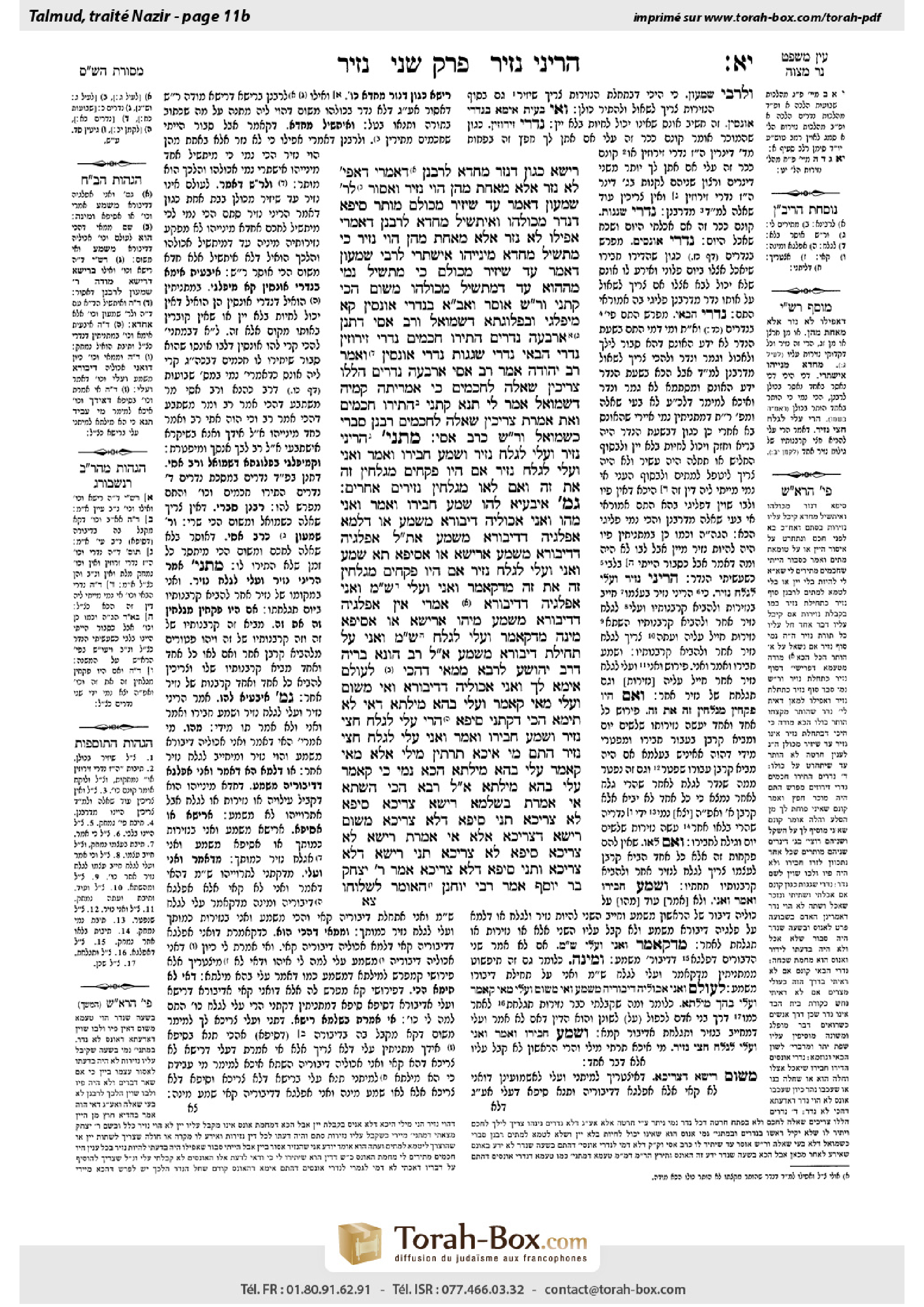
Nazir 11b: Talmud study for Daf Yomi
Daf Yomi is the daily study of one Talmud folio. Explore 37 tractates with scans, Hebrew text, Sefaria English and AI-generated French translations where annotated.
Passage selection and English or AI-generated French translation are available where the scan has annotations. Daf Study is independent of Torah-Box and Sefaria.
Browse Nazir · נזיר · All tractatesNazir 11b text and translations
This page of Nazir includes the Aramaic text, an English translation and an AI-generated French translation, alongside the scan above.
נזיר י״א ב · Aramaic and Hebrew text
רֵישָׁא, כְּגוֹן דִּנְזַר מֵחֲדָא, לְרַבָּנַן דְּאָמְרִי דַּאֲפִילּוּ לֹא נָזַר אֶלָּא מֵאַחַת מֵהֶן — הָוֵי נָזִיר, וְאָסוּר. לְרַבִּי שִׁמְעוֹן דְּאָמַר עַד שֶׁיַּזִּיר מִכּוּלָּם — מוּתָּר.
סֵיפָא דִּנְדַר מִכּוּלְּהוּ, וְאִיתְּשִׁיל מֵחֲדָא.
לְרַבָּנַן דְּאָמְרִי אֲפִילּוּ לֹא נָזַר אֶלָּא מֵאַחַת מֵהֶן הָוֵי נָזִיר, כִּי מִתְּשִׁיל מֵחֲדָא מִינַּיְיהוּ — אִישְׁתְּרִי. לְרַבִּי שִׁמְעוֹן דְּאָמַר עַד שֶׁיַּזִּיר מִכּוּלָּם, כִּי מִתְּשִׁיל נָמֵי מֵהָהוּא, עַד דְּמִתְּשִׁיל מִכּוּלְּהוּ. מִשּׁוּם הָכִי קָתָנֵי: וְרַבִּי שִׁמְעוֹן אוֹסֵר.
וְאִיבָּעֵית אֵימָא: בְּנִדְרֵי אוֹנָסִין קָא מִיפַּלְגִי, וּבִפְלוּגְתָּא דִּשְׁמוּאֵל וְרַב אַסִּי. דִּתְנַן: אַרְבָּעָה נְדָרִים הִתִּירוּ חֲכָמִים: נִדְרֵי זֵירוּזִין. נִדְרֵי הֲבַאי. נִדְרֵי שְׁגָגוֹת. נִדְרֵי אוֹנָסִין.
וְאָמַר רַב יְהוּדָה אָמַר רַב אַסִּי: אַרְבָּעָה נְדָרִים הַלָּלוּ, צְרִיכִין שְׁאֵלָה לַחֲכָמִים. כִּי אַמְרִיתַהּ קַמֵּיהּ דִּשְׁמוּאֵל, אָמַר לִי: תַּנָּא קָתָנֵי ״הִתִּירוּ חֲכָמִים״, וְאַתְּ אָמְרַתְּ צְרִיכִין שְׁאֵלָה לַחֲכָמִים?!
רַבָּנַן סָבְרִי כִּשְׁמוּאֵל. וְרַבִּי שִׁמְעוֹן כְּרַב אַסִּי.
מַתְנִי׳ ״הֲרֵינִי נָזִיר וְעָלַי לְגַלֵּחַ נָזִיר״, וְשָׁמַע חֲבֵירוֹ וְאָמַר ״וַאֲנִי וְעָלַי לְגַלֵּחַ נָזִיר״. אִם הָיוּ פִּקְחִים — מְגַלְּחִין זֶה אֶת זֶה. וְאִם לָאו — מְגַלְּחִין נְזִירִים אֲחֵרִים.
גְּמָ׳ אִיבַּעְיָא לְהוּ: שָׁמַע חֲבֵירוֹ וְאָמַר ״וַאֲנִי״, מַהוּ? ״וַאֲנִי״ — אַכּוּלֵּיהּ דִּיבּוּרָא מַשְׁמַע, אוֹ דִלְמָא אַפַּלְגֵיהּ דְּדִיבּוּרָא מַשְׁמַע. אִם תִּמְצֵי לוֹמַר אַפַּלְגֵיהּ דְּדִיבּוּרָא מַשְׁמַע: אַרֵישָׁא, אוֹ אַסֵּיפָא?
תָּא שְׁמַע: ״וַאֲנִי וְעָלַי לְגַלֵּחַ נָזִיר״, אִם הָיוּ פִּקְחִים מְגַלְּחִין זֶה אֶת זֶה. מִדְּקָאָמַר ״וַאֲנִי וְעָלַי״ — שְׁמַע מִינַּהּ וַאֲנִי אַפַּלְגֵיהּ דְּדִיבּוּרָא אָמְרִי. אִין, אַפַּלְגֵיהּ דְּדִיבּוּרָא מַשְׁמַע, מִיהוּ: אַרֵישָׁא, אוֹ אַסֵּיפָא? מִינָּה, מִדְּקָאָמַר ״וְעָלַי לְגַלֵּחַ״, שְׁמַע מִינַּהּ: ״וַאֲנִי״ — עַל תְּחִילַּת דִּיבּוּרָא מַשְׁמַע.
אֲמַר לֵיהּ רַב הוּנָא בְּרֵיהּ דְּרַב יְהוֹשֻׁעַ לְרָבָא: מִמַּאי דְּהָכִי? לְעוֹלָם אֵימָא לָךְ ״וַאֲנִי״ — אַכּוּלֵּיהּ דְּדִיבּוּרָא, וְאִי מִשּׁוּם ״וְעָלַי״, מַאי קָאָמַר — ״וְעָלַי״ בְּהָא מִילְּתָא. דְּאִי לָא תֵּימָא הָכִי, דְּקָתָנֵי סֵיפָא ״הֲרֵי עָלַי לְגַלֵּחַ חֲצִי נָזִיר״ וְשָׁמַע חֲבֵירוֹ וְאָמַר ״וַאֲנִי עָלַי לְגַלֵּחַ חֲצִי נָזִיר״, הָתָם מִי אִיכָּא תַּרְתֵּין מִילֵּי? אֶלָּא, מַאי קָאָמַר: ״עָלַי״ בְּהָא מִילְּתָא, הָכָא נָמֵי, כִּי קָאָמַר ״עָלַי״ — בְּהָא מִילְּתָא.
אֲמַר לֵיהּ רָבָא: הָכִי הַשְׁתָּא?! אִי אָמְרַתְּ בִּשְׁלָמָא רֵישָׁא צְרִיכָא סֵיפָא לָא צְרִיכָא — תָּנֵי סֵיפָא דְּלָא צְרִיכָא מִשּׁוּם רֵישָׁא דִּצְרִיכָא. אֶלָּא אִי אָמְרַתְּ רֵישָׁא לָא צְרִיכָא סֵיפָא לָא צְרִיכָא, תָּנֵי רֵישָׁא דְּלָא צְרִיכָא וְתָנֵי סֵיפָא דְּלָא צְרִיכָא?!
אָמַר רַבִּי יִצְחָק בַּר יוֹסֵף אָמַר רַבִּי יוֹחָנָן: הָאוֹמֵר לִשְׁלוּחוֹ
Nazir 11b · English translation
in the earlier clause, where one said: I did not know that a nazirite is prohibited from drinking wine, that is a case where he vowed naziriteship with regard to only one of the prohibitions. The difference of opinion is as follows: According to the Rabbis, who say that even if he vowed naziriteship with regard to only one of the prohibitions of naziriteship he is nevertheless a nazirite, in that case he is prohibited by all of them, despite not knowing about the prohibition against consuming wine. According to Rabbi Shimon who said he is not a nazirite unless he takes a vow of naziriteship with regard to all of them, he is permitted.
Conversely, the last clause addresses one who vowed naziriteship with regard to all of them, thereby accepting upon himself all the halakhot of naziriteship, and now wishes to request dissolution of one of the prohibitions, thinking that a halakhic authority can dissolve one aspect of his naziriteship.
The Gemara explains: According to the Rabbis, who say that even if he vowed naziriteship with regard to only one of the prohibitions of naziriteship he is nevertheless a nazirite, in that case too, when he requests of a halakhic authority to dissolve one of them, he is permitted to engage in all of the behaviors forbidden to a nazirite. Just as the acceptance of one part of naziriteship causes one to be bound by all the halakhot of naziriteship, dissolution of one element of naziriteship nullifies the entire naziriteship. According to Rabbi Shimon, who said that he is not a nazirite unless he takes a vow of naziriteship with regard to all of them, when he requests dissolution of that prohibition, none of the prohibitions are permitted until he requests dissolution of all of the prohibitions of naziriteship. Due to this the mishna teaches: And Rabbi Shimon prohibits him.
And if you wish, say instead: The Rabbis and Rabbi Shimon disagree with regard to vows impeded by circumstances beyond one’s control, and their disagreement is in the dispute between Shmuel and Rav Asi. As we learned in a mishna (Nedarim 20b): The Sages dissolved four types of vows without the requirement of a request to a halakhic authority. The first category is vows of exhortation, where one employs a vow to urge another to perform some action. The second category is vows of exaggeration [havai], where one utters a vow that is dependent upon some outlandish claim, such as: I should be bound by a vow if I did not see a square snake. Since he knows that there are no square snakes, it is evident that he is not serious in taking his vow. The third category is vows that are unintentional, where one vows for a particular reason and later discovers he was mistaken with regard to the facts; and the fourth is vows whose fulfillment are impeded by circumstances beyond one’s control.
The Gemara relates the dispute between Shmuel and Rav Asi: And Rav Yehuda said that Rav Asi said: These four vows require a request made to the halakhic authorities to dissolve them, and the vows are not dissolved unless one does so. Rav Yehuda related: When I stated this halakha of Rav Asi before Shmuel, he said to me: The tanna teaches that the Sages dissolved them, and you say they require a request made to the halakhic authorities? Shmuel holds that they are dissolved automatically.
The Gemara continues its explanation: The dispute between the Rabbis and Rabbi Shimon in the last clause of the mishna is also with regard to this halakha. This case is referring to a kind of a vow impeded by circumstances beyond one’s control, as he claims that he has no choice but to drink wine or contract impurity from corpses. The Rabbis hold in accordance with the opinion of Shmuel, and therefore the vow is dissolved automatically, without the need to request dissolution from a halakhic authority; and Rabbi Shimon holds in accordance with the opinion of Rav Asi that one must make a request to a halakhic authority to dissolve the vow, and he remains a nazirite until he does so.
MISHNA: If one says: I am hereby a nazirite and it is incumbent upon me to shave a nazirite, meaning he will also pay for the offerings that a nazirite brings when he cuts his hair; and another heard and said: And I too am a nazirite and it is incumbent upon me to shave a nazirite, the other is also a nazirite and is obligated to pay for the offerings of a nazirite. If they were perspicacious and wish to limit their expenses, they shave each other. They may each pay for the other’s offerings, so that their additional vows will not cost them anything. And if not, if this arrangement did not occur to them and each brought his own offerings, they shave other nazirites, i.e., they must pay for the offerings of other nazirites.
GEMARA: A dilemma was raised before the Sages. If one said: I am hereby a nazirite and it is incumbent upon me to shave a nazirite as well, and another heard and said only: And I, what is the halakha? Do we say that: And I, indicates acceptance of the entire statement of the first one, which would mean he is both a nazirite and must shave a nazirite, or perhaps it indicates acceptance of only half the statement of the first speaker? If you say it indicates acceptance of only half the statement, does it indicate acceptance of the first clause, i.e., I am hereby a nazirite, or the last clause, i.e., it is incumbent upon me to shave a nazirite?
The Gemara suggests: Come and hear a proof from the mishna. If a second person said: And I, and it is incumbent upon me to shave a nazirite, then if they are perspicacious they shave each other. From the fact that it says: And I, and it is incumbent upon me, you can learn from this that: And I, indicates acceptance of only half the statement, as otherwise he would not need to add the second part. The Sages say in response to this attempted proof: Yes, this proves that it indicates acceptance of only half the statement. However, the other question still has not been answered: Is he referring to the first part of the original statement or to the last part? The Gemara answers: This can be learned from the mishna itself. From the fact that it says: And it is incumbent upon me to shave a nazirite, one can learn from this that: And I, indicates acceptance of the beginning of the statement to become a nazirite, which is why one has to add that he must also pay for the offerings of a nazirite.
Rav Huna, son of Rav Yehoshua, said to Rava: From where do you know that it is so that the words: And I, are referring to the first part of the statement? Actually, I will say to you that: And I, is referring to the entire statement, and if you claim otherwise because he added: And it is incumbent upon me, the explanation of what he is saying is: And it is incumbent on me to do this matter. He was merely clarifying what his intention was when he said: And I. As, if you do not say so, then with regard to that which is taught in the last clause, in the following mishna, that if one said: It is incumbent upon me to shave half a nazirite, and another heard that and said: And I, it is incumbent upon me to shave half a nazirite, then there, are there two statements? That mishna is addressing only a single vow. Rather, what is he saying by using the words: It is incumbent upon me? He is referring to that whole matter; here too, in this mishna, when he says: And it is incumbent upon me, he is referring to that whole matter.
Rava said to him: How can these cases be compared? Granted, if you say that in the first clause it is necessary to teach both parts of the statement and in the latter clause it is not necessary to teach both parts of the statement, then it can be said that he taught the unnecessary latter clause due to the necessary first clause, as it is typical for a mishna to phrase both of its sections in the same style. But if you say that it is not necessary to teach both parts of the statement in the first clause and it is also not necessary to teach both parts of the statement in the latter clause, as one has accepted the other’s entire statement by saying: And I, would the tanna teach an unnecessary first clause and teach an unnecessary latter clause? Since the addition of: And it is incumbent upon me, is not required in the latter mishna, it must be necessary in this mishna, so the inference of Rava is correct.
§ After analyzing the mishna itself, the Gemara turns to a related issue. Rabbi Yitzḥak bar Yosef said that Rabbi Yoḥanan said: One who says to his agent:
Nazir 11b · Traduction française (IA)
Dans la clause précédente, où quelqu’un a dit : « Je ne savais pas qu’un nazir était interdit de boire du vin », il s’agit d’un cas où il a fait vœu de naziréat en ne visant qu’une seule des interdictions. La divergence d’opinions est la suivante : selon les Rabbins, qui disent que même s’il a fait vœu de naziréat en ne visant qu’une seule de ses interdictions, il est néanmoins nazir, il est alors soumis à toutes ces interdictions, bien qu’il ignorât l’interdiction de consommer du vin. Selon Rabbi Shimon, qui dit qu’il n’est nazir que s’il fait vœu de naziréat en visant toutes ces interdictions, il en est exempt.
À l’inverse, la dernière clause traite de quelqu’un qui a fait vœu de naziréat en visant toutes ces interdictions, acceptant ainsi sur lui-même toutes les halakhot du naziréat, et qui souhaite maintenant demander à une autorité halakhique d’annuler l’une d’elles, pensant qu’elle peut annuler un aspect de son naziréat.
La Guemara explique : selon les Rabbins, qui disent que même s’il a fait vœu de naziréat en ne visant qu’une seule de ses interdictions, il est néanmoins nazir, dans ce cas également, lorsqu’il demande à une autorité halakhique d’annuler l’une d’elles, toutes les conduites interdites à un nazir lui sont permises. De même que l’acceptation d’une partie du naziréat entraîne l’assujettissement à toutes les halakhot du naziréat, l’annulation d’un élément du naziréat annule celui-ci tout entier. Selon Rabbi Shimon, qui dit qu’il n’est nazir que s’il fait vœu de naziréat en visant toutes ces interdictions, lorsqu’il demande l’annulation de cette interdiction, aucune des interdictions ne lui est levée tant qu’il n’a pas demandé l’annulation de toutes les interdictions du naziréat. C’est pourquoi la Michna enseigne : « Et Rabbi Shimon le lui interdit. »
Et si tu préfères, dis plutôt que les Rabbins et Rabbi Shimon sont en désaccord au sujet des vœux dont l’accomplissement est empêché par des circonstances indépendantes de la volonté de la personne, et que leur désaccord s’inscrit dans la controverse entre Shmuel et Rav Asi. En effet, nous avons appris dans une Michna (Nedarim 20b) : Les Sages ont annulé quatre catégories de vœux sans qu’il soit nécessaire de demander leur annulation à une autorité halakhique. La première catégorie est celle des vœux d’exhortation, par lesquels on recourt à un vœu pour inciter autrui à accomplir une action. La deuxième est celle des vœux d’exagération [havai], où l’on prononce un vœu fondé sur une affirmation extravagante, telle que : « Que je sois lié par un vœu si je n’ai pas vu un serpent carré. » Puisqu’il sait qu’il n’existe pas de serpent carré, il est évident qu’il ne prend pas son vœu au sérieux. La troisième catégorie est celle des vœux involontaires : on fait un vœu pour une raison particulière, puis on découvre qu’on s’était trompé sur les faits. La quatrième est celle des vœux dont l’accomplissement est empêché par des circonstances indépendantes de la volonté de la personne.
La Guemara rapporte la controverse entre Shmuel et Rav Asi : Rav Yehouda a dit au nom de Rav Asi : Ces quatre catégories de vœux nécessitent une demande adressée aux autorités halakhiques pour être annulées, et elles ne le sont pas sans cela. Rav Yehouda rapporta : « Lorsque j’ai exposé cette halakha de Rav Asi devant Shmuel, il m’a dit : “Le tanna enseigne que les Sages les ont annulés, et toi, tu dis qu’il faut demander leur annulation aux autorités halakhiques ?” » Shmuel estime qu’ils sont annulés automatiquement.
La Guemara poursuit son explication : dans la dernière clause de la Michna, la divergence entre les Rabbins et Rabbi Shimon porte également sur cette halakha. Il s’agit d’un type de vœu dont l’accomplissement est empêché par des circonstances indépendantes de la volonté de la personne, car celle-ci affirme qu’elle n’a pas d’autre choix que de boire du vin ou de contracter une impureté au contact de cadavres. Les Rabbins suivent l’opinion de Shmuel ; le vœu est donc annulé automatiquement, sans qu’il soit nécessaire de demander son annulation à une autorité halakhique. Rabbi Shimon suit l’opinion de Rav Asi, selon laquelle il faut demander à une autorité halakhique d’annuler le vœu ; il reste donc nazir jusqu’à ce qu’il le fasse.
MICHNA : Si quelqu’un dit : « Me voici nazir, et il m’incombe de financer les offrandes d’un nazir », c’est-à-dire qu’il paiera également les offrandes qu’un nazir apporte lorsqu’il se coupe les cheveux, et qu’un autre l’entend et dit : « Moi aussi, je suis nazir et il m’incombe de financer les offrandes d’un nazir », ce second homme est également nazir et est tenu de financer les offrandes d’un nazir. S’ils sont perspicaces et souhaitent limiter leurs dépenses, ils financent les offrandes l’un de l’autre. Chacun peut payer les offrandes de l’autre, de sorte que leurs vœux supplémentaires ne leur coûtent rien. Sinon, si cette solution ne leur vient pas à l’esprit et que chacun apporte ses propres offrandes, ils financent les offrandes d’autres nazirim, c’est-à-dire qu’ils doivent payer les offrandes d’autres nazirim.
GUEMARA : Les Sages posèrent une question : si quelqu’un dit : « Me voici nazir, et il m’incombe aussi de financer les offrandes d’un nazir », et qu’un autre l’entend et dit seulement : « Moi aussi », quelle est la halakha ? Faut-il dire que « moi aussi » indique qu’il accepte toute la déclaration du premier, ce qui signifierait qu’il est à la fois nazir et tenu de financer les offrandes d’un nazir ? Ou bien ces mots indiquent-ils qu’il n’accepte que la moitié de la déclaration du premier locuteur ? Si tu dis qu’il n’en accepte que la moitié, s’agit-il de la première partie, c’est-à-dire « Me voici nazir », ou de la dernière partie, c’est-à-dire « Il m’incombe de financer les offrandes d’un nazir » ?
La Guemara propose : Viens et écoute une preuve tirée de la Michna. Si une deuxième personne a dit : « Moi aussi, et il m’incombe de financer les offrandes d’un nazir », alors, s’ils sont perspicaces, ils financent les offrandes l’un de l’autre. Du fait qu’il est écrit : « Moi aussi, et il m’incombe », on peut en déduire que « moi aussi » indique qu’il n’accepte que la moitié de la déclaration ; sinon, il n’aurait pas eu besoin d’ajouter la seconde partie. Les Sages répondent à cette tentative de preuve : Oui, cela prouve que ces mots indiquent qu’il n’accepte que la moitié de la déclaration. Toutefois, l’autre question reste sans réponse : vise-t-il la première partie de la déclaration originale ou sa dernière partie ? La Guemara répond : On peut le déduire de la Michna elle-même. Du fait qu’il est écrit : « Et il m’incombe de financer les offrandes d’un nazir », on peut en déduire que « moi aussi » indique qu’il accepte le début de la déclaration et devient nazir ; c’est pourquoi il doit ajouter qu’il est également tenu de financer les offrandes d’un nazir.
Rav Houna, fils de Rav Yehoshoua, dit à Rava : « D’où sais-tu que les mots “Moi aussi” se rapportent à la première partie de la déclaration ? En réalité, je vais te dire que “Moi aussi” se rapporte à toute la déclaration ; et si tu prétends qu’il a ajouté “et il m’incombe”, voici ce qu’il veut dire : “Et il m’incombe d’accomplir cette chose.” Il ne faisait que préciser son intention lorsqu’il a dit : “Moi aussi.” En effet, si tu ne l’admets pas, alors, à propos de ce qui est enseigné dans la dernière clause de la Michna suivante, à savoir que si quelqu’un dit : “Il m’incombe de financer les offrandes correspondant à la moitié d’un nazir”, et qu’un autre l’entend et dit : “Moi aussi, il m’incombe de financer les offrandes correspondant à la moitié d’un nazir”, y a-t-il là deux déclarations ? Cette Michna traite uniquement d’un seul vœu. Que veut-il donc dire par “Il m’incombe” ? Il se rapporte à toute cette affaire. Ici aussi, dans cette Michna, lorsqu’il dit : “Et il m’incombe”, il se rapporte à toute cette affaire. »
Rava lui dit : « Comment peut-on comparer ces cas ? Certes, si tu dis que, dans la première clause, il est nécessaire d’enseigner les deux parties de la déclaration, tandis que, dans la dernière clause, il n’est pas nécessaire de les enseigner toutes les deux, on peut alors dire que le tanna a enseigné la dernière clause, qui n’était pas nécessaire, à cause de la première clause, qui l’était, car il est courant qu’une Michna formule ses deux sections de la même manière. Mais si tu dis qu’il n’est nécessaire d’enseigner les deux parties de la déclaration ni dans la première clause ni dans la dernière, puisque, en disant “Moi aussi”, on accepte toute la déclaration de l’autre, le tanna aurait-il enseigné une première clause inutile et une dernière clause inutile ? Puisque l’ajout “et il m’incombe” n’est pas nécessaire dans la Michna suivante, il doit être nécessaire dans cette Michna ; l’inférence de Rava est donc correcte. »
§ Après avoir analysé la Michna elle-même, la Guemara aborde une question connexe. Rabbi Yitzḥak bar Yosef a dit au nom de Rabbi Yoḥanan : Celui qui dit à son agent :
Traduction française générée par IA à partir de l’édition anglaise de Sefaria. Vérifie toujours un passage avec le texte source.
Text from Sefaria: William Davidson Edition - Vocalized Aramaic (CC BY NC); William Davidson Edition - English (CC BY NC).