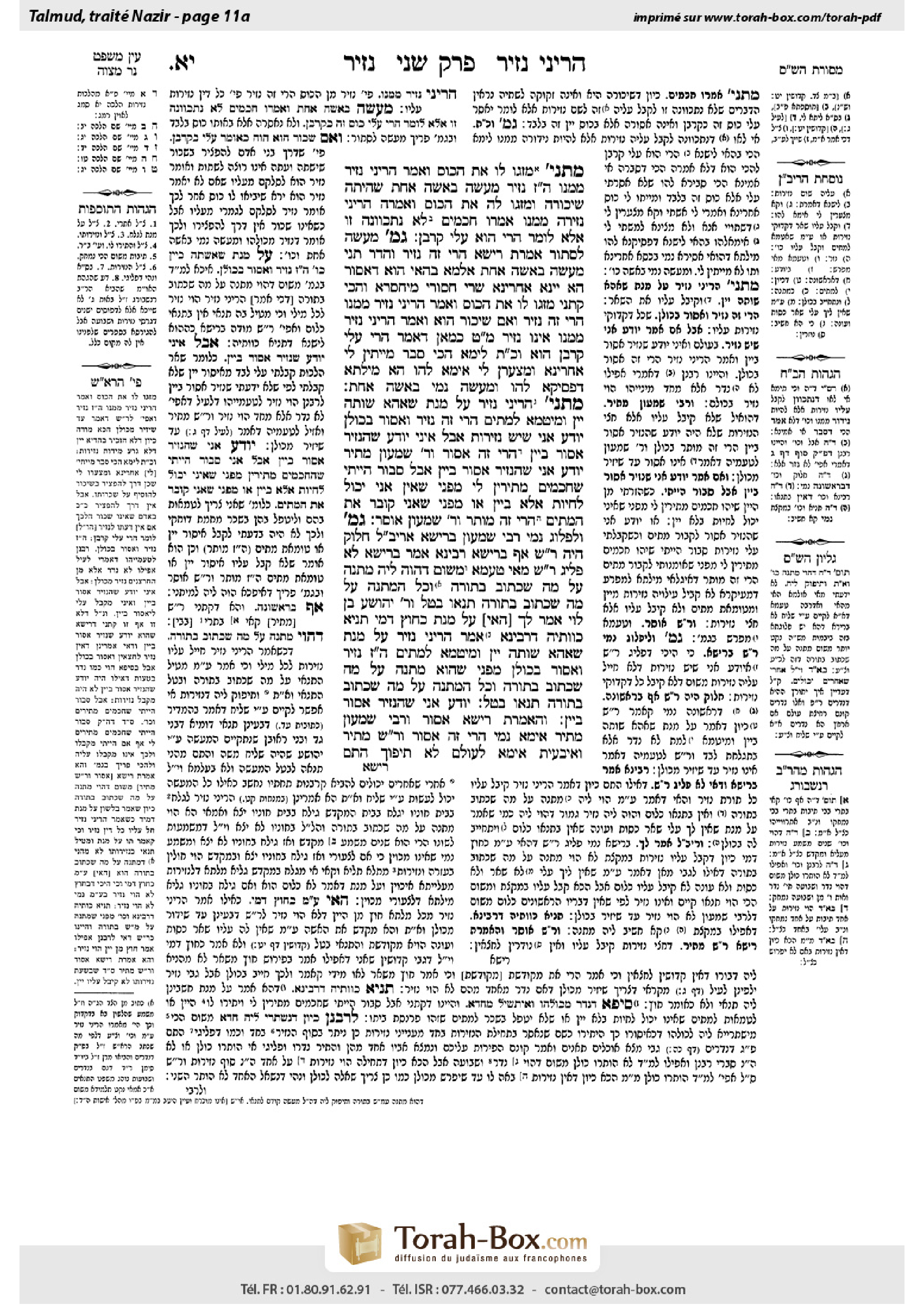
Nazir 11a: Talmud study for Daf Yomi
Daf Yomi is the daily study of one Talmud folio. Explore 37 tractates with scans, Hebrew text, Sefaria English and AI-generated French translations where annotated.
Passage selection and English or AI-generated French translation are available where the scan has annotations. Daf Study is independent of Torah-Box and Sefaria.
Browse Nazir · נזיר · All tractatesNazir 11a text and translations
This page of Nazir includes the Aramaic text, an English translation and an AI-generated French translation, alongside the scan above.
נזיר י״א א · Aramaic and Hebrew text
מַתְנִי׳ מָזְגוּ לוֹ אֶת הַכּוֹס, וְאָמַר ״הֲרֵינִי נָזִיר מִמֶּנּוּ״ — הֲרֵי זֶה נָזִיר. מַעֲשֶׂה בְּאִשָּׁה אַחַת שֶׁהָיְתָה שִׁיכּוֹרָה, וּמָזְגוּ לָהּ אֶת הַכּוֹס, וְאָמְרָה: ״הֲרֵינִי נְזִירָה מִמֶּנּוּ״. אָמְרוּ חֲכָמִים: לֹא נִתְכַּוְּונָה זוֹ אֶלָּא לוֹמַר ״הֲרֵי הוּא עָלַי קׇרְבָּן״.
גְּמָ׳ מַעֲשֶׂה לִסְתּוֹר?! אָמְרַתְּ רֵישָׁא — הֲרֵי זֶה נָזִיר, וַהֲדַר תָּנֵי: מַעֲשֶׂה בְּאִשָּׁה אַחַת, אַלְמָא בְּהַאי הוּא דְּאָסוּר, הָא יֵינָא אַחֲרִינָא — שְׁרֵי!
חַסּוֹרֵי מִיחַסְּרָא וְהָכִי קָתָנֵי: מָזְגוּ לוֹ אֶת הַכּוֹס, וְאָמַר ״הֲרֵינִי נָזִיר מִמֶּנּוּ״ — הֲרֵי זֶה נָזִיר. וְאִם שִׁיכּוֹר הוּא, וְאָמַר ״הֲרֵינִי נָזִיר מִמֶּנּוּ״ — אֵינוֹ נָזִיר. מַאי טַעְמָא — כְּמַאן דְּאָמַר ״הֲרֵי עָלַי קׇרְבָּן״ הוּא, וְכִי תֵּימָא: לֵימָא הָכִי? סָבַר: מַיְיתִין לִי אַחֲרִינָא וּמְצַעֲרִן לִי, אֵימָא לְהוּ הָא מִילְּתָא דִּפְסִיקָא לְהוּ. וּמַעֲשֶׂה נָמֵי בְּאִשָּׁה אַחַת.
מַתְנִי׳ ״הֲרֵינִי נָזִיר עַל מְנָת שֶׁאֱהֵא שׁוֹתֶה יַיִן וּמִיטַּמֵּא לְמֵתִים״ — הֲרֵי זֶה נָזִיר, וְאָסוּר בְּכוּלָּן.
״יוֹדֵעַ אֲנִי שֶׁיֵּשׁ נְזִירוּת, אֲבָל אֵינִי יוֹדֵעַ שֶׁהַנָּזִיר אָסוּר בְּיַיִן״ — הֲרֵי זֶה אָסוּר, וְרַבִּי שִׁמְעוֹן מַתִּיר. ״יוֹדֵעַ אֲנִי שֶׁהַנָּזִיר אָסוּר בְּיַיִן, אֲבָל סָבוּר הָיִיתִי שֶׁחֲכָמִים מַתִּירִין לִי מִפְּנֵי שֶׁאֵין אֲנִי יָכוֹל לִחְיוֹת אֶלָּא בְּיַיִן״, אוֹ ״מִפְּנֵי שֶׁאֲנִי קוֹבֵר אֶת הַמֵּתִים״ — הֲרֵי זֶה מוּתָּר, וְרַבִּי שִׁמְעוֹן אוֹסֵר.
גְּמָ׳ וְלִפְלוֹג נָמֵי רַבִּי שִׁמְעוֹן בְּרֵישָׁא! אָמַר רַבִּי יְהוֹשֻׁעַ בֶּן לֵוִי: חָלוּק הָיָה רַבִּי שִׁמְעוֹן אַף בְּרֵישָׁא.
רָבִינָא אָמַר: בְּרֵישָׁא לָא פְּלִיג רַבִּי שִׁמְעוֹן, מַאי טַעְמָא — מִשּׁוּם דְּהָוֵה לֵיהּ מַתְנֶה עַל מַה שֶּׁכָּתוּב בַּתּוֹרָה, וְכׇל הַמַּתְנֶה עַל מַה שֶּׁכָּתוּב בַּתּוֹרָה — תְּנָאוֹ בָּטֵל. וְרַבִּי יְהוֹשֻׁעַ בֶּן לֵוִי אָמַר לָךְ: [הַאי] ״עַל מְנָת״ — כְּחוּץ דָּמֵי.
תַּנְיָא כְּווֹתֵיהּ דְּרָבִינָא: אָמַר ״הֲרֵינִי נָזִיר עַל מְנָת שֶׁאֱהֵא שׁוֹתֶה יַיִן וּמִיטַּמֵּא לְמֵתִים״ — הֲרֵי זֶה נָזִיר וְאָסוּר בְּכוּלָּן, מִפְּנֵי שֶׁהוּא מַתְנֶה עַל מַה שֶּׁכָּתוּב בְּתוֹרָה, וְכׇל הַמַּתְנֶה עַל מַה שֶּׁכָּתוּב בַּתּוֹרָה — תְּנָאוֹ בָּטֵל.
״יוֹדֵעַ אֲנִי שֶׁהַנָּזִיר אָסוּר בְּיַיִן״. וְהָאָמְרַתְּ רֵישָׁא אָסוּר, וְרַבִּי שִׁמְעוֹן מַתִּיר! אֵימָא נָמֵי: הֲרֵי זֶה אָסוּר, וְרַבִּי שִׁמְעוֹן מַתִּיר. וְאִיבָּעֵית אֵימָא: לְעוֹלָם לָא תֵּיפוֹךְ. הָתָם
Nazir 11a · English translation
MISHNA: If they poured one a cup of wine and he said: I am hereby a nazirite and therefore will refrain from it, he is a full-fledged nazirite who must observe all the halakhot of naziriteship. An incident occurred with regard to a certain woman who was intoxicated from wine, and they poured a cup for her and she said: I am hereby a nazirite and therefore will refrain from it. The Sages said: This woman did not intend to accept naziriteship but rather, meant to say: It is hereby forbidden to me as an offering. She vowed against deriving benefit from that cup alone, since she did not want to drink any more.
GEMARA: The Gemara asks: Was an incident cited to contradict the previous ruling? You said in the first clause of the mishna that if one said that he is hereby a nazirite and therefore will refrain from a cup that was poured for him, then he is a nazirite. And the tanna then teaches: An incident occurred with regard to a certain woman who said: I am hereby a nazirite and therefore will refrain from it, which the Sages interpreted as a vow rendering the cup forbidden to her like an offering. Apparently it is only with regard to this cup of wine that is forbidden to her; consequently, any other wine is permitted, and she is not a nazirite.
The Gemara answers: The mishna is incomplete and is teaching the following: If they poured a cup of wine for one and he said: I am hereby a nazirite and therefore will refrain from it, he is a nazirite. And if he is intoxicated and they pour a cup of wine for him and he said: I am hereby a nazirite and therefore will refrain from it, he is not a nazirite. What is the reason for this? He is considered to be like one who said: This cup is forbidden to me like an offering. The Gemara asks: And if you would say that this was his meaning, let him say so explicitly; why would he say: I am hereby a nazirite and therefore will refrain from it? The reason is because he maintains: If I specify this cup, they will bring me another cup and aggravate me with it. It is better that I say to them this statement, which is definitive to them, and they will understand that I do not want to drink any more wine. The mishna continues: And an incident also occurred with regard to a certain woman who was intoxicated and took this vow, and the Sages explained her statement accordingly.
MISHNA: If one says: I am hereby a nazirite on the condition that I will be allowed to drink wine and may become ritually impure from corpses, i.e., he wishes to be a nazirite only with respect to the growth of his hair, he is a full-fledged nazirite and is prohibited from engaging in all of the behaviors forbidden to a nazirite, including consuming products of the vine and contracting impurity from a corpse.
If one stated a vow of naziriteship and then said: I know that there is naziriteship, but I do not know that a nazirite is prohibited from wine, he is prohibited in all the prohibitions of naziriteship. But Rabbi Shimon permits him, since he holds that naziriteship takes effect only if the person accepts all the relevant prohibitions. If one said: I know that a nazirite is prohibited from wine, but I thought that the Sages would permit me to drink wine because I cannot live without wine, or: I thought that the Sages would allow me to contract impurity from corpses because I bury the dead, he is permitted and the vow of naziriteship does not take effect, but Rabbi Shimon prohibits him.
GEMARA: In the second case of the mishna, where one states that he did not know that the prohibitions of naziriteship include wine, Rabbi Shimon says that the naziriteship does not take effect because he did not include all of the prohibitions in his vow. The Gemara therefore asks: Let Rabbi Shimon disagree with the first tanna in the first clause in the mishna as well, where one said: I am hereby a nazirite on the condition that I may drink wine. Rabbi Yehoshua ben Levi said: In fact, Rabbi Shimon disagrees even with the first tanna in the first clause of the mishna, and the mishna’s statement: Rabbi Shimon permits him, is referring to both clauses.
Ravina said: Rabbi Shimon does not disagree with the first tanna in the first clause of the mishna. What is the reason for that? It is because one was stipulating counter to that which is written in the Torah by attempting to limit an explicit Torah law, and with regard to anyone who stipulates counter to that which is written in the Torah, his stipulation is void. The statement: I am hereby a nazirite, remains valid, and he is therefore a nazirite in all regards. Conversely, Rabbi Yehoshua ben Levi could have said to you: This phrase: On the condition, does not mean he accepts upon himself all the halakhot of naziriteship and then adds a stipulation counter to that which is written in the Torah; rather, it is considered like he said: Apart from. It is as though he stated from the outset that he will be a nazirite apart from one particular aspect. According to Rabbi Yehoshua ben Levi, Rabbi Shimon holds that since he is not trying to stipulate alternative halakhot for full naziriteship but is instead accepting a partial naziriteship, his vow takes effect.
The Gemara comments: It is taught in the Tosefta (Nazir 2:2) in accordance with the opinion of Ravina. If one said: I am hereby a nazirite on the condition that I will be allowed to drink wine and may become ritually impure from corpses, he is a nazirite and is prohibited from all of them because he stipulates counter to that which is written in the Torah, and with regard to anyone who stipulates counter to that which is written in the Torah, his stipulation is void.
§ The final clause of the mishna teaches that if one says: I know that a nazirite is prohibited from drinking wine but I thought that the Sages would permit me to drink, the Rabbis say that the vow is void, but Rabbi Shimon disagrees. The Gemara asks: But didn’t you say in the earlier clause of the mishna that with regard to one who says: But I did not know that a nazirite is prohibited from wine, the first tanna holds that he is prohibited and Rabbi Shimon permits him? What is the difference between the two cases? The Gemara answers: Emend the text and say in the final clause as well: He is prohibited, and Rabbi Shimon permits him. And if you wish, say instead: Actually, do not reverse the opinions, and leave the text as it is. Instead, distinguish between the two cases, as there
Nazir 11a · Traduction française (IA)
MICHNA : Si l’on lui a versé une coupe de vin et qu’il a dit : « Me voici nazir, et je m’en abstiendrai », il est pleinement nazir et doit observer toutes les halakhot du naziréat. Un incident s’est produit au sujet d’une certaine femme qui était ivre de vin. On lui versa une coupe et elle dit : « Me voici nazir, et je m’en abstiendrai. » Les Sages dirent : cette femme n’avait pas l’intention d’accepter le naziréat, mais voulait plutôt dire : « Que cette coupe me soit interdite comme une offrande. » Elle avait fait le vœu de ne tirer aucun profit de cette seule coupe, car elle ne voulait plus boire.
GUEMARA : La Guemara demande : A-t-on cité un incident qui contredit la décision précédente ? Tu as dit dans la première partie de la Michna que si quelqu’un dit, à propos d’une coupe qu’on lui a versée : « Me voici nazir, et je m’en abstiendrai », il est nazir. Puis le tanna enseigne qu’un incident s’est produit au sujet d’une certaine femme qui dit : « Me voici nazir, et je m’en abstiendrai », et que les Sages interprétèrent ses paroles comme un vœu rendant la coupe interdite pour elle comme une offrande. Apparemment, seule cette coupe de vin lui est interdite ; tout autre vin lui est donc permis et elle n’est pas nazir.
La Guemara répond : La Michna est incomplète et enseigne ceci : si l’on a versé une coupe de vin à quelqu’un et qu’il a dit : « Me voici nazir, et je m’en abstiendrai », il est nazir. Mais s’il est ivre et qu’on lui verse une coupe de vin, et qu’il dit : « Me voici nazir, et je m’en abstiendrai », il n’est pas nazir. Pour quelle raison ? Il est considéré comme ayant dit : « Cette coupe m’est interdite comme une offrande. » La Guemara demande : S’il voulait dire cela, qu’il le dise explicitement ; pourquoi dirait-il : « Me voici nazir, et je m’en abstiendrai » ? C’est parce qu’il pense : si je désigne cette coupe, ils m’en apporteront une autre et me tourmenteront avec elle. Mieux vaut leur dire cette phrase, qui leur sera sans équivoque, et ils comprendront que je ne veux plus boire de vin. La Michna poursuit : Un incident s’est également produit au sujet d’une certaine femme qui était ivre et fit ce vœu ; les Sages expliquèrent ses paroles de cette manière.
MICHNA : Si quelqu’un dit : « Me voici nazir, à condition d’être autorisé à boire du vin et à devenir impur au contact de cadavres », c’est-à-dire qu’il ne souhaite être nazir qu’en ce qui concerne la pousse de ses cheveux, il est pleinement nazir et il lui est interdit d’adopter tous les comportements prohibés au nazir, notamment de consommer des produits de la vigne et de contracter l’impureté au contact d’un cadavre.
Si quelqu’un a prononcé un vœu de naziréat, puis a dit : « Je sais qu’il existe le naziréat, mais je ne sais pas qu’il est interdit à un nazir de boire du vin », toutes les interdictions du naziréat s’appliquent à lui. Mais Rabbi Shimon le permet, car il estime que le naziréat ne prend effet que si la personne accepte toutes les interdictions pertinentes. Si quelqu’un dit : « Je sais qu’il est interdit à un nazir de boire du vin, mais je pensais que les Sages me permettraient de boire du vin, car je ne peux pas vivre sans vin », ou : « Je pensais que les Sages me permettraient de contracter l’impureté au contact de cadavres, car j’enterre les morts », cela lui est permis et le vœu de naziréat ne prend pas effet ; mais Rabbi Shimon le lui interdit.
GUEMARA : Dans le deuxième cas de la Michna, où quelqu’un déclare qu’il ignorait que les interdictions du naziréat incluaient le vin, Rabbi Shimon dit que le naziréat ne prend pas effet, car il n’a pas inclus toutes les interdictions dans son vœu. La Guemara demande donc : Pourquoi Rabbi Shimon ne s’oppose-t-il pas également au premier tanna dans la première partie de la Michna, où quelqu’un dit : « Me voici nazir, à condition de pouvoir boire du vin » ? Rabbi Yehoshua ben Levi dit : En réalité, Rabbi Shimon s’oppose aussi au premier tanna dans la première partie de la Michna ; la déclaration de la Michna « Rabbi Shimon le permet » se rapporte aux deux cas.
Ravina dit : Rabbi Shimon ne s’oppose pas au premier tanna dans la première partie de la Michna. Pour quelle raison ? Parce que la personne pose une condition contraire à ce qui est écrit dans la Torah, en tentant de restreindre une loi explicite de la Torah ; or, toute personne qui pose une condition contraire à ce qui est écrit dans la Torah voit sa condition annulée. La déclaration « Me voici nazir » reste valable et elle est donc nazir à tous égards. À l’inverse, Rabbi Yehoshua ben Levi aurait pu te dire : l’expression « à condition » ne signifie pas qu’il accepte sur lui toutes les halakhot du naziréat puis ajoute une condition contraire à ce qui est écrit dans la Torah ; elle est plutôt considérée comme s’il avait dit : « à l’exception de ». C’est comme s’il avait déclaré d’emblée qu’il serait nazir à l’exception d’un aspect particulier. Selon Rabbi Yehoshua ben Levi, Rabbi Shimon estime que, puisqu’il ne cherche pas à imposer des halakhot de remplacement à un naziréat complet, mais accepte plutôt un naziréat partiel, son vœu prend effet.
La Guemara fait remarquer : Il est enseigné dans la Tosefta (Nazir 2:2) conformément à l’opinion de Ravina. Si quelqu’un dit : « Me voici nazir, à condition d’être autorisé à boire du vin et à devenir impur au contact de cadavres », il est nazir et toutes ces choses lui sont interdites, car il pose une condition contraire à ce qui est écrit dans la Torah ; or, toute personne qui pose une condition contraire à ce qui est écrit dans la Torah voit sa condition annulée.
§ La dernière partie de la Michna enseigne que si quelqu’un dit : « Je sais qu’il est interdit à un nazir de boire du vin, mais je pensais que les Sages me permettraient d’en boire », les Rabbins disent que le vœu est annulé, tandis que Rabbi Shimon s’y oppose. La Guemara demande : Mais n’as-tu pas dit dans la partie précédente de la Michna que, pour celui qui dit : « Mais je ne savais pas qu’il était interdit à un nazir de boire du vin », le premier tanna estime que cela lui est interdit, tandis que Rabbi Shimon le permet ? Quelle différence y a-t-il entre ces deux cas ? La Guemara répond : Corrige le texte et dis que, dans la dernière partie aussi, cela lui est interdit et Rabbi Shimon le permet. Et si tu préfères, dis plutôt : En réalité, n’inverse pas les opinions et laisse le texte tel quel. Distingue plutôt les deux cas, car il
Traduction française générée par IA à partir de l’édition anglaise de Sefaria. Vérifie toujours un passage avec le texte source.
Text from Sefaria: William Davidson Edition - Vocalized Aramaic (CC BY NC); William Davidson Edition - English (CC BY NC).