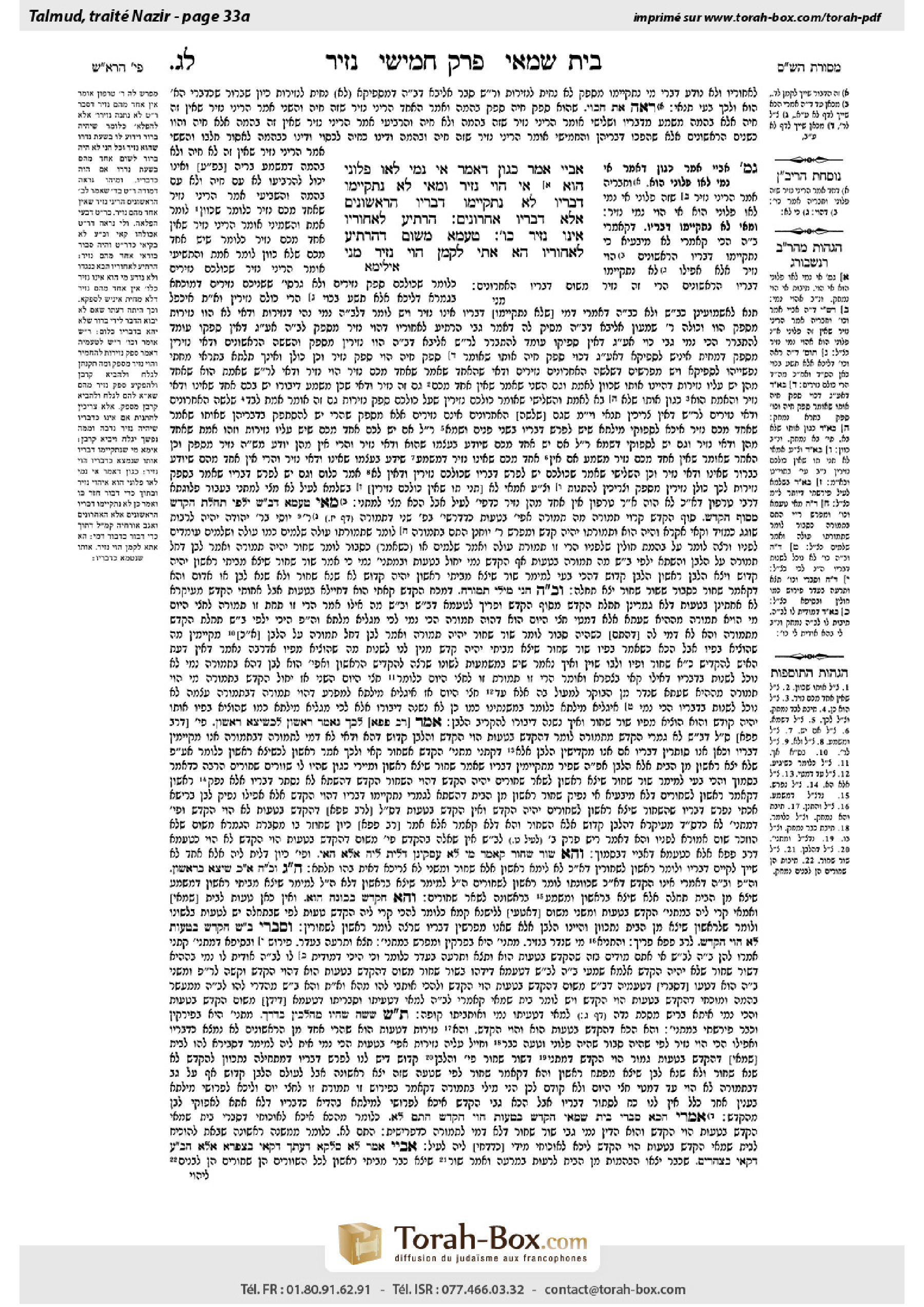
Nazir 33a: Talmud study for Daf Yomi
Daf Yomi is the daily study of one Talmud folio. Explore 37 tractates with scans, Hebrew text, Sefaria English and AI-generated French translations where annotated.
Passage selection and English or AI-generated French translation are available where the scan has annotations. Daf Study is independent of Torah-Box and Sefaria.
Browse Nazir · נזיר · All tractatesNazir 33a text and translations
This page of Nazir includes the Aramaic text, an English translation and an AI-generated French translation, alongside the scan above.
נזיר ל״ג א · Aramaic and Hebrew text
אַבָּיֵי אָמַר, כְּגוֹן דְּאָמַר: ״אִי נָמֵי לָאו פְּלוֹנִי הוּא — אִי הָוֵי נָזִיר״. וּמַאי ״לֹא נִתְקַיְּימוּ דְּבָרָיו״ — לֹא נִתְקַיְּימוּ דְּבָרָיו הָרִאשׁוֹנִים, אֶלָּא דְּבָרָיו אַחֲרוֹנִים.
הִרְתִּיעַ לַאֲחוֹרָיו אֵינוֹ נָזִיר כּוּ׳. טַעְמָא מִשּׁוּם דְּהִרְתִּיעַ לַאֲחוֹרָיו, הָא אָתֵי לְקַמַּן — הָוֵי נָזִיר. מַנִּי?
Nazir 33a · English translation
Abaye said: One must correct his understanding of the mishna, so that it deals with a situation where in addition to his first statement he said: Even if it is not so-and-so, I shall be a nazirite. And what is the meaning of the phrase: Whose statement was not fulfilled? It means: His first statement was not fulfilled, as it was not that person; rather, he is a nazirite because his last statement was fulfilled.
§ The mishna taught that if the individual walking toward them turned back, so that his identity remained unknown, not one of them is a nazirite. The Gemara clarifies: The reason is only because he turned back, from which it may be inferred that if that person comes before us and is identified, the one who said he would be a nazirite if it is so-and-so is considered to be a nazirite. The Gemara inquires: In accordance with whose opinion is this halakha?
This amud has no Gemara text, as in the classic Vilna layout it is entirely filled with the commentary of Tosafot.
Nazir 33a · Traduction française (IA)
Abayé a dit : Il faut corriger l’interprétation de la Michna, de sorte qu’elle porte sur un cas où, en plus de sa première déclaration, il a dit : « Même si ce n’est pas untel, je serai naziréen. » Que signifie alors l’expression « dont la déclaration ne s’est pas réalisée » ? Elle signifie que sa première déclaration ne s’est pas réalisée, puisqu’il ne s’agissait pas de cette personne ; il est néanmoins naziréen, car sa dernière déclaration s’est réalisée.
§ La Michna enseigne que si l’homme qui s’avançait vers eux rebroussa chemin, si bien que son identité resta inconnue, aucun d’eux n’est naziréen. La Guemara précise que c’est uniquement parce qu’il a rebroussé chemin. On peut en déduire que si cet homme se présente devant nous et est identifié, celui qui a dit qu’il serait naziréen s’il s’agissait d’untel est considéré comme naziréen. La Guemara demande : Selon l’opinion de qui cette halakha est-elle établie ? Ce daf ne contient pas de texte de Guemara : dans la mise en page classique de Vilna, il est entièrement occupé par le commentaire des Tossafot.
Traduction française générée par IA à partir de l’édition anglaise de Sefaria. Vérifie toujours un passage avec le texte source.
Text from Sefaria: William Davidson Edition - Vocalized Aramaic (CC BY NC); William Davidson Edition - English (CC BY NC).