Nazir 34a: Talmud study for Daf Yomi
Daf Yomi is the daily study of one Talmud folio. Explore 37 tractates with scans, Hebrew text, Sefaria English and AI-generated French translations where annotated.
Passage selection and English or AI-generated French translation are available where the scan has annotations. Daf Study is independent of Torah-Box and Sefaria.
Browse Nazir · נזיר · All tractatesNazir 34a text and translations
This page of Nazir includes the Aramaic text, an English translation and an AI-generated French translation, alongside the scan above.
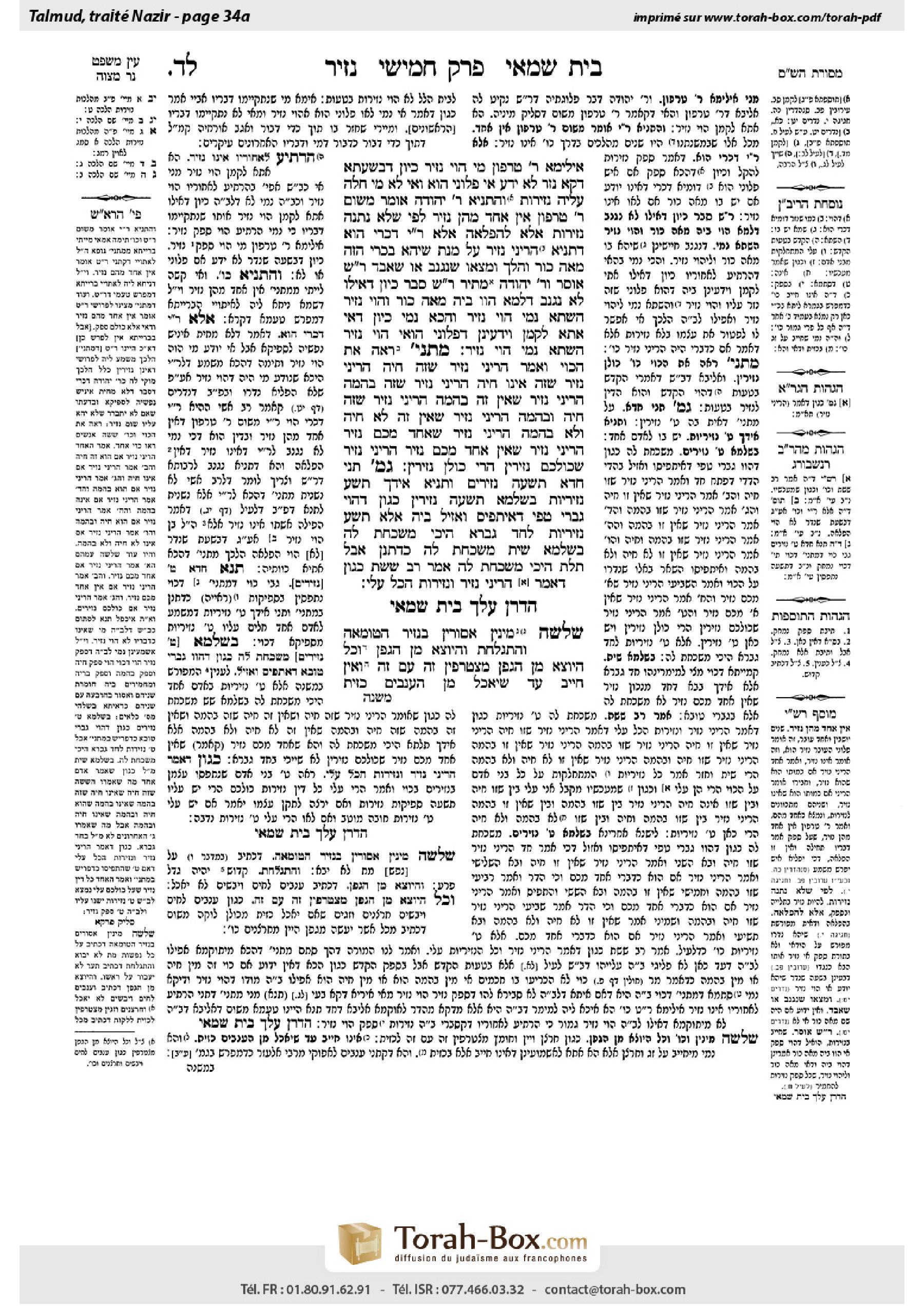
נזיר ל״ד א · Aramaic and Hebrew text
אִילֵימָא רַבִּי טַרְפוֹן — מִי הָוֵי נָזִיר? כֵּיוָן דִּבְשַׁעְתָּא דְּקָא נָזַר לָא יָדַע אִי פְּלוֹנִי הוּא וְאִי לָא, מִי חָלָה עֲלֵיהּ נְזִירוּת? וְהָתַנְיָא, רַבִּי יְהוּדָה אוֹמֵר מִשּׁוּם רַבִּי טַרְפוֹן: אֵין אֶחָד מֵהֶן נָזִיר, לְפִי שֶׁלֹּא נִתְּנָה נְזִירוּת אֶלָּא לְהַפְלָאָה!
אֶלָּא רַבִּי יְהוּדָה דִּכְרִי הוּא. דְּתַנְיָא: ״הֲרֵינִי נָזִיר עַל מְנָת שֶׁיְּהֵא בַּכְּרִי הַזֶּה מֵאָה כּוֹר״, וְהָלַךְ וּמְצָאוֹ שֶׁנִּגְנַב אוֹ שֶׁאָבַד — רַבִּי שִׁמְעוֹן אוֹסֵר, וְרַבִּי יְהוּדָה מַתִּיר.
רַבִּי שִׁמְעוֹן סָבַר כֵּיוָן דְּאִילּוּ לֹא נִגְנַב, דִּלְמָא הֲווֹ בֵּיהּ מְאָה כּוֹר וְהָוֵי נָזִיר — הַשְׁתָּא נָמֵי הָוֵי נָזִיר. וְהָכָא נָמֵי כֵּיוָן דְּאִי אֲתָא לְקַמַּן וְיָדְעִינַן דִּפְלוֹנִי הֲוַאי, הָוֵי נָזִיר — הַשְׁתָּא נָמֵי הָוֵי נָזִיר.
מַתְנִי׳ רָאָה אֶת הַכּוֹי וְאָמַר: ״הֲרֵינִי נָזִיר שֶׁזֶּה חַיָּה״, ״הֲרֵינִי נָזִיר שֶׁזֶּה אֵינוֹ חַיָּה״, ״הֲרֵינִי נָזִיר שֶׁזֶּה בְּהֵמָה״, ״הֲרֵינִי נָזִיר שֶׁאֵין זֶה בְּהֵמָה״.
״הֲרֵינִי נָזִיר שֶׁזֶּה חַיָּה וּבְהֵמָה״, ״הֲרֵינִי נָזִיר שֶׁאֵין זֶה לֹא חַיָּה וְלֹא בְּהֵמָה״, ״הֲרֵינִי נָזִיר שֶׁאֶחָד מִכֶּם נָזִיר״, ״הֲרֵינִי נָזִיר שֶׁאֵין אֶחָד מִכֶּם נָזִיר״, ״הֲרֵינִי נָזִיר שֶׁכּוּלְּכֶם נְזִירִין״ — הֲרֵי כּוּלָּן נְזִירִין.
גְּמָ׳ תָּנֵי חֲדָא: תִּשְׁעָה נְזִירִים, וְתַנְיָא אִידַּךְ: תֵּשַׁע נְזִירִיּוֹת. בִּשְׁלָמָא תִּשְׁעָה נְזִירִין — כְּגוֹן דְּהָוֵי גַּבְרֵי טְפֵי, דְּאִיתְּפִיס וְאָזֵיל בֵּיהּ.
אֶלָּא תֵּשַׁע נְזִירִיּוֹת לְחַד גַּבְרָא הֵיכִי מַשְׁכַּחַתְּ לַהּ? בִּשְׁלָמָא שֵׁית מַשְׁכַּחַתְּ לַהּ, כְּדִתְנַן.
אֲבָל תְּלָת הֵיכִי מַשְׁכַּחַתְּ לַהּ! אָמַר רַב שֵׁשֶׁת: כְּגוֹן דְּאָמַר ״הֲרֵינִי נָזִיר, וּנְזִירוּת הַכֹּל עָלַי״.
הַדְרָן עֲלָךְ בֵּית שַׁמַּאי
שְׁלֹשָׁה מִינִין אֲסוּרִין בַּנָּזִיר: הַטּוּמְאָה, וְהַתִּגְלַחַת, וְהַיּוֹצֵא מִן הַגֶּפֶן. וְכׇל הַיּוֹצֵא מִן הַגֶּפֶן מִצְטָרְפִין זֶה עִם זֶה. וְאֵין חַיָּיב עַד שֶׁיֹּאכַל מִן הָעֲנָבִים כַּזַּיִת.
Nazir 34a · English translation
If we say it is the opinion of Rabbi Tarfon, even in a case where the individual in question came before us and identified himself, is the one who claimed to know his identity a nazirite? Since at the time when he vowed he did not know whether the subject of their debate is so-and-so or not, does naziriteship take effect with regard to him? But isn’t it taught in a baraita (Tosefta 3:19) that Rabbi Yehuda says in the name of Rabbi Tarfon: In the case of the mishna not one of the six people is a nazirite, since naziriteship is imposed upon someone only if the vow is stated with explicitness [hafla’a]. The Torah says that a vow must be “clearly” pronounced, as the verse states: “When either man or woman shall clearly utter [yafli] a vow, the vow of a nazirite” (Numbers 6:2). This verse indicates that his vow is valid only if it is explicit.
Rather, the mishna represents the opinion of Rabbi Yehuda, as stated with regard to a heap of grain. As it is taught in a baraita (Tosefta 2:9): If someone said: I am hereby a nazirite on the condition that this heap of grain contains one hundred kor, a measurement of volume, and when he went to measure it he discovered that the heap was stolen or lost, so that the amount it held cannot be determined, Rabbi Shimon deems him prohibited in all the halakhot of naziriteship, as the heap might have contained one hundred kor. And Rabbi Yehuda deems him permitted, as he maintains that the halakha is lenient in cases of uncertain naziriteship. Rabbi Yehuda’s reasoning applies equally to the case of the mishna.
As for Rabbi Shimon, who disputes the ruling of the mishna, he holds with regard to the heap of grain: Since if the heap had not been stolen perhaps it might have contained one hundred kor and he would have been a nazirite, now too, he is a nazirite due to the uncertainty. And here too, in the case of the mishna, since if that person would have come before us and we would have known that he was so-and-so, the one who took the vow would have been a nazirite, consequently, now too, he is a nazirite as a result of the uncertainty cast by the unknown identity of the individual.
MISHNA: Someone saw a kosher animal with characteristics of both a domesticated animal and a non-domesticated animal [koy], and said: I am hereby a nazirite if this is a non-domesticated animal; and another individual said: I am hereby a nazirite if this is not a non-domesticated animal; and a third person said: I am hereby a nazirite if this is a domesticated animal; and a fourth said: I am hereby a nazirite if this not a domesticated animal.
The mishna continues: A fifth person added: I am hereby a nazirite if this is a non-domesticated animal and a domesticated animal, and a sixth person said: I am hereby a nazirite if this is neither a non-domesticated animal nor a domesticated animal. Someone who heard all the above statements said: I am hereby a nazirite if one of you is a nazirite, and another one stated: I am hereby a nazirite if not one of you is a nazirite, and a final person said: I am hereby a nazirite if all of you are nazirites. In this case, they are all nazirites.
GEMARA: With regard to the ruling of the mishna that they are all nazirites, it is taught in one baraita that this case involves a total of nine nazirites, and it is taught in the other baraita that there are nine sets of naziriteship here. The Gemara clarifies: Granted, one can understand the baraita that says that there are nine nazirites, for example, if there were many people who associated their naziriteship with the status of this koy, each with one of the statements listed above.
However, how can you find these circumstances of nine sets of naziriteship in one person? Granted, you find six, as we learned in the mishna that there are six ways in which the nature of a koy can be expressed: It is a non-domesticated animal; it is not a non-domesticated animal; it is a domesticated animal; it is not a domesticated animal; is a non-domesticated animal and a domesticated animal; it is neither a non-domesticated animal nor a domesticated animal. One person could associate his acceptance of naziriteship with all of the above possibilities.
However, how can you find these circumstances of the other three sets of naziriteship? The statements: If one of you is a nazirite, and: If one of you is not a nazirite, are necessarily expressed by individuals who did not make the initial six statements, as these last three statements address the group of people who made the first six statements. Rav Sheshet said: It is possible in a case where nine people issued the statements mentioned in the mishna, and someone said: I am hereby a nazirite and the naziriteship of all of them are incumbent upon me. Since each of the nine people is obligated to observe a term of naziriteship, this last one is obligated to observe nine terms.
MISHNA: Three types of actions are prohibited for a nazirite: The contraction of ritual impurity from a corpse, and the shaving of one’s hair, and eating or drinking any substances that emerge from the vine. The mishna adds: And all products that emerge from the vine combine with one another to the amount that renders a nazirite liable to receive lashes. And he is liable only if he eats an olive-bulk of the grapes.
Nazir 34a · Traduction française (IA)
Si nous disons qu’il s’agit de l’opinion de Rabbi Tarfon, même dans le cas où la personne en question s’est présentée devant nous et s’est identifiée, celui qui prétendait connaître son identité est-il nazir ? Puisqu’au moment où il a fait son vœu, il ignorait si la personne dont ils débattaient était untel ou non, le naziréat prend-il effet à son égard ? Mais n’est-il pas enseigné dans une baraïta (Tossefta 3:19) que Rabbi Yehouda dit au nom de Rabbi Tarfon : dans le cas de la Michna, aucun des six hommes n’est nazir, car le naziréat ne s’impose à quelqu’un que si le vœu est formulé explicitement [hafla’a]. La Torah dit qu’un vœu doit être prononcé « clairement », comme le dit le verset : « Lorsqu’un homme ou une femme prononcera clairement [yafli] un vœu, le vœu d’un nazir » (Nombres 6:2). Ce verset indique que son vœu n’est valable que s’il est explicite.
Il faut plutôt dire que la Michna reflète l’opinion de Rabbi Yehouda, comme dans le cas d’un tas de céréales. En effet, il est enseigné dans une baraïta (Tossefta 2:9) : si quelqu’un dit : « Me voici nazir à condition que ce tas de céréales contienne cent kor », mesure de volume, et qu’au moment où il entreprend de le mesurer, il découvre que le tas a été volé ou perdu, de sorte qu’il est impossible d’en déterminer la quantité, Rabbi Shimon le considère comme interdit selon toutes les halakhot du naziréat, car le tas pouvait contenir cent kor. Rabbi Yehouda le considère comme autorisé, car il estime que la halakha est indulgente dans les cas de naziréat incertain. Le raisonnement de Rabbi Yehouda s’applique tout autant au cas de la Michna.
Quant à Rabbi Shimon, qui conteste la décision de la Michna, il considère, à propos du tas de céréales, que puisque, s’il n’avait pas été volé, il aurait peut-être contenu cent kor et l’homme aurait été nazir, celui-ci est également nazir maintenant, en raison de l’incertitude. Ici aussi, dans le cas de la Michna, puisque, si cette personne s’était présentée devant nous et que nous avions su qu’elle était untel, celui qui a fait le vœu aurait été nazir, il est donc également nazir maintenant, du fait de l’incertitude créée par l’identité inconnue de cette personne.
Michna : Quelqu’un vit un animal casher présentant les caractéristiques d’un animal domestique et d’un animal sauvage [koy], et dit : « Me voici nazir si cet animal est un animal sauvage » ; un autre dit : « Me voici nazir si cet animal n’est pas un animal sauvage » ; un troisième dit : « Me voici nazir si cet animal est un animal domestique » ; et un quatrième dit : « Me voici nazir si cet animal n’est pas un animal domestique ».
La Michna poursuit : un cinquième ajouta : « Me voici nazir si cet animal est à la fois un animal sauvage et un animal domestique » ; un sixième dit : « Me voici nazir si cet animal n’est ni un animal sauvage ni un animal domestique. » Quelqu’un qui avait entendu toutes les déclarations précédentes dit : « Me voici nazir si l’un d’entre vous est nazir » ; un autre déclara : « Me voici nazir si aucun d’entre vous n’est nazir » ; et un dernier dit : « Me voici nazir si vous êtes tous nazir. » Dans ce cas, ils sont tous nazir.
Guemara : À propos de la décision de la Michna selon laquelle ils sont tous nazir, une baraïta enseigne que ce cas concerne neuf nazir, tandis qu’une autre baraïta enseigne qu’il y a ici neuf périodes de naziréat. On comprend bien la baraïta qui parle de neuf nazir : par exemple, plusieurs personnes ont lié leur naziréat au statut de ce koy, chacune en prononçant l’une des déclarations énumérées ci-dessus.
Mais comment trouver ces neuf périodes de naziréat chez une seule personne ? On peut certes en trouver six, puisque nous avons appris dans la Michna qu’il existe six façons d’exprimer la nature d’un koy : c’est un animal sauvage ; ce n’est pas un animal sauvage ; c’est un animal domestique ; ce n’est pas un animal domestique ; c’est à la fois un animal sauvage et un animal domestique ; ce n’est ni un animal sauvage ni un animal domestique. Une personne pourrait lier son engagement au naziréat à toutes ces possibilités.
Mais comment trouver les trois autres périodes de naziréat ? Les déclarations « si l’un d’entre vous est nazir » et « si aucun d’entre vous n’est nazir » doivent nécessairement être prononcées par des personnes qui n’ont pas fait les six premières déclarations, car ces trois dernières déclarations portent sur le groupe de personnes ayant fait les six premières. Rav Sheshet dit : c’est possible dans le cas où neuf personnes ont prononcé les déclarations mentionnées dans la Michna, puis où quelqu’un a dit : « Me voici nazir, et les naziréats de tous ces hommes me sont imposés. » Puisque chacun des neuf hommes est tenu d’observer une période de naziréat, ce dernier est tenu d’en observer neuf.
Michna : Trois types d’actions sont interdits au nazir : contracter une impureté rituelle au contact d’un mort, se raser les cheveux, et manger ou boire toute substance provenant de la vigne. La Michna ajoute : tous les produits de la vigne se combinent entre eux jusqu’à atteindre la quantité qui rend le nazir passible de coups. Il n’est passible que s’il mange l’équivalent du volume d’une olive de raisin.
Traduction française générée par IA à partir de l’édition anglaise de Sefaria. Vérifie toujours un passage avec le texte source.
Text from Sefaria: William Davidson Edition - Vocalized Aramaic (CC BY NC); William Davidson Edition - English (CC BY NC).