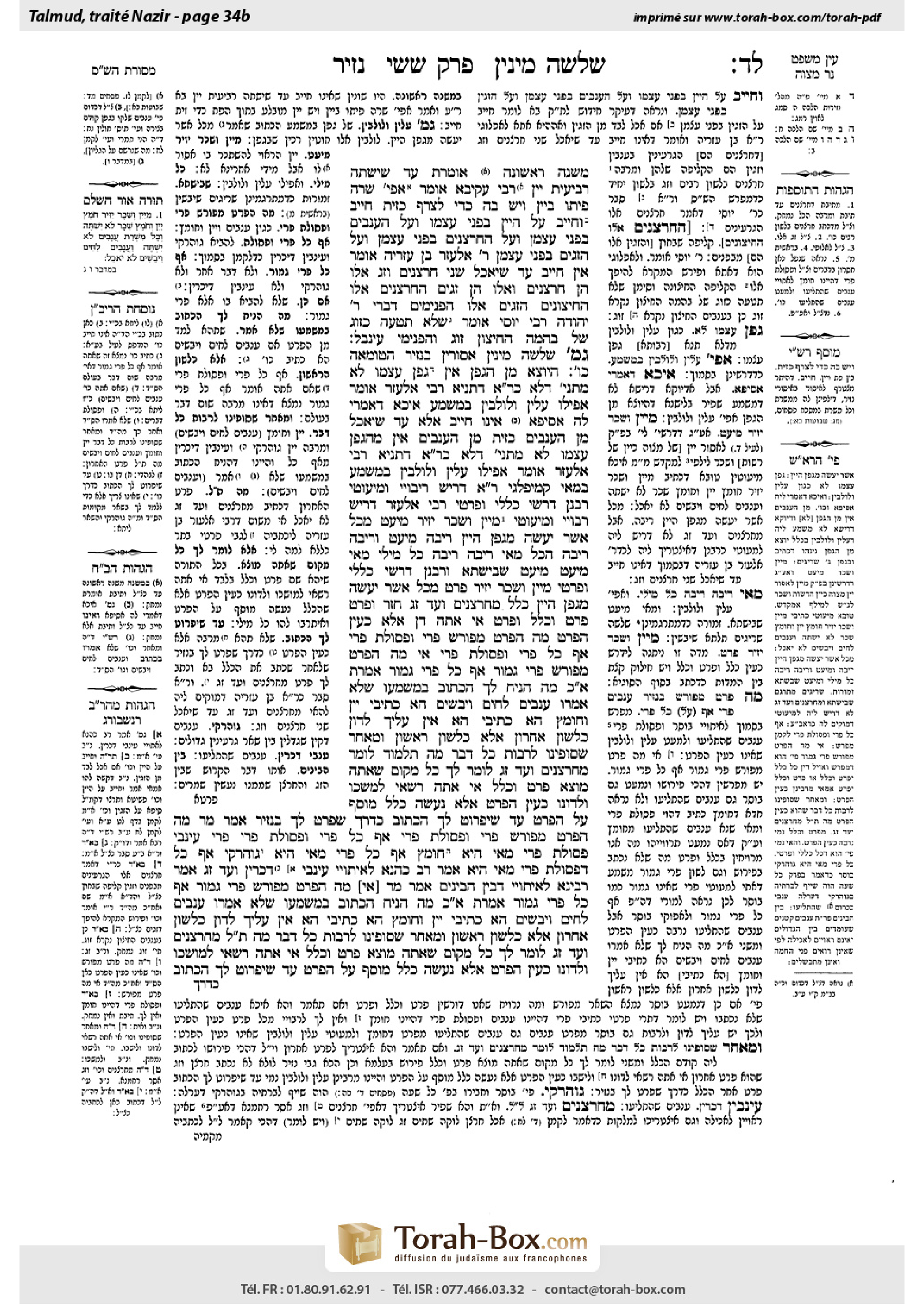
Nazir 34b: Talmud study for Daf Yomi
Daf Yomi is the daily study of one Talmud folio. Explore 37 tractates with scans, Hebrew text, Sefaria English and AI-generated French translations where annotated.
Passage selection and English or AI-generated French translation are available where the scan has annotations. Daf Study is independent of Torah-Box and Sefaria.
Browse Nazir · נזיר · All tractatesNazir 34b text and translations
This page of Nazir includes the Aramaic text, an English translation and an AI-generated French translation, alongside the scan above.
נזיר ל״ד ב · Aramaic and Hebrew text
מִשְׁנָה רִאשׁוֹנָה אוֹמֶרֶת: עַד שֶׁיִּשְׁתֶּה רְבִיעִית יַיִן. רַבִּי עֲקִיבָא אוֹמֵר: אֲפִילּוּ שָׁרָה פִּיתּוֹ בְּיַיִן וְיֵשׁ בָּהּ כְּדֵי לְצָרֵף כְּזַיִת — חַיָּיב, וְחַיָּיב עַל הַיַּיִן בִּפְנֵי עַצְמוֹ, וְעַל הָעֲנָבִים בִּפְנֵי עַצְמָן, וְעַל הַחַרְצַנִּים בִּפְנֵי עַצְמָן, וְעַל הַזַּגִּים בִּפְנֵי עַצְמָן. רַבִּי אֶלְעָזָר בֶּן עֲזַרְיָה אוֹמֵר: אֵין חַיָּיב עַד שֶׁיֹּאכַל שְׁנֵי חַרְצַנִּים וְזָג.
אֵלּוּ הֵן חַרְצַנִּים וְאֵלּוּ הֵן זַגִּים? הַחַרְצַנִּים — אֵלּוּ הַחִיצוֹנִים, הַזַּגִּים — אֵלּוּ הַפְּנִימִים, דִּבְרֵי רַבִּי יְהוּדָה. רַבִּי יוֹסֵי אוֹמֵר, שֶׁלֹּא תִּטְעֶה: כְּזוֹג שֶׁל בְּהֵמָה; הַחִיצוֹן זוֹג, וְהַפְּנִימִי עִינְבָּל.
גְּמָ׳ שְׁלֹשָׁה מִינִין אֲסוּרִין בַּנָּזִיר: הַטּוּמְאָה כּוּ׳. הַיּוֹצֵא מִן הַגֶּפֶן — אִין. גֶּפֶן עַצְמוֹ — לָא. מַתְנִיתִין דְּלָא כְּרַבִּי אֶלְעָזָר. דְּתַנְיָא, רַבִּי אֶלְעָזָר אוֹמֵר: אֲפִילּוּ עָלִין וְלוּלָבִין בַּמַּשְׁמָע.
אִיכָּא דְּאָמְרִי לַהּ אַסֵּיפָא: אֵינוֹ חַיָּיב אֶלָּא עַד שֶׁיֹּאכַל מִן הָעֲנָבִים כְּזַיִת. מִן הָעֲנָבִים — אִין, מֵהַגֶּפֶן עַצְמוֹ — לָא. מַתְנִיתִין דְּלָא כְּרַבִּי אֶלְעָזָר, דְּתַנְיָא, רַבִּי אֶלְעָזָר אוֹמֵר: אֲפִילּוּ עָלִין וְלוּלָבִין בַּמַּשְׁמָע.
בְּמַאי קָמִיפַּלְגִי? רַבִּי אֶלְעָזָר דָּרֵישׁ רִיבּוּיֵי וּמִיעוּטֵי, רַבָּנַן דָּרְשִׁי כְּלָלֵי וּפְרָטֵי. רַבִּי אֶלְעָזָר דָּרֵישׁ רִבּוּיֵי וּמִיעוּטֵי: ״מִיַּיִן וְשֵׁכָר יַזִּיר״ — מִיעֵט, ״מִכֹּל אֲשֶׁר יֵעָשֶׂה מִגֶּפֶן הַיַּיִן״ — רִיבָּה.
מִיעֵט וְרִיבָּה, רִיבָּה הַכֹּל. מַאי רִיבָּה — רִיבָּה כֹּל מִילֵּי. מַאי מִיעֵט — מִיעֵט שְׁבִישָׁתָא.
וְרַבָּנַן דָּרְשִׁי כְּלָלֵי וּפְרָטֵי: ״מִיַּיִן וְשֵׁכָר יַזִּיר״ — פָּרַט, ״מִכֹּל אֲשֶׁר יֵעָשֶׂה מִגֶּפֶן הַיַּיִן״ — כָּלַל, ״מֵחַרְצַנִּים וְעַד זָג״ — חָזַר וּפָרַט. פְּרָט וּכְלָל וּפְרָט, אִי אַתָּה דָן אֶלָּא כְּעֵין הַפְּרָט: מָה הַפְּרָט מְפוֹרָשׁ פְּרִי וּפְסוֹלֶת פְּרִי — אַף כֹּל פְּרִי וּפְסוֹלֶת פְּרִי.
אִי: מָה הַפְּרָט מְפוֹרָשׁ פְּרִי גָּמוּר — אַף כֹּל פְּרִי גָּמוּר. אָמַרְתָּ: אִם כֵּן מָה הִנִּיחַ לְךָ הַכָּתוּב בְּמַשְׁמָעוֹ שֶׁלֹּא אֲמָרוֹ? עֲנָבִים לַחִים וִיבֵשִׁים — הָא כְּתִיבִי? יַיִן וָחוֹמֶץ — הָא כְּתִיבִי? הָא אֵין עָלֶיךָ לָדוּן כְּלָשׁוֹן אַחֲרוֹן, אֶלָּא כְּלָשׁוֹן רִאשׁוֹן.
וּמֵאַחַר שֶׁסּוֹפֵינוּ לְרַבּוֹת כׇּל דָּבָר, מָה תַּלְמוּד לוֹמַר ״מֵחַרְצַנִּים וְעַד זָג״? לוֹמַר לָךְ: כׇּל מָקוֹם שֶׁאַתָּה מוֹצֵא פְּרָט וּכְלָל — אִי אַתָּה רַשַּׁאי לְמׇשְׁכוֹ וּלְדוּנוֹ כְּעֵין הַפְּרָט.
אֶלָּא נַעֲשֶׂה כְּלָל מוּסָף עַל הַפְּרָט, עַד שֶׁיִּפְרוֹט לְךָ הַכָּתוּב, כְּדֶרֶךְ שֶׁפָּרַט לְךָ בַּנָּזִיר.
אָמַר מָר: מָה הַפְּרָט מְפוֹרָשׁ פְּרִי וּפְסוֹלֶת פְּרִי — אַף כֹּל פְּרִי וּפְסוֹלֶת פְּרִי. ״פְּרִי״ — עִינְבֵי, ״פְּסוֹלֶת פְּרִי״ מַאי הִיא — חוֹמֶץ.
״אַף כֹּל פְּרִי״ מַאי הִיא — גּוּהַרְקֵי. ״אַף כֹּל״ דִּפְסוֹלֶת פְּרִי, מַאי הִיא? אָמַר רַב כָּהֲנָא: לְאֵיתוֹיֵי עִינְבֵי דִּכְרִין. ״וְעַד זָג״, אָמַר רָבִינָא: לְאֵיתוֹיֵי דְּבֵין הַבֵּינַיִם.
אָמַר מָר: [אִי] מָה הַפְּרָט מְפוֹרָשׁ פְּרִי גָּמוּר — אַף כֹּל פְּרִי גָּמוּר. אָמַרְתָּ: אִם כֵּן מָה הִנִּיחַ הַכָּתוּב בְּמַשְׁמָעוֹ שֶׁלֹּא אֲמָרוֹ? עֲנָבִים לַחִים וִיבֵשִׁים — הָא כְּתִיבִי, יַיִן וָחוֹמֶץ — הָא כְּתִיבִי, הָא אֵין עָלֶיךָ לָדוּן כְּלָשׁוֹן אַחֲרוֹן אֶלָּא כְּלָשׁוֹן רִאשׁוֹן. וּמֵאַחַר שֶׁסּוֹפֵינוּ לְרַבּוֹת כׇּל דָּבָר, מַה תַּלְמוּד לוֹמַר ״מֵחַרְצַנִּים וְעַד זָג״? לוֹמַר לָךְ: כׇּל מָקוֹם שֶׁאַתָּה מוֹצֵא פְּרָט וּכְלָל, אִי אַתָּה רַשַּׁאי לְמוֹשְׁכוֹ וּלְדוּנוֹ כְּעֵין הַפְּרָט, אֶלָּא נַעֲשֶׂה כְּלָל מוּסָף עַל הַפְּרָט, עַד שֶׁיִּפְרוֹט לְךָ הַכָּתוּב
Nazir 34b · English translation
An initial version of the mishna says that a nazirite is liable to receive lashes only if he drinks a quarter-log of wine. Rabbi Akiva says: Even if he soaked his bread in wine and the two together contain enough to combine to the amount of an olive-bulk, he is liable. And furthermore, a nazirite is liable to receive lashes for consuming wine by itself, and for grapes by themselves, and for ḥartzannim by themselves, and for zaggim by themselves, as each of these is forbidden separately by the Torah. Rabbi Elazar ben Azarya says: He is liable only if he eats an olive-bulk that includes at least two ḥartzannim and one zag, in accordance with the verse “From ḥartzannim to zag” (Numbers 6:4), where the first term is in the plural and the second in the singular.
The mishna discusses the meaning of these terms: Which parts are ḥartzannim and which are zaggim? The ḥartzannim are the outside parts, the skin of the grape, while the zaggim are the inner parts, the seeds. This is the statement of Rabbi Yehuda. Rabbi Yosei says: The opposite is the case and this is the mnemonic so that you should not err: It is like a bell [zog] worn by an animal, in which the outer part, which corresponds to the skin of a grape, is called zog, and the inner portion of the bell, the clapper, which corresponds to the seeds in a grape, is called inbal.
GEMARA: The mishna taught that three types of actions are prohibited for a nazirite: Contracting ritual impurity, shaving, and consuming products of the vine. The Gemara infers: That which emerges from the vine, yes, it is included in the prohibition; however, any part of the vine itself, other than its fruit, no, this is not forbidden. The Gemara comments: The mishna is not in accordance with the opinion of Rabbi Elazar. This is as it is taught in a baraita that Rabbi Elazar says: Even the leaves and tendrils of the vine are included in the prohibitions of naziriteship.
Some say this statement with regard to the latter clause of the mishna: He is liable to receive lashes only if he eats an olive-bulk of the grapes. The Gemara infers: If he eats from the grapes, yes, he is liable, but if he eats from the vine itself, no, he is not liable. If so, the mishna is not in accordance with the opinion of Rabbi Elazar. This is as it is taught in a baraita that Rabbi Elazar says: Even the leaves and tendrils are included in the prohibition.
The Gemara asks: With regard to what do Rabbi Elazar and the Rabbis disagree; what is the basis of their dispute? The Gemara explains: Rabbi Elazar interprets the verses employing the hermeneutical principle of amplifications and restrictions, while the Rabbis interpret them employing the hermeneutical principle of generalizations and details. The Gemara clarifies: Rabbi Elazar interprets the verses employing the principle of amplifications and restrictions, as the phrase: “He shall abstain from wine and strong drink” (Numbers 6:3), restricts the prohibition to wine and strong drink, and the subsequent phrase: “Anything that is made of the grapevine” (Numbers 6:4), amplifies the prohibition.
The Gemara elaborates: In this manner, the Torah restricts and amplifies, which, according to the principles of exegesis, amplifies and includes virtually all substances. What does it amplify and include? It amplifies and includes all matters and substances that come from the vine. What does it restrict? After all, the phrase “He shall abstain from wine and strong drink” must be excluding something. According to this interpretation, the verse restricts only one part of a vine, the branches. A nazirite who eats the branches of the vine has not committed a transgression.
And conversely, the Rabbis interpret the verses employing the principle of generalizations and details, as the phrase “He shall abstain from wine and strong drink” (Numbers 6:3) is an example of a detail, the phrase “anything that is made of the grapevine” (Numbers 6:4) is a generalization, and when the verse continues: “From pits to grape skin,” it has given an example of a detail again. This is a detail, and a generalization, and a detail. According to this exegetical method, you may deduce that the verse is referring only to items similar to the detail: Just as the items mentioned in the detail are clearly defined as a fruit or fruit waste, i.e., grape seeds or skins, so too, everything forbidden by the generalization is a fruit or fruit waste, but not leaves or tendrils, as maintained by Rabbi Elazar.
The Gemara asks: If so, one can suggest an alternative derivation: Just as the items mentioned in the detail are clearly defined as a complete, i.e., ripe, fruit, so too, everything forbidden must be a complete fruit, excluding unripe fruit. Why, according to the Rabbis, are unripe grapes included in the prohibition? You will say the following counterargument: If so, what has the verse left you to derive from its meaning that it has not stated? If you say grapes and raisins, these are explicitly written; if you say wine and vinegar, these are also written. What, then, does the generalization come to add? Evidently, you cannot learn in accordance with the last version, which excludes unripe fruit; rather, you must learn in accordance with the first version, which includes this fruit and excludes only leaves and tendrils.
The Gemara asks: And as we eventually include everything that is similar to the detail of fruit and the waste of fruit, what is the meaning when the verse states: “From pits to grape skin”? This serves to tell you a general principle of exegesis that applies throughout the Torah: Wherever you find only a detail and a generalization, you cannot broaden it and learn that the generalization is limited to be like the detail, by saying that the generalization merely clarifies the previous detail.
Rather, the generalization becomes added to the detail so that it includes all matters, even those dissimilar to the detail, until the verse specifies and adds another detail after the generalization, in the manner that it specified with regard to a nazirite, by inserting the phrase “from pits to grape skin” after “anything that is made of the grapevine.” The exegetical method of: A detail, a generalization, and a detail, means that the generalization includes only something that is similar to the detail. In this particular example, leaves and tendrils are excluded.
The Gemara analyzes the details of this baraita. The Master said above: Just as the items mentioned in the detail are clearly defined as a fruit or fruit waste, so too everything forbidden to the nazirite by the Torah is a fruit or fruit waste. The Gemara clarifies: The fruit mentioned by the Torah is grapes. What is fruit waste? Vinegar, as in the verse: “He shall drink no vinegar of wine or vinegar of strong drink” (Numbers 6:3).
What is the statement: So too everything forbidden by the generalization is a fruit, serving to include? It serves to include unripe grapes. And what is the statement: So too everything forbidden by the generalization is a fruit or fruit waste, stated with regard to fruit waste, serving to include? Which fruit waste unspecified by the verse is added by means of this derivation? Rav Kahana said: This serves to include grapes that have become wormy. With regard to the phrase “from pits to grape skin,” Ravina said: This serves to include the part of the fruit that is in between the seeds and the skin.
The Gemara continues to analyze the baraita, which it cites at length. The Master said above: If so, just as the items mentioned in the detail are clearly defined as a complete fruit, so too everything is a complete fruit. You say: If so, what has the verse left you to derive from its meaning that it has not stated? Grapes and raisins, these are written; wine and vinegar, these are written. You cannot learn in accordance with the last version; rather, you must learn in accordance with the first version. And as we eventually include everything, what is the meaning when the verse states: “From pit to grape skin”? This serves to tell you that wherever you find a detail and a generalization, you cannot broaden it and learn that the generalization is limited to be like the detail; rather, the generalization becomes added to the detail, until the verse specifies for you
Nazir 34b · Traduction française (IA)
Une première version de la Michna enseigne qu’un nazir n’est passible de flagellation que s’il boit un quart de log de vin. Rabbi Akiva dit : Même s’il a trempé son pain dans du vin et que les deux ensemble atteignent le volume d’une olive, il est passible de flagellation. De plus, un nazir est passible de flagellation pour avoir consommé du vin seul, des raisins seuls, des ḥartzannim seuls ou des zaggim seuls, car chacun de ces éléments est interdit séparément par la Torah. Rabbi Elazar ben Azarya dit : Il n’est passible que s’il mange le volume d’une olive comprenant au moins deux ḥartzannim et un zag, conformément au verset : « Des ḥartzannim jusqu’au zag » (Nombres 6:4), où le premier terme est au pluriel et le second au singulier.
La Michna explique le sens de ces termes : quelles parties sont les ḥartzannim et quelles parties sont les zaggim ? Les ḥartzannim sont les parties extérieures, la peau du raisin, tandis que les zaggim sont les parties intérieures, les pépins. Telle est l’opinion de Rabbi Yehuda. Rabbi Yosei dit : C’est l’inverse, et voici un moyen mnémotechnique pour ne pas se tromper : cela ressemble à une clochette [zog] portée par un animal ; sa partie extérieure, qui correspond à la peau du raisin, s’appelle zog, et sa partie intérieure, le battant, qui correspond aux pépins du raisin, s’appelle inbal.
GUEMARA : La Michna a enseigné que trois types d’actes sont interdits au nazir : contracter une impureté rituelle, se raser et consommer des produits de la vigne. La Guemara en déduit que ce qui provient de la vigne est inclus dans l’interdiction, mais que toute partie de la vigne elle-même, autre que son fruit, ne l’est pas. La Guemara fait remarquer que la Michna n’est pas conforme à l’opinion de Rabbi Elazar. En effet, une baraïta enseigne que Rabbi Elazar dit : même les feuilles et les vrilles de la vigne sont incluses dans les interdictions du naziréat.
Certains rapportent cette affirmation au sujet de la dernière clause de la Michna : il n’est passible de flagellation que s’il mange le volume d’une olive de raisins. La Guemara en déduit que s’il mange des raisins, il est passible de flagellation, mais que s’il mange de la vigne elle-même, il ne l’est pas. Si tel est le cas, la Michna n’est pas conforme à l’opinion de Rabbi Elazar. En effet, une baraïta enseigne que Rabbi Elazar dit : même les feuilles et les vrilles sont incluses dans l’interdiction.
La Guemara demande : Sur quoi porte le désaccord entre Rabbi Elazar et les Rabbins ? Quel est le fondement de leur controverse ? La Guemara explique : Rabbi Elazar interprète les versets selon le principe herméneutique des amplifications et des restrictions, tandis que les Rabbins les interprètent selon le principe des termes généraux et des détails. La Guemara précise que Rabbi Elazar interprète les versets selon le principe des amplifications et des restrictions, car l’expression « Il s’abstiendra de vin et de boisson forte » (Nombres 6:3) restreint l’interdiction au vin et à la boisson forte, tandis que l’expression suivante, « tout ce qui est fait de la vigne » (Nombres 6:4), l’élargit.
La Guemara développe : De cette manière, la Torah formule une restriction suivie d’une amplification, ce qui, selon les principes d’exégèse, élargit la portée de l’interdiction et inclut presque toutes les substances. Qu’est-ce que cela amplifie et inclut ? Toutes les choses et substances qui proviennent de la vigne. Que restreint-elle ? Après tout, l’expression « Il s’abstiendra de vin et de boisson forte » doit bien exclure quelque chose. Selon cette interprétation, le verset ne restreint qu’une partie de la vigne : les branches. Un nazir qui mange les branches de la vigne n’a commis aucune transgression.
À l’inverse, les Rabbins interprètent les versets selon le principe des termes généraux et des détails : l’expression « Il s’abstiendra de vin et de boisson forte » (Nombres 6:3) est un détail ; l’expression « tout ce qui est fait de la vigne » (Nombres 6:4) est un terme général ; et lorsque le verset poursuit : « Des pépins à la peau du raisin », il donne de nouveau un détail. Il s’agit donc d’un détail, d’un terme général, puis d’un détail. Selon cette méthode exégétique, on peut déduire que le verset ne vise que les éléments semblables au détail : de même que les éléments mentionnés dans le détail sont clairement définis comme un fruit ou un déchet de fruit, c’est-à-dire des pépins ou des peaux de raisin, de même, tout ce que le terme général interdit est un fruit ou un déchet de fruit, mais non les feuilles ou les vrilles, contrairement à l’opinion de Rabbi Elazar.
La Guemara demande : Dans ce cas, on pourrait proposer une autre déduction : de même que les éléments mentionnés dans le détail sont clairement définis comme des fruits entiers, c’est-à-dire mûrs, de même, tout ce qui est interdit doit être un fruit entier, ce qui exclurait les fruits non mûrs. Pourquoi, selon les Rabbins, les raisins non mûrs sont-ils inclus dans l’interdiction ? On répondra par l’argument suivant : si tel était le cas, que te resterait-il à déduire du sens du verset qui n’y soit pas déjà énoncé ? Si tu dis les raisins et les raisins secs, ils sont explicitement mentionnés ; si tu dis le vin et le vinaigre, ils sont eux aussi mentionnés. Qu’est-ce donc que le terme général vient ajouter ? De toute évidence, on ne peut pas retenir la dernière version, qui exclut les fruits non mûrs ; il faut plutôt retenir la première version, qui les inclut et n’exclut que les feuilles et les vrilles.
La Guemara demande : Et puisque nous finissons par inclure tout ce qui est semblable au détail — un fruit ou un déchet de fruit —, quel est le sens des mots du verset : « Des pépins à la peau du raisin » ? Ils viennent t’enseigner un principe général d’exégèse qui s’applique dans toute la Torah : chaque fois que tu ne trouves qu’un détail et un terme général, tu ne peux pas élargir la portée du texte et déduire que le terme général se limite à ce qui ressemble au détail, en disant qu’il ne fait que préciser le détail précédent.
Au contraire, le terme général s’ajoute au détail et inclut toutes les choses, même celles qui ne ressemblent pas au détail, jusqu’à ce que le verset précise et ajoute un autre détail après le terme général, comme il le fait pour le nazir en insérant l’expression « des pépins à la peau du raisin » après « tout ce qui est fait de la vigne ». La méthode exégétique du détail, du terme général, puis du détail signifie que le terme général n’inclut que ce qui est semblable au détail. Dans cet exemple précis, les feuilles et les vrilles sont exclues.
La Guemara analyse les détails de cette baraïta. Le Maître a dit plus haut : de même que les éléments mentionnés dans le détail sont clairement définis comme un fruit ou un déchet de fruit, de même, tout ce que la Torah interdit au nazir est un fruit ou un déchet de fruit. La Guemara précise : le fruit mentionné par la Torah, ce sont les raisins. Qu’est-ce qu’un déchet de fruit ? Le vinaigre, comme le dit le verset : « Il ne boira ni vinaigre de vin ni vinaigre de boisson forte » (Nombres 6:3).
Que signifie l’affirmation : « De même, tout ce que le terme général interdit est un fruit », qui sert à inclure quelque chose ? Elle sert à inclure les raisins non mûrs. Et que signifie l’affirmation : « De même, tout ce que le terme général interdit est un fruit ou un déchet de fruit », formulée à propos des déchets de fruit et servant à inclure quelque chose ? Quel déchet de fruit non précisé par le verset est ajouté par cette déduction ? Rav Kahana a dit : cela sert à inclure les raisins véreux. Quant à l’expression « des pépins à la peau du raisin », Ravina a dit : cela sert à inclure la partie du fruit située entre les pépins et la peau.
La Guemara poursuit l’analyse de la baraïta, qu’elle cite longuement. Le Maître a dit plus haut : dans ce cas, de même que les éléments mentionnés dans le détail sont clairement définis comme un fruit entier, de même, tout doit être un fruit entier. On dit alors : si tel était le cas, que te resterait-il à déduire du sens du verset qui n’y soit pas déjà énoncé ? Les raisins et les raisins secs y sont mentionnés ; le vin et le vinaigre y sont mentionnés. On ne peut pas retenir la dernière version ; il faut plutôt retenir la première. Et puisque nous finissons par tout inclure, quel est le sens des mots du verset : « Des pépins à la peau du raisin » ? Ils viennent t’enseigner que chaque fois que tu trouves un détail et un terme général, tu ne peux pas élargir la portée du texte et déduire que le terme général se limite à ce qui ressemble au détail ; au contraire, le terme général s’ajoute au détail, jusqu’à ce que le verset précise pour toi
Traduction française générée par IA à partir de l’édition anglaise de Sefaria. Vérifie toujours un passage avec le texte source.
Text from Sefaria: William Davidson Edition - Vocalized Aramaic (CC BY NC); William Davidson Edition - English (CC BY NC).