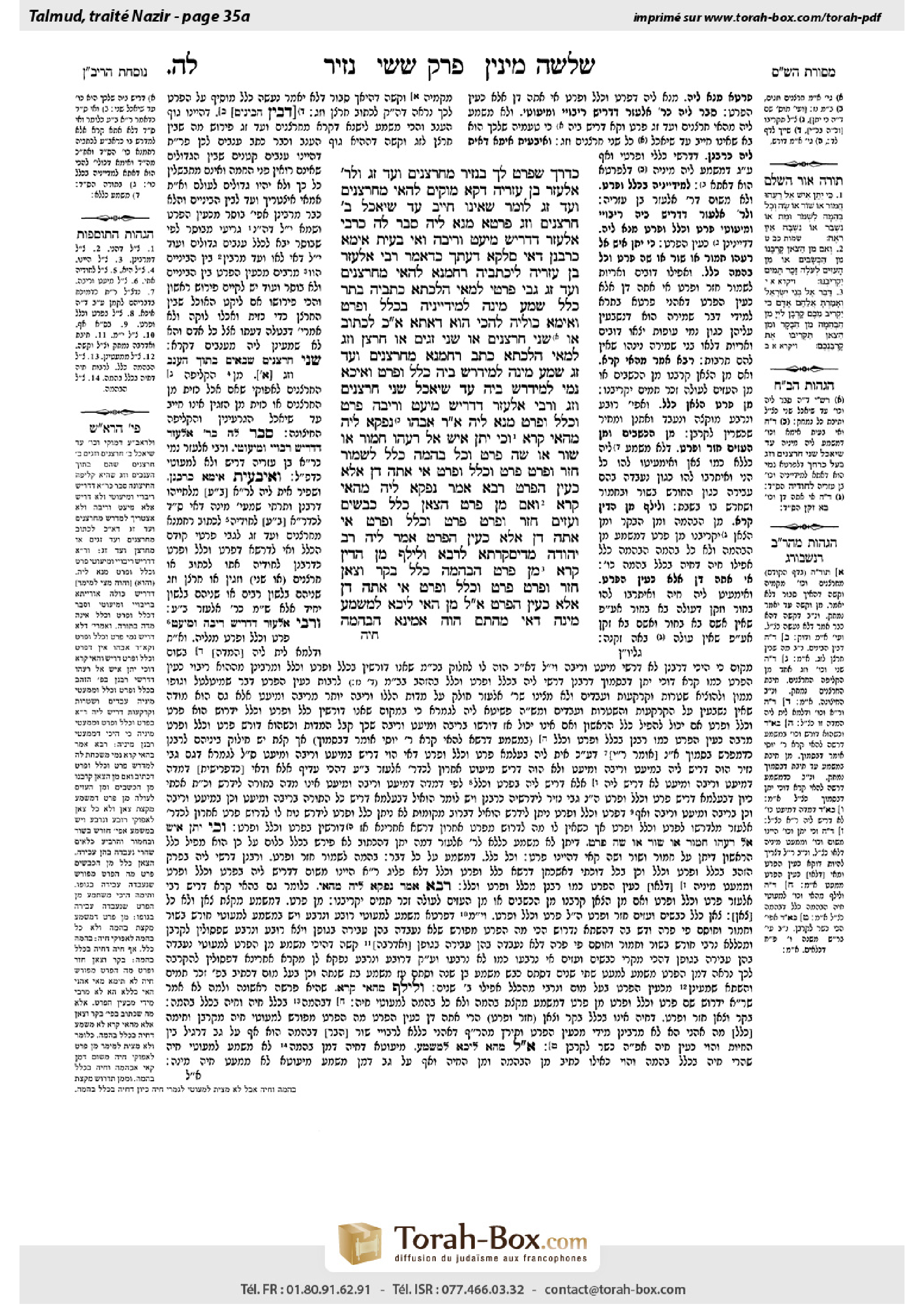
Nazir 35a: Talmud study for Daf Yomi
Daf Yomi is the daily study of one Talmud folio. Explore 37 tractates with scans, Hebrew text, Sefaria English and AI-generated French translations where annotated.
Passage selection and English or AI-generated French translation are available where the scan has annotations. Daf Study is independent of Torah-Box and Sefaria.
Browse Nazir · נזיר · All tractatesNazir 35a text and translations
This page of Nazir includes the Aramaic text, an English translation and an AI-generated French translation, alongside the scan above.
נזיר ל״ה א · Aramaic and Hebrew text
כְּדֶרֶךְ שֶׁפָּרַט לְךָ בְּנָזִיר ״מֵחַרְצַנִּים וְעַד זָג״. וּלְרַבִּי אֶלְעָזָר בֶּן עֲזַרְיָה דְּקָא מוֹקֵים לְהַאי ״מֵחַרְצַנִּים וְעַד זָג״ לוֹמַר שֶׁאֵינוֹ חַיָּיב עַד שֶׁיֹּאכַל שְׁנֵי חַרְצַנִּים וְזַג, פְּרָטָא מְנָא לֵיהּ! סָבַר לַהּ כְּרַבִּי אֶלְעָזָר דְּדָרֵישׁ מִיעֵט וְרִיבָּה.
וְאִי בָּעֵית אֵימָא כְּרַבָּנַן, דְּאִי סָלְקָא דַעְתָּךְ כִּדְאָמַר רַבִּי אֶלְעָזָר בֶּן עֲזַרְיָה, לִיכְתְּבֵיהּ רַחֲמָנָא לְהַאי ״מֵחַרְצַנִּים וְעַד זָג״ גַּבֵּי פְּרָטֵי, לְמַאי הִלְכְתָא כַּתְבֵיהּ בָּתַר כְּלָל? שְׁמַע מִינַּהּ לְמֵידַּיְינֵיהּ בִּכְלָל וּפְרָט.
וְאֵימָא כּוּלֵּיהּ לְהָכִי הוּא דַּאֲתָא! אִם כֵּן לִכְתּוֹב אוֹ שְׁנֵי חַרְצַנִּים, אוֹ שְׁנֵי זַגִּים, אוֹ חַרְצַן וְזָג. לְמַאי הִלְכְתָא כְּתַב רַחֲמָנָא ״מֵחַרְצַנִּים וְעַד זָג״? שְׁמַע מִינַּהּ לְמִידְרַשׁ בֵּיהּ כְּלָל וּפְרָט, וְאִיכָּא נָמֵי לְמִידְרַשׁ בֵּיהּ: עַד שֶׁיֹּאכַל שְׁנֵי חַרְצַנִּים וְזָג.
וְרַבִּי אֶלְעָזָר דְּדָרֵישׁ מִיעֵט וְרִיבָּה, פְּרָט וּכְלָל וּפְרָט מְנָא לֵיהּ?
אָמַר רַבִּי אֲבָהוּ, נָפְקָא לֵיהּ מֵהַאי קְרָא: ״וְכִי יִתֵּן אִישׁ אֶל רֵעֵהוּ חֲמוֹר אוֹ שׁוֹר אוֹ שֶׂה״ — פָּרַט, ״וְכׇל בְּהֵמָה״ — כָּלַל, ״לִשְׁמוֹר״ — חָזַר וּפָרַט. פְּרָט וּכְלָל וּפְרָט, אִי אַתָּה דָן אֶלָּא כְעֵין הַפְּרָט.
רָבָא אָמַר: נָפְקָא לֵיהּ מֵהַאי קְרָא: ״וְאִם מִן״ — פָּרַט. ״הַצֹּאן״ — כָּלַל, ״כְּבָשִׁים וְעִזִּים״ — חָזַר וּפָרַט,
פְּרָט וּכְלָל וּפָרַט, אִי אַתָּה דָן אֶלָּא כְעֵין הַפְּרָט.
אֲמַר לֵיהּ רַב יְהוּדָה מִדִּיסְקַרְתָּא לְרָבָא, וְלֵילַף מִן הָדֵין קְרָא: ״מִן״ — פָּרַט, ״הַבְּהֵמָה״ — כָּלַל, ״בָּקָר וָצֹאן״ — חָזַר וּפָרַט. פְּרָט וּכְלָל וּפְרָט, אִי אַתָּה דָן אֶלָּא כְעֵין הַפְּרָט.
אֲמַר לֵיהּ: מִן הַאי לֵיכָּא לְמִשְׁמַע מִינַּהּ, דְּאִי מֵהָתָם, הֲוָה אָמֵינָא: ״הַבְּהֵמָה״ —
Nazir 35a · English translation
in the manner that it specified with regard to a nazirite: “From pits to grape skin” (Numbers 6:4). The Gemara asks: And according to the opinion of Rabbi Elazar ben Azarya, who establishes this verse: “From pits to grape skin” (Numbers 6:4), as serving to say that a nazirite is liable only if he eats two grape seeds and a grape skin, if so from where does he derive the detail? It is unclear how he applies this method of a detail, a generalization, and a detail, as according to his interpretation, the phrase “from pits to grape skin” does not serve to limit the previous generalization but to state a different halakha. The Gemara answers: Rabbi Elazar ben Azarya holds in accordance with the opinion of Rabbi Elazar, who interprets this by saying that a verse restricts and amplifies.
And if you wish, say instead that Rabbi Elazar ben Azarya holds in accordance with the opinion of the Rabbis that this is a case of a detail, a generalization, and a detail. As, if it should enter your mind that the verse is merely teaching that which was stated by Rabbi Elazar ben Azarya, let the Merciful One write this phrase: “From pits to grape skin,” alongside the other details of wine and vinegar. For what halakha did the Torah write: “From pits to grape skin,” after the generalization? Conclude from it that you should derive this halakha by means of the method of a generalization and a detail.
The Gemara asks: But if so, you can say that the entire phrase comes only for this purpose, for a generalization and a detail, and Rabbi Elazar ben Azarya should not derive his halakha, that a nazirite is liable only if he eats two grape seeds and a grape skin, from this verse at all. The Gemara answers that Rabbi Elazar ben Azarya would say: If so, let the Torah write either two grape seeds and two grape skins, with both terms in the plural, or a grape seed and a grape skin, with both terms in the singular. For what halakha did the Merciful One write: “From pits to grape skin”? Learn from it that one should interpret it in the manner of a generalization and a detail, and one can also interpret from it that a nazirite is liable only if he eats two grape seeds and a grape skin.
The Gemara asks: And Rabbi Elazar, who interprets by the method of restriction and amplification that even tendrils and the leaves of a grapevine are included in the prohibition, from where does he derive the method of a detail, a generalization, and a detail?
Rabbi Abbahu says: He derives it from this verse, which deals with a bailee: “And if a man deliver to his neighbor a donkey, or an ox, or a sheep, or any animal to guard, and it dies…the oath of the Lord shall be between them both” (Exodus 22:9). The phrase “a donkey, or an ox, or a sheep” is a detail; “or any animal” is a generalization that includes all animals; and in the phrase “to guard” the Torah detailed again. This is a detail, and a generalization, and a detail. In this case, you may deduce that the verse is referring only to items similar to the detail; i.e., items that can be guarded.
Rava said: Rabbi Elazar derives the method of a detail, a generalization, and a detail from this verse: “And if his offering is from the flock, whether of the sheep or of the goats, for a burnt-offering, he shall offer it a male without blemish” (Leviticus 1:10). The phrase “and if his offering is from” is a detail, as it indicates part but not all of something, “the flock” is a generalization that includes animals that have been used sinfully, and when it stated: “Sheep,” and: “Goats,” the Torah has detailed again.
This is a detail, and a generalization, and a detail, and therefore you may deduce that the verse is referring only to items similar to the detail. The details teach that only animals that copulated with a person may not be brought as offerings.
Rav Yehuda of Diskarta said to Rava: And let Rabbi Elazar derive the method of a detail, a generalization, and a detail from this earlier verse, which appears in the same chapter: “From animals, from the herd or from the flock, you shall bring your offering” (Leviticus 1:2), in the following manner: “From” is a detail that excludes an undomesticated animal; “animals” is a generalization which includes undomesticated animals (see Deuteronomy, chapter 14); and when it states: “Herd,” and: “Flock,” the Torah has detailed again. This is a detail, and a generalization, and a detail, and therefore you may deduce that the verse is referring only to items similar to the detail, i.e., domesticated animals.
Rava said to Rav Yehuda of Diskarta: One cannot derive the method of a detail, a generalization, and a detail from this verse, as if the source were from there, I would say the phrase “animals”
Nazir 35a · Traduction française (IA)
de la manière dont cela est précisé à propos du nazir : « Depuis les pépins jusqu’à la peau du raisin » (Nombres 6:4). La Guemara demande : Et selon l’opinion de Rabbi Elazar ben Azarya, qui comprend ce verset — « Depuis les pépins jusqu’à la peau du raisin » (Nombres 6:4) — comme enseignant qu’un nazir n’est passible que s’il mange deux pépins de raisin et une peau de raisin, d’où tire-t-il alors cette précision ? On ne comprend pas comment il applique la méthode du particulier, du général et du particulier, puisque, selon son interprétation, l’expression « Depuis les pépins jusqu’à la peau du raisin » ne vient pas limiter le général précédent, mais énoncer une autre halakha. La Guemara répond : Rabbi Elazar ben Azarya suit l’opinion de Rabbi Elazar, qui interprète le verset selon le principe de la restriction et de l’amplification.
Et si tu préfères, dis plutôt que Rabbi Elazar ben Azarya suit l’opinion des Rabbins : il s’agit ici du particulier, du général et du particulier. En effet, si l’on pouvait penser que le verset enseigne seulement ce qu’a dit Rabbi Elazar ben Azarya, que le Miséricordieux écrive l’expression « Depuis les pépins jusqu’à la peau du raisin » à côté des autres détails concernant le vin et le vinaigre. Pourquoi la Torah a-t-elle écrit « Depuis les pépins jusqu’à la peau du raisin » après le général ? Déduis-en qu’il faut tirer cette halakha au moyen de la méthode du général et du particulier.
La Guemara demande : Mais dans ce cas, tu pourrais dire que toute l’expression ne vient que pour appliquer la méthode du général et du particulier, et que Rabbi Elazar ben Azarya ne devrait pas du tout tirer de ce verset sa halakha selon laquelle un nazir n’est passible que s’il mange deux pépins de raisin et une peau de raisin. La Guemara répond que Rabbi Elazar ben Azarya dirait : Si tel était le cas, que la Torah écrive soit « deux pépins de raisin et deux peaux de raisin », les deux termes au pluriel, soit « un pépin de raisin et une peau de raisin », les deux termes au singulier. Pourquoi le Miséricordieux a-t-il écrit « Depuis les pépins jusqu’à la peau du raisin » ? Déduis-en qu’il faut l’interpréter selon la méthode du général et du particulier, et qu’on peut également en déduire qu’un nazir n’est passible que s’il mange deux pépins de raisin et une peau de raisin.
Et Rabbi Elazar, qui interprète le verset selon le principe de la restriction et de l’amplification, de sorte que les vrilles et les feuilles de vigne sont elles aussi incluses dans l’interdiction, d’où tire-t-il la méthode du particulier, du général et du particulier ?
Rabbi Abbahou dit : Il la tire de ce verset, qui traite d’un gardien : « Si un homme remet à son prochain un âne, un bœuf, un mouton ou tout autre animal à garder, et que celui-ci meure… le serment du Seigneur sera entre les deux » (Exode 22:9). L’expression « un âne, un bœuf, un mouton » est un particulier ; « ou tout autre animal » est un général qui inclut tous les animaux ; et, dans l’expression « à garder », la Torah énonce de nouveau un particulier. Il s’agit du particulier, du général et du particulier. On peut donc en déduire que le verset ne vise que les éléments semblables à ceux désignés par le particulier, c’est-à-dire ceux qui peuvent être gardés.
Rava dit : Rabbi Elazar tire la méthode du particulier, du général et du particulier de ce verset : « Si son offrande provient du petit bétail, des moutons ou des chèvres, pour un holocauste, il présentera un mâle sans défaut » (Lévitique 1:10). L’expression « si son offrande provient de » est un particulier, car elle désigne une partie, mais pas la totalité, d’un ensemble ; « le petit bétail » est un général qui inclut les animaux ayant été utilisés à des fins interdites ; et, lorsqu’il est dit « moutons » et « chèvres », la Torah énonce de nouveau des particuliers.
Il s’agit du particulier, du général et du particulier ; on peut donc en déduire que le verset ne vise que les éléments semblables à ceux désignés par le particulier. Les particuliers enseignent que seuls les animaux qui se sont accouplés avec un être humain ne peuvent pas être apportés en offrande.
Rav Yehouda de Diskarta dit à Rava : Que Rabbi Elazar tire donc la méthode du particulier, du général et du particulier de ce verset antérieur, qui apparaît dans le même chapitre : « Parmi les animaux, du gros bétail ou du petit bétail, vous apporterez votre offrande » (Lévitique 1:2), de la manière suivante : « Parmi » est un particulier, qui exclut les animaux sauvages ; « les animaux » est un général qui inclut les animaux sauvages (voir Deutéronome, chapitre 14) ; et, lorsqu’il est dit « gros bétail » et « petit bétail », la Torah énonce de nouveau des particuliers. Il s’agit du particulier, du général et du particulier ; on peut donc en déduire que le verset ne vise que les éléments semblables à ceux désignés par le particulier, c’est-à-dire les animaux domestiques.
Rava dit à Rav Yehouda de Diskarta : On ne peut pas tirer la méthode du particulier, du général et du particulier de ce verset, car si la source était là, je dirais que l’expression « les animaux »
Traduction française générée par IA à partir de l’édition anglaise de Sefaria. Vérifie toujours un passage avec le texte source.
Text from Sefaria: William Davidson Edition - Vocalized Aramaic (CC BY NC); William Davidson Edition - English (CC BY NC).