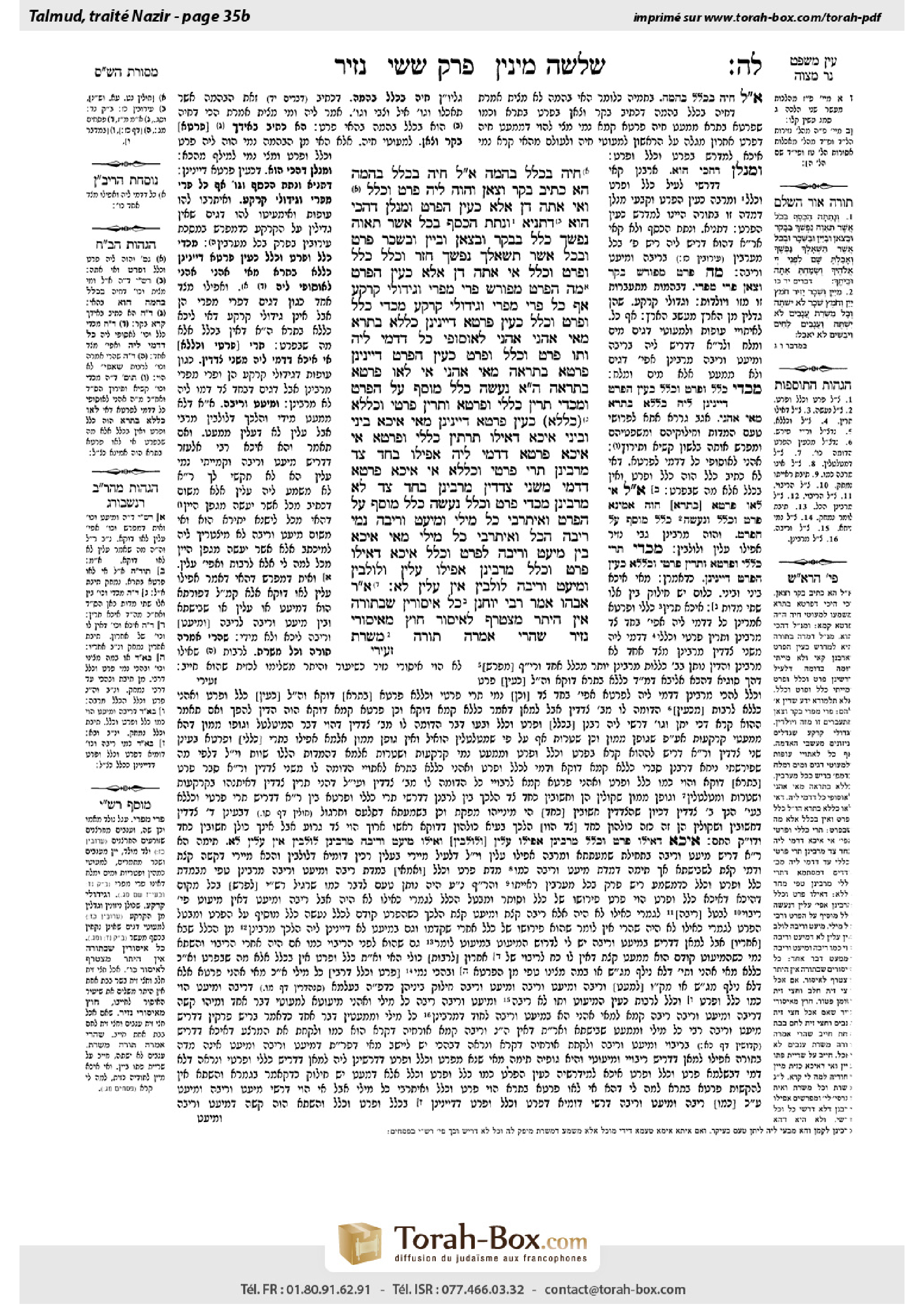
Nazir 35b: Talmud study for Daf Yomi
Daf Yomi is the daily study of one Talmud folio. Explore 37 tractates with scans, Hebrew text, Sefaria English and AI-generated French translations where annotated.
Passage selection and English or AI-generated French translation are available where the scan has annotations. Daf Study is independent of Torah-Box and Sefaria.
Browse Nazir · נזיר · All tractatesNazir 35b text and translations
This page of Nazir includes the Aramaic text, an English translation and an AI-generated French translation, alongside the scan above.
נזיר ל״ה ב · Aramaic and Hebrew text
חַיָּה בִּכְלַל בְּהֵמָה.
אֲמַר לֵיהּ: חַיָּה בִּכְלַל בְּהֵמָה? הָא כְּתִיב ״בָּקָר וָצֹאן״, וְהָוֵה לֵיהּ פְּרָט וּכְלָל, וְאִי אַתָּה דָן אֶלָּא כְעֵין הַפְּרָט!
וּמְנָלַן דְּהָכִי הוּא? דְּתַנְיָא:
״וְנָתַתָּ הַכֶּסֶף בְּכֹל אֲשֶׁר תְּאַוֶּה נַפְשְׁךָ״ — כָּלַל, ״בַּבָּקָר וּבַצֹּאן וּבַיַּיִן וּבַשֵּׁכָר״ — פָּרַט, ״וּבְכֹל אֲשֶׁר תִּשְׁאָלְךָ נַפְשֶׁךָ״ — חָזַר וְכָלַל.
כְּלָל וּפְרָט וּכְלָל, אִי אַתָּה דָן אֶלָּא כְּעֵין הַפְּרָט: מָה הַפְּרָט מְפוֹרָשׁ פְּרִי מִפְּרִי וְגִידּוּלֵי קַרְקַע — אַף כֹּל פְּרִי מִפְּרִי וְגִידּוּלֵי קַרְקַע.
מִכְּדִי כְּלָל וּפְרָט וּכְלָל כְּעֵין פְּרָטָא דָּיְינִינַן, כְּלָלָא בָּתְרָא מַאי אַהֲנִי? אַהֲנִי לְאוֹסוֹפֵי כׇּל דְּדָמֵי לֵיהּ.
וְתוּ: פְּרָט וּכְלָל וּפְרָט כְּעֵין הַפְּרָט דָּיְינִינַן, פְּרָטָא בָּתְרָאָה מַאי אַהֲנִי! אִי לָאו פְּרָטָא בָּתְרָאָה, הֲוָה אָמֵינָא: נַעֲשֶׂה כְּלָל מוּסָף עַל הַפְּרָט.
וּמִכְּדֵי, תְּרֵין כְּלָלֵי וּפְרָטָא וּתְרֵין פְּרָטֵי וּכְלָלָא — (כְּלָלָא) כְּעֵין פְּרָטָא דָּיְינִינַן, מַאי אִיכָּא בֵּינֵי וּבֵינֵי?
אִיכָּא דְּאִילּוּ תַּרְתֵּין כְּלָלֵי וּפְרָטָא, אִי אִיכָּא פְּרָטָא דְּדָמֵי לֵיהּ אֲפִילּוּ בְּחַד צַד — מְרַבִּינַן, תְּרֵי פְּרָטֵי וּכְלָלָא, אִי אִיכָּא פְּרָטָא דְּדָמֵי מִשְּׁנֵי צְדָדִין — מְרַבִּינַן, בְּחַד צַד — לָא מְרַבִּינַן.
מִכְּדִי פְּרָט וּכְלָל — נַעֲשֶׂה כְּלָל מוּסָף עַל הַפְּרָט, וְאִיתְרַבִּי כֹּל מִילֵּי. וּמִיעֵט וְרִיבָּה נָמֵי — רִיבָּה הַכֹּל, וְאִיתְרַבִּי כֹּל מִילֵּי. מַאי אִיכָּא בֵּין מִיעֵט וְרִיבָּה לִפְרָט וּכְלָל?
אִיכָּא, דְּאִילּוּ פְּרָט וּכְלָל — מְרַבִּינַן אֲפִילּוּ עָלִין וְלוּלָבִין. וּמִיעֵט וְרִיבָּה, לוּלָבִין — אִין, עָלִין — לָא.
אָמַר רַבִּי אֲבָהוּ אָמַר רַבִּי יוֹחָנָן: כׇּל אִיסּוּרִין שֶׁבַּתּוֹרָה אֵין הֶיתֵּר מִצְטָרֵף לְאִיסּוּר, חוּץ מֵאִיסּוּרֵי נָזִיר, שֶׁהֲרֵי אָמְרָה תּוֹרָה: ״מִשְׁרַת״.
Nazir 35b · English translation
is referring even to undomesticated animals, as an undomesticated animal is included in the general category of animal.
Rav Yehuda of Diskarta said to Rava: How can you suggest that in this verse an undomesticated animal is included in the general category of animal? It is written: “Herd” and: “Flock,” and this entire phrase is a detail, and a generalization, and a detail, from which you may deduce that the verse is referring only to items similar to the detail, which are herd and flock, not undomesticated animals.
§ The Gemara asks: And from where do we derive that it is so, that in the methodology of generalizations and details, the generalizations are similar to the details? It is as it is taught in a baraita: The verse states with regard to the mitzva to bring money for the second tithe to Jerusalem: “And you shall bestow the money on all that your heart desires, on cattle, on sheep, on wine, and on strong drink, and on whatever your soul requests” (Deuteronomy 14:26).
The baraita elaborates: The phrase “And you shall bestow the money on all that your heart desires” is a generalization, as no particular type of food is specified. The phrase “on cattle, on sheep, on wine, and on strong drink” is a detail, as specific foods are mentioned. And when the verse concludes: “On whatever your soul requests,” it then generalized again, as no specific type of food is stated.
Since the verse is formulated as a generalization, and a detail, and a generalization, you may deduce that it is referring only to items similar to the detail. Just as the items mentioned in the detail are clearly defined as the produce of produce, i.e., not only the produce itself but also items that come from it, such as grapes from a seed, and they are also items grown from the ground, as all of these items grow from the ground or receive their main sustenance from it, so too, the generalization includes all items that are the produce of produce and are grown from the ground. This includes birds, but it does not include fish, water, or salt.
§ The Gemara discusses a series of problems with regard to these and other methods of halakhic exegesis: Now, in the case of a generalization, and a detail, and a generalization, one derives that all items which are like the detail are included. However, if that is so, what purpose does the last generalization stated in the verse serve? The same conclusion would be reached if the verse had stated merely a generalization and a detail. The Gemara answers: The purpose of the last generalization is to add all that is similar to it, i.e., even those articles or cases not explicitly listed among the details.
And furthermore, in the case of a detail, and a generalization, and a detail, one again derives that all items which are like the detail are included. If so, what purpose does the last detail stated in the verse serve? The same conclusion would apply if there was simply a detail and a generalization. The Gemara answers: If it were not for the last detail, I would say that the generalization becomes added to the detail, which is broadened in all possible ways. Therefore, the last detail limits the generalization to items or cases that are similar to the detail.
The Gemara continues this line of questioning. And now that it has been established that both with regard to two generalizations and a detail, i.e., a generalization, a detail, and a generalization, and two details and a generalization, i.e., a detail, a generalization, and a detail, one derives that all items that are like the detail are included, what difference is there between this method and that one? The two methods are apparently identical.
The Gemara answers: There is a difference between them, as whereas in a case of two generalizations and a detail, if there is another detail that is similar to the detail specified in the verse even in one aspect, one includes it, due to the two generalizations. By contrast, in the case of two details and a generalization, if there is another detail that is similar to the one mentioned in the verse in two aspects, one includes it. However, if it is similar in only one aspect one does not include it, as the halakha is limited by two details.
The Gemara asks another question: Now, in the method of a detail and a generalization, the generalization becomes added to the detail, and all matters are included by the generalization. And the method of restriction and amplification also amplifies and includes everything, and therefore all matters are included in both cases. If so, what difference is there between the method of restriction and amplification and that of a detail and a generalization?
The Gemara answers: There is the following difference, as whereas in the method of a detail and a generalization one includes and renders forbidden to a nazirite even leaves and tendrils of the vine, with the method of restriction and amplification one includes less, as tendrils, yes, they are included in the prohibition, whereas leaves, no, they are not included.
§ Rabbi Abbahu says that Rabbi Yoḥanan says: With regard to all prohibitions that are written in the Torah, a permitted substance does not combine with a forbidden substance. If one eats a permitted food with a forbidden food and together they constitute the minimum prohibited measure, he is exempt from punishment for this act of consumption. This principle applies to all halakhot except for the prohibitions of a nazirite, who is liable for eating a mixture of that kind, as the Torah said with regard to a nazirite: “Neither shall he drink anything soaked in grapes” (Numbers 6:3). This verse indicates that a nazirite is prohibited from consuming not only wine and vinegar, but also any food that was soaked in these liquids.
Nazir 35b · Traduction française (IA)
Cela fait référence même aux animaux sauvages, car un animal sauvage appartient à la catégorie générale des animaux.
Rav Yehouda de Diskarta dit à Rava : Comment peux-tu suggérer que, dans ce verset, un animal sauvage appartient à la catégorie générale des animaux ? Il est écrit « troupeau » et « petit bétail » ; toute cette expression suit le schéma d’un détail, d’une règle générale et d’un détail. On peut donc en déduire que le verset ne fait référence qu’aux éléments semblables aux détails, à savoir le troupeau et le petit bétail, et non aux animaux sauvages.
§ La Guemara demande : Et d’où déduisons-nous qu’il en est ainsi, c’est-à-dire que, selon la méthode des règles générales et des détails, les règles générales sont assimilées aux détails ? Cela ressort de ce qui est enseigné dans une baraïta : au sujet de la mitsva d’apporter à Jérusalem l’argent de la seconde dîme, le verset dit : « Tu dépenseras l’argent pour tout ce que ton cœur désire, pour du gros bétail, du petit bétail, du vin et des boissons fortes, et pour tout ce que ton âme réclame » (Deutéronome 14,26).
La baraïta développe : l’expression « Tu dépenseras l’argent pour tout ce que ton cœur désire » est une règle générale, car aucun type particulier d’aliment n’est précisé. L’expression « pour du gros bétail, du petit bétail, du vin et des boissons fortes » est un détail, car des aliments précis sont mentionnés. Et lorsque le verset conclut : « Pour tout ce que ton âme réclame », il énonce de nouveau une règle générale, puisqu’aucun type particulier d’aliment n’est indiqué.
Puisque le verset suit le schéma d’une règle générale, d’un détail, puis d’une règle générale, on peut en déduire qu’il ne fait référence qu’aux éléments semblables au détail. Les éléments mentionnés dans le détail sont caractérisés comme des produits issus de produits — c’est-à-dire non seulement les produits eux-mêmes, mais aussi ce qui en provient, comme les raisins issus d’un pépin — et comme des éléments qui poussent de la terre, puisque tous poussent de la terre ou en tirent leur principale subsistance. De même, la règle générale inclut tout ce qui est un produit issu de produits et pousse de la terre. Cela inclut les oiseaux, mais pas les poissons, l’eau ni le sel.
§ La Guemara examine une série de difficultés concernant ces méthodes et d’autres méthodes d’exégèse halakhique : Dans le cas d’une règle générale, suivie d’un détail, puis d’une règle générale, on déduit que tous les éléments semblables au détail sont inclus. Si tel est le cas, à quoi sert la dernière règle générale énoncée dans le verset ? On arriverait à la même conclusion si le verset ne formulait qu’une règle générale et un détail. La Guemara répond : la dernière règle générale sert à ajouter tout ce qui lui est semblable, c’est-à-dire même les objets ou les cas qui ne sont pas explicitement énumérés parmi les détails.
En outre, dans le cas d’un détail, suivi d’une règle générale, puis d’un détail, on déduit à nouveau que tous les éléments semblables au détail sont inclus. Si tel est le cas, à quoi sert le dernier détail énoncé dans le verset ? On arriverait à la même conclusion si l’on avait simplement un détail et une règle générale. La Guemara répond : sans le dernier détail, j’aurais dit que la règle générale s’ajoute au détail et l’élargit de toutes les manières possibles. Le dernier détail limite donc la règle générale aux éléments ou aux cas semblables au détail.
La Guemara poursuit cette série de questions. Maintenant qu’il a été établi que, tant dans le cas de deux règles générales et d’un détail — c’est-à-dire une règle générale, un détail, puis une règle générale — que dans celui de deux détails et d’une règle générale — c’est-à-dire un détail, une règle générale, puis un détail — on déduit que tous les éléments semblables au détail sont inclus, quelle différence y a-t-il entre cette méthode et l’autre ? Les deux méthodes semblent identiques.
La Guemara répond : il existe une différence entre elles. Dans le cas de deux règles générales et d’un détail, si un autre élément ressemble au détail précisé dans le verset sous un seul aspect, on l’inclut en raison des deux règles générales. En revanche, dans le cas de deux détails et d’une règle générale, on inclut un autre élément s’il ressemble sous deux aspects à celui mentionné dans le verset. Mais s’il ne lui ressemble que sous un seul aspect, on ne l’inclut pas, car la halakha est limitée par les deux détails.
La Guemara pose une autre question : selon la méthode du détail suivi d’une règle générale, la règle générale s’ajoute au détail et tout est inclus par cette règle générale. La méthode de la restriction et de l’amplification amplifie elle aussi et inclut tout ; ainsi, dans les deux cas, tout est inclus. Quelle différence y a-t-il donc entre la méthode de la restriction et de l’amplification et celle du détail suivi d’une règle générale ?
La Guemara répond : il existe la différence suivante. Selon la méthode du détail suivi d’une règle générale, on inclut et on interdit au nazir même les feuilles et les vrilles de la vigne. Selon la méthode de la restriction et de l’amplification, on inclut moins : les vrilles, oui, sont comprises dans l’interdiction, mais les feuilles, non, ne le sont pas.
§ Rabbi Abbahou dit au nom de Rabbi Yoḥanan : pour toutes les interdictions énoncées dans la Torah, une substance permise ne se combine pas avec une substance interdite. Si quelqu’un consomme un aliment permis avec un aliment interdit et que les deux réunis atteignent la quantité minimale requise pour enfreindre l’interdiction, il n’est pas passible de sanction pour cette consommation. Ce principe s’applique à toutes les halakhot, à l’exception des interdictions qui concernent le nazir, qui est passible de sanction s’il consomme un mélange de ce type, car la Torah dit à son sujet : « Il ne boira rien de trempé dans le raisin » (Nombres 6,3). Ce verset indique qu’il est interdit au nazir de consommer non seulement du vin et du vinaigre, mais aussi tout aliment trempé dans ces liquides.
Traduction française générée par IA à partir de l’édition anglaise de Sefaria. Vérifie toujours un passage avec le texte source.
Text from Sefaria: William Davidson Edition - Vocalized Aramaic (CC BY NC); William Davidson Edition - English (CC BY NC).