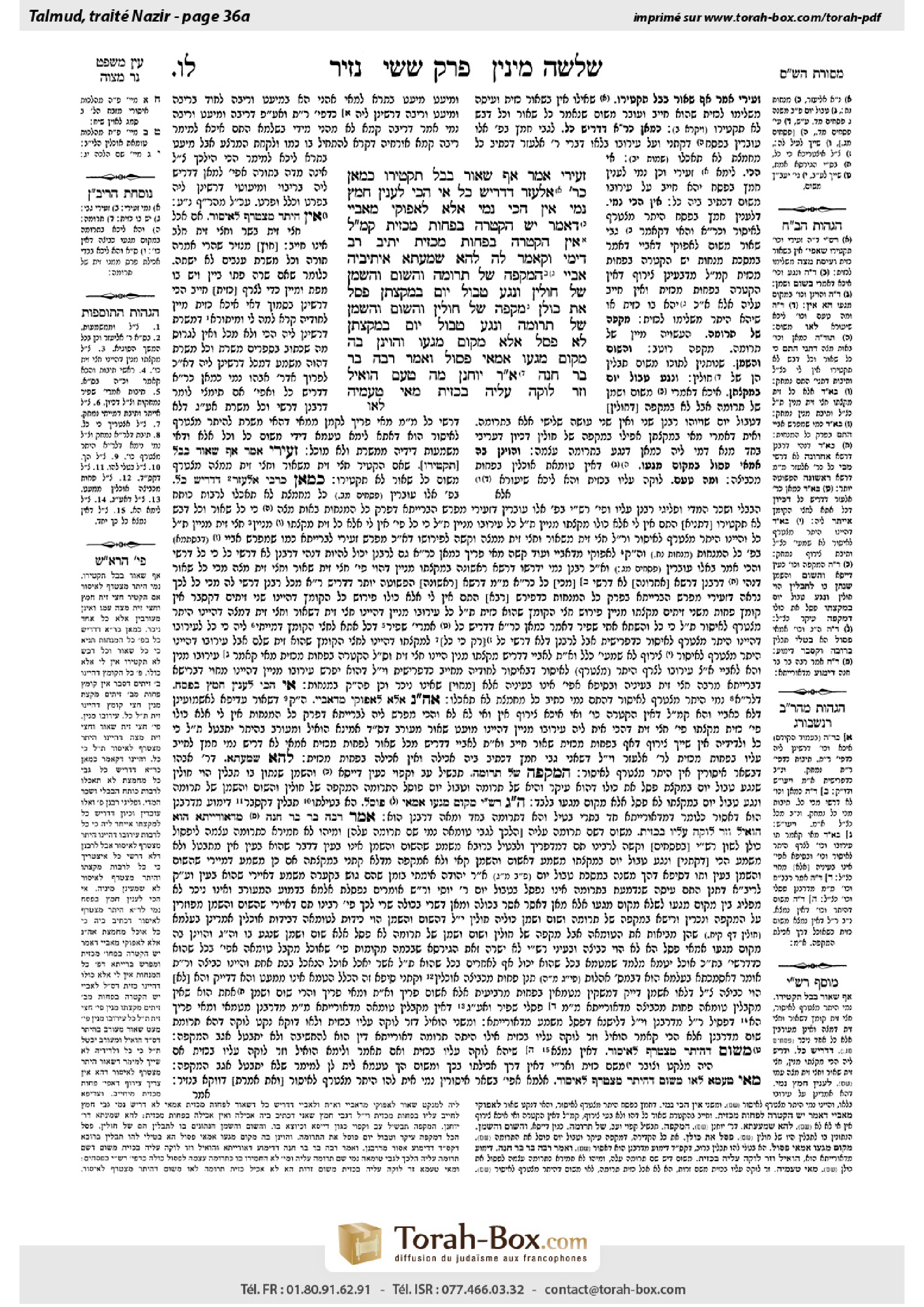
Nazir 36a: Talmud study for Daf Yomi
Daf Yomi is the daily study of one Talmud folio. Explore 37 tractates with scans, Hebrew text, Sefaria English and AI-generated French translations where annotated.
Passage selection and English or AI-generated French translation are available where the scan has annotations. Daf Study is independent of Torah-Box and Sefaria.
Browse Nazir · נזיר · All tractatesNazir 36a text and translations
This page of Nazir includes the Aramaic text, an English translation and an AI-generated French translation, alongside the scan above.
נזיר ל״ו א · Aramaic and Hebrew text
זְעֵירִי אָמַר: אַף שְׂאוֹר בְּבַל תַּקְטִירוּ. כְּמַאן — כְּרַבִּי אֶלְעָזָר, דְּדָרֵישׁ ״כֹּל״?
אִי הָכִי לְעִנְיַן חָמֵץ נָמֵי! אִין הָכִי נָמֵי. אֶלָּא לְאַפּוֹקֵי מֵאַבָּיֵי דְּאָמַר: יֵשׁ הַקְטָרָה בְּפָחוֹת מִכְּזַיִת, קָא מַשְׁמַע לַן: אֵין הַקְטָרָה בְּפָחוֹת מִכְּזַיִת.
יָתֵיב רַב דִּימִי וְקָאָמַר לַהּ לְהָא שְׁמַעְתָּא. אֵיתִיבֵיהּ אַבָּיֵי: הַמִּקְפָּה שֶׁל תְּרוּמָה, וְהַשּׁוּם וְהַשֶּׁמֶן שֶׁל חוּלִּין, וְנָגַע טְבוּל יוֹם בְּמִקְצָתָן — פָּסַל אֶת כּוּלָּן. מִקְפָּה שֶׁל חוּלִּין, וְהַשּׁוּם וְהַשֶּׁמֶן שֶׁל תְּרוּמָה, וְנָגַע טְבוּל יוֹם בְּמִקְצָתָן — לֹא פָּסַל אֶלָּא מְקוֹם מַגָּעוֹ.
וְהָוֵינַן בַּהּ: מְקוֹם מַגָּעוֹ אַמַּאי פָּסוּל? וְאָמַר רַבָּה בַּר בַּר חָנָה אָמַר רַבִּי יוֹחָנָן: מָה טַעַם — הוֹאִיל וְזָר לוֹקֶה עָלֶיהָ בִּכְזַיִת.
מַאי טַעְמֵיהּ?
Nazir 36a · English translation
Ze’eiri says: Permitted and forbidden substances combine with regard to the prohibition against offering leaven on the altar, as well, as it states: “For any [kol] leaven and any [kol] honey shall not be offered as a burnt-offering before the Lord” (Leviticus 2:11). This indicates that one is also liable for sacrificing leaven in a mixture in addition to the liability for sacrificing pure leaven. The Gemara asks: In accordance with whose opinion did Ze’eiri issue his ruling? It is in accordance with the opinion of Rabbi Eliezer, who derives from the term kol in the verse “You shall eat nothing [kol] leavened” (Exodus 12:20) that a mixture with part leaven is forbidden on Passover.
The Gemara raises a difficulty: If so, then with regard to the matter of leavened bread on Passover, one should also be liable for eating leaven combined with a permitted substance, e.g., less than an olive-bulk of bread soaked in wine, so that the volume is now an olive-bulk. The Gemara answers: Yes, indeed it is so. Rather, when Ze’eiri specifies that the prohibition applies with regard to sacrificing leaven in offerings, he meant to exclude the statement of Abaye, who says: There is significance to sacrificing less than an olive-bulk of leaven on the altar, i.e., one is flogged for sacrificing an offering of that kind. By noting that one is liable due to the fact that permitted substances combine with forbidden substances, Ze’eiri teaches us that there is no significance to sacrificing less than an olive-bulk, and therefore this is not punishable by lashes.
§ Rav Dimi sat and stated this halakha of Rabbi Yoḥanan that a permitted substance does not combine with a forbidden substance except in the case of a nazirite. Abaye raised an objection to his opinion from a mishna (Tevul Yom 2:3): In a case where the thick soup was made with produce that had the status of teruma but the garlic and oil therein were of non-sacred produce, and one who was ritually impure who immersed that day and is waiting for nightfall for the purification process to be completed touched some of the contents, he has disqualified all the contents of the pot from being eaten, as it all is considered teruma soup. However, if the thick soup was made with produce of non-sacred status but the garlic and the oil had the status of teruma produce, and one who immersed himself that day touched some of them, he has disqualified only the contents in the place that he touched.
Abaye continues: And we discussed this issue: Why are the contents in the place that he touched disqualified? Since the primary ingredients of the dish are of non-sacred produce, it should not be disqualified by contact with one who immersed himself that day. And Rabba bar bar Ḥana says that Rabbi Yoḥanan says: What is the reason that the contents become disqualified? It is due to the fact that a non-priest is flogged for eating an olive-bulk of the soup, as anything into which teruma is mixed is considered teruma by Torah law.
Abaye concludes his question: What is Rabbi Yoḥanan’s reason that one is flogged for eating this mixture?
Nazir 36a · Traduction française (IA)
Ze’eiri dit : Les substances permises et les substances interdites s’additionnent également au regard de l’interdiction d’offrir du levain sur l’autel, comme il est écrit : « Car tout [kol] levain et tout [kol] miel ne seront pas offerts en holocauste devant le Seigneur » (Lévitique 2:11). Cela indique que l’on est également passible pour avoir sacrifié du levain dans un mélange, en plus de l’être pour avoir sacrifié du levain pur. La Guemara demande : Selon l’opinion de qui Ze’eiri a-t-il rendu sa décision ? Selon celle de Rabbi Eliezer, qui déduit du terme kol dans le verset « Vous ne mangerez rien [kol] de levé » (Exode 12:20) qu’un mélange contenant une part de levain est interdit pendant Pessa’h.
La Guemara soulève une difficulté : si tel est le cas, concernant le pain levé à Pessa’h également, on devrait être passible pour avoir mangé du levain mélangé à une substance permise, par exemple moins d’un volume d’olive de pain trempé dans du vin, de sorte que le volume atteigne désormais un volume d’olive. La Guemara répond : Oui, en effet, il en est ainsi. Mais lorsque Ze’eiri précise que l’interdiction s’applique au sacrifice de levain dans les offrandes, il entend exclure l’opinion d’Abaye, qui dit : Il y a lieu de sanctionner le fait d’offrir sur l’autel moins d’un volume d’olive de levain, c’est-à-dire que l’on reçoit la flagellation pour avoir présenté une offrande de ce type. En indiquant que l’on est passible parce que les substances permises s’additionnent aux substances interdites, Ze’eiri nous enseigne qu’offrir moins d’un volume d’olive n’a aucune portée et n’est donc pas puni de flagellation.
§ Rav Dimi était assis et énonça cette halakha de Rabbi Yoḥanan, selon laquelle une substance permise ne s’additionne à une substance interdite que dans le cas d’un nazir. Abaye souleva une objection à son opinion à partir d’une Michna (Tevul Yom 2:3) : si une soupe épaisse est préparée avec des produits ayant le statut de terouma, mais que l’ail et l’huile qu’elle contient sont des produits profanes, et qu’une personne impure qui s’est immergée ce jour-là — mais doit attendre la tombée de la nuit pour que sa purification soit achevée — en touche une partie, elle rend impropre à la consommation tout le contenu de la marmite, puisque le tout est considéré comme une soupe de terouma. En revanche, si la soupe épaisse est préparée avec des produits profanes, mais que l’ail et l’huile ont le statut de produits de terouma, et qu’une personne qui s’est immergée ce jour-là en touche une partie, elle ne rend impropre à la consommation que le contenu à l’endroit qu’elle a touché.
Abaye poursuit : Nous avons discuté de cette question : pourquoi le contenu à l’endroit qu’il a touché est-il rendu impropre à la consommation ? Puisque les ingrédients principaux du plat sont des produits profanes, le contact d’une personne qui s’est immergée ce jour-là ne devrait pas le rendre impropre. Or Rabba bar bar Ḥana dit au nom de Rabbi Yoḥanan : Pour quelle raison le contenu devient-il impropre à la consommation ? Parce qu’un non-prêtre reçoit la flagellation s’il mange un volume d’olive de cette soupe, car tout ce à quoi de la terouma est mêlée est considéré comme de la terouma selon la Torah.
Abaye conclut sa question : quelle est la raison pour laquelle, selon Rabbi Yoḥanan, on reçoit la flagellation en mangeant ce mélange ?
Traduction française générée par IA à partir de l’édition anglaise de Sefaria. Vérifie toujours un passage avec le texte source.
Text from Sefaria: William Davidson Edition - Vocalized Aramaic (CC BY NC); William Davidson Edition - English (CC BY NC).