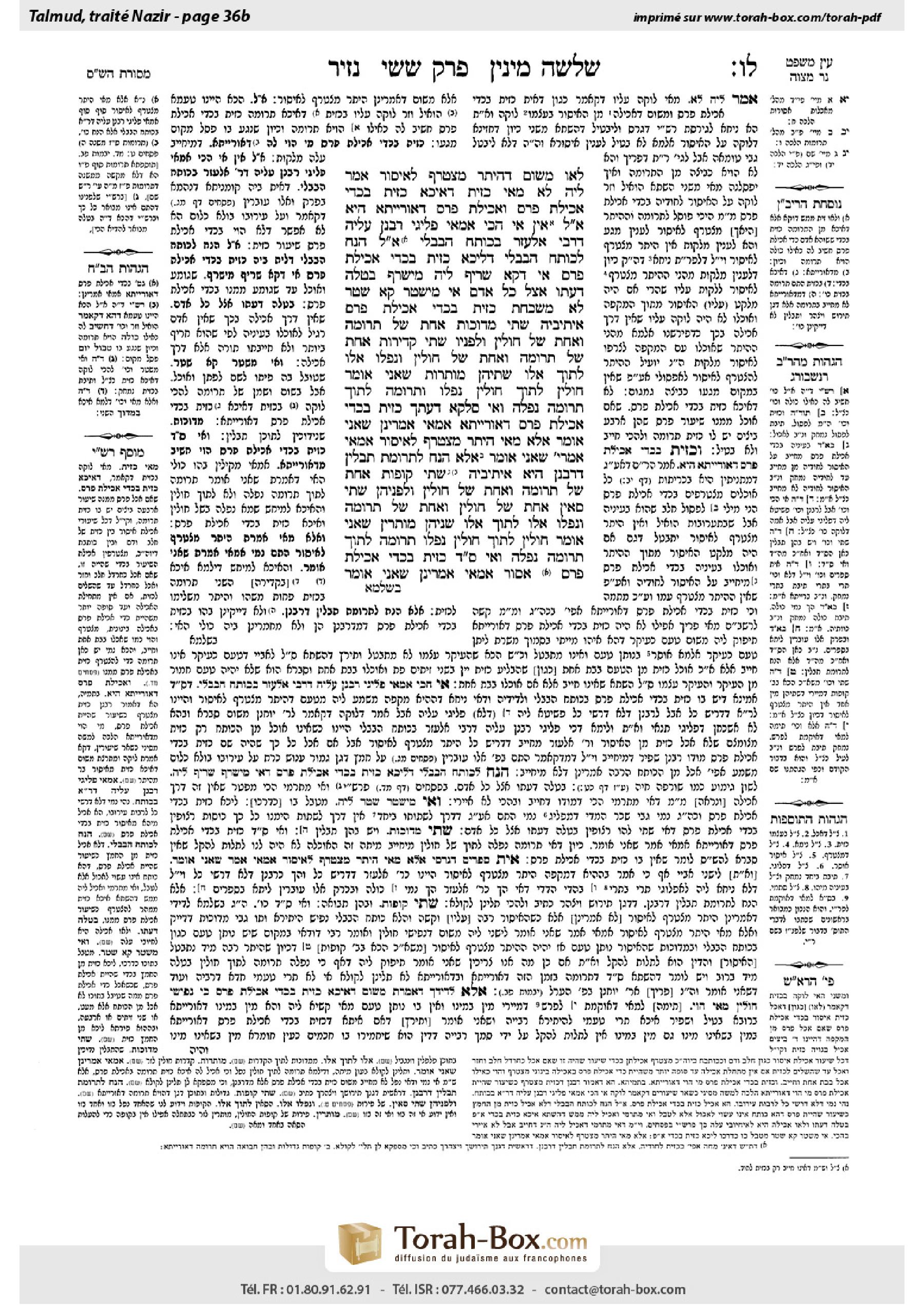
Nazir 36b: Talmud study for Daf Yomi
Daf Yomi is the daily study of one Talmud folio. Explore 37 tractates with scans, Hebrew text, Sefaria English and AI-generated French translations where annotated.
Passage selection and English or AI-generated French translation are available where the scan has annotations. Daf Study is independent of Torah-Box and Sefaria.
Browse Nazir · נזיר · All tractatesNazir 36b text and translations
This page of Nazir includes the Aramaic text, an English translation and an AI-generated French translation, alongside the scan above.
נזיר ל״ו ב · Aramaic and Hebrew text
לָאו מִשּׁוּם דְּהֶיתֵּר מִצְטָרֵף לְאִיסּוּר? אֲמַר לֵיהּ: לָא, מַאי ״כְּזַיִת״ — דְּאִיכָּא כְּזַיִת בִּכְדֵי אֲכִילַת פְּרָס.
וַאֲכִילַת פְּרָס דְּאוֹרָיְיתָא הִיא? אֲמַר לֵיהּ: אִין. אִי הָכִי, אַמַּאי פְּלִיגִי רַבָּנַן עֲלֵיהּ דְּרַבִּי אֶלְעָזָר בְּכוּתָּח הַבַּבְלִי?
אֲמַר לֵיהּ: הַנַּח לְכוּתָּח הַבַּבְלִי, דְּלֵיכָּא כְּזַיִת בִּכְדֵי אֲכִילַת פְּרָס. אִי דְּקָא שָׂרֵיף לֵיהּ מִישְׂרָף — בָּטְלָה דַּעְתּוֹ אֵצֶל כׇּל אָדָם. אִי מִישְׁטָר קָא שָׁטַר — לָא מַשְׁכַּחַתְּ כְּזַיִת בִּכְדֵי אֲכִילַת פְּרָס.
אֵיתִיבֵיהּ: שְׁתֵּי מְדוֹכוֹת, אַחַת שֶׁל תְּרוּמָה וְאַחַת שֶׁל חוּלִּין. וּלְפָנָיו שְׁתֵּי קְדֵירוֹת, אַחַת שֶׁל תְּרוּמָה וְאַחַת שֶׁל חוּלִּין, וְנָפְלוּ אֵלּוּ לְתוֹךְ אֵלּוּ — שְׁתֵּיהֶן מוּתָּרוֹת, שֶׁאֲנִי אוֹמֵר: חוּלִּין לְתוֹךְ חוּלִּין נָפְלוּ, וּתְרוּמָה לְתוֹךְ תְּרוּמָה נָפְלָה.
וְאִי סָלְקָא דַעְתָּךְ כְּזַיִת בִּכְדֵי אֲכִילַת פְּרָס דְּאוֹרָיְיתָא, אַמַּאי אָמְרִינַן ״שֶׁאֲנִי אוֹמֵר״?
אֶלָּא מַאי, הֶיתֵּר מִצְטָרֵף לְאִיסּוּר? אַמַּאי אָמְרִינַן ״שֶׁאֲנִי אוֹמֵר״?! אֶלָּא הַנַּח לִתְרוּמַת תַּבְלִין דְּרַבָּנַן הִיא.
אֵיתִיבֵיהּ: שְׁתֵּי קוּפּוֹת, אַחַת שֶׁל תְּרוּמָה וְאַחַת שֶׁל חוּלִּין. וּלְפָנֵיהֶן שְׁתֵּי סְאִין, אַחַת שֶׁל חוּלִּין וְאַחַת שֶׁל תְּרוּמָה, וְנָפְלוּ אֵלּוּ לְתוֹךְ אֵלּוּ — שְׁנֵיהֶן מוּתָּרִין. שֶׁאֲנִי אוֹמֵר: חוּלִּין לְתוֹךְ חוּלִּין נָפְלוּ, תְּרוּמָה לְתוֹךְ תְּרוּמָה נָפְלָה.
וְאִי סָלְקָא דַעְתָּךְ כְּזַיִת בִּכְדֵי אֲכִילַת פְּרָס אָסוּר, אַמַּאי אָמְרִינַן ״שֶׁאֲנִי אוֹמֵר״?
Nazir 36b · English translation
Is it not due to the fact that the permitted substance combines with the forbidden substance? This would mean that this principle applies in other areas of Torah law besides naziriteship. Rav Dimi said to him: No; what is the meaning of an olive-bulk in this mishna? It means that there is enough teruma in the mixture so that when one eats from the mixture he will consume an olive-bulk of teruma in the time it takes to eat a half-loaf of bread. In that case one is liable to receive a punishment for eating this olive-bulk, as though he ate the teruma alone.
Abaye asked him: But is eating an olive-bulk in the time it takes to eat a half-loaf of bread prohibited by Torah law, and is one flogged for it? Rav Dimi said to him: Yes. Abaye asked in response: If so, why do the Rabbis disagree with Rabbi Eliezer with regard to eating Babylonian kutaḥ, a dip that contains bread, on Passover? The Rabbis maintain that one is not punished by Torah law for eating a mixture that contains leaven. Although the Rabbis do not derive from the term “nothing [kol],” that leaven in a mixture is forbidden, they should nevertheless hold one liable for eating an olive-bulk of a forbidden substance in the time it takes to eat a half-loaf of bread.
Rav Dimi said to Abaye: Leave aside the case of Babylonian kutaḥ, as there is no possibility that one will consume an olive-bulk of the leaven in the time it takes to eat a half-loaf of bread. If he eats kutaḥ in its pure, unadulterated form, by swallowing [shareif] it as food, not as a dip, his intention is rendered irrelevant by the opinions of all other people. It is unusual for a person to eat a pungent dip by itself, and especially so quickly. One receives no punishment for conduct that anomalous. And if he dips [shatar] other food into the kutaḥ and eats it, he will not be found to have consumed an olive-bulk in the time it takes to eat a half-loaf of bread. Due to the pungency of the dip, one typically adds only a small portion of it to his food.
Abaye raised an objection to Rav Dimi from a baraita: With regard to two spice mortars, one used for teruma spices and one used for non-sacred spices, before which were two pots, one of teruma produce and the other one of non-sacred produce, and the contents of these mortars fell into these pots, but it is unknown which produce fell into which pot, the contents of both pots are permitted; the pot containing the teruma produce is permitted for a priest and the pot containing non-sacred produce is permitted for all. This is because I say, with no definitive proof to the contrary, that the non-sacred spices fell into the non-sacred produce and the teruma spices fell into the teruma.
Abaye explains his objection: And if it would enter your mind to say that eating an olive-bulk of a forbidden substance in the time it takes to eat a half-loaf of bread is prohibited by Torah law, why do we say this principle: Because I say that the non-sacred spices fell into the non-sacred produce? If the teruma spices fell into the pot containing non-sacred produce, one who eats from the mixture will consume an olive-bulk of teruma within the time it takes to eat a half-loaf of bread, and he will thereby violate a Torah prohibition. One is not lenient in a case of this kind.
Rav Dimi said to him: Rather, what will you say? That the permitted substance combines with the forbidden substance? But if so, one can still ask why we say this principle: Because I say that the non-sacred spices fell into the non-sacred produce. After all, it is possible that the second mortar contained slightly less than an olive-bulk of teruma, and the permitted substance combined with it to form the amount of an olive-bulk. Rather, leave aside the case of teruma separated from spices, which is teruma by rabbinic law. By Torah law one is required to separate teruma only from grain, wine, and oil. The Sages are lenient with regard to teruma by rabbinic law.
Abaye raised an objection to Rav Dimi from a similar baraita: There were two baskets, one filled with teruma and one filled with non-sacred produce, and before them were two containers each containing a se’a of produce, one of non-sacred produce and the one of teruma, and these, the contents of each of the baskets, fell into those, each of the containers before them. Although it is prohibited for non-priests to eat a mixture of teruma and non-sacred produce, and it is possible that the teruma fell into the non-sacred produce, the contents of both of the vessels are nevertheless permitted; the container of teruma produce is permitted for a priest and the container of non-sacred produce is permitted for all. This is because I say that the non-sacred produce fell into the non-sacred produce and the teruma fell into the teruma.
Abaye explains: And if it would enter your mind to say that eating an olive-bulk of forbidden food in the time it takes to eat a half-loaf of bread is prohibited by Torah law, why do we say the principle: Because I say the non-sacred produce fell into the non-sacred produce? Why are the Sages not concerned that one might eat an olive-bulk of teruma in the time it takes to eat a half-loaf of bread, which is prohibited by Torah law?
Nazir 36b · Traduction française (IA)
N’est-ce pas parce que la substance permise s’associe à la substance interdite ? Cela signifierait que ce principe s’applique à d’autres domaines du droit de la Torah qu’au naziréat. Rav Dimi lui dit : Non. Que signifie alors la mesure d’un volume d’olive dans cette Michna ? Elle signifie que le mélange contient suffisamment de terouma pour que, lorsqu’on en mange, on consomme un volume d’olive de terouma dans le temps nécessaire pour manger un demi-pain. Dans ce cas, on est passible d’une peine pour avoir mangé ce volume d’olive, comme si l’on avait mangé la terouma seule.
Abayé lui demanda : Mais le fait de manger un volume d’olive dans le temps nécessaire pour manger un demi-pain est-il interdit par la Torah, et est-on passible de flagellation pour cela ? Rav Dimi lui répondit : Oui. Abayé répliqua : Si tel est le cas, pourquoi les Sages sont-ils en désaccord avec Rabbi Éliézer au sujet de la consommation de koutea’h babylonien, une sauce contenant du pain, pendant Pessa’h ? Les Sages estiment qu’on n’est pas passible d’une peine prévue par la Torah pour avoir mangé un mélange contenant du levain. Même si les Sages ne déduisent pas du terme « tout [kol] » que le levain est interdit dans un mélange, ils devraient néanmoins tenir pour passible celui qui mange un volume d’olive d’une substance interdite dans le temps nécessaire pour manger un demi-pain.
Rav Dimi dit à Abayé : Écarte le cas du koutea’h babylonien, car il est impossible d’y consommer un volume d’olive de levain dans le temps nécessaire pour manger un demi-pain. Si quelqu’un mange le koutea’h pur, sans rien y ajouter, en l’avalant [shareif] comme un aliment et non comme une sauce, son intention n’est pas déterminante, car les autres gens ne mangent pas ainsi : il est inhabituel de manger une sauce piquante seule, et plus encore de la manger aussi rapidement. On ne reçoit pas de peine pour un comportement aussi exceptionnel. Et s’il trempe [shatar] un autre aliment dans le koutea’h et le mange, il ne peut pas avoir consommé un volume d’olive dans le temps nécessaire pour manger un demi-pain. En raison du goût piquant de la sauce, on n’en ajoute habituellement qu’une petite quantité à son aliment.
Abayé objecta à Rav Dimi en citant une baraïta : Il y avait deux mortiers à épices, l’un utilisé pour des épices de terouma et l’autre pour des épices profanes. Devant eux se trouvaient deux marmites, l’une contenant des produits de terouma et l’autre des produits profanes. Le contenu des mortiers tomba dans ces marmites, mais on ignore quel contenu tomba dans quelle marmite. Le contenu des deux marmites est permis : celle contenant les produits de terouma est permise à un prêtre, et celle contenant les produits profanes est permise à tous. En effet, faute de preuve concluante du contraire, je suppose que les épices profanes sont tombées dans les produits profanes et que les épices de terouma sont tombées dans la terouma.
Abayé précise son objection : Si l’on pouvait envisager que le fait de manger un volume d’olive d’une substance interdite dans le temps nécessaire pour manger un demi-pain soit interdit par la Torah, pourquoi énonce-t-on ce principe : « Je suppose que les épices profanes sont tombées dans les produits profanes » ? Si les épices de terouma sont tombées dans la marmite contenant les produits profanes, celui qui mange le mélange consommera un volume d’olive de terouma dans le temps nécessaire pour manger un demi-pain, et enfreindra ainsi une interdiction de la Torah. On ne se montre pas indulgent dans un cas de ce genre.
Rav Dimi lui dit : Alors, que diras-tu ? Que la substance permise s’associe à la substance interdite ? Mais dans ce cas, on peut encore demander pourquoi on énonce ce principe : « Je suppose que les épices profanes sont tombées dans les produits profanes ». Après tout, il est possible que le second mortier ait contenu un peu moins d’un volume d’olive de terouma et que la substance permise s’y soit associée pour former un volume d’olive. Écarte plutôt le cas de la terouma prélevée sur des épices, qui relève du droit rabbinique. Selon la Torah, on n’est tenu de prélever la terouma que sur les céréales, le vin et l’huile. Les Sages se montrent indulgents en matière de terouma rabbinique.
Abayé objecta à Rav Dimi en citant une baraïta similaire : Il y avait deux paniers, l’un rempli de terouma et l’autre de produits profanes. Devant eux se trouvaient deux récipients contenant chacun un séa de produits, l’un de produits profanes et l’autre de terouma. Le contenu de chacun des paniers tomba dans le récipient placé devant lui. Bien qu’il soit interdit aux non-prêtres de manger un mélange de terouma et de produits profanes, et qu’il soit possible que la terouma soit tombée dans les produits profanes, le contenu des deux récipients est néanmoins permis : celui qui contient des produits de terouma est permis à un prêtre, et celui qui contient des produits profanes est permis à tous. En effet, je suppose que les produits profanes sont tombés dans les produits profanes et que la terouma est tombée dans la terouma.
Abayé précise : Si l’on pouvait envisager que le fait de manger un volume d’olive d’un aliment interdit dans le temps nécessaire pour manger un demi-pain soit interdit par la Torah, pourquoi énonce-t-on ce principe : « Je suppose que les produits profanes sont tombés dans les produits profanes » ? Pourquoi les Sages ne craignent-ils pas que quelqu’un mange un volume d’olive de terouma dans le temps nécessaire pour manger un demi-pain, ce qui est interdit par la Torah ?
Traduction française générée par IA à partir de l’édition anglaise de Sefaria. Vérifie toujours un passage avec le texte source.
Text from Sefaria: William Davidson Edition - Vocalized Aramaic (CC BY NC); William Davidson Edition - English (CC BY NC).