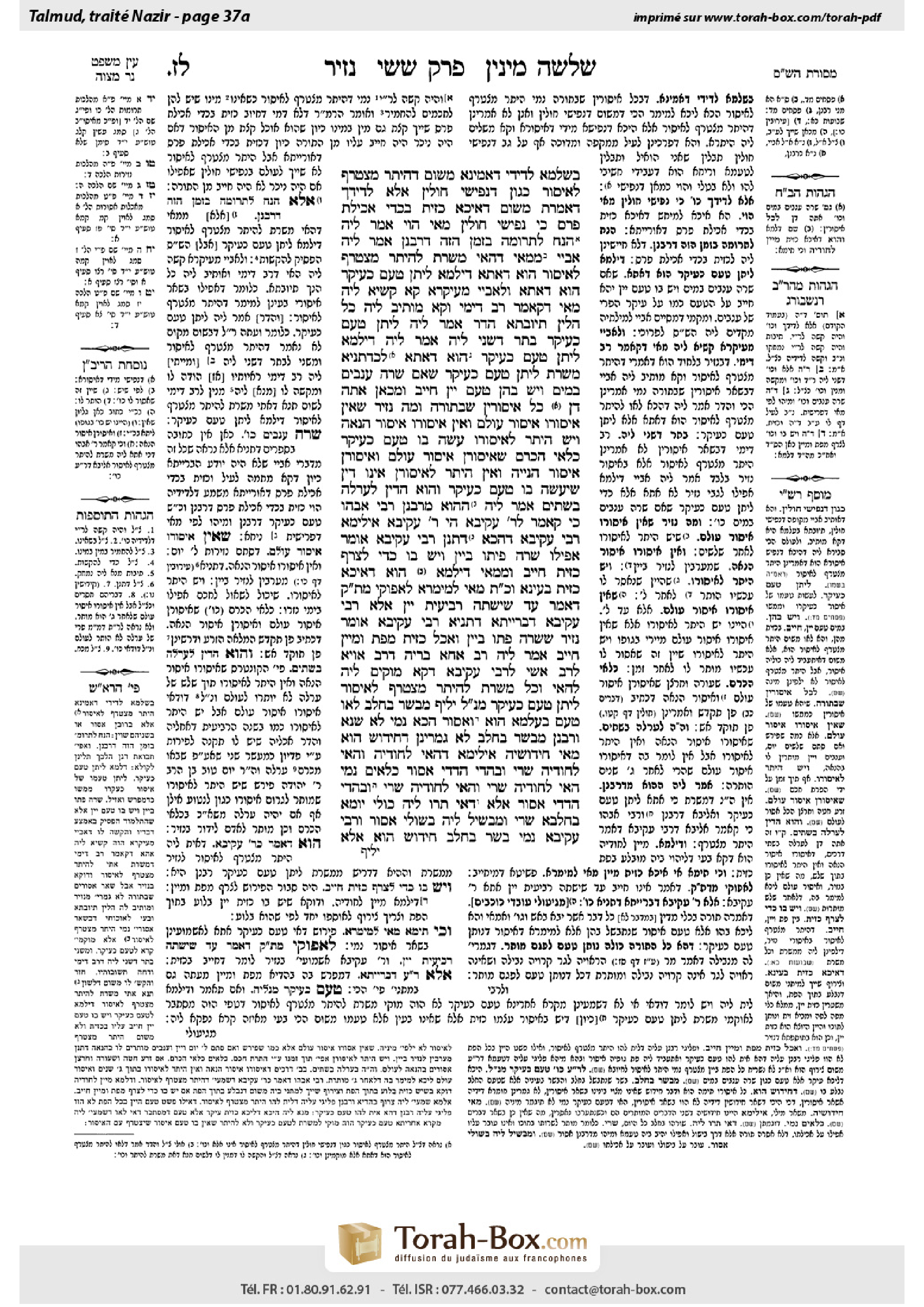
Nazir 37a: Talmud study for Daf Yomi
Daf Yomi is the daily study of one Talmud folio. Explore 37 tractates with scans, Hebrew text, Sefaria English and AI-generated French translations where annotated.
Passage selection and English or AI-generated French translation are available where the scan has annotations. Daf Study is independent of Torah-Box and Sefaria.
Browse Nazir · נזיר · All tractatesNazir 37a text and translations
This page of Nazir includes the Aramaic text, an English translation and an AI-generated French translation, alongside the scan above.
נזיר ל״ז א · Aramaic and Hebrew text
בִּשְׁלָמָא לְדִידִי דְּאָמֵינָא מִשּׁוּם דְּהֶיתֵּר מִצְטָרֵף לְאִיסּוּר, כְּגוֹן דִּנְפִישִׁי חוּלִּין. אֶלָּא לְדִידָךְ דְּאָמְרַתְּ מִשּׁוּם דְּאִיכָּא כְּזַיִת בִּכְדֵי אֲכִילַת פְּרָס — כִּי נְפִישִׁי חוּלִּין מַאי הָוֵי?
אֲמַר לֵיהּ: הַנַּח לִתְרוּמָה בַּזְּמַן הַזֶּה דְּרַבָּנַן.
אֲמַר לֵיהּ אַבָּיֵי: מִמַּאי דְּהַאי ״מִשְׁרַת״ לְהֶיתֵּר מִצְטָרֵף לְאִיסּוּר הוּא דַּאֲתָא? דִּילְמָא לִיתֵּן טַעַם כְּעִיקָּר הוּא דַּאֲתָא!
וּלְאַבָּיֵי, מֵעִיקָּרָא קָא קַשְׁיָא לֵיהּ מַאי דְּקָאָמַר רַב דִּימִי, וְקָא מוֹתֵיב לֵיהּ כׇּל הָלֵין תְּיוּבָתָא. הֲדַר אֲמַר לֵיהּ, לִיתֵּן טַעַם כְּעִיקָּר?
בָּתַר דְּשַׁנִּי לֵיהּ, אֲמַר לֵיהּ: דִּילְמָא לִיתֵּן טַעַם כָּעִיקָּר הוּא דַּאֲתָא?
לְכִדְתַנְיָא: ״מִשְׁרַת״ לִיתֵּן טַעַם כְּעִיקָּר, שֶׁאִם שָׁרָה עֲנָבִים בְּמַיִם וְיֵשׁ בָּהֶן טַעַם יַיִן — חַיָּיב. וּמִכָּאן אַתָּה דָּן כׇּל אִיסּוּרִין שֶׁבַּתּוֹרָה.
וּמָה נָזִיר שֶׁאֵין אִיסּוּרוֹ אִיסּוּר עוֹלָם, וְאֵין אִיסּוּרוֹ אִיסּוּר הֲנָאָה, וְיֵשׁ הֶיתֵּר לְאִיסּוּרוֹ — עָשָׂה בּוֹ טַעַם כְּעִיקָּר. כִּלְאֵי הַכֶּרֶם, שֶׁאִיסּוּרָן אִיסּוּר עוֹלָם, וְאִיסּוּרָן אִיסּוּר הֲנָיָיה, וְאֵין הֶיתֵּר לְאִיסּוּרָן — אֵינוֹ דִּין שֶׁיַּעֲשֶׂה בּוֹ טַעַם כְּעִיקָּר?!
וְהוּא הַדִּין לְעׇרְלָה בִּשְׁתַּיִם.
אֲמַר לֵיהּ הָהוּא מֵרַבָּנַן: רַבִּי אֲבָהוּ כִּי קָאָמַר לְרַבִּי עֲקִיבָא, הֵי רַבִּי עֲקִיבָא? אִילֵימָא רַבִּי עֲקִיבָא דְּהָכָא, דִּתְנַן: רַבִּי עֲקִיבָא אוֹמֵר: אֲפִילּוּ שָׁרָה פִּיתּוֹ בְּיַיִן וְיֵשׁ בּוֹ כְּדֵי לְצָרֵף כְּזַיִת — חַיָּיב, וּמִמַּאי? דִּילְמָא הוּא דְּאִיכָּא כְּזַיִת בָּעֵינָא!
וְכִי תֵּימָא: מַאי לְמֵימְרָא? לְאַפּוֹקֵי מִתַּנָּא קַמָּא, דְּאָמַר: עַד שֶׁיִּשְׁתֶּה רְבִיעִית יַיִן!
אֶלָּא, רַבִּי עֲקִיבָא דְּבָרַיְיתָא. דְּתַנְיָא, רַבִּי עֲקִיבָא אוֹמֵר: נָזִיר שֶׁשָּׁרָה פִּתּוֹ בְּיַיִן, וְאָכַל כְּזַיִת מִפַּת וּמִיַּיִן — חַיָּיב.
אֲמַר לֵיהּ רַב אַחָא בְּרֵיהּ דְּרַב אַוְיָא לְרַב אָשֵׁי: לְרַבִּי עֲקִיבָא דְּקָא מוֹקֵים לֵיהּ לְהַאי ״וְכׇל מִשְׁרַת״ לְהֶיתֵּר מִצְטָרֵף לְאִיסּוּר, לִיתֵּן טַעַם כְּעִיקָּר מְנָא לֵיהּ? יָלֵיף מִבָּשָׂר בְּחָלָב. לָאו טַעַם בְּעָלְמָא הוּא, וְאָסוּר? הָכָא נָמֵי לָא שְׁנָא.
וְרַבָּנַן, מִבָּשָׂר בְּחָלָב לָא גָּמְרִינַן, דְּחִידּוּשׁ הוּא.
מַאי חִידּוּשֵׁיהּ? אִילֵּימָא דְּהַאי לְחוֹדֵיהּ וְהַאי לְחוֹדֵיהּ שְׁרֵי, וּבַהֲדֵי הֲדָדֵי אָסוּר, כִּלְאַיִם נָמֵי: הַאי לְחוֹדֵיהּ שְׁרֵי וְהַאי לְחוֹדֵיהּ שְׁרֵי, וּבַהֲדֵי הֲדָדֵי אָסוּר!
אֶלָּא: דְּאִי תָּרוּ לֵיהּ כּוּלֵּי יוֹמָא בַּחֲלָבָא — שְׁרֵי, וּמְבַשֵּׁיל לֵיהּ בַּשּׁוֹלֵי — אָסוּר.
וְרַבִּי עֲקִיבָא נָמֵי, בָּשָׂר בְּחָלָב חִידּוּשׁ הוּא? אֶלָּא
Nazir 37a · English translation
Granted, according to my opinion, as I say that this is because permitted food combines with forbidden food, I can explain that this is referring to a case where there is more non-sacred produce than teruma, and the combination assumes the status of the forbidden item or teruma only when those are the majority. However, according to your opinion, that you say this is because there is an olive-bulk consumed in the time it takes to eat a half-loaf of bread, then even if there is more non-sacred produce, what of it? In any case there is an olive-bulk of teruma eaten within the time it takes to eat a half-loaf of bread.
Rav Dimi said to Abaye: Leave aside teruma in the present, as it applies by rabbinic law. Since the exile of the Jewish people from Eretz Yisrael, the halakhot of teruma and tithes apply by rabbinic law, not Torah law. This is the basis for the lenient ruling with regard to this mixture.
Abaye said to him: From where do you derive that this verse: “Nor shall he drink anything soaked in grapes” (Numbers 6:3), comes to teach the principle that permitted food combines with forbidden food, as stated by Rabbi Yoḥanan (35b)? Perhaps instead it comes to establish the principle that the legal status of the flavor of a forbidden food is like that of its substance. This principle states that any food that absorbs the taste of a forbidden item assumes the status of this forbidden item itself.
The Gemara expresses surprise at Abaye’s question. And according to the opinion of Abaye, initially that which Rav Dimi said was difficult for him. Rav Dimi had cited Rabbi Yoḥanan as saying that permitted food combines with forbidden foods only in the case of naziriteship (36a), due to the term “soaked,” and Abaye had objected with all these aforementioned refutations to prove that this principle applies in all areas of Torah law. And yet he then said to him that one should derive a very different principle from that same verse, that the verse establishes the principle that the legal status of the flavor of a forbidden food is like that of its substance.
The Gemara answers: After Rav Dimi resolved Abaye’s difficulties, and Abaye had accepted his answer that the principle that permitted food combines with forbidden food does not apply to the rest of Torah law, he said to Rav Dimi that perhaps the verse comes to establish that the legal status of the flavor of a forbidden food is like that of its substance, with the following application.
This is relevant for that which is taught in a baraita: The term “soaked” serves to establish the principle that the legal status of the flavor of a forbidden food is like that of its substance. As, if a nazirite soaked grapes in water and the water has the taste of wine, he is liable to receive punishment for drinking this liquid, as it assumes the status of wine. And from here you derive the halakha with regard to all prohibitions of the Torah; in all cases, the legal status of the taste of a forbidden food is like that of its substance. The fact that with regard to all other prohibitions, the legal status of the flavor of a forbidden food is like that of its substance, is derived from the halakhot of naziriteship.
The baraita explains the derivation: And just as with regard to a nazirite, whose prohibition against eating grapes is not a permanent prohibition, as he will be permitted to eat grapes once his term of naziriteship is over, and furthermore his prohibition is not a prohibition against deriving benefit from wine, and there is a way to permit his prohibition against eating grape products by requesting from a halakhic authority to dissolve his vow, and nevertheless, in his case the Torah rendered the legal status of the flavor of food like that of its substance. With regard to a forbidden mixture of diverse kinds in a vineyard, i.e., grain seeds sown with grape seeds, whose prohibition is a permanent prohibition and whose prohibition is a prohibition against deriving benefit, and there is no way to permit their prohibition, is it not right that the Torah should render the legal status of the flavor of its forbidden food like that of its substance?
The baraita adds: And the same is true for the prohibition against eating the fruit of a tree during the first three years after its planting [orla], on two of three counts: Although the prohibition of orla is not a permanent prohibition, as one may eat the fruit of this tree after three years have passed, it is prohibited to derive benefit from orla, and this prohibition cannot be permitted, as the fruits that grow during the first three years remain forbidden. Similarly, all other prohibitions in the Torah are more severe than the case of a nazirite in one of these aspects, and therefore this principle is universal. Abaye is asking Rav Dimi: In any case doesn’t this entire derivation present a difficulty for Rabbi Yoḥanan, who derives a different halakha from the term “soaked”?
One of the Sages said to Abaye: When Rabbi Abbahu said that Rabbi Yoḥanan said that the principle of permitted food combining with forbidden food is derived from the term “soaked,” he spoke in accordance with the opinion of Rabbi Akiva. The Gemara asks: To which statement of Rabbi Akiva is the Gemara referring? If we say it is referring to the opinion of Rabbi Akiva of this mishna, as we learned (Shevuot 21b) that Rabbi Akiva says: Even if a nazirite soaked his bread in wine, and the bread and the wine contain enough to combine to constitute an olive-bulk, he is liable; but from where do we know that Rabbi Akiva means an olive-bulk taken from the bread and the wine together? Perhaps that ruling applies only when there is an olive-bulk of wine as is, without the bread?
And if you would say: In that case, what is the purpose of stating this ruling? What is the novelty of Rabbi Akiva’s statement if the mixture contains an olive-bulk of wine? One can say that it serves to exclude the opinion of the first tanna, who said that he is liable only if he drinks a quarter-log of wine. Rabbi Akiva emphasizes that one is liable even if he drinks the amount of an olive-bulk.
Rather, the reference is to the following statement of Rabbi Akiva in a baraita. As it is taught in a baraita that Rabbi Akiva says: A nazirite who soaked his bread in wine and ate an olive-bulk of the mixture of bread and wine is liable. This baraita indicates that according to the opinion of Rabbi Akiva a permitted substance combines with a forbidden substance.
Rav Aḥa, son of Rav Avya, said to Rav Ashi: According to Rabbi Akiva, who establishes the verse “neither shall he drink anything soaked” (Numbers 6:3) as referring to the principle that the permitted combines with the forbidden, from where does he derive the principle that the legal status of the flavor is like that of the substance itself? The Gemara answers: He derives this principle from the prohibition of meat cooked in milk. Is it not the case that there is no actual milk present, and it is merely the taste of the milk absorbed in the meat, and yet the mixture is prohibited? Here too, in the case of other prohibitions, it is no different, and the legal status of the flavor is like that of the substance itself.
The Gemara asks: And with regard to the Rabbis, who disagree with Rabbi Akiva and derive the halakha that the legal status of the flavor is like that of the substance itself from the phrase “neither shall he drink anything soaked,” why do they not derive this principle from the case of meat cooked in milk? The Gemara answers: The Rabbis claim that we do not derive other prohibitions from meat cooked in milk, as that prohibition is a novelty, and one does not learn general halakhot from unusual cases.
The Gemara asks: What is the novelty of that prohibition? If we say that it is unique in that this meat alone and that milk alone are each permitted, and yet together they are forbidden, that characteristic is not unique to meat cooked in milk. In the case of forbidden mixtures of diverse kinds too, this element alone and that element alone are each permitted, and yet together they are forbidden.
The Gemara answers: Rather, the novelty is that if one soaks meat in milk all day, it is permitted by Torah law, despite the fact that the meat certainly absorbed some taste of the milk, whereas if one cooked meat in milk even for a short time, the mixture is forbidden by Torah law. The novelty is that it is not the fact that they are mixed together that renders meat and milk forbidden, but the act of cooking.
The Gemara asks: And Rabbi Akiva too, he certainly agrees that the halakha of meat cooked in milk is a novelty. How can he derive a general principle from this case? Rather,
Nazir 37a · Traduction française (IA)
Admettons que, selon mon avis, puisque je dis que cela tient au fait qu’un aliment permis se combine avec un aliment interdit, je puisse expliquer qu’il s’agit d’un cas où les produits non consacrés sont plus abondants que la terouma et où le mélange n’acquiert le statut de l’élément interdit — ici, la terouma — que lorsque celui-ci est majoritaire. Mais selon ton avis, puisque tu dis que cela tient au fait qu’une quantité équivalant au volume d’une olive est consommée dans le temps nécessaire pour manger un demi-pain, qu’importe qu’il y ait davantage de produits non consacrés ? En tout état de cause, une quantité équivalant au volume d’une olive de terouma est consommée dans le temps nécessaire pour manger un demi-pain.
Rav Dimi dit à Abayé : Écartons la terouma à notre époque, car elle relève de la loi rabbinique. Depuis l’exil du peuple juif d’Eretz Israël, les halakhot de la terouma et des dîmes relèvent de la loi rabbinique et non de la Torah. C’est là le fondement de la décision indulgente concernant ce mélange.
Abayé lui dit : D’où déduis-tu que ce verset — « Il ne boira rien qui ait macéré dans le raisin » (Nombres 6, 3) — vient enseigner le principe selon lequel un aliment permis se combine avec un aliment interdit, comme l’a affirmé Rabbi Yoḥanan (35b) ? Peut-être vient-il plutôt établir le principe selon lequel la saveur d’un aliment interdit a le même statut que sa substance. Ce principe signifie que tout aliment qui absorbe le goût d’un élément interdit acquiert lui-même le statut de cet élément interdit.
La Guemara s’étonne de la question d’Abayé. Selon l’avis d’Abayé, ce que Rav Dimi lui avait dit au départ lui posait donc difficulté. Rav Dimi avait cité Rabbi Yoḥanan, qui affirmait que les aliments permis ne se combinent avec les aliments interdits que dans le cas du nazir (36a), en raison du terme « macéré », et Abayé avait présenté toutes les réfutations mentionnées précédemment pour prouver que ce principe s’applique dans tous les domaines de la loi de la Torah. Et pourtant, il lui dit ensuite qu’il faudrait déduire de ce même verset un principe tout à fait différent : le verset établit que la saveur d’un aliment interdit a le même statut que sa substance.
La Guemara répond : Après que Rav Dimi eut résolu les difficultés d’Abayé et qu’Abayé eut accepté sa réponse, selon laquelle le principe voulant qu’un aliment permis se combine avec un aliment interdit ne s’applique pas aux autres domaines de la loi de la Torah, il dit à Rav Dimi que le verset vient peut-être établir le principe selon lequel la saveur d’un aliment interdit a le même statut que sa substance, avec l’application suivante.
Cela concerne ce qui est enseigné dans une baraïta : le terme « macéré » sert à établir le principe selon lequel la saveur d’un aliment interdit a le même statut que sa substance. En effet, si un nazir fait macérer des raisins dans de l’eau et que l’eau a le goût du vin, il est passible d’une sanction pour avoir bu ce liquide, car celui-ci acquiert le statut du vin. Et c’est de là que l’on déduit la halakha concernant toutes les interdictions de la Torah : dans tous les cas, la saveur d’un aliment interdit a le même statut que sa substance. Le fait que, pour toutes les autres interdictions, la saveur d’un aliment interdit ait le même statut que sa substance se déduit des halakhot du nazir.
La baraïta explique la déduction : de même que, pour un nazir, l’interdiction de manger des raisins n’est pas permanente, puisqu’il lui sera permis d’en manger une fois son vœu de naziréat achevé, que son interdiction ne porte pas sur le fait de tirer profit du vin et qu’il existe un moyen de faire lever l’interdiction portant sur les produits de la vigne en demandant à une autorité halakhique de dissoudre son vœu, et que, malgré cela, dans son cas, la Torah a donné à la saveur de l’aliment le même statut qu’à sa substance ; à plus forte raison, dans le cas d’un mélange interdit d’espèces hétérogènes dans une vigne, c’est-à-dire de graines de céréales semées avec des pépins de raisin, dont l’interdiction est permanente, interdit d’en tirer profit et ne peut être levée, la Torah devrait-elle donner à la saveur de l’aliment interdit le même statut qu’à sa substance.
La baraïta ajoute : il en va de même de l’interdiction de manger les fruits d’un arbre pendant les trois premières années suivant sa plantation [orla], sur deux des trois points. Bien que l’interdiction de l’orla ne soit pas permanente, puisqu’on peut manger les fruits de cet arbre après trois ans, il est interdit d’en tirer profit, et cette interdiction ne peut être levée, car les fruits qui poussent pendant les trois premières années demeurent interdits. De même, toutes les autres interdictions de la Torah sont plus sévères que le cas du nazir à l’égard de l’un de ces aspects ; ce principe est donc universel. Abayé demande à Rav Dimi : En tout état de cause, toute cette déduction ne constitue-t-elle pas une difficulté pour Rabbi Yoḥanan, qui déduit du terme « macéré » une autre halakha ?
L’un des Sages dit à Abayé : lorsque Rabbi Abbahou a dit que Rabbi Yoḥanan disait que le principe selon lequel un aliment permis se combine avec un aliment interdit se déduit du terme « macéré », il parlait conformément à l’opinion de Rabbi Akiva. La Guemara demande : À quelle déclaration de Rabbi Akiva fait-elle référence ? Si l’on dit qu’elle fait référence à l’opinion de Rabbi Akiva dans cette Michna, car nous avons appris (Shevouot 21b) que Rabbi Akiva dit : même si un nazir a trempé son pain dans du vin et que le pain et le vin contiennent ensemble une quantité équivalant au volume d’une olive, il est passible d’une sanction ; mais d’où savons-nous que Rabbi Akiva parle d’une quantité équivalant au volume d’une olive provenant du pain et du vin réunis ? Peut-être cette décision ne s’applique-t-elle que s’il y a, à lui seul, une quantité équivalant au volume d’une olive de vin, sans compter le pain ?
Et si tu dis : dans ce cas, à quoi sert cette décision ? Quelle nouveauté apporte la déclaration de Rabbi Akiva si le mélange contient déjà une quantité équivalant au volume d’une olive de vin ? On peut répondre qu’elle vient exclure l’opinion du premier tanna, qui disait qu’il n’est passible d’une sanction que s’il boit un quart de log de vin. Rabbi Akiva souligne qu’il est passible d’une sanction même s’il ne boit qu’une quantité équivalant au volume d’une olive.
Il s’agit plutôt de la déclaration suivante de Rabbi Akiva dans une baraïta. En effet, il est enseigné dans une baraïta que Rabbi Akiva dit : un nazir qui a trempé son pain dans du vin et a mangé une quantité équivalant au volume d’une olive du mélange de pain et de vin est passible d’une sanction. Cette baraïta indique que, selon Rabbi Akiva, une substance permise se combine avec une substance interdite.
Rav Aḥa, fils de Rav Avya, dit à Rav Ashi : Selon Rabbi Akiva, qui interprète le verset « il ne boira rien qui ait macéré » (Nombres 6, 3) comme se rapportant au principe selon lequel le permis se combine avec l’interdit, d’où déduit-il le principe selon lequel la saveur a le même statut que la substance elle-même ? La Guemara répond : il déduit ce principe de l’interdiction de la viande cuite dans le lait. N’est-il pas vrai qu’il n’y a pas de lait à l’état de substance, mais seulement le goût du lait absorbé par la viande, et que pourtant le mélange est interdit ? Il en va de même ici, pour les autres interdictions : la saveur a le même statut que la substance elle-même.
La Guemara demande : Et les Rabbins, qui ne sont pas d’accord avec Rabbi Akiva et déduisent de l’expression « il ne boira rien qui ait macéré » que la saveur a le même statut que la substance elle-même, pourquoi ne déduisent-ils pas ce principe du cas de la viande cuite dans le lait ? La Guemara répond : les Rabbins soutiennent qu’on ne déduit pas les autres interdictions de la viande cuite dans le lait, car cette interdiction constitue une nouveauté ; on ne déduit pas de halakhot générales de cas inhabituels.
La Guemara demande : En quoi cette interdiction constitue-t-elle une nouveauté ? Si l’on dit qu’elle est particulière en ce que la viande, à elle seule, est permise et que le lait, à lui seul, est permis, mais qu’ensemble ils sont interdits, cette caractéristique n’est pas propre à la viande cuite dans le lait. Dans le cas des mélanges interdits d’espèces hétérogènes également, chaque élément est permis à lui seul, mais les deux ensemble sont interdits.
La Guemara répond : la nouveauté réside plutôt dans le fait que si l’on fait tremper de la viande dans du lait toute la journée, le mélange est permis par la loi de la Torah, bien que la viande ait certainement absorbé une partie du goût du lait, tandis que si l’on fait cuire de la viande dans du lait, même brièvement, le mélange est interdit par la loi de la Torah. La nouveauté est que ce n’est pas le simple fait qu’ils soient mélangés qui rend la viande et le lait interdits, mais l’acte de cuisson.
La Guemara demande : Rabbi Akiva aussi reconnaît certainement que la halakha de la viande cuite dans le lait constitue une nouveauté. Comment peut-il déduire de ce cas un principe général ? Il faut plutôt dire que
Traduction française générée par IA à partir de l’édition anglaise de Sefaria. Vérifie toujours un passage avec le texte source.
Text from Sefaria: William Davidson Edition - Vocalized Aramaic (CC BY NC); William Davidson Edition - English (CC BY NC).