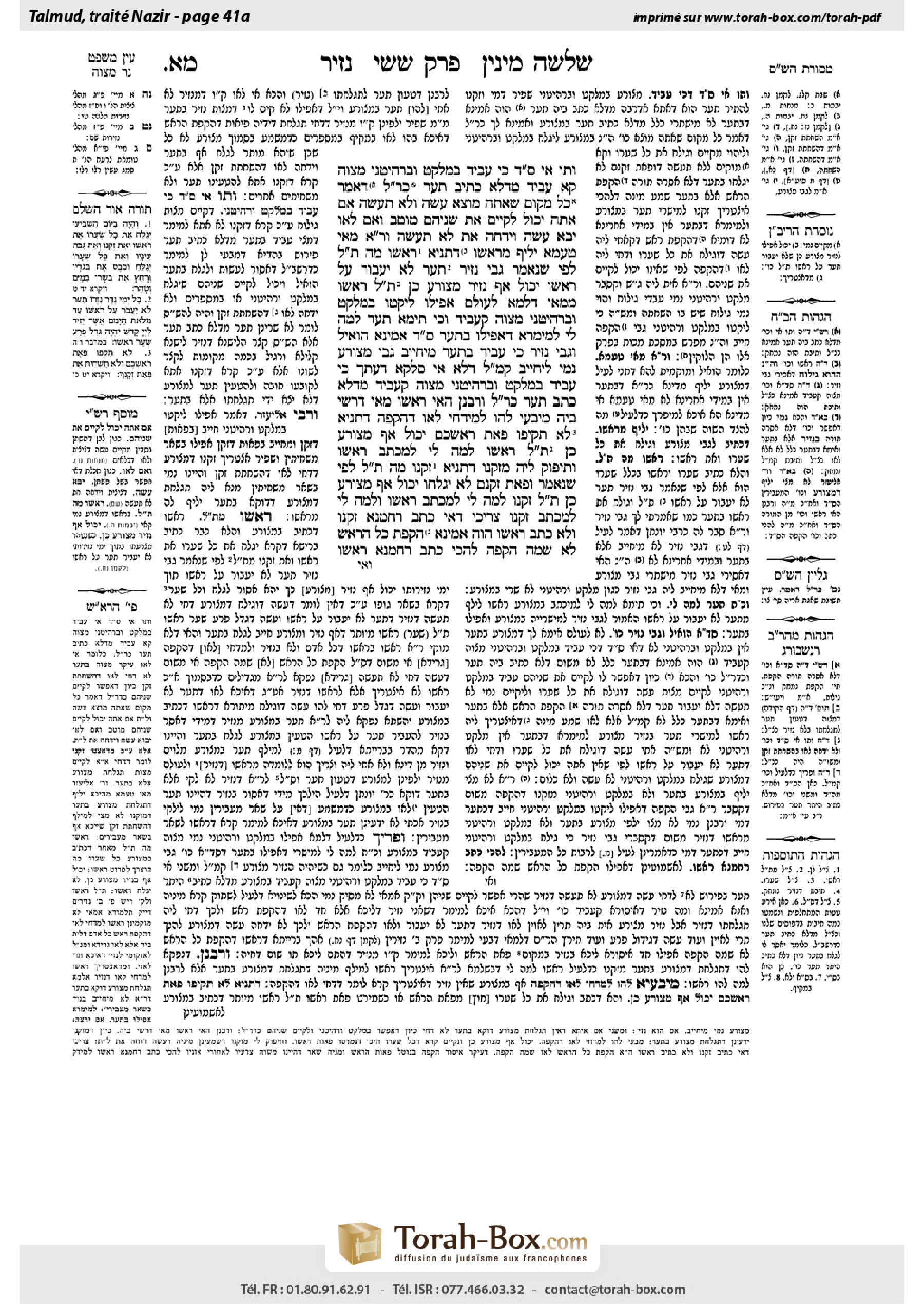
Nazir 41a: Talmud study for Daf Yomi
Daf Yomi is the daily study of one Talmud folio. Explore 37 tractates with scans, Hebrew text, Sefaria English and AI-generated French translations where annotated.
Passage selection and English or AI-generated French translation are available where the scan has annotations. Daf Study is independent of Torah-Box and Sefaria.
Browse Nazir · נזיר · All tractatesNazir 41a text and translations
This page of Nazir includes the Aramaic text, an English translation and an AI-generated French translation, alongside the scan above.
נזיר מ״א א · Aramaic and Hebrew text
וְתוּ, אִי סָלְקָא דַּעְתָּךְ כִּי עָבֵיד בְּמַלְקֵט וּבְרָהִיטְנֵי — מִצְוָה קָא עָבֵיד, מִדְּלָא כְּתִיב ״תַּעַר״, כְּרֵישׁ לָקִישׁ, דְּאָמַר:
כׇּל מָקוֹם שֶׁאַתָּה מוֹצֵא עֲשֵׂה וְלֹא תַעֲשֶׂה, אִם אַתָּה יָכוֹל לְקַיֵּים אֶת שְׁנֵיהֶם — מוּטָב, וְאִם לָאו — יָבֹא עֲשֵׂה וְיִדְחֶה אֶת לֹא תַעֲשֶׂה.
וְרַבִּי אֱלִיעֶזֶר מַאי טַעְמָא? יָלֵיף מֵ״רֹאשׁוֹ״. דְּתַנְיָא: ״רֹאשׁוֹ״, מָה תַּלְמוּד לוֹמַר? לְפִי שֶׁנֶּאֱמַר גַּבֵּי נָזִיר ״תַּעַר לֹא יַעֲבוֹר עַל רֹאשׁוֹ״, יָכוֹל אַף נָזִיר מְצוֹרָע כֵּן — תַּלְמוּד לוֹמַר: ״רֹאשׁוֹ״.
מִמַּאי? דִּלְמָא לְעוֹלָם אֲפִילּוּ לִיקְּטוֹ בְּמַלְקֵט וּבְרָהִיטְנֵי — מִצְוָה קָעָבֵיד. וְכִי תֵּימָא: תַּעַר לְמָה לִי — לְמֵימְרָא דַּאֲפִילּוּ בְּתַעַר. סָלְקָא דַּעְתָּךְ אָמֵינָא, הוֹאִיל וְגַבֵּי נָזִיר כִּי עָבֵיד בְּתַעַר מִיחַיַּיב, גַּבֵּי מְצוֹרָע נָמֵי לִיחַיַּיב, קָא מַשְׁמַע לַן דְּלָא!
אִי סָלְקָא דַּעְתָּךְ כִּי עָבֵיד בְּמַלְקֵט וּבְרָהִיטְנֵי מִצְוָה קָעָבֵיד, מִדְּלָא כְּתַב ״תַּעַר״, כְּרֵישׁ לָקִישׁ.
וְרַבָּנַן הַאי ״רֹאשׁוֹ״, מַאי דָּרְשִׁי בֵּיהּ? מִיבְּעֵי לְהוּ לְמִידְחֵי לָאו דְּהַקָּפָה. דְּתַנְיָא: ״לֹא תַקִּיפוּ פְּאַת רֹאשְׁכֶם״, יָכוֹל אַף מְצוֹרָע כֵּן — תַּלְמוּד לוֹמַר: ״רֹאשׁוֹ״.
לְמָה לִי לְמִכְתַּב ״רֹאשׁוֹ״? וְתִיפּוֹק לֵיהּ מִ״זְּקָנוֹ״. דְּתַנְיָא: ״זְקָנוֹ״, מָה תַּלְמוּד לוֹמַר? לְפִי שֶׁנֶּאֱמַר ״וּפְאַת זְקָנָם לֹא יְגַלֵּחוּ״, יָכוֹל אַף מְצוֹרָע כֵּן — תַּלְמוּד לוֹמַר: ״זְקָנוֹ״.
לְמָה לִי לְמִכְתַּב ״רֹאשׁוֹ״ וּלְמָה לִי לְמִכְתַּב ״זְקָנוֹ״? צְרִיכִי, דְּאִי כְּתַב רַחֲמָנָא ״זְקָנוֹ״ וְלָא כְּתַב ״רֹאשׁוֹ״, הֲוָה אָמֵינָא: הַקָּפַת כׇּל הָרֹאשׁ לֹא שְׁמָהּ הַקָּפָה. לְהָכִי כְּתַב רַחֲמָנָא ״רֹאשׁוֹ״.
Nazir 41a · English translation
And furthermore, if it should enter your mind that when he performs his shaving with tweezers or a plane he performs a mitzva, from the fact that the word razor is not written he should not be allowed to use a razor at all, in accordance with the opinion of Reish Lakish, who says a principle in this regard.
The Gemara cites the relevant principle: Any place where you find a positive mitzva and a prohibition that clash with one another, if you can find some way to fulfill both, that is preferable; and if that is not possible, the positive mitzva will come and override the prohibition. In this case the leper can fulfill his duty with tweezers or a plane, and therefore it should be prohibited for him to shave with a razor. Since it was necessary for the verse to say that the positive mitzva for a leper to shave overrides the prohibition against destroying one’s beard, this proves that the mitzva can be performed only with a razor.
The Gemara asks: And Rabbi Eliezer, what is his reason? From where does he derive the halakha that a leper must use a razor? He derives it from the fact that the verse states with regard to a leper: “He shall shave all his hair off his head and his beard” (Leviticus 14:9). As it is taught in a baraita: Why does the verse state: “His head,” if it already stated: “All his hair”? It is because it is stated with regard to a nazirite: “No razor shall come upon his head” (Numbers 6:5), and therefore one might have thought that the same should also apply to a nazirite who is a leper, i.e., it should be prohibited for him to shave his head even for the purification ritual for his leprosy. Therefore, the verse states: “His head,” to teach that a nazirite who is a leper must shave his head with a razor. Being that a nazirite is prohibited only to use a razor, if a leper could fulfill his obligation to remove his hair using other implements, a nazirite who is a leper would not be permitted to use a razor. Therefore, it can be inferred from the halakha of a nazirite who is a leper that the only way for a leper to remove his hair is with a razor.
The Gemara rejects this suggestion: And from where do you know that a leper must shave his head with a razor? Perhaps even if he actually removed it with tweezers or a plane he performs a mitzva. And if you would say: If so, why do I need the verse to teach me that he uses a razor, through the derivation of the superfluous term “his hair,” as above, one can answer: That is to say that he is permitted to shave even with a razor. As, it might enter your mind to say that since with regard to a nazirite, when he performs the act of shaving with a razor he is liable for transgressing the prohibition, with regard to a nazirite who is a leper as well, he should also be liable even if he shaved for his leprosy. The verse therefore teaches us that this is not the case, but it does not teach that a leper must use a razor.
The Gemara rejects this suggestion: If it should enter your mind that when a leper performs his hair removal with tweezers or a plane he performs a mitzva, then from the fact that the verse did not explicitly write: Razor, it can be inferred that he is not allowed to use one, in accordance with the aforementioned principle of Reish Lakish that one may not violate a prohibition, even for the sake of a mitzva, if it is possible to perform the mitzva in a different manner. Rather, the verse must be coming to teach that the mitzva of the shaving of a leper can be fulfilled only with a razor.
The Gemara asks: And the Rabbis, with regard to this term: “His head,” which is referring to a leper, what do they learn from it? The Gemara answers: They require this term to override the prohibition of rounding the corners of the head. As it is taught in a baraita with regard to the verse “You shall not round the corners of your heads” (Leviticus 19:27): One might have thought that the same should also apply to a leper, that it should also be prohibited for him to round the corners of his head when he shaves. Therefore, the verse states: “His head,” with regard to a leper.
The Gemara asks: Why do I need the Torah to write: “His head”? And let one derive this halakha that the mitzva of shaving overrides that prohibition from the term “his beard” (Leviticus 14:9). As it is taught in a baraita: Why does the verse state: “His beard”? It is because the verse states with regard to priests: “Neither shall they shave off the corners of their beards” (Leviticus 21:5), and therefore one might have thought that the same prohibition against shaving one’s beard should also apply to a leper. Therefore, the verse states: “His beard.”
The Gemara asks: If so, why do I need the Torah to write: “His head,” and why do I need it to write: “His beard”? One source should suffice to teach that the shaving of a leper overrides any prohibitions that would be violated by that act. The Gemara answers: Both verses are necessary. As, had the Merciful One written only: “His beard,” and not written: “His head,” I would say that the rounding of the entire head, i.e., shaving all the hair off one’s head and not merely the sides, is not called a prohibited rounding. If that were so, the shaving of a leper’s head would not be prohibited by Torah law. For this reason the Merciful One writes: “His head,” to teach that the shaving that the leper performs would be considered a prohibited rounding of the head had the Torah not commanded him to shave.
Nazir 41a · Traduction française (IA)
Et de plus, s’il te venait à l’esprit que, lorsqu’il se rase avec une pince à épiler ou un rabot, il accomplit une mitsva, alors, puisque le mot « rasoir » n’est pas écrit, on ne devrait pas lui permettre d’utiliser un rasoir, conformément à l’opinion de Reish Lakish, qui énonce un principe à cet égard.
La Guemara cite le principe pertinent : partout où une mitsva positive et une interdiction entrent en conflit, si l’on peut trouver un moyen d’accomplir les deux, c’est préférable ; si ce n’est pas possible, la mitsva positive vient alors écarter l’interdiction. Dans le cas présent, le lépreux peut s’acquitter de son obligation avec une pince à épiler ou un rabot ; il devrait donc lui être interdit de se raser avec un rasoir. Puisqu’il a fallu que le verset précise que la mitsva positive imposant au lépreux de se raser écarte l’interdiction de détruire sa barbe, cela prouve que la mitsva ne peut être accomplie qu’avec un rasoir.
La Guemara demande : Et Rabbi Eliezer, quelle est sa raison ? D’où déduit-il la halakha selon laquelle le lépreux doit utiliser un rasoir ? Il la déduit du fait que le verset dit au sujet du lépreux : « Il rasera tous les poils de sa tête et de sa barbe » (Lévitique 14, 9). En effet, il est enseigné dans une baraïta : Pourquoi le verset dit-il « sa tête », alors qu’il a déjà dit « tous ses poils » ? C’est parce qu’il est dit au sujet du nazir : « Le rasoir ne passera pas sur sa tête » (Nombres 6, 5), et l’on aurait donc pu penser qu’il en va de même pour un nazir lépreux, c’est-à-dire qu’il lui est interdit de se raser la tête, même dans le cadre du rituel de purification de sa lèpre. Le verset dit donc « sa tête », pour enseigner qu’un nazir lépreux doit se raser la tête avec un rasoir. Puisqu’il n’est interdit au nazir que d’utiliser un rasoir, si le lépreux pouvait s’acquitter de son obligation d’enlever ses poils au moyen d’autres outils, un nazir lépreux ne serait pas autorisé à utiliser un rasoir. On peut donc déduire de la halakha concernant le nazir lépreux que le seul moyen pour un lépreux d’enlever ses poils est d’utiliser un rasoir.
La Guemara rejette cette suggestion : D’où sais-tu que le lépreux doit se raser la tête avec un rasoir ? Peut-être accomplit-il une mitsva même s’il enlève effectivement ses poils avec une pince à épiler ou un rabot. Et si tu dis : dans ce cas, pourquoi le verset doit-il m’enseigner qu’il utilise un rasoir, par la déduction du terme superflu « ses poils », comme ci-dessus ? On peut répondre que cela signifie qu’il lui est permis de se raser même avec un rasoir. Car on aurait pu penser que, puisque, dans le cas d’un nazir qui se rase avec un rasoir, il est passible d’avoir transgressé l’interdiction, il en va de même pour un nazir lépreux, qui serait également passible même s’il se rasait dans le cadre de sa purification de la lèpre. Le verset nous enseigne donc que tel n’est pas le cas ; il n’enseigne pas pour autant que le lépreux doit utiliser un rasoir.
La Guemara rejette cette suggestion : s’il te venait à l’esprit que, lorsqu’un lépreux enlève ses poils avec une pince à épiler ou un rabot, il accomplit une mitsva, alors, puisque le verset n’a pas explicitement écrit « rasoir », on peut en déduire qu’il n’a pas le droit d’en utiliser un, conformément au principe précité de Reish Lakish : on ne peut pas transgresser une interdiction, même pour accomplir une mitsva, s’il est possible d’accomplir cette mitsva autrement. Le verset doit donc enseigner que la mitsva du rasage du lépreux ne peut être accomplie qu’avec un rasoir.
La Guemara demande : Et les Sages, que déduisent-ils du terme « sa tête », qui se rapporte au lépreux ? La Guemara répond : Ils ont besoin de ce terme pour écarter l’interdiction de raser les coins de la tête. En effet, il est enseigné dans une baraïta au sujet du verset « Vous ne raserez pas les coins de vos têtes » (Lévitique 19, 27) : On aurait pu penser qu’il en va de même pour le lépreux, et qu’il lui est également interdit de raser les coins de sa tête lorsqu’il se rase. Le verset dit donc « sa tête » au sujet du lépreux.
La Guemara demande : Pourquoi la Torah doit-elle écrire « sa tête » ? Ne peut-on pas déduire cette halakha, selon laquelle la mitsva du rasage écarte cette interdiction, du terme « sa barbe » (Lévitique 14, 9) ? En effet, il est enseigné dans une baraïta : Pourquoi le verset dit-il « sa barbe » ? C’est parce que le verset dit au sujet des prêtres : « Ils ne raseront pas les coins de leur barbe » (Lévitique 21, 5), et l’on aurait donc pu penser que la même interdiction de se raser la barbe s’applique aussi au lépreux. Le verset dit donc « sa barbe ».
La Guemara demande : Dans ce cas, pourquoi la Torah doit-elle écrire « sa tête » et pourquoi doit-elle écrire « sa barbe » ? Une seule source devrait suffire pour enseigner que le rasage du lépreux écarte toutes les interdictions que cet acte entraînerait. La Guemara répond : Les deux versets sont nécessaires. En effet, si le Miséricordieux avait écrit uniquement « sa barbe », sans écrire « sa tête », j’aurais dit que raser toute la tête, c’est-à-dire enlever tous les cheveux de la tête et pas seulement ceux des côtés, n’est pas considéré comme un rasage interdit des coins de la tête. Dans ce cas, le rasage de la tête du lépreux ne serait pas interdit par la Torah. C’est pourquoi le Miséricordieux écrit « sa tête », pour enseigner que le rasage effectué par le lépreux serait considéré comme un rasage interdit des coins de la tête si la Torah ne lui avait pas ordonné de se raser.
Traduction française générée par IA à partir de l’édition anglaise de Sefaria. Vérifie toujours un passage avec le texte source.
Text from Sefaria: William Davidson Edition - Vocalized Aramaic (CC BY NC); William Davidson Edition - English (CC BY NC).