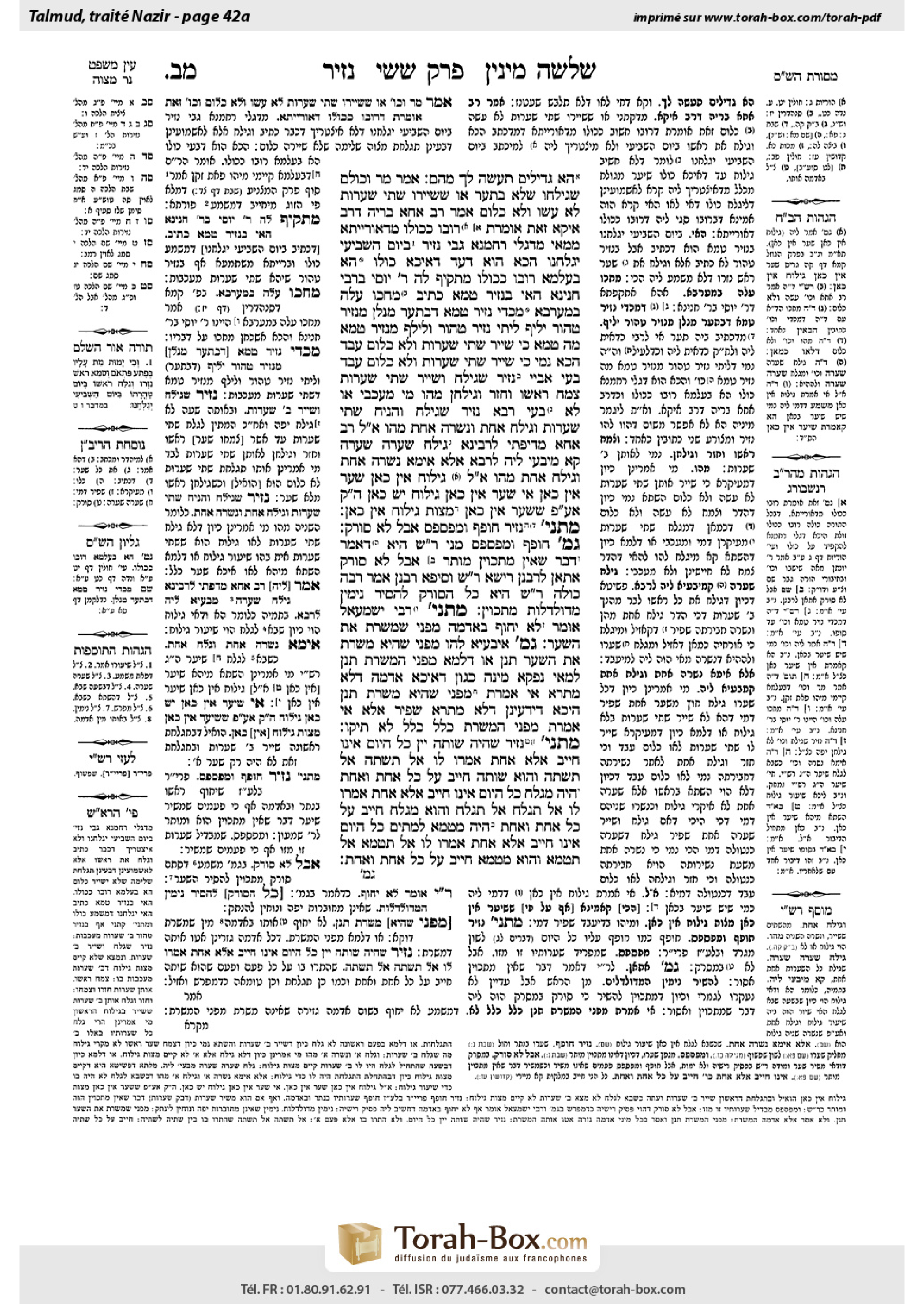
Nazir 42a: Talmud study for Daf Yomi
Daf Yomi is the daily study of one Talmud folio. Explore 37 tractates with scans, Hebrew text, Sefaria English and AI-generated French translations where annotated.
Passage selection and English or AI-generated French translation are available where the scan has annotations. Daf Study is independent of Torah-Box and Sefaria.
Browse Nazir · נזיר · All tractatesNazir 42a text and translations
This page of Nazir includes the Aramaic text, an English translation and an AI-generated French translation, alongside the scan above.
נזיר מ״ב א · Aramaic and Hebrew text
הָא ״גְּדִילִים תַּעֲשֶׂה לָּךְ״ מֵהֶם.
אָמַר מָר: וְכוּלָּם שֶׁגִּילְּחוּ שֶׁלֹּא בְּתַעַר, אוֹ שֶׁשִּׁיְּירוּ שְׁתֵּי שְׂעָרוֹת — לֹא עָשׂוּ וְלֹא כְלוּם. אָמַר רַב אַחָא בְּרֵיהּ דְּרַב אִיקָא: זֹאת אוֹמֶרֶת, רוּבּוֹ כְּכוּלּוֹ מִדְּאוֹרָיְיתָא.
מִמַּאי — מִדְּגַלִּי רַחֲמָנָא גַּבֵּי נָזִיר ״בְּיוֹם הַשְּׁבִיעִי יְגַלְּחֶנּוּ״ — הָכָא הוּא דְּעַד דְּאִיכָּא כּוּלּוֹ. הָא בְּעָלְמָא: רוּבּוֹ כְּכוּלּוֹ.
מַתְקֵיף לַהּ רַבִּי יוֹסֵי בְּרַבִּי חֲנִינָא: הַאי בְּנָזִיר טָמֵא כְּתִיב! מַחֲכוּ עֲלַהּ בְּמַעְרְבָא: מִכְּדֵי נָזִיר טָמֵא דִּבְתַעַר מְנָלַן — מִנָּזִיר טָהוֹר יָלֵיף, לַיְתֵי נָזִיר טָהוֹר וְלֵילַף מִנָּזִיר טָמֵא: מָה טָמֵא כִּי שַׁיַּיר שְׁתֵּי שְׂעָרוֹת — וְלָא כְּלוּם עֲבַד, הָכָא נָמֵי, כִּי שַׁיַּיר שְׁתֵּי שְׂעָרוֹת — וְלָא כְּלוּם עֲבַד.
בָּעֵי אַבָּיֵי: נָזִיר שֶׁגִּילַּח וְשִׁיֵּיר שְׁתֵּי שְׂעָרוֹת, צָמַח רֹאשׁוֹ וְחָזַר וְגִילְּחָן, מַהוּ? מִי מְעַכְּבִי אוֹ לָא?
בָּעֵי רָבָא: נָזִיר שֶׁגִּילַּח וְהִנִּיחַ שְׁתֵּי שְׂעָרוֹת, וְגִילַּח אַחַת וְנָשְׁרָה אַחַת, מַהוּ? אֲמַר לֵיהּ רַב אַחָא מִדִּיפְתִּי לְרָבִינָא: גִּילַּח שַׂעֲרָה שַׂעֲרָה קָא מִיבְּעֵי לֵיהּ לְרָבָא?
אֶלָּא אֵימָא: נָשְׁרָה אַחַת וְגִילַּח אַחַת, מַהוּ? אֲמַר לֵיהּ: גִּילּוּחַ אֵין כָּאן, שֵׂעָר אֵין כָּאן. אִי שֵׂעָר אֵין כָּאן — גִּילּוּחַ יֵשׁ כָּאן! הָכִי קָאָמַר: אַף עַל פִּי שֶׁשֵּׂעָר אֵין כָּאן, מִצְוַת גִּילּוּחַ אֵין כָּאן.
מַתְנִי׳ נָזִיר חוֹפֵף וּמְפַסְפֵּס, אֲבָל לֹא סוֹרֵק.
גְּמָ׳ חוֹפֵף וּמְפַסְפֵּס, מַנִּי? רַבִּי שִׁמְעוֹן הִיא, דְּאָמַר: דָּבָר שֶׁאֵין מִתְכַּוֵּין — מוּתָּר. אֲבָל לֹא סוֹרֵק — אֲתָאן לְרַבָּנַן.
רֵישָׁא רַבִּי שִׁמְעוֹן וְסֵיפָא רַבָּנַן? אָמַר רַבָּה: כּוּלָּהּ רַבִּי שִׁמְעוֹן הִיא, כׇּל הַסּוֹרֵק — לְהָסִיר נִימִין מְדוּלְדָּלוֹת מִתְכַּוֵּין.
מַתְנִי׳ רַבִּי יִשְׁמָעֵאל אוֹמֵר: לֹא יָחוֹף בַּאֲדָמָה, מִפְּנֵי שֶׁמַּשֶּׁרֶת אֶת הַשֵּׂעָר.
גְּמָ׳ אִיבַּעְיָא לְהוּ: ״מִפְּנֵי שֶׁהִיא מַשֶּׁרֶת אֶת הַשֵּׂעָר״ תְּנַן, אוֹ דִּלְמָא: ״מִפְּנֵי הַמַּשֶּׁרֶת״ תְּנַן? לְמַאי נָפְקָא מִינַּהּ?
כְּגוֹן דְּאִיכָּא אֲדָמָה דְּלָא מַתְּרָא. אִי אָמְרַתְּ ״מִפְּנֵי שֶׁהִיא מַשֶּׁרֶת״ תְּנַן, הֵיכָא דְּיָדְעִינַן דְּלָא מַתְּרָא — שַׁפִּיר. אֶלָּא אִי אָמְרַתְּ ״מִפְּנֵי הַמַּשֶּׁרֶת״ — כְּלָל כְּלָל לָא. תֵּיקוּ.
מַתְנִי׳ נָזִיר שֶׁהָיָה שׁוֹתֶה יַיִן כׇּל הַיּוֹם — אֵינוֹ חַיָּיב אֶלָּא אַחַת. אָמְרוּ לוֹ: ״אַל תִּשְׁתֶּה״ ״אַל תִּשְׁתֶּה״, וְהוּא שׁוֹתֶה — חַיָּיב עַל כׇּל אַחַת וְאַחַת. הָיָה מְגַלֵּחַ כׇּל הַיּוֹם — אֵינוֹ חַיָּיב אֶלָּא אַחַת. אָמְרוּ לוֹ: ״אַל תְּגַלֵּחַ״ ״אַל תְּגַלֵּחַ״, וְהוּא מְגַלֵּחַ — חַיָּיב עַל כׇּל אַחַת וְאַחַת. הָיָה מִטַּמֵּא לְמֵתִים כׇּל הַיּוֹם — אֵינוֹ חַיָּיב אֶלָּא אַחַת. אָמְרוּ לוֹ: ״אַל תִּטַּמֵּא״ ״אַל תִּטַּמֵּא״, וְהוּא מִטַּמֵּא — חַיָּיב עַל כׇּל אַחַת וְאַחַת.
Nazir 42a · English translation
indicates that fringes in the mitzva stated in the adjacent verse: “You shall make for yourself fringes” (Deuteronomy 22:12), can be from them, wool and linen. By juxtaposing the mitzva of ritual fringes to the prohibition against diverse kinds of cloth, the Torah teaches that the positive mitzva of ritual fringes, which includes dyed blue wool, overrides the prohibition against diverse kinds of cloth, i.e., one may attach woolen ritual fringes to a linen garment. From here one derives the general principle that a positive mitzva overrides a prohibition.
§ The Gemara returns to the mishna that teaches that nazirites, lepers, and Levites must shave their hair. The Master said above: And with regard to all of them, if they shaved with an implement other than a razor, or if they left two hairs uncut, they have done nothing. Rav Aḥa, son of Rav Ika, said: That is to say that the principle: The majority of an entity is considered like all of it, applies by Torah law.
The Gemara asks: From where do we learn this? The Gemara explains: This principle is derived from the fact that the Merciful One revealed in the Torah and specified with regard to a nazirite: “On the seventh day he shall shave it” (Numbers 6:9), despite the fact that the same verse already stated: “And he shall shave his head on the day of his cleansing.” This teaches that it is only in this case here that he does not fulfill the mitzva of shaving until there is the removal of all of it, i.e., shaving part of his head is insufficient. This shows that in general the majority of an entity is like all of it.
Rabbi Yosei, son of Rabbi Ḥanina, objects to this assertion. This verse: “On the seventh day he shall shave it,” is written with regard to a ritually impure nazirite, not a pure one, whereas the halakha in the mishna applies even to a pure nazirite. This shows that the above inference is invalid. They laughed at this difficulty in the West, i.e., Eretz Yisrael: After all, from where do we derive the halakha that an impure nazirite shaves with a razor? It is derived from the halakha of a pure nazirite. If so, let the case of a pure nazirite come and derive the following halakha from the case of an impure nazirite: Just as with regard to an impure nazirite, if he leaves two hairs he has done nothing, here too, if a pure nazirite leaves two hairs he has done nothing.
On the same topic, Abaye raised a dilemma: With regard to a nazirite who shaved and left two hairs, which is not considered an act of shaving, if the hairs of his head grew and he again shaved, this time those two hairs alone, what is the halakha? Do these hairs invalidate the fulfillment of his obligation or not? Has he now completed his initial act of shaving, or is the shaving of two hairs from a head full of hair of no significance, and he must now shave his entire head?
Similarly, Rava raised a dilemma: With regard to a nazirite who shaved and left two hairs, and afterward shaved one of them, and the other one fell out of its own accord, what is the halakha? Is this considered shaving one’s entire head or not? Rav Aḥa of Difti said to Ravina: Is Rava raising a dilemma as to whether one can shave his head one hair by one hair? How does this case differ from that of one who shaves his entire head one hair at a time, which is a fulfillment of his obligation?
Rather, say that the dilemma is as follows: If one hair fell out and he shaved the other one, what is the halakha? Has he performed the obligation of shaving if there was only one hair left when he came to shave? Ravina said to him: In that case there is no shaving here; there is no hair here. The Gemara expresses surprise at this expression: If there is no hair here, then there is shaving here, as no hair remains. The Gemara explains: This is what he said: Even though there is no hair here, as only one hair remains, nevertheless there is no fulfillment of the mitzva of shaving here, as he failed to shave it all on the first attempt, and the second time he shaved less than the required amount.
MISHNA: A nazirite may shampoo [ḥofef ] his head and separate [mefaspes] his hairs manually, without concern that hairs might fall out. However, he may not comb his hair.
GEMARA: The Gemara clarifies: Who is the tanna who maintains that a nazirite may shampoo and separate his hairs? It is Rabbi Shimon, who says: An unintentional act is permitted. Even if hairs do fall out as a result of this action, as he did not intend this to happen the action is permitted. Yet in the latter clause of the mishna, which states: However, he may not comb his hair, we have come to the opinion of the Rabbis. Although this nazirite also does not intend to tear out any hair when he combs it, it is nevertheless prohibited.
This leads to a surprising conclusion, that the first clause represents the opinion of Rabbi Shimon and the latter clause is the opinion of the Rabbis. Rabba said: The entire mishna is in accordance with the opinion of Rabbi Shimon, as he maintains that anyone who combs his hair intends to remove stray hairs, and therefore this is considered an intentional act.
MISHNA: Rabbi Yishmael says: A nazirite may not shampoo his hair with earth because this causes the hair to fall out.
GEMARA: A dilemma was raised before the Sages: What is the precise wording of the mishna? Do we learn: Because it removes hair, i.e., earth in general removes hair, or do we perhaps learn: Because of that which removes hair. In other words, although some types of earth do not remove hair, it is prohibited to use these as well, due to those types that do remove hair. The Gemara inquires: What is the difference of this textual question?
The Gemara explains: There is a difference in a case where there is a type of earth that does not remove hair. If you say that we learned in the mishna: Because it removes hair, then in a case where we know that it does not remove hair it is fine to shampoo with that substance. However, if you say the text reads: Because of that which removes hair, this indicates that the Sages prohibited using any type of earth, due to the type that removes hair. If so, a nazirite may not shampoo his head with any earth at all, not even if it does not remove hair. No answer was found, and the Gemara says that the dilemma shall stand unresolved.
MISHNA: A nazirite who was drinking wine all day is liable to receive only one set of lashes. If people said to him during the course of the day: Do not drink, do not drink, and nevertheless he continues to drink, he is liable for each and every time he was warned. If a nazirite kept shaving all day, he is liable to receive only one set of lashes. If they said to him: Do not shave, do not shave, and he shaves, he is liable for each and every time he was warned. If he became ritually impure from a corpse many times all day, he is liable to receive only one set of lashes. If they said to him: Do not become impure, do not become impure, and he continues to become impure, he is liable for each and every time he was warned.
Nazir 42a · Traduction française (IA)
Cela indique que les franges de la mitsva énoncée dans le verset adjacent — « Tu te feras des franges » (Deutéronome 22:12) — peuvent être faites de laine et de lin. En juxtaposant la mitsva des franges rituelles à l’interdiction des étoffes composées de diverses espèces, la Torah enseigne que la mitsva positive des franges rituelles, qui comprend de la laine teinte en bleu, l’emporte sur l’interdiction des étoffes composées de diverses espèces : on peut donc attacher des franges de laine à un vêtement de lin. On en déduit le principe général selon lequel une mitsva positive l’emporte sur une interdiction.
§ La Guemara revient à la Michna, qui enseigne que les naziréens, les lépreux et les Lévites doivent se raser les cheveux. Le Maître a dit plus haut : « Pour tous, s’ils se sont rasés avec un ustensile autre qu’un rasoir, ou s’ils ont laissé deux cheveux sans les couper, ils n’ont rien fait. » Rav Aḥa, fils de Rav Ika, dit : Cela revient à dire que, selon la Torah, le principe selon lequel la majorité d’un ensemble est considérée comme l’ensemble entier s’applique.
La Guemara demande : D’où apprenons-nous cela ? La Guemara explique : Ce principe se déduit du fait que le Miséricordieux a révélé dans la Torah et précisé au sujet du naziréen : « Le septième jour, il se rasera » (Nombres 6:9), alors que le même verset avait déjà dit : « Il se rasera la tête le jour de sa purification. » Cela enseigne que c’est seulement dans ce cas précis qu’il n’accomplit pas la mitsva du rasage tant qu’il n’a pas tout enlevé, c’est-à-dire que se raser une partie de la tête ne suffit pas. Cela montre qu’en règle générale, la majorité d’un ensemble équivaut à l’ensemble entier.
Rabbi Yosei, fils de Rabbi Ḥanina, objecte à cette affirmation : le verset « Le septième jour, il se rasera » concerne un naziréen rituellement impur, et non un naziréen pur, alors que la halakha de la Michna s’applique même à un naziréen pur. Cela montre que la déduction précédente n’est pas valable. En Occident, c’est-à-dire en terre d’Israël, on rit de cette difficulté : après tout, d’où déduisons-nous la halakha selon laquelle un naziréen impur se rase au rasoir ? Nous la déduisons de la halakha concernant un naziréen pur. Dès lors, que le cas du naziréen pur vienne déduire la halakha suivante du cas du naziréen impur : de même qu’au sujet d’un naziréen impur, s’il laisse deux cheveux, il n’a rien fait, de même ici, si un naziréen pur laisse deux cheveux, il n’a rien fait.
Sur le même sujet, Abaye soulève un dilemme : concernant un naziréen qui s’est rasé en laissant deux cheveux — ce qui n’est pas considéré comme un rasage —, si les cheveux de sa tête ont repoussé et qu’il s’est rasé de nouveau, cette fois uniquement ces deux cheveux, quelle est la halakha ? Ces cheveux empêchent-ils l’accomplissement de son obligation ou non ? A-t-il maintenant achevé son premier rasage, ou bien le rasage de deux cheveux sur une tête couverte de cheveux n’a-t-il aucune valeur, de sorte qu’il doit maintenant se raser toute la tête ?
De même, Rava soulève un dilemme : concernant un naziréen qui s’est rasé en laissant deux cheveux, puis s’est rasé l’un d’eux, tandis que l’autre est tombé de lui-même, quelle est la halakha ? Est-ce considéré comme le rasage de toute la tête ou non ? Rav Aḥa de Difti dit à Ravina : Rava soulève-t-il un dilemme sur la possibilité de se raser la tête cheveu par cheveu ? En quoi ce cas diffère-t-il de celui d’une personne qui se rase toute la tête un cheveu à la fois, ce qui constitue l’accomplissement de son obligation ?
Il faut plutôt formuler le dilemme ainsi : si un cheveu est tombé et qu’il a rasé l’autre, quelle est la halakha ? A-t-il accompli l’obligation de se raser s’il ne restait qu’un seul cheveu lorsqu’il a entrepris de se raser ? Ravina lui dit : Dans ce cas, il n’y a pas ici de rasage ; il n’y a pas ici de cheveu. La Guemara s’étonne de cette formulation : s’il n’y a pas ici de cheveu, alors il y a ici rasage, puisqu’il ne reste aucun cheveu. La Guemara explique : Voici ce qu’il voulait dire : bien qu’il n’y ait pas ici de cheveux, puisqu’il n’en reste qu’un, il n’y a néanmoins pas ici d’accomplissement de la mitsva du rasage, car il n’a pas tout rasé lors de la première tentative et, la seconde fois, il a rasé moins que la quantité requise.
MICHNA : Un naziréen peut se frictionner [ḥofef] la tête et séparer [mefaspes] ses cheveux à la main, sans craindre que des cheveux ne tombent. Toutefois, il ne peut pas se peigner.
GUEMARA : La Guemara précise : Qui est le tanna qui estime qu’un naziréen peut se frictionner la tête et séparer ses cheveux ? C’est Rabbi Shimon, qui dit : un acte involontaire est permis. Même si des cheveux tombent à la suite de cette action, puisqu’il ne l’a pas fait intentionnellement, l’action est permise. Pourtant, dans la dernière partie de la Michna, qui dit : « Toutefois, il ne peut pas se peigner », nous sommes passés à l’opinion des Rabbins. Bien que ce naziréen n’ait pas non plus l’intention d’arracher des cheveux lorsqu’il se peigne, cela reste interdit.
On aboutit ainsi à une conclusion étonnante : la première partie représente l’opinion de Rabbi Shimon, tandis que la dernière partie exprime celle des Rabbins. Rabba dit : toute la Michna suit l’opinion de Rabbi Shimon, car celui-ci estime que quiconque se peigne a l’intention d’enlever les cheveux qui dépassent ; il s’agit donc d’un acte intentionnel.
MICHNA : Rabbi Yishmael dit : Un naziréen ne peut pas se frictionner les cheveux avec de la terre, car cela fait tomber les cheveux.
GUEMARA : Les Sages soulevèrent un dilemme : quelle est la formulation exacte de la Michna ? Faut-il lire : « Parce qu’elle enlève les cheveux », c’est-à-dire que la terre, en général, enlève les cheveux ; ou bien faut-il lire : « À cause de ce qui enlève les cheveux ». Autrement dit, même si certains types de terre ne font pas tomber les cheveux, il est également interdit de les utiliser, à cause de ceux qui les font tomber. La Guemara demande : Quelle différence y a-t-il entre ces deux formulations ?
La Guemara explique : La différence concerne le cas où il existe un type de terre qui ne fait pas tomber les cheveux. Si l’on dit que la Michna porte : « Parce qu’elle enlève les cheveux », alors, lorsqu’on sait que cette substance ne fait pas tomber les cheveux, il est permis de s’en frictionner. En revanche, si l’on dit que le texte porte : « À cause de ce qui enlève les cheveux », cela indique que les Sages ont interdit l’utilisation de tout type de terre en raison de celui qui fait tomber les cheveux. Dans ce cas, un naziréen ne peut se frictionner la tête avec aucune terre, même si elle ne fait pas tomber les cheveux. Aucune réponse n’ayant été trouvée, la Guemara dit que le dilemme reste sans solution.
MICHNA : Un naziréen qui a bu du vin toute la journée n’est passible que d’une seule série de coups. Si, au cours de la journée, on lui a dit : « Ne bois pas, ne bois pas », et qu’il continue néanmoins à boire, il est passible de coups pour chaque fois qu’il a été averti. Si un naziréen s’est rasé sans cesse toute la journée, il n’est passible que d’une seule série de coups. Si on lui a dit : « Ne te rase pas, ne te rase pas », et qu’il se rase, il est passible de coups pour chaque fois qu’il a été averti. S’il est devenu rituellement impur au contact d’un cadavre à plusieurs reprises au cours de la journée, il n’est passible que d’une seule série de coups. Si on lui a dit : « Ne deviens pas impur, ne deviens pas impur », et qu’il continue à devenir impur, il est passible de coups pour chaque fois qu’il a été averti.
Traduction française générée par IA à partir de l’édition anglaise de Sefaria. Vérifie toujours un passage avec le texte source.
Text from Sefaria: William Davidson Edition - Vocalized Aramaic (CC BY NC); William Davidson Edition - English (CC BY NC).