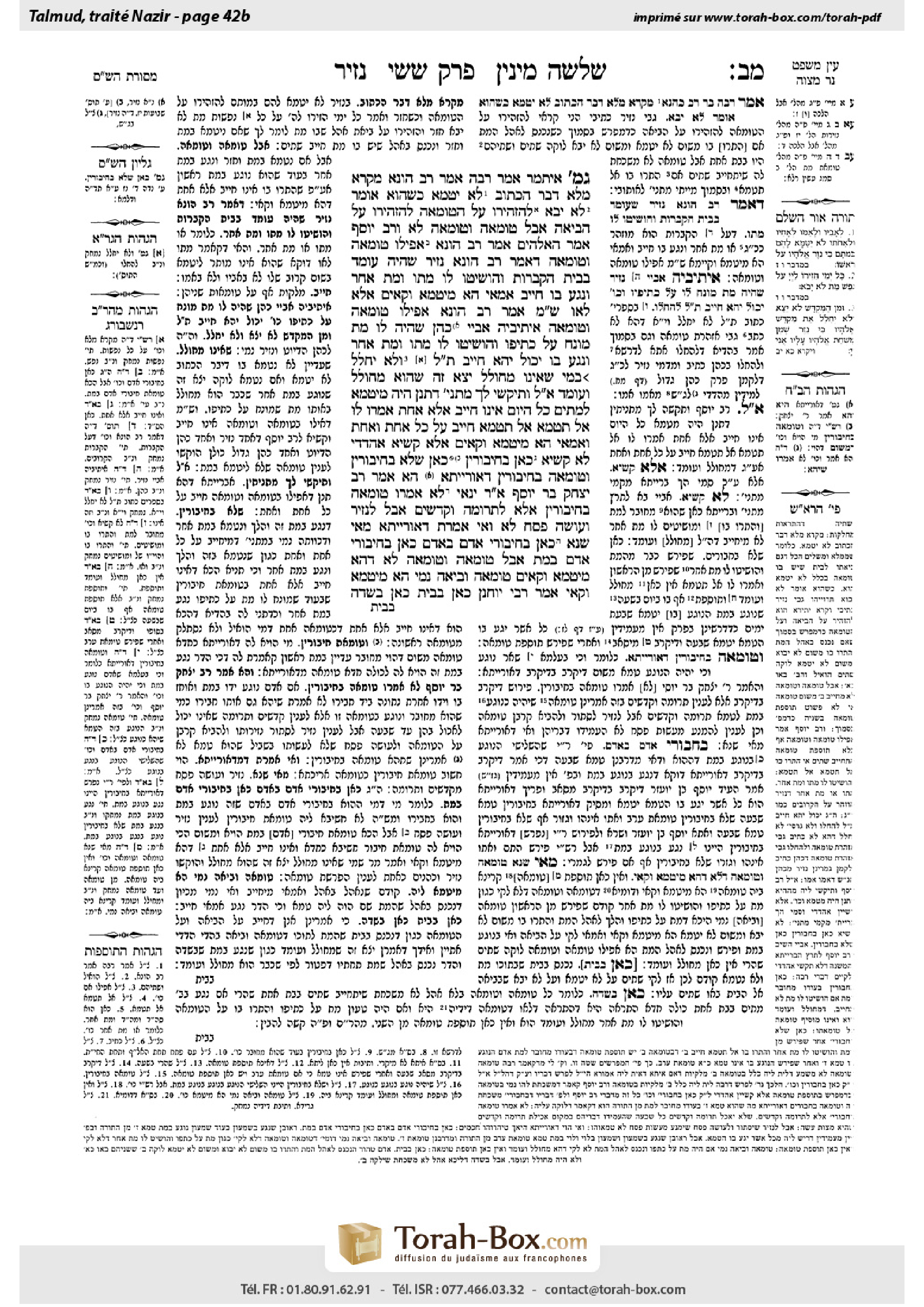
Nazir 42b: Talmud study for Daf Yomi
Daf Yomi is the daily study of one Talmud folio. Explore 37 tractates with scans, Hebrew text, Sefaria English and AI-generated French translations where annotated.
Passage selection and English or AI-generated French translation are available where the scan has annotations. Daf Study is independent of Torah-Box and Sefaria.
Browse Nazir · נזיר · All tractatesNazir 42b text and translations
This page of Nazir includes the Aramaic text, an English translation and an AI-generated French translation, alongside the scan above.
נזיר מ״ב ב · Aramaic and Hebrew text
גְּמָ׳ אִיתְּמַר, אָמַר רַבָּה אָמַר רַב הוּנָא: מִקְרָא מָלֵא דִּבֵּר הַכָּתוּב: ״לֹא יִטַּמָּא״. כְּשֶׁהוּא אוֹמֵר ״לֹא יָבֹא״ — לְהַזְהִירוֹ עַל הַטּוּמְאָה, לְהַזְהִירוֹ עַל הַבִּיאָה. אֲבָל טוּמְאָה וְטוּמְאָה — לֹא.
וְרַב יוֹסֵף אָמַר: הָאֱלֹהִים! אָמַר רַב הוּנָא: אֲפִילּוּ טוּמְאָה וְטוּמְאָה. דְּאָמַר רַב הוּנָא: נָזִיר שֶׁהָיָה עוֹמֵד בְּבֵית הַקְּבָרוֹת, וְהוֹשִׁיטוּ לוֹ מֵתוֹ וּמֵת אַחֵר וְנָגַע בּוֹ — חַיָּיב. אַמַּאי? הָא מִיטַּמֵּא וְקָאֵים! אֶלָּא לָאו שְׁמַע מִינַּהּ, אָמַר רַב הוּנָא: אֲפִילּוּ טוּמְאָה וְטוּמְאָה.
אֵיתִיבֵיהּ אַבָּיֵי: כֹּהֵן שֶׁהָיָה לוֹ מֵת מוּנָּח עַל כְּתֵיפוֹ, וְהוֹשִׁיטוּ לוֹ מֵתוֹ וּמֵת אַחֵר וְנָגַע בּוֹ, יָכוֹל יְהֵא חַיָּיב — תַּלְמוּד לוֹמַר: ״וְלֹא יְחַלֵּל״, בְּמִי שֶׁאֵינוֹ מְחוּלָּל, יָצָא זֶה שֶׁהוּא מְחוּלָּל וְעוֹמֵד.
אֲמַר לֵיהּ: וְתִיקְשֵׁי לָךְ מַתְנִיתִין, דִּתְנַן: הָיָה מִיטַּמֵּא לְמֵתִים כׇּל הַיּוֹם — אֵינוֹ חַיָּיב אֶלָּא אַחַת. אָמְרוּ לוֹ ״אַל תִּטַּמֵּא״ ״אַל תִּטַּמֵּא״ — חַיָּיב עַל כׇּל אַחַת וְאַחַת. וְאַמַּאי? הָא מִיטַּמֵּא וְקָאֵים!
אֶלָּא קַשְׁיָא אַהֲדָדֵי! לָא קַשְׁיָא: כָּאן — בְּחִיבּוּרִין. כָּאן — שֶׁלֹּא בְּחִיבּוּרִין.
וְטוּמְאָה בְּחִיבּוּרִין דְּאוֹרָיְיתָא? הָא אָמַר רַב יִצְחָק בַּר יוֹסֵף אָמַר רַבִּי יַנַּאי: לֹא אָמְרוּ טוּמְאָה בְּחִיבּוּרִין אֶלָּא לִתְרוּמָה וְקָדָשִׁים, אֲבָל לְנָזִיר וְעוֹשֵׂה פֶסַח — לָא. וְאִי אָמְרַתְּ דְּאוֹרָיְיתָא, מַאי שְׁנָא?
כָּאן, בְּחִיבּוּרֵי אָדָם בְּאָדָם. כָּאן, בְּחִיבּוּרֵי אָדָם בְּמֵת.
אֲבָל טוּמְאָה וְטוּמְאָה לָא, דְּהָא מִיטַּמֵּא וְקָאֵים.
טוּמְאָה וּבִיאָה נָמֵי, הָא מִיטַּמֵּא וְקָאֵי! אָמַר רַבִּי יוֹחָנָן: כָּאן בְּבַיִת,
כָּאן בְּשָׂדֶה.
Nazir 42b · English translation
GEMARA: A dispute among amora’im was stated. Rabba said that Rav Huna said: The Torah stated a halakha involving a nazirite in a categorical verse: “He shall not become impure for his father, or for his mother, for his brother, or for his sister, when they die” (Numbers 6:7). This includes all manners of contracting impurity imparted by a corpse, whether ritual impurity imparted by contact, by carrying, or in a tent, i.e., a corpse under the same roof. When the Torah states: “He shall not come near to a dead body” (Numbers 6:6), it serves to warn him with regard to contracting impurity from a corpse in any manner, as above, and to warn him with regard to entering an enclosure with a corpse, which is a unique prohibition applicable to a nazirite that is added by the phrase “He shall not come near to a dead body,” and he is liable separately for each. However, with regard to one contracting impurity from a corpse and again contracting impurity from a corpse, the verse does not warn him, and he is liable to receive only one set of lashes.
And Rav Yosef says in the form of an oath: By God! Rav Huna actually says that he is separately liable even for contracting impurity from a corpse and again contracting impurity from a corpse, not only if he entered an enclosure with a corpse. As Rav Huna says: With regard to a nazirite who was standing in a cemetery, who is already ritually impure, and they extended his corpse, i.e., the corpse of his relative, to him, and similarly if they extended a different corpse to him and he touched it, he is liable. But why is he liable; he has already become impure and is standing in his state of impurity? Rather, isn’t it correct to conclude from this that Rav Huna said he is separately liable even for contracting impurity from a corpse and again contracting impurity from a corpse?
Abaye raised an objection to Rav Yosef from a baraita: With regard to a priest who had a corpse placed on his shoulder, and they extended his corpse, i.e., the corpse of his relative, to him, and similarly if they extended a different corpse to him and he touched it, one might have thought that he should be liable even for this contact. Therefore, the verse states, with regard to the prohibition against a High Priest becoming impure: “And he shall not profane the Sanctuary of his God” (Leviticus 21:12). This teaches that the prohibition of impurity applies to one who is not yet profaned, excluding this one who is already profaned and standing in that state of ritual impurity.
Rav Yosef said to him: But if, as you claim, one is not liable for contracting one impurity after another, the mishna should pose a difficulty for you. As we learned in the mishna: If a nazirite became ritually impure from corpses many times all day, he is liable to receive only one set of lashes. If they said to him: Do not become impure, do not become impure, and he continues to become impure, he is liable for each and every time he was warned. But why should this be so? He has already become impure and is standing in his state of impurity.
Rather, the mishna and baraita pose a difficulty for each other. The Gemara answers: This is not difficult, as here the baraita is referring to a concurrent contact with impurity, i.e., when he touched the second corpse he was still in contact with the first, so he is not liable for the second impurity. Conversely, there the mishna is referring to impurity that was not a concurrent contact. He touched the second corpse only after he had separated himself from the first, and therefore he is liable for each impurity.
The Gemara asks: And this halakha, that a nazirite is exempt from being flogged for a second contact with a corpse in a case of concurrent impurity, does it apply by Torah law? Didn’t Rav Yitzḥak bar Yosef say that Rabbi Yannai said: They stated the principle of concurrent impurity only with regard to partaking of teruma and consecrated foods, i.e., that one who touches a person who is in contact with a corpse is ritually impure with impurity imparted by a corpse for seven days. However, with regard to a nazirite, i.e., the question of whether a nazirite is considered ritually impure and has to bring offerings due to this contact, and with regard to one who performs the ritual of the Paschal offering, this halakha does not apply. And if you say that this halakha applies by Torah law, what is different between the case of teruma and the case of a nazirite?
The Gemara explains that there are two different types of concurrent impurity. Here, where there is a difference between teruma and a nazirite, it is referring to concurrent contact of one person with another person. If one touched another while the other was in contact with a corpse, the impurity of the first is by rabbinic law. By contrast, there it is referring to concurrent contact of a person with a corpse. One who is touching a corpse is considered linked to impurity by Torah law with regard to his second contact with a corpse.
The Gemara summarizes: The fact that one who is touching a corpse is not liable for contact with a second corpse leads to Rabba’s aforementioned ruling: However, with regard to contracting impurity from a corpse and again contracting impurity from a corpse, i.e., if a person contracted impurity imparted by a corpse and then touched another corpse while still in contact with the first corpse, he is not liable for the second impurity, as he has already become impure and is standing in his state of ritual impurity.
The Gemara asks: If so, with regard to impurity and entering one should say likewise, that when he enters an enclosure containing a corpse when he is in contact with a corpse, he has already become impure and is standing in his impurity. Why should he be flogged again for entering the enclosure? Rabbi Yoḥanan said: In the case of impurity and entering one must again distinguish between two instances: Here, where Rav Huna said that one will be liable for both contractions of impurity, it is referring to one who was pure and who went into a house that contained a corpse, rendering him liable twice. The entering the house and the ritual impurity imparted by a corpse in a tent, i.e., to that which is under the same roof, occurred simultaneously, and therefore he is liable twice, once for contracting ritual impurity and once for violating the particular prohibition against a nazirite entering an enclosure with a corpse in it.
Whereas there, where he is liable only once, it is referring to one who was in a field. In other words, if a nazirite touched a corpse in a field and subsequently entered an enclosure with a corpse in it while he was still in contact with the first corpse, he is not liable separately for that entering, as he was already ritually impure.
Nazir 42b · Traduction française (IA)
GUEMARA : Une controverse entre amoraïm a été rapportée. Rabba a dit au nom de Rav Houna : La Torah a énoncé une halakha concernant le nazir dans un verset catégorique : « Il ne se rendra pas impur pour son père, ni pour sa mère, ni pour son frère, ni pour sa sœur, lorsqu’ils mourront » (Nombres 6,7). Cela inclut toutes les manières de contracter l’impureté transmise par un cadavre, que ce soit par contact, par portage ou sous une tente, c’est-à-dire lorsqu’un cadavre se trouve sous le même toit. Lorsque la Torah dit : « Il ne s’approchera pas d’un mort » (Nombres 6,6), cela sert à l’avertir de ne pas contracter l’impureté transmise par un cadavre, de quelque manière que ce soit, comme indiqué plus haut, et de ne pas entrer dans un espace clos où se trouve un cadavre. Cette interdiction particulière, applicable au nazir, est ajoutée par les mots « Il ne s’approchera pas d’un mort », et il est passible séparément pour chacune de ces infractions. Toutefois, lorsqu’il contracte l’impureté transmise par un cadavre puis la contracte de nouveau, le verset ne l’en avertit pas, et il n’est passible que d’une seule série de coups de fouet.
Rav Yossef affirme sous serment : Par Dieu ! Rav Houna dit en réalité qu’il est passible séparément même lorsqu’il contracte l’impureté transmise par un cadavre puis la contracte de nouveau, et pas seulement s’il entre dans un espace clos où se trouve un cadavre. Car Rav Houna dit : À propos d’un nazir qui se tenait dans un cimetière, déjà rituellement impur, si l’on lui tend le cadavre de son proche — et de même si l’on lui tend un autre cadavre et qu’il le touche —, il est passible. Mais pourquoi est-il passible ? Il est déjà devenu impur et se trouve dans son état d’impureté. Ne faut-il pas plutôt en conclure que Rav Houna dit qu’il est passible séparément même lorsqu’il contracte l’impureté transmise par un cadavre puis la contracte de nouveau ?
Abayé souleva une objection contre Rav Yossef à partir d’une baraïta : À propos d’un prêtre qui avait un cadavre posé sur son épaule, si l’on lui tend le cadavre de son proche — et de même si l’on lui tend un autre cadavre et qu’il le touche —, on aurait pu penser qu’il est passible également pour ce contact. Le verset dit donc, au sujet de l’interdiction faite au grand prêtre de se rendre impur : « Et il ne profanera pas le sanctuaire de son Dieu » (Lévitique 21,12). Cela enseigne que l’interdiction relative à l’impureté s’applique à celui qui n’est pas encore profané, à l’exclusion de celui-ci, qui est déjà profané et demeure dans cet état d’impureté rituelle.
Rav Yossef lui dit : Mais si, comme tu le prétends, on n’est pas passible pour avoir contracté une impureté après une autre, la Michna devrait te poser une difficulté. Car nous avons appris dans la Michna : Si un nazir est devenu rituellement impur par des cadavres à plusieurs reprises au cours de la journée, il n’est passible que d’une seule série de coups de fouet. Si on lui a dit : « Ne te rends pas impur, ne te rends pas impur », et qu’il continue à se rendre impur, il est passible pour chaque fois où il a été averti. Mais pourquoi en serait-il ainsi ? Il est déjà devenu impur et demeure dans son état d’impureté.
La Michna et la baraïta présentent donc chacune une difficulté pour l’autre. La Guemara répond : Il n’y a pas de difficulté, car ici, la baraïta parle d’un contact impur concomitant : au moment où il a touché le second cadavre, il était encore en contact avec le premier ; il n’est donc pas passible pour la seconde impureté. Là, en revanche, la Michna parle d’une impureté qui ne résultait pas d’un contact concomitant. Il n’a touché le second cadavre qu’après s’être séparé du premier, et il est donc passible pour chaque impureté.
La Guemara demande : Cette halakha, selon laquelle un nazir est exempt de flagellation pour un second contact avec un cadavre en cas d’impureté concomitante, s’applique-t-elle selon la loi de la Torah ? Rav Yitzḥak bar Yossef n’a-t-il pas dit au nom de Rabbi Yannai : Le principe de l’impureté concomitante n’a été énoncé qu’à propos de la consommation de terouma et d’aliments consacrés, c’est-à-dire qu’une personne qui touche quelqu’un en contact avec un cadavre devient rituellement impure de l’impureté transmise par un cadavre pendant sept jours. Toutefois, ce principe ne s’applique ni au nazir — c’est-à-dire à la question de savoir si un nazir est considéré comme rituellement impur et doit apporter des offrandes à la suite de ce contact — ni à celui qui accomplit le rite de l’offrande pascale. Et si tu dis que cette halakha s’applique selon la loi de la Torah, quelle différence y a-t-il entre le cas de la terouma et celui du nazir ?
La Guemara explique qu’il existe deux types d’impureté concomitante. Ici, lorsqu’il y a une différence entre la terouma et le nazir, il s’agit du contact concomitant d’une personne avec une autre personne. Si quelqu’un touche une autre personne alors que celle-ci est en contact avec un cadavre, la transmission de l’impureté à la première personne relève de la loi rabbinique. Là, en revanche, il s’agit du contact concomitant d’une personne avec un cadavre. Celui qui touche un cadavre est considéré, selon la loi de la Torah, comme lié à l’impureté pour ce qui est de son second contact avec un cadavre.
La Guemara résume : Le fait que celui qui touche un cadavre ne soit pas passible pour le contact avec un second cadavre conduit à la conclusion évoquée plus haut par Rabba : lorsqu’il contracte l’impureté transmise par un cadavre puis la contracte de nouveau — c’est-à-dire lorsqu’une personne a contracté l’impureté transmise par un cadavre, puis a touché un autre cadavre alors qu’elle était encore en contact avec le premier —, elle n’est pas passible pour la seconde impureté, car elle est déjà devenue impure et demeure dans son état d’impureté rituelle.
La Guemara demande : Si tel est le cas, pour ce qui est de l’impureté et de l’entrée, ne devrait-on pas dire de même que lorsqu’il entre dans un espace clos contenant un cadavre alors qu’il est en contact avec un cadavre, il est déjà devenu impur et demeure dans son état d’impureté ? Pourquoi devrait-il être de nouveau frappé pour être entré dans cet espace ? Rabbi Yoḥanan dit : Dans le cas de l’impureté et de l’entrée, il faut à nouveau distinguer deux situations. Ici, lorsque Rav Houna dit qu’on est passible pour les deux actes de contraction d’impureté, il s’agit de quelqu’un qui était pur et qui est entré dans une maison contenant un cadavre, ce qui le rend passible deux fois. L’entrée dans la maison et l’impureté rituelle transmise par un cadavre sous une tente — c’est-à-dire à ce qui se trouve sous le même toit — se sont produites simultanément ; il est donc passible deux fois, une fois pour avoir contracté l’impureté rituelle et une fois pour avoir enfreint l’interdiction particulière faite au nazir d’entrer dans un espace clos contenant un cadavre.
Là, en revanche, où il n’est passible qu’une seule fois, il s’agit de quelqu’un qui se trouvait dans un champ. Autrement dit, si un nazir a touché un cadavre dans un champ, puis est entré dans un espace clos contenant un cadavre alors qu’il était encore en contact avec le premier cadavre, il n’est pas passible séparément pour cette entrée, puisqu’il était déjà rituellement impur.
Traduction française générée par IA à partir de l’édition anglaise de Sefaria. Vérifie toujours un passage avec le texte source.
Text from Sefaria: William Davidson Edition - Vocalized Aramaic (CC BY NC); William Davidson Edition - English (CC BY NC).