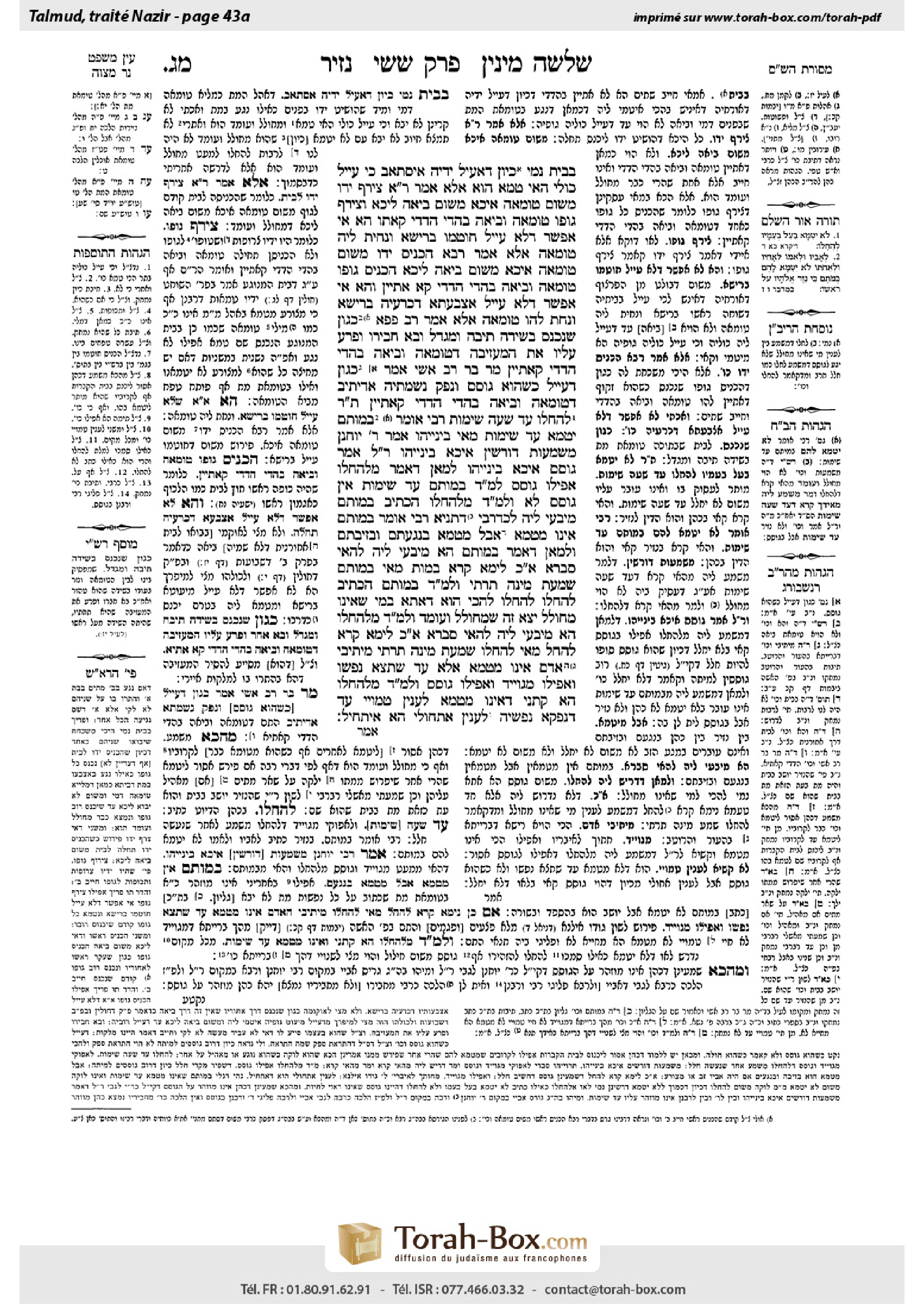
Nazir 43a: Talmud study for Daf Yomi
Daf Yomi is the daily study of one Talmud folio. Explore 37 tractates with scans, Hebrew text, Sefaria English and AI-generated French translations where annotated.
Passage selection and English or AI-generated French translation are available where the scan has annotations. Daf Study is independent of Torah-Box and Sefaria.
Browse Nazir · נזיר · All tractatesNazir 43a text and translations
This page of Nazir includes the Aramaic text, an English translation and an AI-generated French translation, alongside the scan above.
נזיר מ״ג א · Aramaic and Hebrew text
בְּבַיִת נָמֵי, כֵּיוָן דְּאַעֵיל יְדֵיהּ — אִיסְתָּאַב, כִּי עָיֵיל כּוּלֵּי, הַאי טָמֵא הוּא!
אֶלָּא אָמַר רַבִּי אֶלְעָזָר: צֵירַף יָדוֹ, מִשּׁוּם טוּמְאָה — אִיכָּא, מִשּׁוּם בִּיאָה — לֵיכָּא. וְצֵירַף גּוּפוֹ — טוּמְאָה וּבִיאָה בַּהֲדֵי הֲדָדֵי קָאָתוּ. הָא אִי אֶפְשָׁר דְּלָא עָיֵיל חוֹטְמוֹ בְּרֵישָׁא, וְנָחֵית לֵיהּ טוּמְאָה!
אֶלָּא אָמַר רָבָא: הִכְנִיס יָדוֹ, מִשּׁוּם טוּמְאָה — אִיכָּא, מִשּׁוּם בִּיאָה — לֵיכָּא. הִכְנִיס גּוּפוֹ — טוּמְאָה וּבִיאָה בַּהֲדֵי הֲדָדֵי קָא אָתְיָין. וְהָא אִי אֶפְשָׁר דְּלָא עָיֵיל אֶצְבְּעָתָא דְכַרְעֵיהּ בְּרֵישָׁא וְנָחֵת לְהוּ טוּמְאָה!
אֶלָּא אָמַר רַב פָּפָּא: כְּגוֹן שֶׁנִּכְנַס בְּשִׁידָּה תֵּיבָה וּמִגְדָּל, וּבָא חֲבֵירוֹ וּפָרַע עָלָיו אֶת הַמַּעֲזִיבָה, דְּטוּמְאָה וּבִיאָה בַּהֲדֵי הֲדָדֵי קָאָתְיָין. מָר בַּר רַב אָשֵׁי אָמַר: כְּגוֹן דְּעָיֵיל כְּשֶׁהוּא גּוֹסֵס, וּנְפַק נִשְׁמְתֵיהּ אַדְּיָתֵיב. דְּטוּמְאָה וּבִיאָה בַּהֲדֵי הֲדָדֵי קָאָתְיָין.
תָּנוּ רַבָּנַן: ״לְהֵחַלּוֹ״, עַד שָׁעָה שֶׁיָּמוּת. רַבִּי אוֹמֵר: ״בְּמוֹתָם יִטַּמָּא״, עַד שֶׁיָּמוּת.
מַאי בֵּינַיְיהוּ? אָמַר רַבִּי יוֹחָנָן: מַשְׁמָעוּת דּוֹרְשִׁין אִיכָּא בֵּינַיְיהוּ. רֵישׁ לָקִישׁ אָמַר: גּוֹסֵס אִיכָּא בֵּינַיְיהוּ. לְמַאן דְּאָמַר מִ״לְּהֵחַלּוֹ״ — אֲפִילּוּ גּוֹסֵס, לְמַאן דְּאָמַר ״בְּמוֹתָם״ — עַד שֶׁיָּמוּת אִין, גּוֹסֵס לָא.
וּלְמַאן דְּאָמַר מִ״לְּהֵחַלּוֹ״, הָכְתִיב ״בְּמוֹתָם״! מִיבְּעֵי לֵיהּ לְכִדְרַבִּי. דְּתַנְיָא, רַבִּי אוֹמֵר: בְּמוֹתָם אֵינוֹ מִטַּמֵּא, אֲבָל מִטַּמֵּא בְּנִגְעָתָם וּבְזִיבָתָם.
וּלְמַאן דְּאָמַר ״בְּמוֹתָם״, הָא מִיבְּעֵי לֵיהּ לְהַאי סְבָרָא! אִם כֵּן, לֵימָא קְרָא ״בְּמוֹת״, מַאי ״בְּמוֹתָם״ — שָׁמְעַתְּ מִינַּהּ תַּרְתֵּי.
וּלְמַאן דְּאָמַר ״בְּמוֹתָם״, הָכְתִיב ״לְהֵחַלּוֹ״! ״לְהֵחַלּוֹ״ לְהָכִי הוּא דַּאֲתָא, בְּמִי שֶׁאֵינוֹ מְחוּלָּל, יָצָא זֶה שֶׁמְּחוּלָּל וְעוֹמֵד.
וּלְמַאן דְּאָמַר מִ״לְּהֵחַלּוֹ״, הָא מִיבְּעֵי לֵיהּ לְהַאי סְבָרָא! אִם כֵּן לֵימָא קְרָא ״לְהֵחֵל״, מַאי ״לְהֵחַלּוֹ״ — שָׁמְעַתְּ מִינַּהּ תַּרְתֵּי.
מֵיתִיבִי: אָדָם אֵינוֹ מְטַמֵּא (אֶלָּא) עַד שֶׁתֵּצֵא נַפְשׁוֹ. וַאֲפִילּוּ מְגוּיָּיד וַאֲפִילּוּ גּוֹסֵס. וּלְמַאן דְּאָמַר מִ״לְּהֵחַלּוֹ״ הָא קָתָנֵי דְּאֵינוֹ מְטַמֵּא! לְעִנְיַן טַמּוֹיֵי — עַד דְּנָפְקָא נַפְשֵׁיהּ, לְעִנְיַן אִתַּחוֹלֵי — הָא אִיתַּחִיל.
Nazir 43a · English translation
The Gemara asks: With regard to one who enters into a house too, why should he be liable twice? Since one typically enters a place with his hands before his body, once he inserts his hand he immediately becomes ritually impure. This means that when all the rest of him enters, this person is already impure.
Rather, Rabbi Elazar said: If he inserted his hand into the house first, there is liability due to contracting ritual impurity; however, there is no liability due to entering the enclosure. But if he joined his body and his hands, i.e., all of him entered at once, contraction of impurity and entering the enclosure occur simultaneously, and in that case he is liable twice. The Gemara objects: It is impossible that his nose would not enter first, and once it does, impurity would descend to it and thereby to this person immediately, before the rest of his body entered the house.
Rather, Rava said: If he entered with only his hand there is liability due to contracting ritual impurity, but there is no liability due to entering an enclosure with a corpse, as he cannot be considered inside the house. If he entered with his body by standing upright so that his head would not enter first, contraction of impurity and entering the enclosure occur simultaneously. The Gemara asks: But even so, it is impossible that his toes would not enter first, and once they do, impurity would thereby descend to them, causing him to become impure before his entire body enters the house.
Rather, Rav Pappa said: We are dealing with a case where one entered into a house in a chest, a box, or a cabinet, which are not susceptible to ritual impurity and which protect their contents from impurity when they can hold more than forty se’a, and another came and opened the cover of the vessel from over him. In that case contracting impurity and entering the enclosure occur simultaneously. Mar bar Rav Ashi said: It is referring to a case where one entered the house when someone there was dying, and the latter’s soul departed when he was sitting there. In that case too, contracting impurity and entering the enclosure with a corpse occur simultaneously. Since there was no corpse in the enclosure when he entered, he is considered to have entered an enclosure with a corpse at the moment the person died.
§ With regard to the ritual impurity of a corpse, the Sages taught: The Torah states concerning a priest’s exposure to ritual impurity imparted by a corpse: “He shall not become impure, a chief among his people, to profane himself” (Leviticus 21:4), from which it is derived that the prohibition does not apply until the time that the person with whom he comes into contact dies. A priest does not become impure or profane his priesthood at any earlier stage. Rabbi Yehuda HaNasi says that the verse stated with regard to a nazirite: “He shall not become impure for his father, or for his mother, for his brother, or for his sister, when they die” (Numbers 6:7), from which one can infer that when they die, one contracts ritual impurity from them, i.e., not until the other person actually dies.
The Gemara asks: What is the difference between these two derivations? They apparently state the same halakha from different verses. Rabbi Yoḥanan says: The interpretation of the meaning of the verse is the difference between them. There is no practical difference between them; rather, they derive the halakha from different verses. Reish Lakish said: The difference between them is with regard to a dying person: According to the one who says that one derives the halakha from “He shall not become impure, a chief among his people, to profane himself,” even a dying person is included in the prohibition of impurity. According to the one who says that it is derived from “when they die,” once he dies, yes there is impurity, whereas a dying person, no, he does not impart impurity.
The Gemara asks with regard to Reish Lakish’s opinion: And according to the one who says that it is derived from “to profane himself,” isn’t it written: “When they die”? What does he derive from that verse? The Gemara answers: He requires that verse for that which was taught by Rabbi Yehuda HaNasi. As it is taught in a baraita that Rabbi Yehuda HaNasi says that the verse stresses “when they die,” to teach: In a case when they die he may not become impure; however, he may become impure from their leprosy or from their gonorrhea-like discharge. A nazirite is prohibited from contracting ritual impurity only if it is from a corpse.
The Gemara asks: And according to the one who says that the earliest time the prohibition takes effect is derived from the phrase “when they die,” he also requires that verse for this reason; how does he derive two halakhot from the same verse? The Gemara answers: If so, let the verse state: When he dies; what is the reason for the emphasis of “when they die”? You can learn from this verse two halakhot, that one does not impart impurity until he is actually dead, and that a nazirite is prohibited from contracting only the impurity of a corpse.
The Gemara asks the reverse question: And according to the one who says that the source for the earliest time of the impurity of a corpse is the verse “when they die,” isn’t it written: “To profane himself”? What does he derive from that verse? The Gemara answers: “To profane himself” comes for this purpose, that the prohibition against becoming impure apply only to one who is not profaned, excluding one who is already profaned. There is no prohibition against a ritually impure priest becoming impure from a corpse.
The Gemara asks: And according to the one who says that the source for the commencement of impurity imparted by a corpse is “to profane himself,” he also requires that verse for this reason; how does he derive two halakhot from the same verse? The Gemara answers: If so, let the verse state: To profane; what is the reason for the emphasis of “to profane himself”? You can learn from this verse two halakhot, that a nazirite is prohibited from becoming impure even through contact with a dying person, and that there is no prohibition against contracting impurity a second time for one who is already impure.
The Gemara raises an objection from a mishna (Oholot 1:6): A person renders others impure only when his soul departs from him, even if he has severe lacerations [meguyyad], and even if he is dying. But according to the one who says that the commencement of the impurity of a corpse is derived from “to profane himself,” this baraita is difficult, as it teaches that a dying person does not impart impurity. The Gemara answers: With regard to imparting impurity, he does not impart impurity until his soul departs, but with regard to profaning the sanctity of the priesthood, a priest is profaned by a dying person.
Nazir 43a · Traduction française (IA)
La Guemara demande : Pourquoi celui qui entre aussi dans une maison serait-il passible deux fois ? Puisqu’on entre généralement dans un lieu les mains avant le corps, dès qu’il y introduit la main, il devient immédiatement impur. Ainsi, lorsque le reste de son corps entre, il est déjà impur.
Rabbi Elazar a plutôt dit : S’il a introduit sa main dans la maison en premier, il est passible pour avoir contracté l’impureté rituelle, mais il n’est pas passible pour être entré dans l’enceinte. En revanche, s’il a fait entrer ensemble son corps et ses mains, c’est-à-dire que tout son corps est entré d’un seul coup, la contraction de l’impureté et l’entrée dans l’enceinte ont lieu simultanément ; dans ce cas, il est passible deux fois. La Guemara objecte : Il est impossible que son nez ne soit pas entré en premier ; dès qu’il entre, l’impureté l’atteint et se transmet aussitôt à cet homme, avant que le reste de son corps ne soit entré dans la maison.
Rava a plutôt dit : S’il est entré avec sa seule main, il est passible pour avoir contracté l’impureté rituelle, mais il n’est pas passible pour être entré dans une enceinte où se trouve un cadavre, car on ne peut pas considérer qu’il se trouve à l’intérieur de la maison. S’il est entré avec son corps en se tenant droit, de sorte que sa tête ne soit pas entrée en premier, la contraction de l’impureté et l’entrée dans l’enceinte ont lieu simultanément. La Guemara demande : Mais même ainsi, il est impossible que ses orteils ne soient pas entrés en premier ; dès qu’ils entrent, l’impureté les atteint et le rend impur avant que tout son corps ne soit entré dans la maison.
Rav Pappa a plutôt dit : Il s’agit d’un cas où quelqu’un est entré dans une maison dans un coffre, une caisse ou une armoire, des récipients qui ne sont pas susceptibles de contracter l’impureté rituelle et protègent leur contenu de l’impureté lorsqu’ils peuvent contenir plus de quarante séa, puis où quelqu’un d’autre est venu et a soulevé le couvercle du récipient au-dessus de lui. Dans ce cas, la contraction de l’impureté et l’entrée dans l’enceinte ont lieu simultanément. Mar bar Rav Ashi a dit : Il s’agit d’un cas où quelqu’un est entré dans la maison alors qu’une personne qui s’y trouvait était mourante, et où l’âme de cette dernière l’a quittée tandis qu’il était assis là. Dans ce cas aussi, la contraction de l’impureté et l’entrée dans l’enceinte avec un cadavre ont lieu simultanément. Puisqu’il n’y avait pas de cadavre dans l’enceinte au moment de son entrée, on considère qu’il est entré dans une enceinte avec un cadavre au moment où la personne est morte.
§ À propos de l’impureté rituelle liée à un cadavre, les Sages ont enseigné : Au sujet de l’exposition d’un prêtre à l’impureté rituelle transmise par un cadavre, la Torah dit : « Il ne se rendra pas impur, étant un chef parmi son peuple, pour se profaner » (Lévitique 21:4). On en déduit que l’interdiction ne s’applique qu’au moment où la personne avec laquelle il entre en contact meurt. Un prêtre ne devient pas impur et ne profane pas son sacerdoce avant ce moment. Rabbi Yehouda HaNassi dit que le verset concernant un nazir dit : « Il ne se rendra pas impur pour son père, pour sa mère, pour son frère ou pour sa sœur, lorsqu’ils mourront » (Nombres 6:7). On peut en déduire que c’est lorsqu’ils meurent qu’on contracte l’impureté auprès d’eux, c’est-à-dire pas avant que l’autre personne ne soit effectivement morte.
La Guemara demande : Quelle différence y a-t-il entre ces deux déductions ? Elles énoncent apparemment la même halakha à partir de versets différents. Rabbi Yoḥanan dit : La différence entre elles tient à l’interprétation du sens du verset. Il n’y a entre elles aucune différence pratique ; elles tirent simplement la halakha de versets différents. Reish Lakish dit : La différence entre elles concerne une personne mourante. Selon celui qui dit que la halakha se déduit de « Il ne se rendra pas impur, étant un chef parmi son peuple, pour se profaner », même une personne mourante est incluse dans l’interdiction de l’impureté. Selon celui qui dit que cela se déduit de « lorsqu’ils mourront », une fois la personne morte, oui, elle transmet l’impureté ; mais tant qu’elle est mourante, non, elle ne transmet pas l’impureté.
La Guemara demande au sujet de l’opinion de Reish Lakish : Et selon celui qui dit que cela se déduit de « pour se profaner », n’est-il pas écrit : « Lorsqu’ils mourront » ? Que déduit-il de ce verset ? La Guemara répond : Il a besoin de ce verset pour la leçon enseignée par Rabbi Yehouda HaNassi. En effet, il est enseigné dans une baraïta que Rabbi Yehouda HaNassi dit que le verset insiste sur « lorsqu’ils mourront » pour enseigner que, lorsqu’ils meurent, il ne peut pas se rendre impur ; en revanche, il peut se rendre impur à cause de leur lèpre ou de leur écoulement semblable à la gonorrhée. Un nazir n’est interdit de contracter l’impureté rituelle que si celle-ci provient d’un cadavre.
La Guemara demande : Et selon celui qui dit que le moment le plus précoce où l’interdiction prend effet se déduit de l’expression « lorsqu’ils mourront », lui aussi a besoin de ce verset pour cette raison ; comment peut-il déduire deux halakhot du même verset ? La Guemara répond : Dans ce cas, que le verset dise : « Lorsqu’il mourra ». Pourquoi insiste-t-il en disant « lorsqu’ils mourront » ? On peut déduire de ce verset deux halakhot : il ne transmet pas l’impureté tant qu’il n’est pas effectivement mort, et un nazir n’est interdit de contracter que l’impureté d’un cadavre.
La Guemara pose la question inverse : Et selon celui qui dit que la source du moment où commence l’impureté transmise par un cadavre est le verset « lorsqu’ils mourront », n’est-il pas écrit : « Pour se profaner » ? Que déduit-il de ce verset ? La Guemara répond : « Pour se profaner » vient enseigner que l’interdiction de se rendre impur ne s’applique qu’à celui qui n’est pas déjà profané, à l’exclusion de celui qui l’est déjà. Il n’est pas interdit à un prêtre rituellement impur de se rendre impur au contact d’un cadavre.
La Guemara demande : Et selon celui qui dit que la source du commencement de l’impureté transmise par un cadavre est « pour se profaner », lui aussi a besoin de ce verset pour cette raison ; comment peut-il déduire deux halakhot du même verset ? La Guemara répond : Dans ce cas, que le verset dise : « Pour profaner ». Pourquoi insiste-t-il en disant « pour se profaner » ? On peut déduire de ce verset deux halakhot : un nazir est interdit de se rendre impur même au contact d’une personne mourante, et il n’est pas interdit à celui qui est déjà impur de contracter une nouvelle fois l’impureté.
La Guemara soulève une objection à partir d’une Michna (Oholot 1:6) : Une personne ne rend les autres impures que lorsque son âme la quitte, même si elle présente de graves lacérations [meguyyad], et même si elle est mourante. Mais selon celui qui dit que le commencement de l’impureté d’un cadavre se déduit de « pour se profaner », cette Michna pose problème, puisqu’elle enseigne qu’une personne mourante ne transmet pas l’impureté. La Guemara répond : S’agissant de transmettre l’impureté, elle ne la transmet que lorsque son âme la quitte ; mais s’agissant de profaner la sainteté du sacerdoce, un prêtre est profané par une personne mourante.
Traduction française générée par IA à partir de l’édition anglaise de Sefaria. Vérifie toujours un passage avec le texte source.
Text from Sefaria: William Davidson Edition - Vocalized Aramaic (CC BY NC); William Davidson Edition - English (CC BY NC).