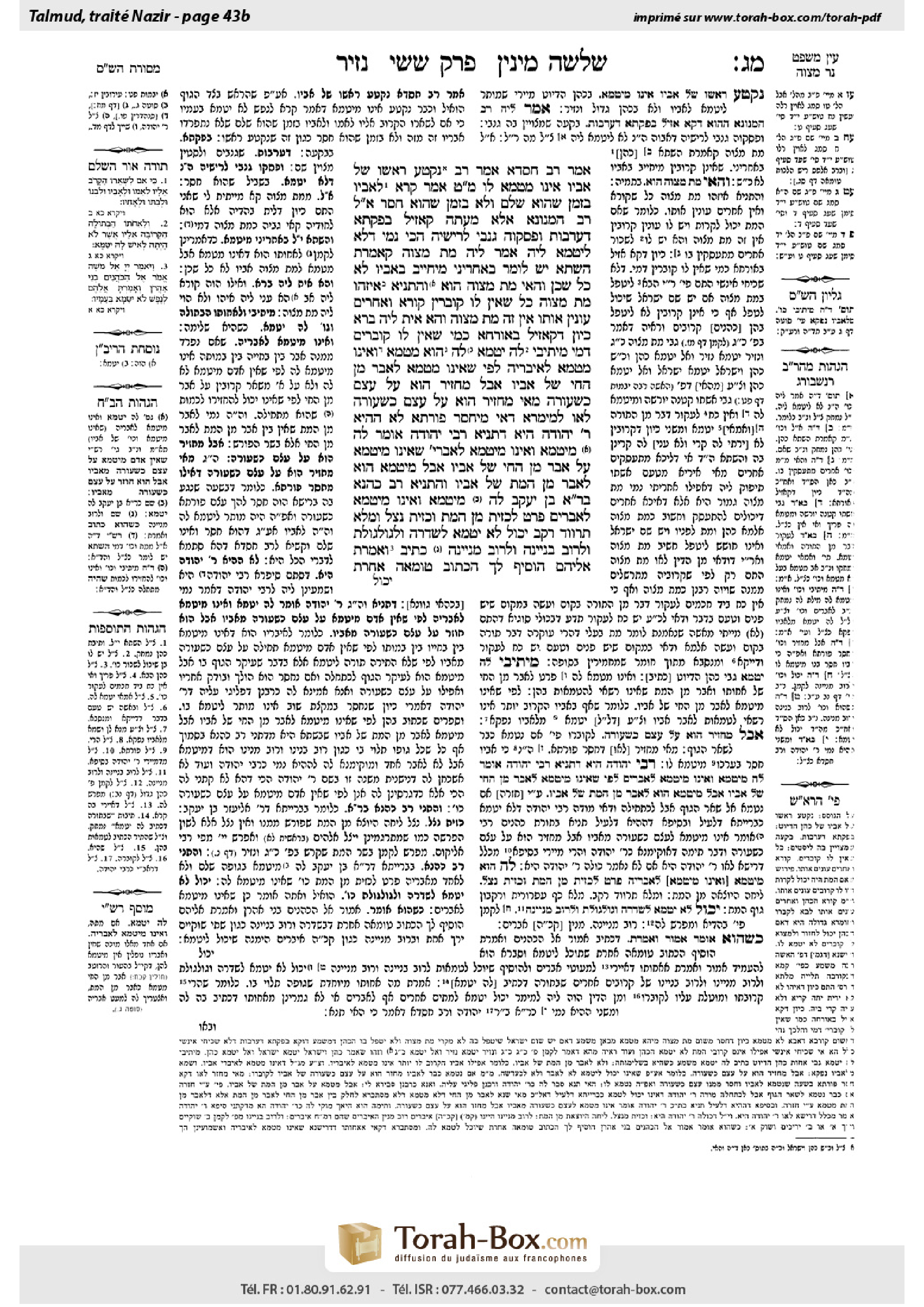
Nazir 43b: Talmud study for Daf Yomi
Daf Yomi is the daily study of one Talmud folio. Explore 37 tractates with scans, Hebrew text, Sefaria English and AI-generated French translations where annotated.
Passage selection and English or AI-generated French translation are available where the scan has annotations. Daf Study is independent of Torah-Box and Sefaria.
Browse Nazir · נזיר · All tractatesNazir 43b text and translations
This page of Nazir includes the Aramaic text, an English translation and an AI-generated French translation, alongside the scan above.
נזיר מ״ג ב · Aramaic and Hebrew text
אָמַר רַב חִסְדָּא אָמַר רַב: נִקְטַע רֹאשׁוֹ שֶׁל אָבִיו — אֵינוֹ מִטַּמֵּא לוֹ. מַאי טַעְמָא — אָמַר קְרָא: ״לְאָבִיו״, בִּזְמַן שֶׁהוּא שָׁלֵם, וְלֹא בִּזְמַן שֶׁהוּא חָסֵר. אֲמַר לֵיהּ רַב הַמְנוּנָא: אֶלָּא מֵעַתָּה, קָאָזֵיל בְּפַקְתָּא דַּעֲרָבוֹת, וּפַסְקוּהּ גַּנָּבֵי לְרֵישֵׁיהּ, הָכִי נָמֵי דְּלָא לִיטַמֵּא לֵיהּ?
אֲמַר לֵיהּ: מֵת מִצְוָה קָאָמְרַתְּ? הַשְׁתָּא יֵשׁ לוֹמַר: בְּאַחְרִינֵי מִיחַיַּיב, בְּאָבִיו לֹא כׇּל שֶׁכֵּן?
וְהַאי מֵת מִצְוָה הוּא? וְהָתַנְיָא: אֵיזֶהוּ מֵת מִצְוָה — כֹּל שֶׁאֵין לוֹ קוֹבְרִין. קוֹרֵא וַאֲחֵרִים עוֹנִין אוֹתוֹ — אֵין זֶה מֵת מִצְוָה. וְהָא אִית לֵיהּ בְּרָא! כֵּיוָן דְּקָאָזֵיל בְּאוֹרְחָא — כְּמִי שֶׁאֵין לוֹ קוֹבְרִים דָּמֵי.
מֵיתִיבִי: ״לָהּ יִטַּמָּא״, לָהּ הוּא מִטַּמֵּא, וְאֵינוֹ מִטַּמֵּא לְאֵיבָרֶיהָ. לְפִי שֶׁאֵינוֹ מִטַּמֵּא לְאֵבֶר מִן הַחַי שֶׁל אָבִיו. אֲבָל מְחַזֵּיר הוּא עַל עֶצֶם כִּשְׂעוֹרָה.
מַאי ״מְחַזֵּיר הוּא עַל עֶצֶם כִּשְׂעוֹרָה״? לָאו לְמֵימְרָא דְּאִי מִיחַסַּר פּוּרְתָּא?
לָא, הָהִיא רַבִּי יְהוּדָה הִיא. דְּתַנְיָא, רַבִּי יְהוּדָה אוֹמֵר: לָהּ מִיטַּמֵּא, וְאֵינוֹ מִיטַּמֵּא לְאֵבָרֶיהָ. שֶׁאֵינוֹ מִיטַּמֵּא עַל אֵבֶר מִן הַחַי שֶׁל אָבִיו, אֲבָל מִיטַּמֵּא הוּא לְאֵבֶר מִן הַמֵּת שֶׁל אָבִיו.
וְהָתַנְיָא, רַב כָּהֲנָא בְּרַבִּי אֱלִיעֶזֶר בֶּן יַעֲקֹב: לָהּ מִיטַּמֵּא, וְאֵינוֹ מִיטַּמֵּא לְאֵבָרִים. פְּרָט לִכְזַיִת מִן הַמֵּת, וּכְזַיִת נֶצֶל, וּמְלֹא תַרְווֹד רָקָב.
יָכוֹל לֹא יִטַּמֵּא לַשִּׁדְרָה וְלַגּוּלְגּוֹלֶת וּלְרוֹב בִּנְיָינָהּ וּלְרוֹב מִנְיָינָהּ — כְּתִיב: ״וְאָמַרְתָּ אֲלֵיהֶם״, הוֹסִיף לְךָ הַכָּתוּב טוּמְאָה אַחֶרֶת.
Nazir 43b · English translation
§ Rav Ḥisda said that Rav said: If the head of his father, or any other relative for whom a priest becomes impure, was severed, he may not become impure to bury him. What is the reason for this? The verse states: “None shall become impure for the dead among his people, except…for his father” (Leviticus 21:1–2), which indicates that this applies when his father is whole, and not when he is lacking. Rav Hamnuna said to Rav Ḥisda: If that is so, then in a case where one was walking in the valley [pakta] of Aravot, a place frequented by bandits, and robbers severed his head, will you also say that his son the priest does not become impure to bury him because he is not whole?
Rav Ḥisda said to him: Do you speak of a corpse with no one to bury it [met mitzva]? This halakha certainly does not apply to a case of this kind. For now consider, if one can say that to bury others, i.e., non-relatives, he is obligated to become ritually impure, as even priests and nazirites must become impure to bury an unattended corpse, then with regard to a met mitzva who is his father is it not all the more so the case that he must become impure to bury him even if his head is severed?
The Gemara asks: And is this a met mitzva? But isn’t it taught in a baraita: Which is a met mitzva for whom a priest must become impure? It is anyone who does not have people to bury him apart from this priest. If the corpse is in a place where if he would call, others would answer him, that is not considered a met mitzva. And if this dead father has a son who was with him, it means the father is not classified as a met mitzva, and therefore his son the priest must ensure that others tend to his burial, without doing so himself. The Gemara answers: Since he was walking along the way, he is considered like one who does not have people to bury him.
The Gemara raises an objection against Rav Ḥisda’s opinion. The superfluous term “for her” in the verse “And for his sister a virgin who is near to him, who has no husband, for her he becomes impure” (Leviticus 21:3) teaches that it is to bury her in her whole state that he becomes impure, but he does not become impure to bury her limbs. If a limb was severed from her during her lifetime he does not tend to it, because he may not become impure to bury a limb severed from one of his living relatives, including that of his father. However, he may search for a bone that is a barley-grain-bulk. If he was already impure from his father’s body, he may search for and bury a bone that was detached from the corpse, even if it is large enough to impart impurity itself.
The Gemara asks: What is the meaning of: He may search for a bone that is a barley-grain-bulk? Isn’t this to say that if the deceased father is lacking a small part, i.e., a single bone, his son the priest becomes impure to bury him? This would contradict Rav Ḥisda’s statement in the name of Rav that he becomes impure to bury his father only if he is whole.
The Gemara answers: No, this presents no difficulty, as that baraita is in accordance with the opinion of Rabbi Yehuda. As it is taught in a baraita that Rabbi Yehuda says: “For her he becomes impure” (Leviticus 21:3), this indicates that to bury her he becomes impure but he does not become impure to bury her limbs, as he does not become impure to bury a limb severed from one of his living relatives, including that of his father. However, he does become impure to bury a limb from his dead father. Rav Ḥisda disagrees with the opinion of Rabbi Yehuda and rules in accordance with the Rabbis, who maintain that a priest may become impure only to bury his relative’s whole body.
The Gemara asks: But isn’t it taught in a baraita that Rav Kahana, son of Rabbi Eliezer ben Ya’akov, said: The words “for her he becomes impure” (Leviticus 21:3) indicate that to bury her he becomes impure when she is whole, but he does not become impure to bury her limbs. This serves to exclude an olive-bulk of solid material from a corpse, and an olive-bulk of fluid from a corpse, and a full spade of dust from a corpse.
One might have thought that he may not become impure for a spine and a skull, or for most of the skeleton or most of the number of bones from his sister’s corpse. Therefore, it is written at the beginning of this passage dealing with the impurity of priests: “Speak to the priests, the sons of Aaron, and say to them” (Leviticus 21:1). The repetition of “speak” and “say” indicates that the verse added a different form of impurity permitted to a priest.
Nazir 43b · Traduction française (IA)
§ Rav Ḥisda a dit au nom de Rav : Si la tête de son père, ou celle de tout autre proche pour lequel un prêtre devient impur, a été tranchée, il ne peut pas devenir impur pour l’enterrer. Pourquoi ? Le verset dit : « Nul ne se rendra impur pour un mort parmi les siens, sauf… pour son père » (Lévitique 21:1-2), ce qui indique qu’il le peut lorsque son père est entier, mais pas lorsqu’il lui manque une partie. Rav Hamnuna dit à Rav Ḥisda : Si tel est le cas, lorsque quelqu’un marchait dans la vallée [pakta] d’Aravot, un lieu fréquenté par des brigands, et que des bandits lui ont tranché la tête, diras-tu aussi que son fils prêtre ne devient pas impur pour l’enterrer parce qu’il n’est pas entier ?
Rav Ḥisda lui dit : Parles-tu d’un mort sans personne pour l’enterrer [met mitsva] ? Cette halakha ne s’applique certainement pas dans un tel cas. En effet, si l’on peut dire qu’il est tenu de devenir impur pour enterrer d’autres personnes, c’est-à-dire des personnes qui ne sont pas ses proches — puisque même les prêtres et les naziréens doivent devenir impurs pour enterrer un mort sans personne pour s’en charger —, à plus forte raison doit-il devenir impur pour enterrer son père, qui est un met mitsva, même si sa tête a été tranchée !
La Guemara demande : Mais s’agit-il d’un met mitsva ? N’est-il pas enseigné dans une baraïta : Quel est le cas d’un met mitsva pour lequel un prêtre doit devenir impur ? C’est toute personne qui n’a personne pour l’enterrer, hormis ce prêtre. Si le cadavre se trouve en un lieu où, s’il appelait, d’autres lui répondraient, il n’est pas considéré comme un met mitsva. Or, si ce père décédé avait un fils auprès de lui, cela signifie qu’il n’est pas considéré comme un met mitsva ; son fils prêtre doit donc veiller à ce que d’autres s’occupent de son enterrement, sans le faire lui-même. La Guemara répond : Puisqu’il marchait en chemin, il est considéré comme quelqu’un qui n’a personne pour l’enterrer.
La Guemara soulève une objection contre l’opinion de Rav Ḥisda. Le terme superflu « pour elle » dans le verset « Et pour sa sœur, une vierge qui lui est proche et qui n’a pas de mari, pour elle il devient impur » (Lévitique 21:3) enseigne qu’il devient impur pour l’enterrer lorsqu’elle est entière, mais qu’il ne devient pas impur pour enterrer ses membres. Si un membre lui a été arraché de son vivant, il ne s’en occupe pas, car il ne peut pas devenir impur pour enterrer un membre arraché à l’un de ses proches vivants, y compris à son père. Cependant, il peut rechercher un os d’un volume équivalant à celui d’un grain d’orge. S’il était déjà impur du fait du corps de son père, il peut rechercher et enterrer un os détaché du cadavre, même si celui-ci est assez gros pour transmettre lui-même l’impureté.
La Guemara demande : Que signifie : « Il peut rechercher un os d’un volume équivalant à celui d’un grain d’orge » ? Cela ne signifie-t-il pas que si une petite partie manque au père décédé, c’est-à-dire un seul os, son fils prêtre devient impur pour l’enterrer ? Cela contredirait la déclaration de Rav Ḥisda au nom de Rav, selon laquelle il ne devient impur pour enterrer son père que si celui-ci est entier.
La Guemara répond : Non, il n’y a pas de difficulté, car cette baraïta suit l’opinion de Rabbi Yehuda. En effet, il est enseigné dans une baraïta que Rabbi Yehuda dit : Les mots « pour elle il devient impur » (Lévitique 21:3) indiquent qu’il devient impur pour l’enterrer, mais qu’il ne devient pas impur pour enterrer ses membres, car il ne devient pas impur pour enterrer un membre arraché à l’un de ses proches vivants, y compris à son père. Cependant, il devient impur pour enterrer un membre de son père décédé. Rav Ḥisda est en désaccord avec Rabbi Yehuda et statue conformément aux Rabbins, qui soutiennent qu’un prêtre ne peut devenir impur que pour enterrer le corps entier de son proche.
La Guemara demande : Mais n’est-il pas enseigné dans une baraïta que Rav Kahana, fils de Rabbi Eliezer ben Ya’akov, a dit : Les mots « pour elle il devient impur » (Lévitique 21:3) indiquent qu’il devient impur pour l’enterrer lorsqu’elle est entière, mais qu’il ne devient pas impur pour enterrer ses membres. Cela exclut un volume d’olive de matière solide provenant d’un cadavre, un volume d’olive de liquide provenant d’un cadavre, ainsi qu’une pelle pleine de poussière provenant d’un cadavre.
On aurait pu penser qu’il ne peut pas devenir impur à cause d’une colonne vertébrale et d’un crâne, ni à cause de la majeure partie du squelette ou de la majorité du nombre des os du cadavre de sa sœur. C’est pourquoi il est écrit au début de ce passage sur l’impureté des prêtres : « Parle aux prêtres, fils d’Aaron, et dis-leur » (Lévitique 21:1). La répétition de « parle » et de « dis » indique que le verset ajoute une autre forme d’impureté à laquelle un prêtre peut s’exposer.
Traduction française générée par IA à partir de l’édition anglaise de Sefaria. Vérifie toujours un passage avec le texte source.
Text from Sefaria: William Davidson Edition - Vocalized Aramaic (CC BY NC); William Davidson Edition - English (CC BY NC).