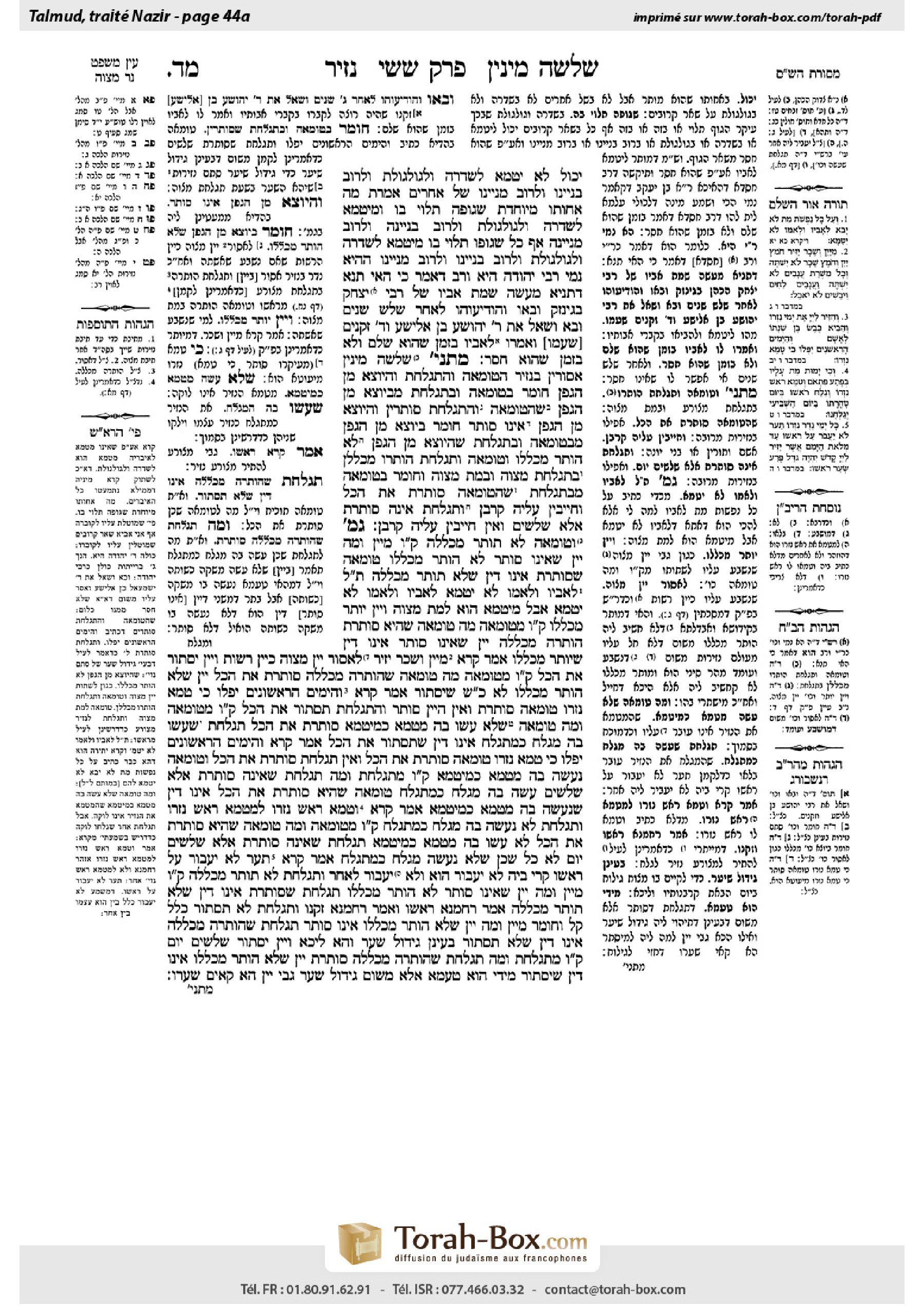
Nazir 44a: Talmud study for Daf Yomi
Daf Yomi is the daily study of one Talmud folio. Explore 37 tractates with scans, Hebrew text, Sefaria English and AI-generated French translations where annotated.
Passage selection and English or AI-generated French translation are available where the scan has annotations. Daf Study is independent of Torah-Box and Sefaria.
Browse Nazir · נזיר · All tractatesNazir 44a text and translations
This page of Nazir includes the Aramaic text, an English translation and an AI-generated French translation, alongside the scan above.
נזיר מ״ד א · Aramaic and Hebrew text
יָכוֹל לֹא יִטַּמֵּא לַשִּׁדְרָה וְלַגּוּלְגּוֹלֶת וּלְרוֹב בִּנְיָינוֹ וּלְרוֹב מִנְיָינוֹ שֶׁל אֲחֵרִים. אָמַרְתָּ: מָה אֲחוֹתוֹ מְיוּחֶדֶת שֶׁגּוּפָה תָּלוּי בּוֹ, וּמִיטַּמֵּא לַשִּׁדְרָה וְלַגּוּלְגּוֹלֶת וּלְרוֹב בִּנְיָינָהּ וּלְרוֹב מִנְיָינָהּ, אַף כֹּל שֶׁגּוּפוֹ תָּלוּי בּוֹ — מִיטַּמֵּא לַשִּׁדְרָה וְלַגּוּלְגּוֹלֶת וּלְרוֹב בִּנְיָינוֹ וּלְרוֹב מִנְיָינוֹ.
הָהִיא נָמֵי רַבִּי יְהוּדָה הִיא. וְרַב דְּאָמַר כִּי הַאי תַּנָּא דְּתַנְיָא: מַעֲשֶׂה שֶׁמֵּת אָבִיו שֶׁל רַבִּי יִצְחָק בְּגִינְזַק, וּבָאוּ וְהוֹדִיעוּהוּ לְאַחַר שָׁלֹשׁ שָׁנִים, וּבָא וְשָׁאַל אֶת רַבִּי יְהוֹשֻׁעַ בֶּן אֱלִישָׁע וְאַרְבָּעָה זְקֵנִים [שֶׁעִמּוֹ],
וְאָמְרוּ: ״לְאָבִיו״ — בִּזְמַן שֶׁהוּא שָׁלֵם, וְלֹא בִּזְמַן שֶׁהוּא חָסֵר.
מַתְנִי׳ שְׁלֹשָׁה מִינִין אֲסוּרִין בַּנָּזִיר: הַטּוּמְאָה, וְהַתִּגְלַחַת, וְהַיּוֹצֵא מִן הַגֶּפֶן. חוֹמֶר בַּטּוּמְאָה וּבַתִּגְלַחַת מִבַּיּוֹצֵא מִן הַגֶּפֶן, שֶׁהַטּוּמְאָה וְהַתִּגְלַחַת — סוֹתְרִין, וְהַיּוֹצֵא מִן הַגֶּפֶן — אֵינוֹ סוֹתֵר.
חוֹמֶר בַּיּוֹצֵא מִן הַגֶּפֶן מִבַּטּוּמְאָה וּבַתִּגְלַחַת, שֶׁהַיּוֹצֵא מִן הַגֶּפֶן לֹא הוּתַּר מִכְּלָלוֹ, וְטוּמְאָה וְתִגְלַחַת הוּתְּרוּ מִכְּלָלָן בְּתִגְלַחַת מִצְוָה וּבְמֵת מִצְוָה.
וְחוֹמֶר בַּטּוּמְאָה מִבַּתִּגְלַחַת, שֶׁהַטּוּמְאָה סוֹתֶרֶת אֶת הַכֹּל, וְחַיָּיבִין עָלֶיהָ קׇרְבָּן. וְתִגְלַחַת אֵינָהּ סוֹתֶרֶת אֶלָּא שְׁלֹשִׁים, וְאֵין חַיָּיבִין עָלֶיהָ קׇרְבָּן.
גְּמָ׳ וְטוּמְאָה לֹא תּוּתַּר מִכְּלָלָהּ, קַל וָחוֹמֶר מִיַּיִן: וּמָה יַיִן שֶׁאֵינוֹ סוֹתֵר לֹא הוּתַּר מִכְּלָלוֹ, טוּמְאָה שֶׁסּוֹתֶרֶת — אֵינוֹ דִּין שֶׁלֹּא תּוּתַּר מִכְּלָלָהּ?
תַּלְמוּד לוֹמַר: ״לְאָבִיו וּלְאִמּוֹ לֹא יִטַּמָּא״. לְאָבִיו וּלְאִמּוֹ לֹא יִטַּמָּא, אֲבָל מִיטַּמֵּא הוּא לְמֵת מִצְוָה.
וְיַיִן יוּתַּר מִכְּלָלוֹ, קַל וָחוֹמֶר מִטּוּמְאָה: מַה טוּמְאָה שֶׁהִיא סוֹתֶרֶת — הוּתְּרָה מִכְּלָלָהּ, יַיִן שֶׁאֵינוֹ סוֹתֵר — אֵינוֹ דִּין שֶׁיּוּתַּר מִכְּלָלוֹ? אָמַר קְרָא: ״מִיַּיִן וְשֵׁכָר יַזִּיר״, לֶאֱסוֹר יֵין מִצְוָה כְּיֵין רְשׁוּת.
וְיַיִן יִסְתּוֹר אֶת הַכֹּל, קַל וָחוֹמֶר מִטּוּמְאָה: מָה טוּמְאָה שֶׁהוּתְּרָה מִכְּלָלָהּ — סוֹתֶרֶת אֶת הַכֹּל, יַיִן שֶׁלֹּא הוּתַּר מִכְּלָלוֹ — לֹא כׇּל שֶׁכֵּן שֶׁיִּסְתּוֹר?
אָמַר קְרָא: ״וְהַיָּמִים הָרִאשׁוֹנִים יִפְּלוּ כִּי טָמֵא נִזְרוֹ״, טוּמְאָה סוֹתֶרֶת וְאֵין הַיַּיִן סוֹתֵר.
וְהַתִּגְלַחַת תִּסְתּוֹר אֶת הַכֹּל, קַל וָחוֹמֶר מִטּוּמְאָה: וּמָה טוּמְאָה שֶׁלֹּא עָשׂוּ בָּהּ מְטַמֵּא כַּמִּיטַּמֵּא — סוֹתֶרֶת אֶת הַכֹּל, תִּגְלַחַת, שֶׁעָשׂוּ בָּהּ מְגַלֵּחַ כַּמִּתְגַּלֵּחַ — אֵינוֹ דִּין שֶׁתִּסְתּוֹר אֶת הַכֹּל?
אָמַר קְרָא: ״וְהַיָּמִים הָרִאשׁוֹנִים יִפְּלוּ כִּי טָמֵא נִזְרוֹ״, טוּמְאָה סוֹתֶרֶת אֶת הַכֹּל, וְאֵין תִּגְלַחַת סוֹתֶרֶת אֶת הַכֹּל.
וְטוּמְאָה נַעֲשֶׂה בָּהּ מְטַמֵּא כַּמִּיטַּמֵּא, קַל וָחוֹמֶר מִתִּגְלַחַת: וּמָה תִּגְלַחַת שֶׁאֵינָהּ סוֹתֶרֶת אֶלָּא שְׁלֹשִׁים — עָשָׂה בָּהּ מְגַלֵּחַ כַּמִּתְגַּלֵּחַ, טוּמְאָה, שֶׁהִיא סוֹתֶרֶת אֶת הַכֹּל — אֵינוֹ דִּין שֶׁנַּעֲשֶׂה בָּהּ מְטַמֵּא כַּמִּיטַּמֵּא?
אָמַר קְרָא: ״וְטִמֵּא רֹאשׁ נִזְרוֹ״, לִמְטַמֵּא רֹאשׁ נִזְרוֹ.
וְתִגְלַחַת לֹא נַעֲשֶׂה בָּהּ מְגַלֵּחַ כַּמִּתְגַּלֵּחַ, קַל וָחוֹמֶר מִטּוּמְאָה: וּמָה טוּמְאָה, שֶׁהִיא סוֹתֶרֶת אֶת הַכֹּל — לֹא עָשׂוּ בָּהּ מְטַמֵּא כַּמִּיטַּמֵּא, תִּגְלַחַת, שֶׁאֵינָהּ סוֹתֶרֶת אֶלָּא שְׁלֹשִׁים יוֹם — לֹא כׇּל שֶׁכֵּן שֶׁלֹּא נַעֲשֶׂה מְגַלֵּחַ כַּמִּתְגַּלֵּחַ?
אָמַר קְרָא: ״תַּעַר לֹא יַעֲבוֹר עַל רֹאשׁוֹ״, קְרִי בֵּיהּ: לֹא יַעֲבוֹר הוּא, וְלֹא יַעֲבוֹר לְאַחֵר.
וְתִגְלַחַת לֹא תּוּתַּר מִכְּלָלָהּ, קַל וָחוֹמֶר מִיַּיִן: וּמָה יַיִן שֶׁאֵינוֹ סוֹתֵר — לֹא הוּתַּר מִכְּלָלוֹ, תִּגְלַחַת שֶׁסּוֹתֶרֶת — אֵינוֹ דִּין שֶׁלֹּא תּוּתַּר מִכְּלָלָהּ? אָמַר רַחֲמָנָא: ״רֹאשׁוֹ״, וְאָמַר רַחֲמָנָא: ״זְקָנוֹ״.
וְתִגְלַחַת לֹא תִּסְתּוֹר כְּלָל, קַל וָחוֹמֶר מִיַּיִן: וּמָה יַיִן שֶׁלֹּא הוּתַּר מִכְּלָלוֹ — אֵינוֹ סוֹתֵר, תִּגְלַחַת שֶׁהוּתְּרָה מִכְּלָלָהּ — אֵינוֹ דִּין שֶׁלֹּא תִּסְתּוֹר? בָּעִינַן גִּידּוּל שֵׂעָר, וְהָא לֵיכָּא.
וְיַיִן יִסְתּוֹר שְׁלֹשִׁים יוֹם, קַל וָחוֹמֶר מִתִּגְלַחַת: וּמָה תִּגְלַחַת שֶׁהוּתְּרָה מִכְּלָלָהּ — סוֹתֶרֶת, יַיִן, שֶׁלֹּא הוּתַּר מִכְּלָלוֹ — אֵינוֹ דִּין שֶׁיִּסְתּוֹר? מִידֵּי הוּא טַעְמָא אֶלָּא מִשּׁוּם גִּידּוּל שֵׂעָר, גַּבֵּי יַיִן הָא קָאֵים שְׂעָרוֹ.
Nazir 44a · English translation
One might have thought that he may not become impure to bury a spine, or for a skull, or to bury most of the skeleton or most of the number of bones of other relatives for whom a priest becomes impure. You say in response: Just as his sister is unique in that her body is dependent upon the brother tending to her burial, and he becomes impure to bury a spine, or to bury a skull, or to bury most of her skeleton, or to bury most of her number of bones, so too, with regard to every person whose body is dependent upon him, i.e., his other close relatives, he becomes impure to bury a spine, or to bury a skull, or to bury most of his skeleton, or to bury most of his number of bones. This presents a difficulty for the opinion of Rav that a priest may not become impure to bury any relative whose head has been severed.
The Gemara answers: That baraita also represents the opinion of Rabbi Yehuda. And Rav stated his opinion in accordance with the opinion of this tanna, as it is taught in a baraita: An incident occurred in which the father of Rabbi Yitzḥak the priest died in Ginzak, and they came and informed him after three years had passed, and he came and asked Rabbi Yehoshua ben Elisha and four Elders who were with him whether he was permitted to become ritually impure by transferring his father’s remains to his ancestral grave, as was the custom.
And they said to Rabbi Yitzḥak that the verse states: “For his father” (Leviticus 21:2), which indicates a priest may become impure only when his father is whole, and not when he is lacking. After three years the father’s body was certainly not whole, and therefore his son, a priest, was no longer permitted to become impure to bury him.
MISHNA: Three types of actions are prohibited for a nazirite: Contracting ritual impurity imparted by a corpse, and shaving his hair, and eating or drinking any substances that emerge from the vine. There is a greater stricture with regard to the prohibitions of impurity and shaving than that of substances that emerge from the vine, as impurity and shaving negate his naziriteship, i.e., he must add thirty days to his term of naziriteship or start it afresh. But if he eats or drinks that which emerges from the vine, this does not negate his naziriteship.
Conversely, there is a greater stricture with regard to substances that emerge from the vine than with regard to impurity and shaving, as in the case of products that emerge from the vine nothing is exempted from its general prohibition in certain circumstances, i.e., there are no exceptions. But with regard to impurity and shaving certain cases are exempted from their general prohibition. For example, there are the cases of obligatory shaving, e.g., a leper who was purified during his naziriteship, and of a corpse with no one to bury it [met mitzva]. A nazirite may tend to the burial of a met mitzva, despite the fact that he will thereby contract ritual impurity from a corpse.
The mishna adds: And there is a greater stricture with regard to impurity than with regard to shaving, as a nazirite’s impurity negates all his days of naziriteship and begins his term afresh, and he is liable to bring an offering for it, before starting his new term of naziriteship. But shaving negates only thirty days at most, and he is not liable to bring an offering for it.
GEMARA: The Gemara asks: And perhaps one should say that the ritual impurity of a nazirite should not be exempted from its general prohibition even for a met mitzva, due to an a fortiori inference from the prohibition of wine: And if wine, whose prohibition is lighter, as it does not negate his naziriteship, is nevertheless not exempted from its general prohibition, then with regard to impurity, which is stringent, as it does negate his naziriteship, is it not logical that it should not be exempted from its general prohibition?
The Gemara answers: Therefore, the verse states, in addition to the general prohibition: “He shall not come near to a dead body” (Numbers 6:6), that: “For his father or his mother, for his brother or for his sister, he shall not become impure when they die” (Numbers 6:7). This verse teaches that it is to bury his father or for his mother that he may not become impure; however, he becomes impure to bury a met mitzva.
The Gemara suggests: If so, one can make the reverse argument. And let wine be exempted from its general prohibition due to an a fortiori inference from the prohibition of impurity: If impurity, which negates naziriteship, is exempted from its general prohibition; with regard to wine, which does not negate naziriteship, is it not logical that it should be exempted from its general prohibition for the sake of a mitzva, e.g., for one who took an oath to drink wine? The Gemara answers: It is for this reason that the verse states with regard to a nazirite: “He shall abstain from wine and strong drink” (Numbers 6:3). The emphasis on the words “wine and strong drink” comes to prohibit obligatory wine like optional wine.
The Gemara further asks: And let wine negate all his days of naziriteship, due to an a fortiori inference from the prohibition of impurity: If impurity, which is exempted from its general prohibition, negates all of his naziriteship, then with regard to wine, which is not exempted from its general prohibition, is it not all the more so logical that it should negate his entire naziriteship?
The Gemara answers: Therefore, the verse states: “But the former days shall be void, for his naziriteship was rendered impure” (Numbers 6:12). The phrase “for his naziriteship was rendered impure” is apparently redundant, as it is clear from the context that the verse is referring to an impure nazirite. Rather, this teaches that only impurity negates his naziriteship, and wine does not negate it.
The Gemara continues to ask along the same lines: And let shaving negate all his naziriteship, due to an a fortiori inference from the prohibition of impurity: And if in the case of impurity, in which the one who renders another impure is not like the one who becomes impure, i.e., one who renders a nazirite ritually impure does not perform a transgression, as only the nazirite who contracts the impurity has performed a transgression, impurity nevertheless negates all his naziriteship; then with regard to shaving, in which the one who shaves is like the one who is shaved, as someone who shaves a nazirite also performs a transgression, is it not logical that it should negate all his naziriteship?
The Gemara answers: Therefore, the verse states: “But the former days shall be void, for his naziriteship was rendered impure” (Numbers 6:12). The emphasis on the phrase “for his naziriteship was rendered impure” teaches that impurity negates all, and shaving does not negate all.
The Gemara suggests: But in that case, one can argue the opposite: With regard to impurity, let the one who renders another impure be like the one who becomes impure, due to an a fortiori inference from the prohibition of shaving: If in the case of shaving, which negates only thirty days, the one who shaves is like the one who is shaved; then, with regard to impurity, which negates all, is it not logical that the one who renders another impure should be like the one who becomes impure?
The Gemara responds: Therefore, the verse states: “And if any man dies very suddenly beside him, and he renders impure his consecrated head” (Numbers 6:9). This teaches that the prohibition of impurity applies only to one who renders impure his consecrated head, but not to others who render him impure.
The Gemara suggests: But if so, one can say the reverse: And with regard to shaving, let the one who shaves not be like the one who is shaved, due to an a fortiori inference from the prohibition of impurity: And if in the case of impurity, which is stringent in that it negates all his naziriteship, the one who renders another impure is nevertheless not like the one who becomes impure; then with regard to shaving, which negates only thirty days, is it not all the more so logical that one who shaves should not be like the one who is shaved?
The Gemara answers: Therefore, the verse states: “No razor shall come upon his head” (Numbers 6:5). Since the verse is written in the passive, read into the verse that he, the nazirite himself, shall not cause a razor to come upon his head; and read the verse as also referring to any other person, who shall not cause a razor to come upon the nazirite’s head.
The Gemara asks: And let shaving not be exempted from its general prohibition in the case of a leper, due to an a fortiori inference from the prohibition of wine: And if wine, which does not negate naziriteship, is not exempted from its general prohibition; then, with regard to shaving, which does negate naziriteship, is it not logical that it should not be exempted from its general prohibition? The Gemara answers: Therefore, the Merciful One states with regard to a leper: “That he shall shave all his hair,” and adds: “Off his head” (Leviticus 14:9). And the Merciful One further states: “And his beard,” which teaches that he shaves despite the prohibition of naziriteship.
The Gemara proposes the reverse argument: And let shaving not negate naziriteship at all, due to an a fortiori inference from the prohibition of wine: And if wine, which is not exempted from its general prohibition, does not negate naziriteship; then with regard to shaving, which is exempted from its general prohibition, is it not logical that it should not negate naziriteship? The Gemara answers: We require hair growth, and there is none at that point. Consequently, the nazirite must necessarily wait until his hair is of sufficient length to shave.
The Gemara asks: And let wine negate thirty days, due to an a fortiori inference from the prohibition of shaving: And if shaving, which is exempted from its general prohibition, nevertheless negates thirty days; then with regard to wine, which is not exempted from its general prohibition, is it not logical that it should negate thirty days? The Gemara answers: As that reason for the halakha that shaving causes a nazirite to negate thirty days is only due to hair growth, so that he has sufficient hair at the end of his naziriteship to shave, the halakha does not apply with regard to wine, since his hair remains in place. The nazirite himself has not changed, so the fact that he has drunk wine is not sufficient reason to negate any time.
Nazir 44a · Traduction française (IA)
On aurait pu penser qu’il ne peut pas se rendre impur pour ensevelir la colonne vertébrale, le crâne, la majeure partie du squelette ou la majorité des os d’autres proches auxquels un prêtre peut se rendre impur. On répond : De même que sa sœur se distingue en ce que son corps dépend de son frère pour être enseveli, et qu’il se rend impur pour ensevelir sa colonne vertébrale, son crâne, la majeure partie de son squelette ou la majorité de ses os, de même, pour toute personne dont le corps dépend de lui, c’est-à-dire ses autres proches, il se rend impur pour ensevelir la colonne vertébrale, le crâne, la majeure partie du squelette ou la majorité des os. Cela met en difficulté l’opinion de Rav, selon laquelle un prêtre ne peut pas se rendre impur pour ensevelir un proche dont la tête a été séparée du corps.
La Guemara répond : Cette baraïta exprime elle aussi l’opinion de Rabbi Yehouda. Rav a formulé son opinion conformément à celle de ce tanna, comme l’enseigne une baraïta : Il arriva que le père de Rabbi Yitzḥak le prêtre mourut à Ginzak. On vint l’en informer trois ans plus tard, et il alla demander à Rabbi Yehoshua ben Elisha et aux quatre Anciens qui étaient avec lui s’il lui était permis de se rendre impur en transférant la dépouille de son père dans le tombeau de ses ancêtres, comme le voulait la coutume.
Ils répondirent à Rabbi Yitzḥak que le verset dit : « Pour son père » (Lévitique 21:2), ce qui indique qu’un prêtre ne peut se rendre impur que lorsque son père est entier, et non lorsqu’il lui manque une partie. Après trois ans, le corps de son père n’était certainement plus entier ; son fils, qui était prêtre, n’était donc plus autorisé à se rendre impur pour l’ensevelir.
Michna : Trois types d’actions sont interdits au nazir : se rendre impur au contact d’un cadavre, se raser les cheveux et manger ou boire toute substance issue de la vigne. Les interdictions relatives à l’impureté et au rasage sont plus strictes que celle des substances issues de la vigne, car l’impureté et le rasage annulent son naziréat : il doit ajouter trente jours à sa période de naziréat ou la recommencer depuis le début. En revanche, manger ou boire une substance issue de la vigne n’annule pas son naziréat.
À l’inverse, l’interdiction des substances issues de la vigne est plus stricte que celles de l’impureté et du rasage, car aucune circonstance ne permet de déroger à l’interdiction générale des produits de la vigne : il n’y a aucune exception. En revanche, certaines situations font exception aux interdictions relatives à l’impureté et au rasage. C’est le cas du rasage obligatoire, par exemple celui d’un lépreux purifié pendant son naziréat, ainsi que du cas d’un cadavre dont personne ne peut assurer l’ensevelissement [met mitsva]. Un nazir peut s’occuper de l’ensevelissement d’un met mitsva, bien qu’il se rende ainsi impur au contact d’un cadavre.
La Michna ajoute : L’impureté est plus stricte que le rasage, car l’impureté annule tous les jours déjà accomplis de son naziréat et l’oblige à recommencer sa période depuis le début ; il est également tenu d’apporter un sacrifice avant d’entamer sa nouvelle période de naziréat. Le rasage, en revanche, n’annule au maximum que trente jours, et il n’est pas tenu d’apporter de sacrifice à ce titre.
Guemara : La Guemara demande : Ne pourrait-on pas dire que l’interdiction de se rendre impur au contact d’un cadavre ne souffre aucune exception, même dans le cas d’un met mitsva, en vertu d’un raisonnement a fortiori fondé sur l’interdiction du vin ? Si le vin, dont l’interdiction est moins stricte puisqu’il n’annule pas son naziréat, ne souffre pourtant aucune exception à l’interdiction générale, à plus forte raison l’impureté, plus stricte puisqu’elle annule son naziréat, ne devrait-elle souffrir aucune exception à l’interdiction générale ?
La Guemara répond : C’est pourquoi, outre l’interdiction générale, le verset dit : « Il ne s’approchera pas d’un mort » (Nombres 6:6), puis : « Pour son père, pour sa mère, pour son frère ou pour sa sœur, il ne se rendra pas impur à leur mort » (Nombres 6:7). Ce verset enseigne qu’il ne peut se rendre impur pour ensevelir son père ou sa mère ; en revanche, il se rend impur pour ensevelir un met mitsva.
La Guemara suggère : Dans ce cas, on peut soutenir l’argument inverse. Que le vin fasse exception à l’interdiction générale, en vertu d’un raisonnement a fortiori fondé sur l’interdiction de l’impureté : si l’impureté, qui annule le naziréat, fait exception à l’interdiction générale, le vin, qui n’annule pas le naziréat, ne devrait-il pas, à plus forte raison, faire exception à l’interdiction générale pour accomplir une mitsva, par exemple pour quelqu’un qui a fait le vœu de boire du vin ? La Guemara répond : C’est pour cette raison que le verset dit au sujet du nazir : « Il s’abstiendra de vin et de boisson enivrante » (Nombres 6:3). L’expression « vin et boisson enivrante » vient interdire le vin consommé par obligation au même titre que le vin consommé librement.
La Guemara demande encore : Que le vin annule tous les jours de son naziréat, en vertu d’un raisonnement a fortiori fondé sur l’interdiction de l’impureté : si l’impureté, qui fait exception à l’interdiction générale, annule tout son naziréat, le vin, qui ne fait pas exception à l’interdiction générale, ne devrait-il pas, à plus forte raison, annuler tout son naziréat ?
La Guemara répond : C’est pourquoi le verset dit : « Mais les jours précédents seront annulés, car son naziréat a été rendu impur » (Nombres 6:12). La formule « car son naziréat a été rendu impur » semble superflue, puisque le contexte indique clairement que le verset parle d’un nazir devenu impur. Elle enseigne plutôt que seule l’impureté annule son naziréat, tandis que le vin ne l’annule pas.
La Guemara poursuit ses questions dans le même sens : Que le rasage annule tout son naziréat, en vertu d’un raisonnement a fortiori fondé sur l’interdiction de l’impureté : si, dans le cas de l’impureté, celui qui rend autrui impur n’est pas assimilé à celui qui devient impur — c’est-à-dire que celui qui rend un nazir impur ne commet pas de transgression, contrairement au nazir qui contracte l’impureté — et que l’impureté annule malgré tout tout son naziréat, à plus forte raison le rasage, où celui qui rase est assimilé à celui qui est rasé, car celui qui rase un nazir commet lui aussi une transgression, ne devrait-il pas annuler tout son naziréat ?
La Guemara répond : C’est pourquoi le verset dit : « Mais les jours précédents seront annulés, car son naziréat a été rendu impur » (Nombres 6:12). L’accent mis sur la formule « car son naziréat a été rendu impur » enseigne que l’impureté annule tous les jours déjà accomplis, tandis que le rasage ne les annule pas tous.
La Guemara suggère : Mais dans ce cas, on peut soutenir l’argument inverse : concernant l’impureté, que celui qui rend autrui impur soit assimilé à celui qui devient impur, en vertu d’un raisonnement a fortiori fondé sur l’interdiction du rasage. Si, dans le cas du rasage, qui n’annule que trente jours, celui qui rase est assimilé à celui qui est rasé, alors, concernant l’impureté, qui annule tout, celui qui rend autrui impur ne devrait-il pas, à plus forte raison, être assimilé à celui qui devient impur ?
La Guemara répond : C’est pourquoi le verset dit : « Si quelqu’un meurt soudainement près de lui, et qu’il rend impur sa tête consacrée » (Nombres 6:9). Cela enseigne que l’interdiction de l’impureté ne s’applique qu’à celui qui rend sa tête consacrée impure, et non à ceux qui le rendent impur.
La Guemara suggère : Mais dans ce cas, on peut soutenir l’argument inverse : concernant le rasage, que celui qui rase ne soit pas assimilé à celui qui est rasé, en vertu d’un raisonnement a fortiori fondé sur l’interdiction de l’impureté. Si, dans le cas de l’impureté, qui est plus stricte puisqu’elle annule tout son naziréat, celui qui rend autrui impur n’est pourtant pas assimilé à celui qui devient impur, alors, concernant le rasage, qui n’annule que trente jours, ne devrait-il pas, à plus forte raison, en être de même pour celui qui rase ?
La Guemara répond : C’est pourquoi le verset dit : « Aucun rasoir ne passera sur sa tête » (Nombres 6:5). Puisque le verset est formulé au passif, on comprend qu’il signifie que le nazir lui-même ne doit pas faire passer de rasoir sur sa tête ; on comprend également qu’il vise toute autre personne, qui ne doit pas faire passer de rasoir sur la tête du nazir.
La Guemara demande : Que le rasage ne fasse pas exception à l’interdiction générale dans le cas d’un lépreux, en vertu d’un raisonnement a fortiori fondé sur l’interdiction du vin. Si le vin, qui n’annule pas le naziréat, ne fait pas exception à l’interdiction générale, alors le rasage, qui annule le naziréat, ne devrait-il pas, à plus forte raison, ne faire exception à aucune interdiction générale ? La Guemara répond : C’est pourquoi le Miséricordieux dit au sujet du lépreux : « Il rasera tous ses cheveux », et ajoute : « De sa tête » (Lévitique 14:9). Le Miséricordieux dit encore : « Et sa barbe », ce qui enseigne qu’il se rase malgré l’interdiction du naziréat.
La Guemara propose l’argument inverse : Que le rasage n’annule pas du tout le naziréat, en vertu d’un raisonnement a fortiori fondé sur l’interdiction du vin. Si le vin, qui ne fait pas exception à l’interdiction générale, n’annule pas le naziréat, le rasage, qui fait exception à l’interdiction générale, ne devrait-il pas, à plus forte raison, ne pas annuler le naziréat ? La Guemara répond : Il faut que les cheveux poussent, et à ce stade ils n’ont pas poussé. Le nazir doit donc nécessairement attendre que ses cheveux aient suffisamment poussé pour pouvoir les raser.
La Guemara demande : Que le vin annule trente jours, en vertu d’un raisonnement a fortiori fondé sur l’interdiction du rasage. Si le rasage, qui fait exception à l’interdiction générale, annule malgré tout trente jours, le vin, qui ne fait pas exception à l’interdiction générale, ne devrait-il pas, à plus forte raison, annuler trente jours ? La Guemara répond : Si le rasage entraîne la perte de trente jours, c’est uniquement parce qu’il faut laisser les cheveux pousser afin qu’ils soient assez longs pour être rasés à la fin du naziréat. Cette halakha ne s’applique donc pas au vin, puisque les cheveux restent en place. Le nazir lui-même n’a pas changé ; le fait qu’il ait bu du vin ne suffit pas à justifier l’annulation d’une quelconque période.
Traduction française générée par IA à partir de l’édition anglaise de Sefaria. Vérifie toujours un passage avec le texte source.
Text from Sefaria: William Davidson Edition - Vocalized Aramaic (CC BY NC); William Davidson Edition - English (CC BY NC).