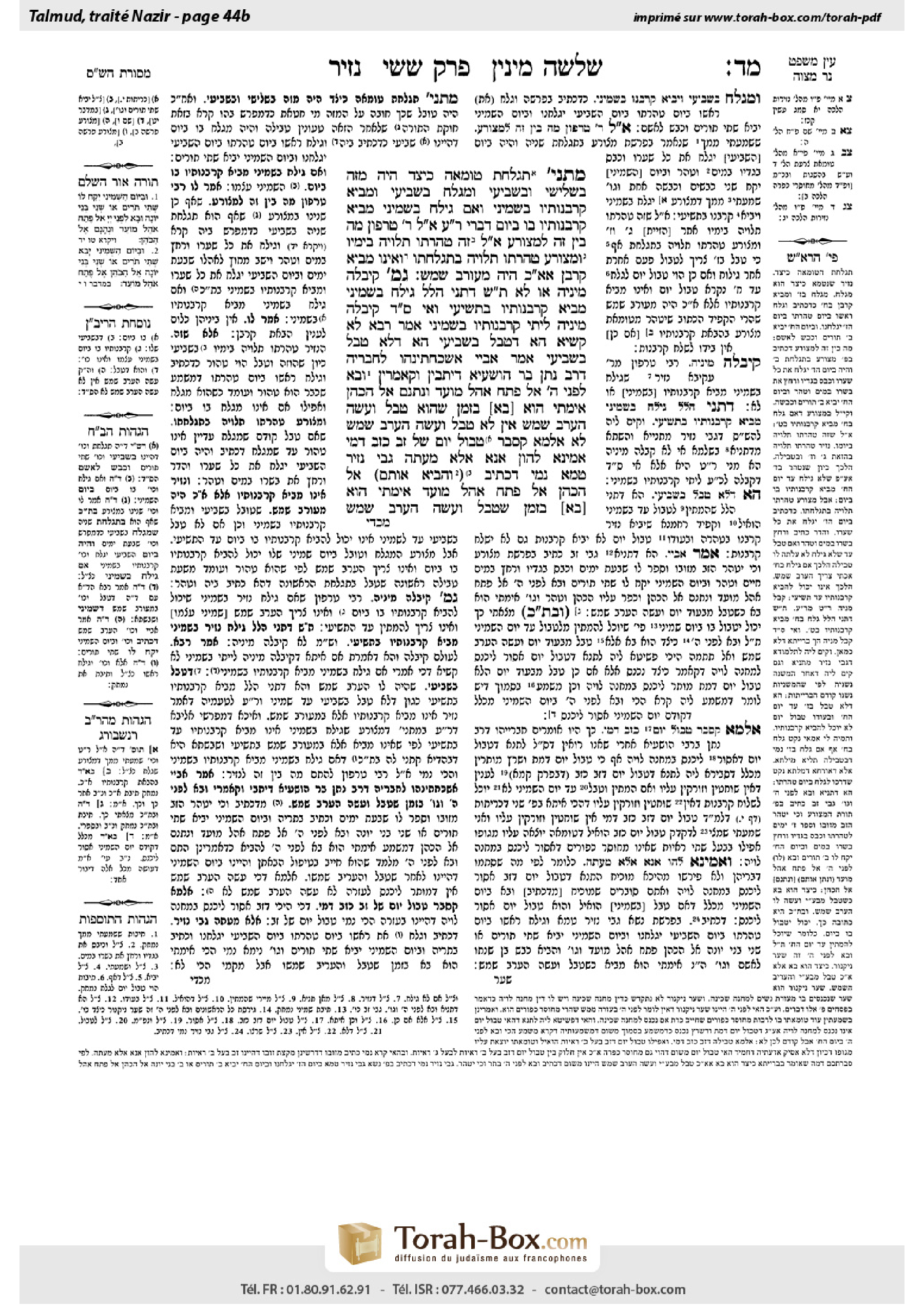
Nazir 44b: Talmud study for Daf Yomi
Daf Yomi is the daily study of one Talmud folio. Explore 37 tractates with scans, Hebrew text, Sefaria English and AI-generated French translations where annotated.
Passage selection and English or AI-generated French translation are available where the scan has annotations. Daf Study is independent of Torah-Box and Sefaria.
Browse Nazir · נזיר · All tractatesNazir 44b text and translations
This page of Nazir includes the Aramaic text, an English translation and an AI-generated French translation, alongside the scan above.
נזיר מ״ד ב · Aramaic and Hebrew text
מַתְנִי׳ תִּגְלַחַת טוּמְאָה כֵּיצַד? הָיָה מַזֶּה בַּשְּׁלִישִׁי וּבַשְּׁבִיעִי וּמְגַלֵּחַ בַּשְּׁבִיעִי, וּמֵבִיא קׇרְבְּנוֹתָיו בַּשְּׁמִינִי. וְאִם גִּילַּח בַּשְּׁמִינִי — מֵבִיא קׇרְבְּנוֹתָיו בּוֹ בַּיּוֹם, דִּבְרֵי רַבִּי עֲקִיבָא. אָמַר לוֹ רַבִּי טַרְפוֹן: מָה בֵּין זֶה לִמְצוֹרָע?
אָמַר לוֹ: זֶה טׇהֳרָתוֹ תְּלוּיָה בְּיָמָיו, וּמְצוֹרָע טׇהֳרָתוֹ תְּלוּיָה בְּתִגְלַחְתּוֹ. וְאֵינוֹ מֵבִיא קׇרְבָּן אֶלָּא אִם כֵּן הָיָה מְעוֹרַב שֶׁמֶשׁ.
גְּמָ׳ קַיבְּלַהּ מִינֵּיהּ אוֹ לָא? תָּא שְׁמַע: דְּתָנֵי הִלֵּל: גִּילַּח בַּשְּׁמִינִי — מֵבִיא קׇרְבְּנוֹתָיו בַּתְּשִׁיעִי. וְאִי סָלְקָא דַּעְתָּךְ קַיבְּלַהּ מִינֵּיהּ, לַיְתֵי קׇרְבְּנוֹתָיו בַּשְּׁמִינִי!
אָמַר רָבָא, לָא קַשְׁיָא: הָא — דְּטָבַל בַּשְּׁבִיעִי, הָא — דְּלֹא טָבַל בַּשְּׁבִיעִי.
אָמַר אַבָּיֵי: אַשְׁכַּחְתִּינְהוּ לְחַבְרֵיהּ דְּרַב נָתָן בַּר הוֹשַׁעְיָא דְּיָתְבִין וְקָאָמְרִין: ״וּבָא לִפְנֵי ה׳ אֶל פֶּתַח אֹהֶל מוֹעֵד וּנְתָנָם אֶל הַכֹּהֵן״, אֵימָתַי הוּא [בָּא]? בִּזְמַן שֶׁהוּא טָבַל וְעָשָׂה הֶעֱרֵב שֶׁמֶשׁ — אִין, לֹא טָבַל וְעָשָׂה הֶעֱרֵב שֶׁמֶשׁ — לָא.
אַלְמָא קָסָבַר טְבוּל יוֹם שֶׁל זָב — כְּזָב דָּמֵי.
אָמֵינָא לְהוֹן אֲנָא: אֶלָּא מֵעַתָּה גַּבֵּי נָזִיר טָמֵא נָמֵי, דִּכְתִיב: ״(וְהֵבִיא אוֹתָם) אֶל הַכֹּהֵן אֶל פֶּתַח אֹהֶל מוֹעֵד״. אֵימָתַי הוּא [בָּא] — בִּזְמַן שֶׁטָּבַל וְעָשָׂה הֶעֱרֵב שֶׁמֶשׁ.
Nazir 44b · English translation
MISHNA: With regard to the shaving of ritual impurity performed by a nazirite who became impure during his naziriteship, how is it performed? The priest would sprinkle the waters of purification on him on the third and the seventh days after he contracted his impurity, as performed for all those who contracted impurity imparted by a corpse. And he shaves his hair on the seventh day and brings his offerings on the eighth day. And if he shaved on the eighth day he brings his offerings on that day, this is the statement of Rabbi Akiva. Rabbi Tarfon said to him: What is the difference between this ritual and that of a leper? A leper also shaves on the seventh day and sacrifices his offerings on the eighth. However, if a leper shaves on the eighth day he brings his offerings on the ninth day, not on the day of his shaving.
Rabbi Akiva said to him: The purification of this impure nazirite depends on his days, as he immerses on the seventh day like all those who contract impurity imparted by a corpse, which means he is already ritually pure on the eighth day. But with regard to a leper, his purification depends on his shaving. Any immersion performed earlier is of no account, and must be repeated. And a leper brings his offering only if the sun has set following his immersion. Since offerings are not sacrificed at night, the bringing of his offering is postponed until the following day.
GEMARA: The Gemara asks: Did Rabbi Tarfon accept this claim from Rabbi Akiva, or did he not accept it? Come and hear an answer to this from that which Hillel the amora taught: If a nazirite shaved on the eighth day, he brings his offerings on the ninth. And if it should enter your mind that Rabbi Tarfon accepted the claim from Rabbi Akiva, let the nazirite bring his offerings on the eighth day itself, in accordance with the opinion of Rabbi Akiva. Rather, this baraita is certainly in accordance with the opinion of Rabbi Tarfon, who remains steadfast in his rejection of Rabbi Akiva’s opinion.
Rava said: This is not difficult, i.e., it is possible that Rabbi Tarfon accepted Rabbi Akiva’s opinion with regard to a nazirite who shaved on the eighth day, and there is a difference between the two statements: In this case of the mishna, it is referring to a nazirite who immersed on the seventh day, which means that he is entirely pure on the eighth and can therefore bring his offerings on the same day after shaving. By contrast, in that case of Hillel’s baraita, it is referring to one who did not immerse on the seventh. Consequently, as he immerses on the eighth day he may sacrifice his offerings only after sunset, on the ninth day.
§ Abaye said: I encountered the members of the assembly of Rav Natan bar Hoshaya sitting and saying the following: The verse states with regard to a man who experiences a gonorrhea-like discharge [zav] who immerses on the seventh day of his purification: “And on the eighth day he shall take for himself two turtledoves or two young pigeons and come before the Lord to the entrance of the Tent of Meeting and give them to the priest” (Leviticus 15:14). When does he come to the courtyard to sacrifice his offerings? Only when he has immersed on the seventh day and performed the requirement to wait until sunset. In that case, yes, he brings his offerings, but if he has not immersed and has not performed the requirement to wait until sunset, no, he may not enter the courtyard.
Apparently, this tanna maintains that one who immersed himself that day to release himself from the status of a zav is considered like an actual zav. Just as a zav is prohibited from entering the Levite camp in his state of impurity, the same applies to him on the day of his immersion, as he must wait until after sunset, when he is entirely pure.
Abaye adds: Upon hearing this, I said to those Sages: If that is so, with regard to an impure nazirite too, as it is written: And he shall bring them, referring to the verse “And on the eighth day he shall bring two turtledoves or two young pigeons to the priest, to the entrance of the Tent of Meeting” (Numbers 6:10), this can be explained in a similar manner: When does he come to the courtyard to sacrifice his offerings? When he has immersed himself and performed the requirement to wait until sunset.
Nazir 44b · Traduction française (IA)
MICHNA : Comment s’effectue le rasage de purification d’un nazir devenu impur au cours de son naziréat ? Le prêtre l’aspergeait avec les eaux de purification les troisième et septième jours après qu’il avait contracté son impureté, comme on le fait pour tous ceux qui ont contracté une impureté transmise par un cadavre. Il se rase le septième jour et apporte ses offrandes le huitième jour. S’il se rase le huitième jour, il apporte ses offrandes ce même jour : telle est la déclaration de Rabbi Akiva. Rabbi Tarfon lui dit : Quelle différence y a-t-il entre ce rite et celui du lépreux ? Le lépreux aussi se rase le septième jour et apporte ses offrandes le huitième. Toutefois, s’il se rase le huitième jour, il apporte ses offrandes le neuvième jour, et non le jour de son rasage.
Rabbi Akiva lui répondit : La purification de ce nazir impur dépend du décompte des jours, car il s’immerge le septième jour, comme tous ceux qui contractent une impureté transmise par un cadavre ; cela signifie qu’il est déjà rituellement pur le huitième jour. Mais, pour le lépreux, sa purification dépend de son rasage. Toute immersion effectuée auparavant est sans valeur et doit être répétée. De plus, le lépreux n’apporte son offrande qu’après le coucher du soleil suivant son immersion. Comme les offrandes ne sont pas sacrifiées la nuit, il doit donc attendre le lendemain pour apporter son offrande.
GUEMARA : La Guemara demande : Rabbi Tarfon a-t-il accepté cet argument de Rabbi Akiva ou non ? Écoutons la réponse dans ce qu’enseigna Hillel l’amora : Si un nazir s’est rasé le huitième jour, il apporte ses offrandes le neuvième. Or, si l’on pouvait penser que Rabbi Tarfon avait accepté l’argument de Rabbi Akiva, le nazir apporterait ses offrandes le huitième jour même, conformément à l’opinion de Rabbi Akiva. Il faut donc conclure que cette baraïta suit nécessairement l’opinion de Rabbi Tarfon, qui maintient son rejet de l’opinion de Rabbi Akiva.
Rava dit : Il n’y a pas de difficulté : il est possible que Rabbi Tarfon ait accepté l’opinion de Rabbi Akiva concernant un nazir qui s’est rasé le huitième jour, et qu’il y ait une différence entre les deux déclarations. Dans le cas de la Michna, il s’agit d’un nazir qui s’est immergé le septième jour ; il est donc entièrement pur le huitième et peut ainsi apporter ses offrandes ce même jour, après s’être rasé. En revanche, dans le cas de la baraïta de Hillel, il s’agit de quelqu’un qui ne s’est pas immergé le septième jour. Par conséquent, puisqu’il s’immerge le huitième jour, il ne peut sacrifier ses offrandes qu’après le coucher du soleil, le neuvième jour.
§ Abayé dit : J’ai rencontré les membres de l’assemblée de Rav Natan bar Hoshaya, assis et enseignant ce qui suit : À propos d’un homme atteint d’un écoulement semblable à une gonorrhée [zav] qui s’immerge le septième jour de sa purification, le verset dit : « Et le huitième jour, il prendra deux tourterelles ou deux jeunes pigeons, se présentera devant le Seigneur, à l’entrée de la Tente d’assignation, et les remettra au prêtre » (Lévitique 15, 14). À quel moment se présente-t-il dans le parvis pour sacrifier ses offrandes ? Seulement s’il s’est immergé le septième jour et a satisfait à l’exigence d’attendre jusqu’au coucher du soleil. Dans ce cas, oui, il apporte ses offrandes ; mais s’il ne s’est pas immergé et n’a pas satisfait à l’exigence d’attendre jusqu’au coucher du soleil, alors non, il ne peut pas entrer dans le parvis.
Il apparaît que ce tanna soutient que celui qui s’est immergé ce jour-là pour sortir du statut de zav est considéré comme un zav à part entière. De même qu’un zav ne peut pas entrer dans le camp des Lévites tant qu’il est impur, il en va de même pour lui le jour de son immersion : il doit attendre après le coucher du soleil, moment où il est entièrement pur.
Abayé ajoute : En entendant cela, je dis à ces Sages : S’il en est ainsi, pour un nazir impur également, puisqu’il est écrit : « Et il les apportera », en référence au verset : « Et le huitième jour, il apportera deux tourterelles ou deux jeunes pigeons au prêtre, à l’entrée de la Tente d’assignation » (Nombres 6, 10), on peut expliquer de la même façon : À quel moment se présente-t-il dans le parvis pour sacrifier ses offrandes ? Lorsqu’il s’est immergé et a satisfait à l’exigence d’attendre jusqu’au coucher du soleil.
Traduction française générée par IA à partir de l’édition anglaise de Sefaria. Vérifie toujours un passage avec le texte source.
Text from Sefaria: William Davidson Edition - Vocalized Aramaic (CC BY NC); William Davidson Edition - English (CC BY NC).