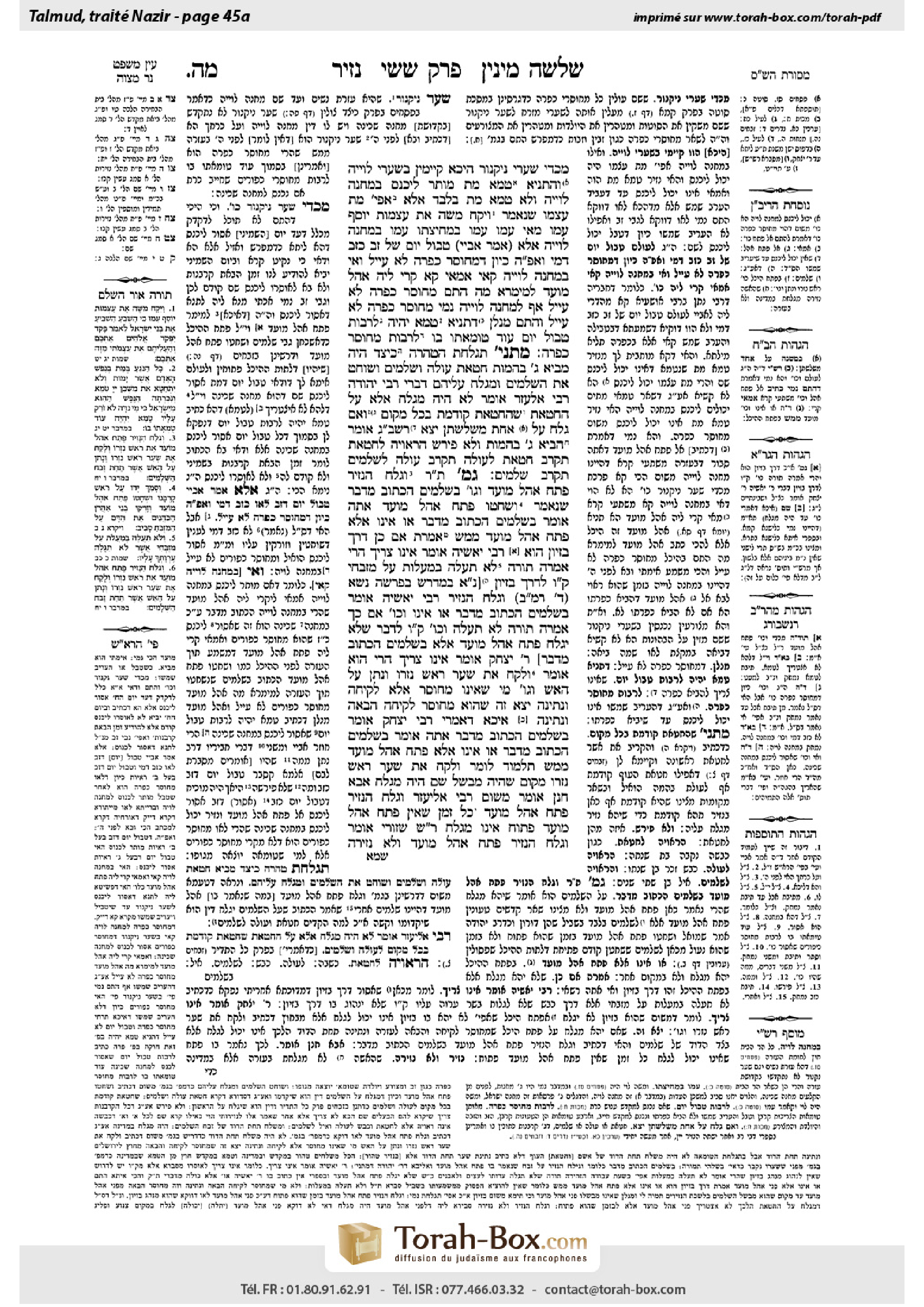
Nazir 45a: Talmud study for Daf Yomi
Daf Yomi is the daily study of one Talmud folio. Explore 37 tractates with scans, Hebrew text, Sefaria English and AI-generated French translations where annotated.
Passage selection and English or AI-generated French translation are available where the scan has annotations. Daf Study is independent of Torah-Box and Sefaria.
Browse Nazir · נזיר · All tractatesNazir 45a text and translations
This page of Nazir includes the Aramaic text, an English translation and an AI-generated French translation, alongside the scan above.
נזיר מ״ה א · Aramaic and Hebrew text
מִכְּדֵי שַׁעֲרֵי נִיקָנוֹר הֵיכָא קָיְימִין — בְּשַׁעֲרֵי לְוִיָּיה.
וְהָתַנְיָא: טְמֵא מֵת מוּתָּר לִיכָּנֵס בְּמַחֲנֵה לְוִיָּיה, וְלֹא טְמֵא מֵת בִּלְבַד אֶלָּא אֲפִילּוּ מֵת עַצְמוֹ, שֶׁנֶּאֱמַר: ״וַיִּקַּח מֹשֶׁה אֶת עַצְמוֹת יוֹסֵף עִמּוֹ״, מַאי ״עִמּוֹ״ — עִמּוֹ בִּמְחִיצָתוֹ, עִמּוֹ בְּמַחֲנֵה לְוִיָּיה.
אֶלָּא (אָמַר אַבָּיֵי): טְבוּל יוֹם שֶׁל זָב — כְּזָב דָּמֵי. וַאֲפִילּוּ הָכִי, כֵּיוָן דִּמְחוּסַּר כַּפָּרָה — לָא עָיֵיל.
וְאִי בְּמַחֲנֵה לְוִיָּיה קָאֵי, אַמַּאי קָא קָרֵי לֵיהּ ״אֹהֶל מוֹעֵד״? לְמֵימְרָא: מָה הָתָם — מְחוּסַּר כַּפָּרָה לָא עָיֵיל, אַף לְמַחֲנֵה לְוִיָּיה נָמֵי — מְחוּסַּר כַּפָּרָה לָא עָיֵיל.
וְהָתָם מְנָלַן? דְּתַנְיָא: ״טָמֵא יִהְיֶה״ — לְרַבּוֹת טְבוּל יוֹם, ״עוֹד טוּמְאָתוֹ בּוֹ״ — לְרַבּוֹת מְחוּסַּר כַּפָּרָה.
מַתְנִי׳ תִּגְלַחַת הַטׇּהֳרָה כֵּיצַד? הָיָה מֵבִיא שָׁלֹשׁ בְּהֵמוֹת: חַטָּאת, עוֹלָה, וּשְׁלָמִים. וְשׁוֹחֵט אֶת הַשְּׁלָמִים וּמְגַלֵּחַ עֲלֵיהֶם, דִּבְרֵי רַבִּי יְהוּדָה. רַבִּי אֶלְעָזָר אוֹמֵר: לֹא הָיָה מְגַלֵּחַ אֶלָּא עַל הַחַטָּאת, שֶׁהַחַטָּאת קוֹדֶמֶת בְּכׇל מָקוֹם. וְאִם גִּלַּח עַל אַחַת מִשְּׁלׇשְׁתָּן — יָצָא.
רַבָּן שִׁמְעוֹן בֶּן גַּמְלִיאֵל אוֹמֵר: הֵבִיא שָׁלֹשׁ בְּהֵמוֹת וְלֹא פֵּירֵשׁ, הָרְאוּיָה לְחַטָּאת — תִּקְרַב חַטָּאת, לְעוֹלָה — תִּקְרַב עוֹלָה, לִשְׁלָמִים — תִּקְרַב שְׁלָמִים.
גְּמָ׳ תָּנוּ רַבָּנַן: ״וְגִלַּח הַנָּזִיר פֶּתַח אֹהֶל מוֹעֵד וְגוֹ׳״, בִּשְׁלָמִים הַכָּתוּב מְדַבֵּר, שֶׁנֶּאֱמַר: ״וּשְׁחָטוֹ פֶּתַח אֹהֶל מוֹעֵד״.
אַתָּה אוֹמֵר בִּשְׁלָמִים הַכָּתוּב מְדַבֵּר, אוֹ אֵינוֹ אֶלָּא פֶּתַח אֹהֶל מוֹעֵד מַמָּשׁ? אָמַרְתָּ: אִם כֵּן — דֶּרֶךְ בִּזָּיוֹן הוּא.
רַבִּי יֹאשִׁיָּה אוֹמֵר: אֵינוֹ צָרִיךְ, הֲרֵי אָמְרָה תּוֹרָה ״לֹא תַעֲלֶה בְמַעֲלוֹת עַל מִזְבְּחִי״, קַל וָחוֹמֶר לְדֶרֶךְ בִּזָּיוֹן.
[נ״א בַּמִּדְרָשׁ בְּפָרָשָׁה נָשֹׂא (דַּף רמ״ב): ״וְגִלַּח הַנָּזִיר״, רַבִּי יֹאשִׁיָּה אוֹמֵר: בִּשְׁלָמִים הַכָּתוּב מְדַבֵּר. אוֹ אֵינוֹ וְכוּ׳. אִם כָּךְ, אָמְרָה תּוֹרָה ״לֹא תַעֲלֶה וְכוּ׳״ — קַל וָחוֹמֶר לַדָּבָר שֶׁלֹּא יְגַלֵּחַ פֶּתַח אֹהֶל מוֹעֵד, אֶלָּא בִּשְׁלָמִים הַכָּתוּב מְדַבֵּר.]
רַבִּי יִצְחָק אוֹמֵר: אֵינוֹ צָרִיךְ, הֲרֵי הוּא אוֹמֵר: ״וְלָקַח אֶת שְׂעַר רֹאשׁ נִזְרוֹ וְנָתַן עַל הָאֵשׁ וְגוֹ׳״, מִי שֶׁאֵינוֹ מְחוּסָּר אֶלָּא לְקִיחָה וּנְתִינָה. יָצָא זֶה, שֶׁהוּא מְחוּסָּר לְקִיחָה, הֲבָאָה, וּנְתִינָה.
אִיכָּא דְּאָמְרִי, רַבִּי יִצְחָק אוֹמֵר: בִּשְׁלָמִים הַכָּתוּב מְדַבֵּר. אַתָּה אוֹמֵר בִּשְׁלָמִים הַכָּתוּב מְדַבֵּר, אוֹ אֵינוֹ אֶלָּא פֶּתַח אֹהֶל מוֹעֵד מַמָּשׁ? תַּלְמוּד לוֹמַר: ״וְלָקַח אֶת שְׂעַר רֹאשׁ נִזְרוֹ״, מְקוֹם שֶׁהָיָה מְבַשֵּׁל — שָׁם הָיָה מְגַלֵּחַ.
אַבָּא חָנָן אוֹמֵר מִשּׁוּם רַבִּי אֱלִיעֶזֶר: ״וְגִלַּח הַנָּזִיר פֶּתַח אֹהֶל מוֹעֵד״, כׇּל זְמַן שֶׁאֵין פֶּתַח אֹהֶל מוֹעֵד פָּתוּחַ — אֵינוֹ מְגַלֵּחַ.
רַבִּי שִׁמְעוֹן שֵׁזוּרִי אוֹמֵר: ״וְגִלַּח הַנָּזִיר פֶּתַח אֹהֶל מוֹעֵד״, וְלֹא נְזִירָה,
Nazir 45a · English translation
Abaye continues: Now consider the Gate of Nicanor, where all those lacking atonement stand to bring their offerings; where is it located? In the gates of the Levites. Three camps are detailed in the verses, each having its own restrictions as to who may or may not enter them (see Numbers, chapter 5). The verses speak of the camps of the Jewish people in the wilderness, and the Sages taught that the statuses of certain areas of Jerusalem corresponded to those camps. The camps in the wilderness were the Israelite camp, the Levite camp, and the camp of the Divine Presence. They correspond to Jerusalem, the Temple Mount, and the Temple itself. The Gate of Nicanor had the status of the Levite camp.
Abaye continues: But isn’t it taught in a baraita (Tosefta, Kelim 1:8) that one who is impure due to contact with a corpse is permitted to enter the Levite camp; and not only one impure from a corpse, but even a corpse itself may be brought inside the Levite camp, as it is stated: “And Moses took the bones of Joseph with him” (Exodus 13:19). The baraita explains: What is the meaning of “with him”? The phrase “with him” indicates that Joseph’s bones were taken within Moses’s boundary, with him in the Levite camp. This demonstrates that even a corpse may be brought into the Levite camp. If so, certainly a nazirite who was impure from contact with a corpse and who has been sprinkled and immersed may enter there. Consequently, the halakha that a nazirite must wait until the eighth day to sacrifice his offerings cannot be due to a prohibition against entering the Gate of Nicanor. One can similarly infer that the halakha that a zav who has immersed may not bring his offerings before the eighth day is not because he is prohibited from entering the Gate of Nicanor.
Rather, Abaye says: The baraita should be understood slightly differently than suggested by the assembly of Rav Natan bar Hoshaya: One who immersed himself that day to release himself from the status of a zav, i.e., a full-fledged zav, who experienced three emissions, not merely two, is considered like a zav with regard to the prohibition against entering the Levite camp. But the reason for this prohibition is not that a zav who immersed himself that day may not enter the Levite camp. Rather, granted that he is permitted to enter the Levite camp in terms of his impurity, even so, since he is lacking atonement, as he has yet to sacrifice his offerings, he may not enter the Levite camp.
Abaye elaborates: The reason he may not enter is that the Torah states with regard to a zav: “And he shall come before the Lord to the entrance of the Tent of Meeting” (Leviticus 15:14), and if he is standing in the Levite camp, at the Gate of Nicanor, when he brings his offerings, why does the Torah call it “the Tent of Meeting”? Rather, this verse must be coming to say: Just as there, with regard to the Tent of Meeting itself, i.e., the camp of the Divine Presence, one who is lacking atonement may not enter there, so too, with regard to the Levite camp as well, one who is lacking atonement may not enter there.
The Gemara asks: And from where do we derive that one who lacks atonement may not enter there, i.e., the camp of the Divine Presence? The Gemara answers: As it is taught in a baraita: The Torah states with regard to the prohibition against an impure person entering the Tabernacle: “He shall be impure; his impurity is yet upon him” (Numbers 19:13). The phrase “he shall be impure” serves to include one who immersed himself that day in the prohibition against entering the Temple. “His impurity is yet upon him” serves to include one who lacks atonement, who is prohibited from entering the camp of the Divine Presence until he has sacrificed his offerings of purity.
MISHNA: With regard to a nazirite’s shaving of purity after the completion of his term of naziriteship, how is it performed? He would bring three animals: One for a sin-offering, one for a burnt-offering, and one for a peace-offering. And he slaughters the peace-offering and shaves his hair after he slaughters them. This is the statement of Rabbi Yehuda. Rabbi Elazar says: He would shave only after he slaughtered the sin-offering, as the sin-offering precedes the other offerings in all places, and therefore he sacrifices the sin-offering first. He shaves his hair after he slaughters this offering. And if he shaved after the sacrifice of any one of the three of them, he has fulfilled his obligation after the fact.
Rabban Shimon ben Gamliel says: If a nazirite brought three animals without specifying which of them was for which offering, the one that is fit for a sin-offering, i.e., a female sheep in its first year, is sacrificed as a sin-offering; that which is fit for a burnt-offering, a male sheep in its first year, is sacrificed as a burnt-offering; and that which is fit for a peace-offering, a ram, i.e., a male sheep over the age of one year, is sacrificed as a peace-offering.
GEMARA: The Gemara first addresses the opinion of Rabbi Yehuda, whose reasoning was not stated in the mishna. The Sages taught that when the Torah states: “And the nazirite shall shave his consecrated head at the entrance to the Tent of Meeting” (Numbers 6:18), the verse is speaking of the peace-offering, as the phrase “the entrance to the Tent of Meeting” alludes to a peace-offering, as it is stated: “And if his offering is a sacrifice of peace-offering…and he shall slaughter it at the entrance to the Tent of Meeting” (Leviticus 3:1–2).
Do you say the verse is speaking of the peace-offering, i.e., that the nazirite shaves after bringing his peace-offering? Or perhaps it is only teaching that he shaves at the actual entrance to the Tent of Meeting, at the gate to the Sanctuary, as indicated by a literal reading of the verse? You can say in response: If so, that is a degrading manner of service, to shave at the entrance to the Sanctuary.
Rabbi Yoshiya says: This proof is not necessary, as the Torah states: “And you shall not ascend by steps to My altar, so that you should not reveal your nakedness upon it” (Exodus 20:23). If the Torah is concerned about the disrespect to the altar presented by normal human behavior, then by an a fortiori inference the Torah prohibits acting in a degrading manner by shaving at the entrance to the Sanctuary.
A different version of this derivation is stated in the midrash to the Torah portion of Naso. The Torah states: “And the nazirite shall shave his consecrated head at the entrance to the Tent of Meeting, and shall take the hair of his consecrated head and put it on the fire which is under the sacrifice of the peace-offering” (Numbers 6:18). Rabbi Yoshiya says: The verse is speaking of the peace-offering. Or perhaps it is only teaching that he shaves at the actual entrance to the Tent of Meeting? If so, the Torah said: “And you shall not ascend by steps to My altar” (Exodus 20:23). By an a fortiori inference with regard to this matter it is derived that he should not shave at the entrance to the Tent of Meeting. Rather, the verse is speaking of the peace-offering.
Rabbi Yitzḥak says: It is not necessary to cite an indirect proof that a nazirite may not shave at the entrance to the Sanctuary, as the verse states with regard to a nazirite: “And he shall take the hair of his consecrated head and put it on the fire which is under the sacrifice of the peace-offering” (Numbers 6:18). The verse is referring to one who has not yet performed only the stages of taking and placing his shaven hair under the pot of the peace-offering, which is outside the Sanctuary. These two stages are the only ones he lacks; he does not have to do any other action. That excludes this one, a nazirite who shaved at the entrance to the Sanctuary, as he has not yet performed three actions, taking, bringing the hair from one sanctified area to another, and placing his shaven hair under the pot of the peace-offering.
Some say a different version of this statement. Rabbi Yitzḥak says: The verse is referring to the peace-offering. He clarifies his assertion: Do you say the verse is speaking of the peace-offering, or is it teaching only that he shaves at the actual entrance to the Tent of Meeting? The verse states: “And he shall take the hair of his consecrated head and put it on the fire which is under the sacrifice of the peace-offering” (Numbers 6:18). This indicates that in the same place where he would cook the peace-offering, outside the courtyard, there he would shave.
Abba Ḥanan says in the name of Rabbi Eliezer that the verse “And the nazirite shall shave his consecrated head at the entrance to the Tent of Meeting” (Numbers 6:18) is referring to the time rather than the place of his shaving, i.e., this verse teaches that as long as the entrance to the Tent of Meeting is not open, he may not shave. He may shave only during those hours when the entrance to the Sanctuary is open.
Rabbi Shimon Shezuri says: The phrase “And the nazirite shall shave his consecrated head at the entrance to the Tent of Meeting” does not refer to the place of his shaving. Rather, the masculine form of the word nazirite serves to emphasize that this applies to a male nazirite and not a female nazirite. A woman does not shave her head in the Sanctuary,
Nazir 45a · Traduction française (IA)
Abayé poursuit : Considérons maintenant la porte de Nicanor, où se tiennent tous ceux qui n’ont pas encore obtenu l’expiation afin d’apporter leurs offrandes. Où se trouve-t-elle ? Dans les portes des Lévites. Les versets détaillent trois camps, chacun soumis à ses propres restrictions quant aux personnes qui peuvent ou non y entrer (voir Nombres, chapitre 5). Ils parlent des camps du peuple juif dans le désert, et les Sages ont enseigné que le statut de certaines zones de Jérusalem correspondait à celui de ces camps. Les camps du désert étaient le camp des Israélites, celui des Lévites et celui de la Présence divine. Ils correspondent respectivement à Jérusalem, au mont du Temple et au Temple lui-même. La porte de Nicanor avait le statut du camp des Lévites.
Abayé poursuit : Mais n’est-il pas enseigné dans une baraïta (Tosefta, Kelim 1:8) que celui qui est impur à la suite d’un contact avec un mort est autorisé à entrer dans le camp des Lévites ? Et non seulement celui qui est impur à la suite d’un contact avec un mort, mais même un mort lui-même peut être introduit dans le camp des Lévites, comme il est dit : « Moïse prit avec lui les ossements de Joseph » (Exode 13:19). La baraïta explique : Que signifie « avec lui » ? Cette expression indique que les ossements de Joseph furent transportés dans les limites de Moïse, avec lui dans le camp des Lévites. Cela démontre que même un mort peut être introduit dans le camp des Lévites. Dans ce cas, à plus forte raison un nazir qui était impur à la suite d’un contact avec un mort et qui a reçu l’aspersion et s’est immergé peut-il y entrer. Par conséquent, la halakha selon laquelle un nazir doit attendre le huitième jour pour sacrifier ses offrandes ne peut pas s’expliquer par une interdiction d’entrer dans la porte de Nicanor. On peut de même déduire que la halakha selon laquelle un zav qui s’est immergé ne peut apporter ses offrandes avant le huitième jour ne tient pas à une interdiction d’entrer dans la porte de Nicanor.
Abayé dit plutôt : Il faut comprendre la baraïta d’une manière légèrement différente de celle proposée par l’assemblée de Rav Natan bar Hoshaya. Celui qui s’est immergé ce jour-là pour sortir du statut de zav, c’est-à-dire un zav à part entière, qui a eu trois émissions et non seulement deux, est considéré comme un zav en ce qui concerne l’interdiction d’entrer dans le camp des Lévites. Toutefois, cette interdiction ne s’explique pas par le fait qu’un zav qui s’est immergé ce jour-là ne peut entrer dans le camp des Lévites. Même si, du point de vue de son impureté, il est autorisé à entrer dans le camp des Lévites, puisqu’il n’a pas encore obtenu l’expiation, car il n’a pas encore sacrifié ses offrandes, il ne peut pas entrer dans le camp des Lévites.
Abayé précise : Il ne peut pas y entrer parce que la Torah dit au sujet d’un zav : « Il viendra devant le Seigneur, à l’entrée de la Tente d’assignation » (Lévitique 15:14). Or, s’il se tient dans le camp des Lévites, à la porte de Nicanor, lorsqu’il apporte ses offrandes, pourquoi la Torah appelle-t-elle cet endroit « la Tente d’assignation » ? Ce verset vient plutôt enseigner ceci : de même que là, dans la Tente d’assignation elle-même, c’est-à-dire dans le camp de la Présence divine, celui qui n’a pas encore obtenu l’expiation ne peut pas entrer, de même, dans le camp des Lévites, celui qui n’a pas encore obtenu l’expiation ne peut pas non plus entrer.
La Guemara demande : D’où déduisons-nous que celui qui n’a pas encore obtenu l’expiation ne peut pas entrer là, c’est-à-dire dans le camp de la Présence divine ? La Guemara répond : Comme il est enseigné dans une baraïta, au sujet de l’interdiction faite à une personne impure d’entrer dans le Tabernacle, la Torah dit : « Il sera impur ; son impureté est encore sur lui » (Nombres 19:13). L’expression « il sera impur » inclut celui qui s’est immergé ce jour-là dans l’interdiction d’entrer dans le Temple. L’expression « son impureté est encore sur lui » inclut celui qui n’a pas encore obtenu l’expiation, à qui il est interdit d’entrer dans le camp de la Présence divine jusqu’à ce qu’il ait sacrifié ses offrandes de purification.
MICHNA : Comment s’effectue le rasage de purification du nazir à l’achèvement de sa période de naziréat ? Il apporte trois animaux : l’un pour un sacrifice expiatoire, l’un pour un holocauste et l’un pour un sacrifice de paix. Il égorge le sacrifice de paix et se rase les cheveux après l’avoir égorgé. Telle est la déclaration de Rabbi Yehouda. Rabbi Elazar dit : Il ne se rase qu’après avoir égorgé le sacrifice expiatoire, car celui-ci précède les autres offrandes en tout lieu ; il sacrifie donc d’abord le sacrifice expiatoire. Il se rase les cheveux après avoir égorgé cette offrande. Et s’il s’est rasé après le sacrifice de l’un des trois animaux, il s’est acquitté de son obligation a posteriori.
Rabban Shimon ben Gamliel dit : Si un nazir a apporté trois animaux sans préciser lequel était destiné à quelle offrande, celui qui convient pour un sacrifice expiatoire, c’est-à-dire une brebis âgée d’un an, est sacrifié comme sacrifice expiatoire ; celui qui convient pour un holocauste, un agneau mâle âgé d’un an, est sacrifié comme holocauste ; et celui qui convient pour un sacrifice de paix, un bélier, c’est-à-dire un mouton mâle âgé de plus d’un an, est sacrifié comme sacrifice de paix.
GUEMARA : La Guemara examine d’abord l’opinion de Rabbi Yehouda, dont la Michna n’a pas indiqué le raisonnement. Les Sages ont enseigné que lorsque la Torah dit : « Le nazir rasera sa tête consacrée à l’entrée de la Tente d’assignation » (Nombres 6:18), le verset parle du sacrifice de paix, car l’expression « l’entrée de la Tente d’assignation » fait allusion à un sacrifice de paix, comme il est dit : « Si son offrande est un sacrifice de paix […] il l’égorgera à l’entrée de la Tente d’assignation » (Lévitique 3:1–2).
Peut-on dire que le verset parle du sacrifice de paix, c’est-à-dire que le nazir se rase après avoir apporté son sacrifice de paix ? Ou bien enseigne-t-il seulement qu’il se rase à l’entrée même de la Tente d’assignation, à la porte du Sanctuaire, comme l’indique le sens littéral du verset ? On peut répondre ainsi : si c’était le cas, ce serait une manière dégradante d’accomplir le service que de se raser à l’entrée du Sanctuaire.
Rabbi Yoshiya dit : Cette preuve n’est pas nécessaire, car la Torah dit : « Tu ne monteras pas à mon autel par des marches, afin que ta nudité ne soit pas dévoilée devant lui » (Exode 20:23). Si la Torah se préoccupe du manque de respect envers l’autel que pourrait entraîner un comportement humain ordinaire, alors, a fortiori, elle interdit d’agir de manière dégradante en se rasant à l’entrée du Sanctuaire.
Une autre version de cette déduction figure dans le midrach sur la section de la Torah de Nasso. La Torah dit : « Le nazir rasera sa tête consacrée à l’entrée de la Tente d’assignation, prendra les cheveux de sa tête consacrée et les mettra sur le feu qui est sous le sacrifice de paix » (Nombres 6:18). Rabbi Yoshiya dit : Le verset parle du sacrifice de paix. Ou bien enseigne-t-il seulement qu’il se rase à l’entrée même de la Tente d’assignation ? Si c’était le cas, la Torah a dit : « Tu ne monteras pas à mon autel par des marches » (Exode 20:23). Par une déduction a fortiori portant sur ce sujet, on apprend qu’il ne doit pas se raser à l’entrée de la Tente d’assignation. Le verset parle donc du sacrifice de paix.
Rabbi Yitzḥak dit : Il n’est pas nécessaire de citer une preuve indirecte pour établir qu’un nazir ne peut pas se raser à l’entrée du Sanctuaire, car le verset dit au sujet du nazir : « Il prendra les cheveux de sa tête consacrée et les mettra sur le feu qui est sous le sacrifice de paix » (Nombres 6:18). Le verset parle de celui à qui il ne reste à accomplir que les étapes consistant à prendre ses cheveux rasés et à les placer sous la marmite du sacrifice de paix, à l’extérieur du Sanctuaire. Ce sont les deux seules étapes qui lui restent ; il n’a aucune autre action à accomplir. Cela exclut le cas du nazir qui s’est rasé à l’entrée du Sanctuaire, car il lui reste alors trois actions à accomplir : prendre les cheveux, les transporter d’une zone consacrée à une autre et les placer sous la marmite du sacrifice de paix.
Certains transmettent une autre version de cette déclaration. Rabbi Yitzḥak dit : Le verset parle du sacrifice de paix. Il précise son affirmation : Peut-on dire que le verset parle du sacrifice de paix, ou bien enseigne-t-il seulement qu’il se rase à l’entrée même de la Tente d’assignation ? Le verset dit : « Il prendra les cheveux de sa tête consacrée et les mettra sur le feu qui est sous le sacrifice de paix » (Nombres 6:18). Cela indique qu’il se rasait au même endroit où il faisait cuire le sacrifice de paix, à l’extérieur de la cour.
Abba Ḥanan dit au nom de Rabbi Eliezer que le verset « Le nazir rasera sa tête consacrée à l’entrée de la Tente d’assignation » (Nombres 6:18) se rapporte au moment du rasage et non à son lieu. Autrement dit, ce verset enseigne que tant que l’entrée de la Tente d’assignation n’est pas ouverte, il ne peut pas se raser. Il ne peut se raser que pendant les heures où l’entrée du Sanctuaire est ouverte.
Rabbi Shimon Shezuri dit : L’expression « Le nazir rasera sa tête consacrée à l’entrée de la Tente d’assignation » ne se rapporte pas au lieu du rasage. La forme masculine du mot « nazir » sert plutôt à souligner que cela concerne un nazir et non une nazir femme. Une femme ne se rase pas la tête dans le Sanctuaire,
Traduction française générée par IA à partir de l’édition anglaise de Sefaria. Vérifie toujours un passage avec le texte source.
Text from Sefaria: William Davidson Edition - Vocalized Aramaic (CC BY NC); William Davidson Edition - English (CC BY NC).