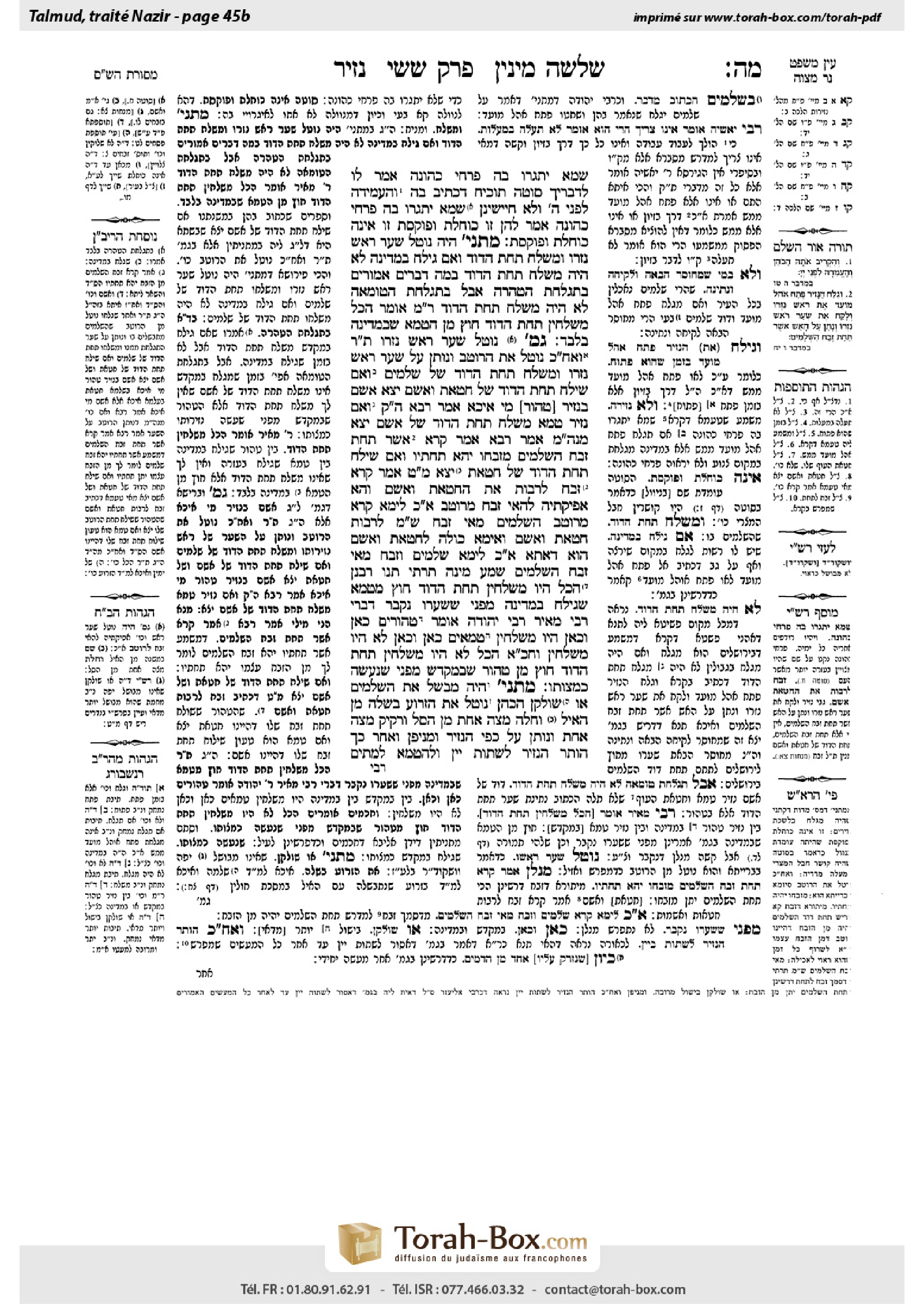
Nazir 45b: Talmud study for Daf Yomi
Daf Yomi is the daily study of one Talmud folio. Explore 37 tractates with scans, Hebrew text, Sefaria English and AI-generated French translations where annotated.
Passage selection and English or AI-generated French translation are available where the scan has annotations. Daf Study is independent of Torah-Box and Sefaria.
Browse Nazir · נזיר · All tractatesNazir 45b text and translations
This page of Nazir includes the Aramaic text, an English translation and an AI-generated French translation, alongside the scan above.
נזיר מ״ה ב · Aramaic and Hebrew text
שֶׁמָּא יִתְגָּרוּ בָּהּ פִּרְחֵי כְהוּנָּה. אָמַר לוֹ: לִדְבָרֶיךָ סוֹטָה תּוֹכִיחַ, דִּכְתִיב בָּהּ ״וְהֶעֱמִידָהּ לִפְנֵי ה׳״, וְלָא חָיְישִׁינַן שֶׁמָּא יִתְגָּרוּ בָּהּ פִּרְחֵי כְהוּנָּה!
אָמַר לָהֶן: זוֹ כּוֹחֶלֶת וּפוֹקֶסֶת, זוֹ אֵינָהּ כּוֹחֶלֶת וּפוֹקֶסֶת.
מַתְנִי׳ הָיָה נוֹטֵל שְׂעַר רֹאשׁ נִזְרוֹ וּמְשַׁלֵּחַ תַּחַת הַדּוּד. וְאִם גִּילַּח בַּמְּדִינָה — לֹא הָיָה מְשַׁלֵּחַ תַּחַת הַדּוּד. בַּמֶּה דְּבָרִים אֲמוּרִים? בְּתִגְלַחַת הַטׇּהֳרָה, אֲבָל בְּתִגְלַחַת הַטּוּמְאָה — לֹא הָיָה מְשַׁלֵּחַ תַּחַת הַדּוּד.
רַבִּי מֵאִיר אוֹמֵר: הַכֹּל מְשַׁלְּחִין תַּחַת הַדּוּד, חוּץ מִן הַטָּמֵא שֶׁבַּמְּדִינָה בִּלְבַד.
גְּמָ׳ נוֹטֵל שְׂעַר רֹאשׁ נִזְרוֹ. תָּנוּ רַבָּנַן: וְאַחַר כָּךְ נוֹטֵל אֶת הָרוֹטֶב וְנוֹתֵן עַל שְׂעַר רֹאשׁ נִזְרוֹ, וּמְשַׁלֵּחַ תַּחַת הַדּוּד שֶׁל שְׁלָמִים. וְאִם שִׁילַּח תַּחַת הַדּוּד שֶׁל חַטָּאת וְאָשָׁם — יָצָא. אָשָׁם בְּנָזִיר [טָהוֹר] מִי אִיכָּא? אָמַר רָבָא, הָכִי קָאָמַר: וְאִם נָזִיר טָמֵא מְשַׁלֵּחַ תַּחַת הַדּוּד שֶׁל אָשָׁם — יָצָא.
מְנָא הָנֵי מִילֵּי? אָמַר רָבָא, אָמַר קְרָא: ״אֲשֶׁר תַּחַת זֶבַח הַשְּׁלָמִים״, מִזִּבְחוֹ יְהֵא תַּחְתָּיו.
וְאִם שִׁילַּח תַּחַת הַדּוּד שֶׁל חַטָּאת — יָצָא. מַאי טַעְמָא? אָמַר קְרָא: ״זֶבַח״, לְרַבּוֹת אֶת הַחַטָּאת וְאָשָׁם. וְהָא אַפֵּיקְתֵּיהּ לְהַאי ״זֶבַח״ מֵרוֹטֶב! אִם כֵּן לֵימָא קְרָא ״מֵרוֹטֶב הַשְּׁלָמִים״, מַאי ״זֶבַח״ — שְׁמַע מִינַּהּ לְרַבּוֹת חַטָּאת וְאָשָׁם.
וְאֵימָא כּוּלָּהּ לְחַטָּאת וְאָשָׁם הוּא דַּאֲתָא! אִם כֵּן, לֵימָא ״שְׁלָמִים וְזֶבַח״, מַאי ״זֶבַח הַשְּׁלָמִים״ — שְׁמַע מִינַּהּ תַּרְתֵּי.
תָּנוּ רַבָּנַן: הַכֹּל הָיוּ מְשַׁלְּחִין תַּחַת הַדּוּד, חוּץ מִטָּמֵא שֶׁגִּילַּח בִּמְדִינָה, מִפְּנֵי שֶׁשְּׂעָרוֹ נִקְבָּר, דִּבְרֵי רַבִּי מֵאִיר. רַבִּי יְהוּדָה אוֹמֵר: טְהוֹרִים כָּאן וְכָאן — הָיוּ מְשַׁלְּחִין. טְמֵאִים כָּאן וְכָאן — לֹא הָיוּ מְשַׁלְּחִין. וַחֲכָמִים אוֹמְרִים: הַכֹּל לֹא הָיוּ מְשַׁלְּחִין תַּחַת הַדּוּד, חוּץ מִן טָהוֹר שֶׁבַּמִּקְדָּשׁ, מִפְּנֵי שֶׁנַּעֲשָׂה כְּמִצְוָתוֹ.
מַתְנִי׳ הָיָה מְבַשֵּׁל אֶת הַשְּׁלָמִים אוֹ שׁוֹלְקָן. הַכֹּהֵן נוֹטֵל אֶת הַזְּרוֹעַ בְּשֵׁלָה מִן הָאַיִל, וְחַלָּה מַצָּה אַחַת מִן הַסַּל, וּרְקִיק מַצָּה אַחַת, וְנוֹתֵן עַל כַּפֵּי הַנָּזִיר, וּמְנִיפָן, וְאַחַר כָּךְ הוּתַּר הַנָּזִיר לִשְׁתּוֹת יַיִן וּלְהִטַּמֵּא לַמֵּתִים.
Nazir 45b · English translation
lest the young priests [pirḥei khehuna] present will become aroused by her when she uncovers her hair in their presence. One of the other Sages said to Rabbi Shimon Shezuri: According to your statement, the case of a sota will prove that this is not a concern, as it is written with regard to her: “And he shall set her before the Lord” (Numbers 5:16), and yet we are not concerned that perhaps the young priests will become aroused by her when her hair is uncovered.
Rabbi Shimon Shezuri said to them: There is a difference between a female nazirite and a sota. This one, the nazirite, paints her eyes blue [koḥelet] and applies blush [fokeset] to her face, and therefore there is a concern that young priests might be aroused by her appearance. By contrast, that one, the sota, does not apply blue eye shadow and does not apply blush. Since a sota is not beautified, but is made to appear wretched and looks disheveled, there is no concern that she might arouse the men.
MISHNA: After the nazirite shaved off his hair, he would take the hair of his consecrated head and throw it under the pot in which the peace-offering was cooked, where it would burn. And if the nazirite shaved in the rest of the country, i.e., outside the Temple, he would not throw the hair under the pot. In what case is this statement said? It is said with regard to the shaving of purity. However, with regard to the shaving of impurity, i.e., shaving that accompanied his guilt-offering and sin-offering of birds after his term of naziriteship was interrupted by impurity, he would not throw his hair under the pot in which his offerings were cooked, as the Torah stated this requirement only for a pure nazirite.
Rabbi Meir says: Everyone throws his hair under the pot, including a pure nazirite who shaved outside the Temple and an impure nazirite, except for an impure nazirite who shaved in the rest of the country. In that case alone he refrains from throwing his hair to be burned beneath his offering.
GEMARA: The mishna states that he would take the hair of his consecrated head. The Sages taught: And afterward, after cooking the peace-offering, he takes the gravy [rotev] in which the offering had been cooked, places it on the shaven hair of his consecrated head, and throws the hair under the pot of his peace-offering. And if he threw his hair under the pot of the sin-offering or the guilt-offering, he has fulfilled his obligation after the fact. The Gemara expresses surprise at this statement: Is there a guilt-offering brought by a pure nazirite? Only an impure nazirite brings a guilt-offering. Rava said that this is what the tanna said, i.e., meant: And if an impure nazirite threw his hair under the pot of the guilt-offering, he has fulfilled his obligation.
The Gemara asks: From where are these matters derived, that he must pour gravy from the offering over his hair? Rava said that as the verse states: “And he shall take the hair of his consecrated head and put it on the fire which is under the sacrifice of the peace-offering” (Numbers 6:18), this indicates that part of his sacrifice must be under the hair.
With regard to the statement of the baraita: And if he threw his hair under the pot of the sin-offering he has fulfilled his obligation, the Gemara asks: What is the reason for this? The Gemara answers that the verse states: “The sacrifice of the peace-offering,” when it could simply have stated: The peace-offering. This serves to include the sin-offering and the guilt-offering, which are also sacrifices. The Gemara asks: But you have already derived from this term “sacrifice” that he must pour part of the gravy of the peace-offering over his hair. The Gemara answers: If so, let the verse say explicitly: From the gravy of the peace-offering. Why does it state: “Sacrifice”? Learn from here that it serves to include the sin-offering and the guilt-offering.
The Gemara questions this statement from a different perspective: And one can say that this verse comes entirely to teach about the sin-offering and guilt-offering, and it does not refer to the gravy at all. The Gemara answers: If so, let it state: Peace-offering and a sacrifice; for what reason does it write: “The sacrifice of the peace-offering”? Conclude two conclusions from the verse.
§ The Sages taught (Tosefta 4:6): All nazirites would throw their hair under the pot, except for an impure nazirite who shaved in the rest of the country, because that one’s hair is buried. This is the statement of Rabbi Meir. Rabbi Yehuda says: Pure nazirites, whether they are here or there, inside or outside the Temple, would throw their hair under the pot; impure nazirites, whether here or there, would not throw it. And the Rabbis say: None would throw their hair under the pot, except for a pure nazirite in the Temple, because only in that case is the mitzva performed properly, as commanded by the Torah.
MISHNA: The nazirite would cook the peace-offering or overcook it, i.e., cook it thoroughly. The priest takes the cooked foreleg from the ram, and one unleavened loaf from the basket, and one unleavened wafer, and places them on the palms of the nazirite and waves them, as described in the Torah (Numbers 6:19–20). And afterward the nazirite is permitted to drink wine and to contract ritual impurity imparted by a corpse.
Nazir 45b · Traduction française (IA)
de peur que les jeunes prêtres [pirḥei khehuna] présents ne soient troublés par elle lorsqu’elle découvre ses cheveux devant eux. L’un des autres Sages dit à Rabbi Shimon Shezuri : Selon tes propos, le cas de la sota prouve que cela ne pose pas de problème, car il est écrit à son sujet : « Il la placera devant le Seigneur » (Nombres 5:16), et pourtant nous ne craignons pas que les jeunes prêtres soient troublés par elle lorsque ses cheveux sont découverts.
Rabbi Shimon Shezuri leur dit : Il y a une différence entre une naziréenne et une sota. Celle-ci, la naziréenne, se peint les yeux en bleu [koḥelet] et se met du fard [fokeset] sur le visage ; on peut donc craindre que les jeunes prêtres soient troublés par son apparence. En revanche, celle-là, la sota, ne se met ni fard bleu sur les yeux ni fard sur le visage. Puisqu’on n’embellit pas la sota, mais qu’on la fait paraître misérable et qu’elle a l’air négligé, il n’y a pas lieu de craindre qu’elle trouble les hommes.
MICHNA : Après s’être rasé la tête, le nazir prenait les cheveux de sa tête consacrée et les jetait sous la marmite où cuisait le sacrifice de paix, afin qu’ils y brûlent. Si le nazir s’était rasé dans le reste du pays, c’est-à-dire hors du Temple, il ne jetait pas les cheveux sous la marmite. Dans quel cas cette règle s’applique-t-elle ? À la tonte de purification. En revanche, lors de la tonte d’impureté, c’est-à-dire celle qui accompagnait son sacrifice de culpabilité et son sacrifice expiatoire d’oiseaux après que l’impureté eut interrompu sa période de naziréat, il ne jetait pas ses cheveux sous la marmite où cuisaient ses sacrifices, car la Torah n’a prescrit cette exigence que pour un nazir pur.
Rabbi Meir dit : Tous jettent leurs cheveux sous la marmite, y compris le nazir pur qui s’est rasé hors du Temple et le nazir impur, à l’exception du nazir impur qui s’est rasé dans le reste du pays. Dans ce seul cas, il ne jette pas ses cheveux pour qu’ils brûlent sous son sacrifice.
GUEMARA : La Michna dit qu’il prenait les cheveux de sa tête consacrée. Les Sages ont enseigné : Ensuite, après la cuisson du sacrifice de paix, il prend le jus [rotev] dans lequel le sacrifice a cuit, le verse sur les cheveux rasés de sa tête consacrée, puis jette les cheveux sous la marmite de son sacrifice de paix. S’il a jeté ses cheveux sous la marmite du sacrifice expiatoire ou du sacrifice de culpabilité, il s’est acquitté de son obligation après coup. La Guemara s’étonne de cette déclaration : Un nazir pur apporte-t-il un sacrifice de culpabilité ? Seul un nazir impur apporte un sacrifice de culpabilité. Rava dit que voici ce que le tanna a enseigné, c’est-à-dire voulu dire : Si un nazir impur a jeté ses cheveux sous la marmite du sacrifice de culpabilité, il s’est acquitté de son obligation.
La Guemara demande : D’où tire-t-on qu’il doit verser le jus du sacrifice sur ses cheveux ? Rava dit que le verset énonce : « Il prendra les cheveux de sa tête consacrée et les mettra sur le feu qui est sous le sacrifice de paix » (Nombres 6:18). Cela indique qu’une partie de son sacrifice doit se trouver sous les cheveux.
À propos de la déclaration de la baraïta : « S’il a jeté ses cheveux sous la marmite du sacrifice expiatoire, il s’est acquitté de son obligation », la Guemara demande : Pourquoi en est-il ainsi ? La Guemara répond que le verset dit : « Le sacrifice de paix », alors qu’il aurait pu simplement dire : « Le sacrifice de paix ». Cela inclut le sacrifice expiatoire et le sacrifice de culpabilité, qui sont eux aussi des sacrifices. La Guemara demande : Mais tu as déjà déduit de ce terme « sacrifice » qu’il doit verser sur ses cheveux une partie du jus du sacrifice de paix. La Guemara répond : Dans ce cas, que le verset dise explicitement : « Du jus du sacrifice de paix ». Pourquoi dit-il : « Le sacrifice » ? Apprends-en que cela sert à inclure le sacrifice expiatoire et le sacrifice de culpabilité.
La Guemara conteste cette déclaration sous un autre angle : On pourrait dire que ce verset vient entièrement enseigner ce qui concerne le sacrifice expiatoire et le sacrifice de culpabilité, et qu’il ne fait nullement référence au jus. La Guemara répond : Dans ce cas, qu’il dise : « Le sacrifice de paix et un sacrifice ». Pourquoi écrit-il : « Le sacrifice de paix » ? Il faut donc tirer deux conclusions du verset.
§ Les Sages ont enseigné (Tosefta 4:6) : Tous les nazirim jetaient leurs cheveux sous la marmite, à l’exception du nazir impur qui s’était rasé dans le reste du pays, car ses cheveux sont enterrés. Telle est la déclaration de Rabbi Meir. Rabbi Yehouda dit : Les nazirim purs, qu’ils soient ici ou là, à l’intérieur ou à l’extérieur du Temple, jetaient leurs cheveux sous la marmite ; les nazirim impurs, qu’ils soient ici ou là, ne les jetaient pas. Et les Sages disent : Personne ne jetait ses cheveux sous la marmite, à l’exception d’un nazir pur dans le Temple, car c’est seulement dans ce cas que la mitsva est accomplie comme il convient, conformément à ce qu’a ordonné la Torah.
MICHNA : Le nazir faisait cuire le sacrifice de paix, ou le faisait cuire à fond. Le prêtre prend la cuisse du bélier cuit, un pain azyme du panier et une galette azyme, les place sur les paumes du nazir et les balance, comme le décrit la Torah (Nombres 6:19–20). Ensuite, le nazir est autorisé à boire du vin et à contracter l’impureté rituelle transmise par un cadavre.
Traduction française générée par IA à partir de l’édition anglaise de Sefaria. Vérifie toujours un passage avec le texte source.
Text from Sefaria: William Davidson Edition - Vocalized Aramaic (CC BY NC); William Davidson Edition - English (CC BY NC).