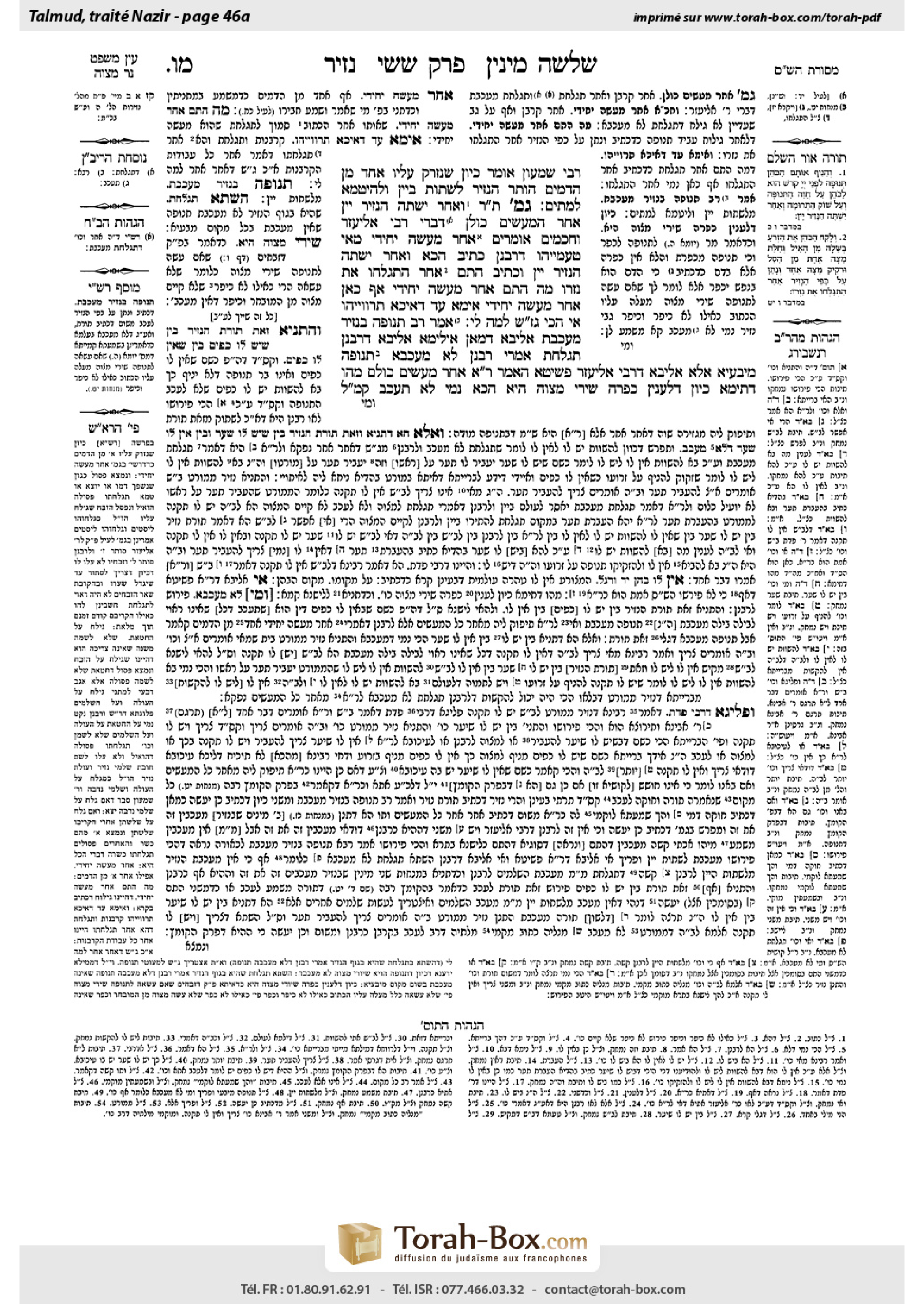
Nazir 46a: Talmud study for Daf Yomi
Daf Yomi is the daily study of one Talmud folio. Explore 37 tractates with scans, Hebrew text, Sefaria English and AI-generated French translations where annotated.
Passage selection and English or AI-generated French translation are available where the scan has annotations. Daf Study is independent of Torah-Box and Sefaria.
Browse Nazir · נזיר · All tractatesNazir 46a text and translations
This page of Nazir includes the Aramaic text, an English translation and an AI-generated French translation, alongside the scan above.
נזיר מ״ו א · Aramaic and Hebrew text
רַבִּי שִׁמְעוֹן אוֹמֵר: כֵּיוָן שֶׁנִּזְרַק עָלָיו אֶחָד מִן הַדָּמִים — הוּתַּר הַנָּזִיר לִשְׁתּוֹת בְּיַיִן וּלְהִיטַּמֵּא לְמֵתִים.
גְּמָ׳ תָּנוּ רַבָּנַן: ״וְאַחַר יִשְׁתֶּה הַנָּזִיר יַיִן״ — אַחַר הַמַּעֲשִׂים כּוּלָּן, דִּבְרֵי רַבִּי אֱלִיעֶזֶר. וַחֲכָמִים אוֹמְרִים: אַחַר מַעֲשֶׂה יְחִידִי.
מַאי טַעְמַיְיהוּ דְּרַבָּנַן? כְּתִיב הָכָא ״וְאַחַר יִשְׁתֶּה הַנָּזִיר יָיִן״, וּכְתִיב הָתָם ״אַחַר הִתְגַּלְּחוֹ אֶת נִזְרוֹ״. מָה הָתָם ״אַחַר״ — מַעֲשֶׂה יְחִידִי, אַף כָּאן ״אַחַר״ — מַעֲשֶׂה יְחִידִי.
אֵימָא עַד דְּאִיכָּא תַּרְוַויְיהוּ! אִי הָכִי, גְּזֵירָה שָׁוָה לְמָה לִי?
אָמַר רַב: תְּנוּפָה בְּנָזִיר מְעַכֶּבֶת. אַלִּיבָּא דְמַאן? אִילֵימָא אַלִּיבָּא דְרַבָּנַן — תִּגְלַחַת אָמְרִי רַבָּנַן לָא מְעַכְּבָא, תְּנוּפָה מִיבַּעְיָא?
אֶלָּא אַלִּיבָּא דְּרַבִּי אֱלִיעֶזֶר — פְּשִׁיטָא, הָאָמַר רַבִּי אֱלִיעֶזֶר: אַחַר מַעֲשִׂים כּוּלָּם! מַהוּ דְּתֵימָא: כֵּיוָן דִּלְעִנְיַן כַּפָּרָה שְׁיָרֵי מִצְוָה הִיא, הָכָא נָמֵי לָא תְּעַכֵּב, קָא מַשְׁמַע לַן.
Nazir 46a · English translation
Rabbi Shimon says: Once the blood of one of the offerings has been sprinkled on the nazirite’s behalf, the nazirite is permitted to drink wine and to contract ritual impurity imparted by a corpse. The rest of the ritual is not indispensable for his purification.
GEMARA: The Sages taught: It states at the end of the passage dealing with naziriteship: “And after that the nazirite may drink wine” (Numbers 6:20), which means after all the actions, i.e., after he has sacrificed all the offerings and shaved, thereby completing the entire ritual of a nazirite. This is the statement of Rabbi Eliezer. And the Rabbis say: After a single action. He may drink wine after sacrificing one offering, even if he has yet to shave, as shaving is not indispensable for being permitted to drink wine.
The Gemara clarifies: What is the reason of the Rabbis? It is written here: “And after that the nazirite may drink wine,” and it is written there, in the previous verse: “And the priest shall take the cooked foreleg…and place it on the palms of the nazirite after he has shaven his naziriteship” (Numbers 6:19). It is derived by verbal analogy: Just as there the term “after” means after a single action, i.e., shaving, here too, the term “after” means after a single action, sacrificing one offering.
The Gemara asks: Perhaps one can say that a nazirite is not permitted to drink wine until there are both actions, i.e., sacrificing an offering and shaving, as implied by a straightforward reading of the verse. The Gemara answers: If so, why do I need this verbal analogy? It must be teaching that a nazirite can drink wine after the performance of a single action.
§ Rav said: The priest’s lack of waving of the offering of a nazirite precludes the release of the prohibitions of his naziriteship. The Gemara asks: According to whose opinion did Rav state this halakha? If we say that he spoke in accordance with the opinion of the Rabbis, this is difficult, as the Rabbis say that even lack of shaving does not preclude the completion of his naziriteship. Is it necessary, then, to state that waving, which is not indispensable in the case of other offerings, is not essential for the ritual of a nazirite?
Rather, will you say that it is in accordance with the opinion of Rabbi Eliezer, who permits a nazirite to drink wine only after he has completed the entire ritual? This is obvious; didn’t Rabbi Eliezer say that he is permitted to drink wine only after all the actions are completed? The Gemara answers that the statement is necessary, lest you say: Since with regard to the atonement effected by all other offerings, waving is considered a peripheral aspect of the mitzva, i.e., one achieves atonement even if he did not perform the ritual of waving, here too its lack does not preclude the release of a nazirite’s prohibitions. Rav therefore teaches us that according to the opinion of Rabbi Eliezer waving is essential in the case of a nazirite.
Nazir 46a · Traduction française (IA)
Rabbi Shimon dit : Dès que le sang de l’un des sacrifices a été aspergé en faveur du nazir, celui-ci est autorisé à boire du vin et à contracter l’impureté rituelle transmise par un cadavre. Le reste du rituel n’est pas indispensable à sa purification.
GUEMARA : Les Sages ont enseigné : À la fin du passage consacré au naziréat, il est écrit : « Et après cela, le nazir pourra boire du vin » (Nombres 6,20). Cela signifie après l’accomplissement de toutes les actions, c’est-à-dire après qu’il a offert tous les sacrifices et s’est rasé, achevant ainsi l’ensemble du rituel du nazir. Telle est l’opinion de Rabbi Eliezer. Les Rabbins disent : après une seule action. Il peut boire du vin après avoir offert un sacrifice, même s’il ne s’est pas encore rasé, car le rasage n’est pas indispensable pour être autorisé à boire du vin.
La Guemara précise : Quelle est la raison des Rabbins ? Il est écrit ici : « Et après cela, le nazir pourra boire du vin », et il est écrit là, dans le verset précédent : « Le prêtre prendra la cuisse cuite… et la posera sur les paumes du nazir après qu’il se sera rasé de son naziréat » (Nombres 6,19). On le déduit par analogie verbale : de même que là, le terme « après » signifie après une seule action, à savoir le rasage, ici aussi, le terme « après » signifie après une seule action, à savoir l’offrande d’un sacrifice.
La Guemara demande : Peut-être peut-on dire qu’un nazir n’est autorisé à boire du vin qu’après avoir accompli les deux actions, c’est-à-dire offert un sacrifice et s’être rasé, comme le suggère une lecture simple du verset. La Guemara répond : Si tel était le cas, pourquoi aurait-on besoin de cette analogie verbale ? Elle doit enseigner qu’un nazir peut boire du vin après l’accomplissement d’une seule action.
§ Rav dit : Le fait que le prêtre n’ait pas procédé à la présentation par balancement du sacrifice d’un nazir empêche la levée des interdictions liées à son naziréat. La Guemara demande : Selon l’opinion de qui Rav a-t-il énoncé cette halakha ? Si l’on dit qu’il l’a énoncée conformément à l’opinion des Rabbins, cela pose difficulté, car les Rabbins disent que même l’absence de rasage n’empêche pas l’achèvement de son naziréat. Est-il donc nécessaire de préciser que la présentation par balancement, qui n’est pas indispensable pour les autres sacrifices, n’est pas essentielle au rituel du nazir ?
Il faudrait plutôt dire que Rav s’exprime conformément à l’opinion de Rabbi Eliezer, qui n’autorise le nazir à boire du vin qu’après l’achèvement de tout le rituel. Mais cela est évident : Rabbi Eliezer n’a-t-il pas dit qu’il n’est autorisé à boire du vin qu’après l’accomplissement de toutes les actions ? La Guemara répond que cette déclaration est nécessaire, de peur que l’on ne dise : puisque, pour l’expiation obtenue par tous les autres sacrifices, la présentation par balancement est considérée comme un aspect secondaire de la mitsva — autrement dit, l’expiation est obtenue même si l’on n’a pas accompli le rite de présentation par balancement —, ici aussi, son omission n’empêche pas la levée des interdictions du nazir. Rav nous enseigne donc que, selon l’opinion de Rabbi Eliezer, la présentation par balancement est essentielle dans le cas d’un nazir.
Traduction française générée par IA à partir de l’édition anglaise de Sefaria. Vérifie toujours un passage avec le texte source.
Text from Sefaria: William Davidson Edition - Vocalized Aramaic (CC BY NC); William Davidson Edition - English (CC BY NC).