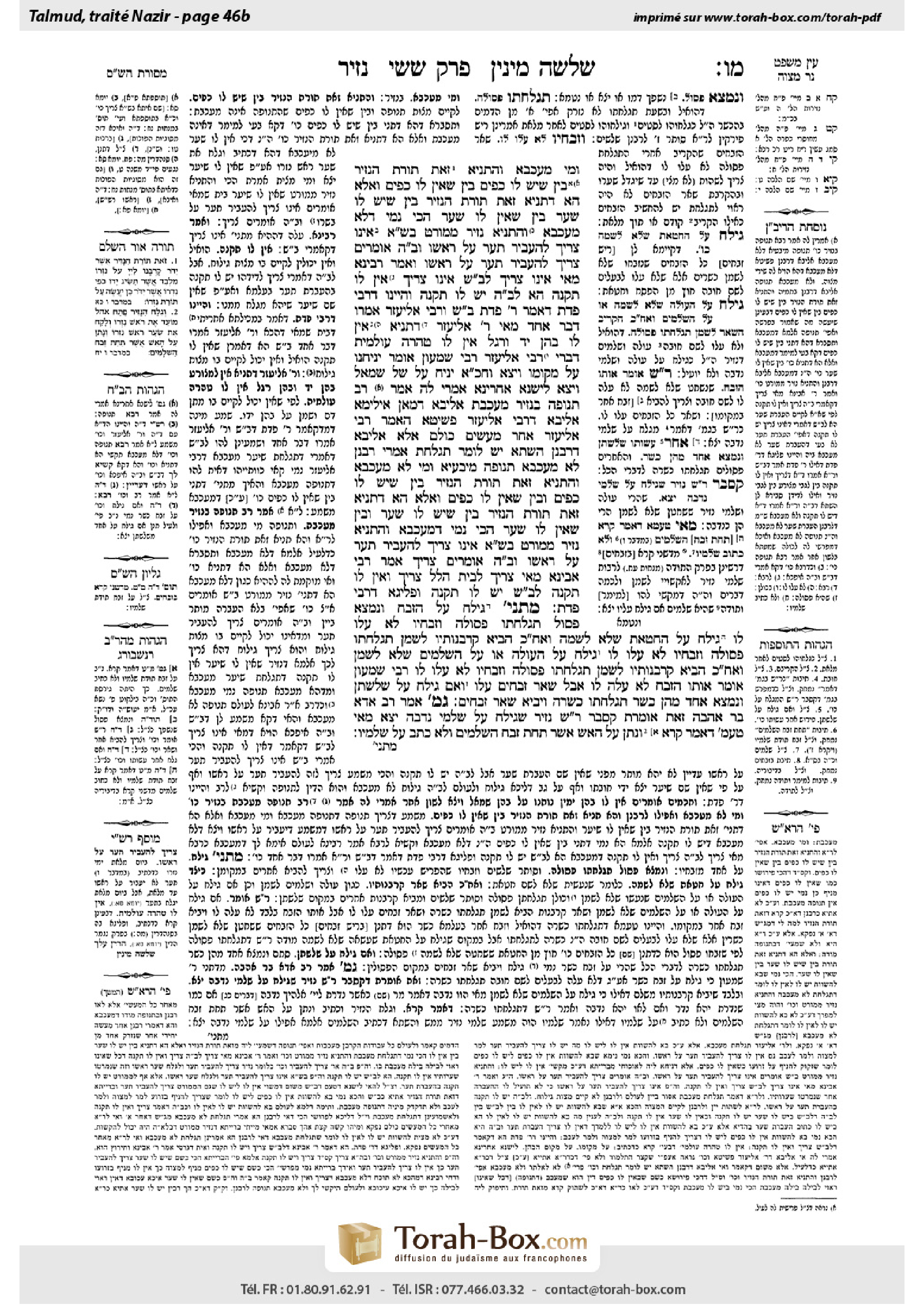
Nazir 46b: Talmud study for Daf Yomi
Daf Yomi is the daily study of one Talmud folio. Explore 37 tractates with scans, Hebrew text, Sefaria English and AI-generated French translations where annotated.
Passage selection and English or AI-generated French translation are available where the scan has annotations. Daf Study is independent of Torah-Box and Sefaria.
Browse Nazir · נזיר · All tractatesNazir 46b text and translations
This page of Nazir includes the Aramaic text, an English translation and an AI-generated French translation, alongside the scan above.
נזיר מ״ו ב · Aramaic and Hebrew text
וּמֵי מְעַכְּבָא? וְהָתַנְיָא: ״זֹאת תּוֹרַת הַנָּזִיר״, בֵּין שֶׁיֵּשׁ לוֹ כַּפַּיִם, בֵּין שֶׁאֵין לוֹ כַּפַּיִם!
וְאֶלָּא הָא דְּתַנְיָא: ״זֹאת תּוֹרַת הַנָּזִיר״, בֵּין שֶׁיֵּשׁ לוֹ שֵׂעָר, בֵּין שֶׁאֵין לוֹ שֵׂעָר — הָכִי נָמֵי דְּלָא מְעַכְּבָא? וְהָתַנְיָא: נָזִיר מְמוֹרָט, בֵּית שַׁמַּאי אוֹמְרִים: אֵינוֹ צָרִיךְ לְהַעֲבִיר תַּעַר עַל רֹאשׁוֹ, וּבֵית הִלֵּל אוֹמְרִים: צָרִיךְ לְהַעֲבִיר תַּעַר עַל רֹאשׁוֹ.
וְאָמַר רָבִינָא: מַאי ״אֵינוֹ צָרִיךְ״ לְבֵית שַׁמַּאי: אֵינוֹ צָרִיךְ — אֵין לוֹ תַּקָּנָה. הָא לְבֵית הִלֵּל יֵשׁ לוֹ תַּקָּנָה!
וְהַיְינוּ דְּרַבִּי פְּדָת. דְּאָמַר רַבִּי פְּדָת: בֵּית שַׁמַּאי וְרַבִּי אֱלִיעֶזֶר אָמְרוּ דָּבָר אֶחָד.
מַאי רַבִּי אֱלִיעֶזֶר, דְּתַנְיָא: אֵין לוֹ בֹּהֶן יָד וָרֶגֶל — אֵין לוֹ טׇהֳרָה עוֹלָמִית, דִּבְרֵי רַבִּי אֱלִיעֶזֶר. רַבִּי שִׁמְעוֹן אוֹמֵר: יַנִּיחֶנּוּ עַל מְקוֹמוֹ וְיֵצֵא. וַחֲכָמִים אוֹמְרִים: יַנִּיחַ עַל שֶׁל שְׂמֹאל וְיֵצֵא.
לִישָּׁנָא אַחֲרִינָא אָמְרִי לַהּ, אָמַר רַב: תְּנוּפָה בְּנָזִיר מְעַכֶּבֶת. אַלִּיבָּא דְּמַאן? אִילֵימָא אַלִּיבָּא דְּרַבִּי אֱלִיעֶזֶר — פְּשִׁיטָא, הָאָמַר רַבִּי אֱלִיעֶזֶר אַחַר מַעֲשִׂים כּוּלָּם! אֶלָּא אַלִּיבָּא דְרַבָּנַן: הַשְׁתָּא יֵשׁ לוֹמַר תִּגְלַחַת אָמְרִי רַבָּנַן לָא מְעַכְּבָא, תְּנוּפָה מִיבַּעְיָא?
וּמִי לָא מְעַכְּבָא? וְהָתַנְיָא: ״זֹאת תּוֹרַת הַנָּזִיר״ — בֵּין שֶׁיֵּשׁ לוֹ כַּפַּיִם וּבֵין שֶׁאֵין לוֹ כַּפַּיִם! וְאֶלָּא הָא דְּתַנְיָא: ״זֹאת תּוֹרַת הַנָּזִיר״ — בֵּין שֶׁיֵּשׁ לוֹ שֵׂעָר וּבֵין שֶׁאֵין לוֹ שֵׂעָר, הָכִי נָמֵי דִּמְעַכְּבָא?
וְהָתַנְיָא: נָזִיר מְמוֹרָט, בֵּית שַׁמַּאי אוֹמְרִים: אֵינוֹ צָרִיךְ לְהַעֲבִיר תַּעַר עַל רֹאשׁוֹ, וּבֵית הִלֵּל אוֹמְרִים: צָרִיךְ! אָמַר רַבִּי אֲבִינָא: מַאי ״צָרִיךְ״ לְבֵית הִלֵּל — צָרִיךְ, וְאֵין לוֹ תַּקָּנָה,
לְבֵית שַׁמַּאי יֵשׁ לוֹ תַּקָּנָה. וּפְלִיגָא דְּרַבִּי פְּדָת.
מַתְנִי׳ גִּילַּח עַל הַזֶּבַח, וְנִמְצָא פָּסוּל — תִּגְלַחְתּוֹ פְּסוּלָה, וּזְבָחָיו לֹא עָלוּ לוֹ. גִּילַּח עַל הַחַטָּאת שֶׁלֹּא לִשְׁמָהּ, וְאַחַר כָּךְ הֵבִיא קׇרְבְּנוֹתָיו לִשְׁמָן, תִּגְלַחְתּוֹ פְּסוּלָה, וּזְבָחָיו לֹא עָלוּ לוֹ. גִּילַּח עַל הָעוֹלָה אוֹ עַל הַשְּׁלָמִים שֶׁלֹּא לִשְׁמָן, וְאַחַר כָּךְ הֵבִיא קׇרְבְּנוֹתָיו לִשְׁמָן — תִּגְלַחְתּוֹ פְּסוּלָה, וּזְבָחָיו לֹא עָלוּ לוֹ.
רַבִּי שִׁמְעוֹן אוֹמֵר: אוֹתוֹ הַזֶּבַח לֹא עָלָה לוֹ, אֲבָל שְׁאָר זְבָחִים עָלוּ. וְאִם גִּילַּח עַל שְׁלָשְׁתָּן, וְנִמְצָא אֶחָד מֵהֶן כָּשֵׁר — תִּגְלַחְתּוֹ כְּשֵׁרָה, וְיָבִיא שְׁאָר זְבָחִים.
גְּמָ׳ אָמַר רַב אַדָּא בַּר אַהֲבָה: זֹאת אוֹמֶרֶת, קָסָבַר רַבִּי שִׁמְעוֹן: נָזִיר שֶׁגִּילַּח עַל שַׁלְמֵי נְדָבָה יָצָא. מַאי טַעְמָא? דְּאָמַר קְרָא: ״וְנָתַן עַל הָאֵשׁ אֲשֶׁר תַּחַת זֶבַח הַשְּׁלָמִים״, וְלֹא כָּתַב ״עַל שְׁלָמָיו״.
Nazir 46b · English translation
The Gemara raises a difficulty against Rabbi Eliezer’s opinion: And does a lack of waving preclude the performance of the purification ritual of a nazirite? But isn’t it taught in a baraita (Tosefta 1:5): The inclusive phrase: “This is the law of the nazirite,” (Numbers 6:21) teaches that all nazirites are bound by the same halakha, whether he has palms, or whether he does not have palms. Since one who is lacking palms certainly cannot wave, this indicates that waving is not essential.
The Gemara refutes this proof: But what about that which is taught in a similar baraita (Tosefta 1:5): “This is the law of the nazirite” whether he has hair or whether he does not have hair; so too, will you explain that lack of shaving does not preclude the ritual in the case of one who has no hair? But isn’t it taught in a baraita (Tosefta 1:6): With regard to an entirely bald nazirite, who cannot shave his hair with a razor as required, Beit Shammai say: He need not pass a razor over his head, and Beit Hillel say: He must pass a razor over his head.
And Ravina said: What is the meaning of the term: Need not, stated by Beit Shammai? It means that he need not shave, and he has no remedy, and he has no way to complete his naziriteship. This indicates that according to Beit Hillel he does have a remedy, i.e., he can pass a razor over his head and thereby fulfill the mitzva, despite the fact that he does not have any hair. Similarly, one can say that Rabbi Eliezer holds that waving is indispensable, and when the baraita states: Whether he has palms or whether he does not have palms, could mean that waving is indispensable.
The Gemara adds: And this interpretation, that Beit Shammai and Rabbi Eliezer maintain one who is unable to perform the action mandated by the Torah has no remedy and cannot complete his naziriteship, is in accordance with a statement of Rabbi Pedat. As Rabbi Pedat said: Beit Shammai and Rabbi Eliezer said the same thing, i.e., they follow the same principle.
To what statement of Rabbi Eliezer is Rabbi Pedat referring? As it is taught in a baraita: A leper who does not have a thumb or big toe, upon both of which he must place the blood and oil of his purification ritual (Leviticus 14:14) can never attain ritual purity. This is the statement of Rabbi Eliezer. Rabbi Shimon says: The priest puts it on the spot of the missing thumb, and the leper thereby fulfills his obligation. The Rabbis say: Let him put it on the left thumb and thereby fulfill his obligation. According to Rabbi Pedat, Rabbi Eliezer and Beit Shammai both maintain that if the ritual cannot be performed in the precise manner delineated, one cannot fulfill his obligation and has no remedy. This is one version of the discussion.
The Gemara cites another version of this discussion. Some say that Rav said: The priest’s lack of waving of the offering of a nazirite precludes the release of the prohibitions of his naziriteship. The Gemara asks: According to whose opinion did he state this halakha? If we say that he spoke in accordance with the opinion of Rabbi Eliezer, this is obvious; didn’t Rabbi Eliezer say that he is permitted to drink wine only after all his actions, including waving? Rather, you will say that Rav spoke in accordance with the opinion of the Rabbis. However, this too is puzzling: Now that one can say that with regard to shaving, a central part of the naziriteship ritual, the Rabbis say that its omission does not preclude the fulfillment of his ritual, is it necessary to state that waving is not essential?
The Gemara asks: And doesn’t the lack of waving preclude a nazirite’s ritual? But isn’t it taught in a baraita (Tosefta 1:5): The inclusive phrase: “This is the law of the nazirite,” teaches that whether he has palms or whether he does not have palms waving is always required, and a nazirite is not exempted by a lack of palms. The Gemara questions this interpretation of the baraita. But what about that which is taught in the same baraita (Tosefta 1:5): “This is the law of the nazirite,” whether he has hair or whether he does not have hair; so too, will you say that the lack of shaving precludes his ritual?
But isn’t it taught in a baraita (Tosefta 1:6): With regard to an entirely bald nazirite, Beit Shammai say: He need not pass a razor over his head, and Beit Hillel say: He must pass a razor over his head. This baraita indicates that even according to the opinion of Beit Hillel a nazirite does not have to actually shave. Rabbi Avina said: What is the meaning of: He must, as stated by Beit Hillel? It means that he must shave, and if he fails to do so he has no remedy, and can never drink wine.
Conversely, according to the opinion of Beit Shammai he has a remedy, as he does not have to use a razor at all. And this interpretation disagrees with the opinion of Rabbi Pedat. Rabbi Pedat claims that both Beit Shammai and Rabbi Eliezer maintain that if the ritual cannot be performed in the precise manner delineated, one cannot fulfill his obligation and has no remedy. By contrast, Rabbi Avina contends that Beit Shammai exempt the nazirite from this obligation, while Beit Hillel say that he has no remedy.
MISHNA: As taught earlier (45a) the nazirite shaves after having brought one, or all, of his offerings. This mishna discusses what the halakha is if the offering was found to be invalid after the nazirite had shaved. If a nazirite shaved based upon the requisite offering, and afterward the offering was found to be invalid for any reason, his shaving is invalid and his offerings do not count toward the fulfillment of his obligation. If he shaved based upon the sin-offering, that was found to have been sacrificed not for its own sake, which invalidates the offering, and afterward he brought his other offerings for their own sake, his shaving is invalid and his other offerings do not count toward the fulfillment of his obligation. If he shaved based upon the requisite burnt-offering or having brought the requisite peace-offering, and these were offered not for their own sake, and afterward he brought his remaining offerings for their own sake, his shaving is invalid and his offerings do not count toward the fulfillment of his obligation.
Rabbi Shimon says: In the case of one who shaved based upon a burnt-offering or a peace-offering that was sacrificed not for its own sake, that offering, which was performed incorrectly, does not count toward the fulfillment of his obligation; however, his other offerings do count. And everyone agrees that if he shaved based upon all three of them, i.e., he brought all three offerings, without specifying which offering he is basing his shaving upon, and even one of them was found valid, his shaving is valid, but he must bring the other offerings in order to fulfill his obligation.
GEMARA: Rav Adda bar Ahava said: That is to say that Rabbi Shimon maintains that a nazirite who shaved based upon voluntary peace-offerings has fulfilled his obligation. A peace-offering that was sacrificed not for its own sake does not count toward the fulfillment of one’s obligation but is considered a voluntary gift-offering. It is clear from the mishna that Rabbi Shimon maintains that shaving based upon any valid offering, even a peace-offering of this type, is effective. What is the reason for this? It is as the verse states: “And put it on the fire which is under the sacrifice of the peace-offering” (Numbers 6:18), and it is not written: On his peace-offering. This indicates that he fulfills his obligation with any type of peace-offering.
Nazir 46b · Traduction française (IA)
La Guemara soulève une difficulté contre l’opinion de Rabbi Eliezer : L’absence d’agitation empêche-t-elle vraiment l’accomplissement du rituel de purification du nazir ? Pourtant, n’est-il pas enseigné dans une baraïta (Tossefta 1:5) : L’expression inclusive « Voici la loi du nazir » (Nombres 6:21) enseigne que la même halakha s’applique à tous les nazirim, qu’ils aient des paumes ou qu’ils n’en aient pas. Puisqu’un homme dépourvu de paumes ne peut certainement pas procéder à l’agitation, cela indique que celle-ci n’est pas indispensable.
La Guemara réfute cette preuve : Mais que dire de ce qui est enseigné dans une baraïta similaire (Tossefta 1:5) : « Voici la loi du nazir », qu’il ait des cheveux ou qu’il n’en ait pas ? Expliquerez-vous également que l’absence de rasage n’empêche pas l’accomplissement du rituel dans le cas de celui qui n’a pas de cheveux ? Pourtant, n’est-il pas enseigné dans une baraïta (Tossefta 1:6) : Au sujet d’un nazir entièrement chauve, qui ne peut pas se raser les cheveux au rasoir comme requis, Beit Chammaï disent : Il n’a pas à passer un rasoir sur sa tête ; et Beit Hillel disent : Il doit passer un rasoir sur sa tête.
Et Ravina a dit : Que signifie l’expression « il n’a pas à », employée par Beit Chammaï ? Cela signifie qu’il n’a pas à se raser, mais qu’il n’a aucun recours et ne peut pas achever son naziréat. Cela indique que, selon Beit Hillel, il a un recours : il peut passer un rasoir sur sa tête et accomplir ainsi la mitsva, bien qu’il n’ait aucun cheveu. De même, on peut dire que Rabbi Eliezer considère l’agitation comme indispensable et que, lorsque la baraïta dit « qu’il ait des paumes ou qu’il n’en ait pas », cela peut signifier que l’agitation est indispensable.
La Guemara ajoute : Cette interprétation, selon laquelle Beit Chammaï et Rabbi Eliezer considèrent que celui qui est incapable d’accomplir l’acte prescrit par la Torah n’a aucun recours et ne peut pas achever son naziréat, concorde avec une déclaration de Rabbi Pedat. Car Rabbi Pedat a dit : Beit Chammaï et Rabbi Eliezer ont dit la même chose, c’est-à-dire qu’ils suivent le même principe.
À quelle déclaration de Rabbi Eliezer Rabbi Pedat fait-il référence ? À ce qui est enseigné dans une baraïta : Un lépreux qui n’a ni pouce ni gros orteil, sur lesquels il doit appliquer le sang et l’huile lors de son rituel de purification (Lévitique 14:14), ne pourra jamais accéder à la pureté rituelle. Telle est la déclaration de Rabbi Eliezer. Rabbi Chimon dit : Le prêtre applique le sang et l’huile à l’emplacement du pouce manquant, et le lépreux s’acquitte ainsi de son obligation. Les Sages disent : Qu’il les applique sur le pouce gauche et qu’il s’acquitte ainsi de son obligation. Selon Rabbi Pedat, Rabbi Eliezer et Beit Chammaï considèrent tous deux que si le rituel ne peut pas être accompli exactement de la manière prescrite, on ne peut pas s’acquitter de son obligation et l’on n’a aucun recours. Telle est l’une des versions de la discussion.
La Guemara cite une autre version de cette discussion. Certains disent que Rav a dit : L’absence d’agitation de l’offrande du nazir par le prêtre empêche la levée des interdits liés à son naziréat. La Guemara demande : Selon l’opinion de qui a-t-il énoncé cette halakha ? Si l’on dit qu’il s’exprimait conformément à l’opinion de Rabbi Eliezer, c’est évident : Rabbi Eliezer n’a-t-il pas dit qu’il ne lui est permis de boire du vin qu’après avoir accompli tous les actes, y compris l’agitation ? Il faut donc dire que Rav s’exprimait conformément à l’opinion des Sages. Mais cela aussi est étonnant : puisqu’on peut dire que, pour le rasage, qui est une partie centrale du rituel du naziréat, les Sages considèrent que son omission n’empêche pas l’accomplissement du rituel, est-il nécessaire de préciser que l’agitation n’est pas indispensable ?
La Guemara demande : L’absence d’agitation n’empêche-t-elle donc pas l’accomplissement du rituel du nazir ? Pourtant, n’est-il pas enseigné dans une baraïta (Tossefta 1:5) : L’expression inclusive « Voici la loi du nazir » enseigne que l’agitation est toujours requise, qu’il ait des paumes ou qu’il n’en ait pas, et qu’un nazir n’en est pas dispensé par l’absence de paumes. La Guemara conteste cette interprétation de la baraïta. Mais que dire de ce qui est enseigné dans la même baraïta (Tossefta 1:5) : « Voici la loi du nazir », qu’il ait des cheveux ou qu’il n’en ait pas ? Direz-vous également que l’absence de rasage empêche l’accomplissement de son rituel ?
Pourtant, n’est-il pas enseigné dans une baraïta (Tossefta 1:6) : Au sujet d’un nazir entièrement chauve, Beit Chammaï disent : Il n’a pas à passer un rasoir sur sa tête ; et Beit Hillel disent : Il doit passer un rasoir sur sa tête. Cette baraïta indique que, même selon Beit Hillel, un nazir n’a pas à se raser réellement. Rabbi Avina a dit : Que signifie « il doit », selon Beit Hillel ? Cela signifie qu’il doit se raser et que, s’il ne le fait pas, il n’a aucun recours et ne pourra jamais boire de vin.
À l’inverse, selon Beit Chammaï, il a un recours, puisqu’il n’a pas du tout à utiliser de rasoir. Cette interprétation est en désaccord avec l’opinion de Rabbi Pedat. Rabbi Pedat soutient que Beit Chammaï et Rabbi Eliezer considèrent tous deux que si le rituel ne peut pas être accompli exactement de la manière prescrite, on ne peut pas s’acquitter de son obligation et l’on n’a aucun recours. En revanche, Rabbi Avina affirme que Beit Chammaï dispensent le nazir de cette obligation, tandis que Beit Hillel considèrent qu’il n’a aucun recours.
MICHNA : Comme cela a été enseigné précédemment (45a), le nazir se rase après avoir apporté une ou toutes ses offrandes. Cette Michna examine la halakha lorsque l’offrande s’avère invalide après que le nazir s’est rasé. Si un nazir s’est rasé en se fondant sur l’offrande requise, puis que celle-ci s’est avérée invalide pour une quelconque raison, son rasage est invalide et ses offrandes ne sont pas prises en compte pour l’accomplissement de son obligation. S’il s’est rasé en se fondant sur le sacrifice expiatoire, qui s’est avéré avoir été offert sans être destiné à ce sacrifice, ce qui invalide l’offrande, puis qu’il a apporté ses autres offrandes en les destinant à leur usage propre, son rasage est invalide et ses autres offrandes ne sont pas prises en compte pour l’accomplissement de son obligation. S’il s’est rasé en se fondant sur l’holocauste requis ou après avoir apporté le sacrifice de paix requis, et que ces sacrifices ont été offerts sans être destinés à leur usage propre, puis qu’il a apporté ses offrandes restantes en les destinant à leur usage propre, son rasage est invalide et ses offrandes ne sont pas prises en compte pour l’accomplissement de son obligation.
Rabbi Chimon dit : Dans le cas de celui qui s’est rasé en se fondant sur un holocauste ou un sacrifice de paix qui a été offert sans être destiné à son usage propre, cette offrande, qui a été accomplie de manière incorrecte, ne compte pas pour l’accomplissement de son obligation ; toutefois, ses autres offrandes comptent. Et tous sont d’accord que s’il s’est rasé en se fondant sur les trois offrandes, c’est-à-dire qu’il les a toutes apportées sans préciser sur laquelle il fondait son rasage, et que l’une d’elles au moins s’est avérée valide, son rasage est valide, mais il doit apporter les autres offrandes afin de s’acquitter de son obligation.
GUEMARA : Rav Adda bar Ahava a dit : On peut donc déduire que Rabbi Chimon considère qu’un nazir qui s’est rasé en se fondant sur des sacrifices de paix volontaires s’est acquitté de son obligation. Un sacrifice de paix offert sans être destiné à son usage propre ne compte pas pour l’accomplissement de l’obligation, mais est considéré comme une offrande volontaire. Il ressort clairement de la Michna que Rabbi Chimon considère que le rasage fondé sur toute offrande valide est opérant, même s’il s’agit d’un sacrifice de paix de ce type. Quelle en est la raison ? C’est ce qu’indique le verset : « Et il le mettra sur le feu qui est sous le sacrifice de paix » (Nombres 6:18), et il n’est pas écrit : « Sur son sacrifice de paix ». Cela indique qu’il s’acquitte de son obligation avec n’importe quel type de sacrifice de paix.
Traduction française générée par IA à partir de l’édition anglaise de Sefaria. Vérifie toujours un passage avec le texte source.
Text from Sefaria: William Davidson Edition - Vocalized Aramaic (CC BY NC); William Davidson Edition - English (CC BY NC).