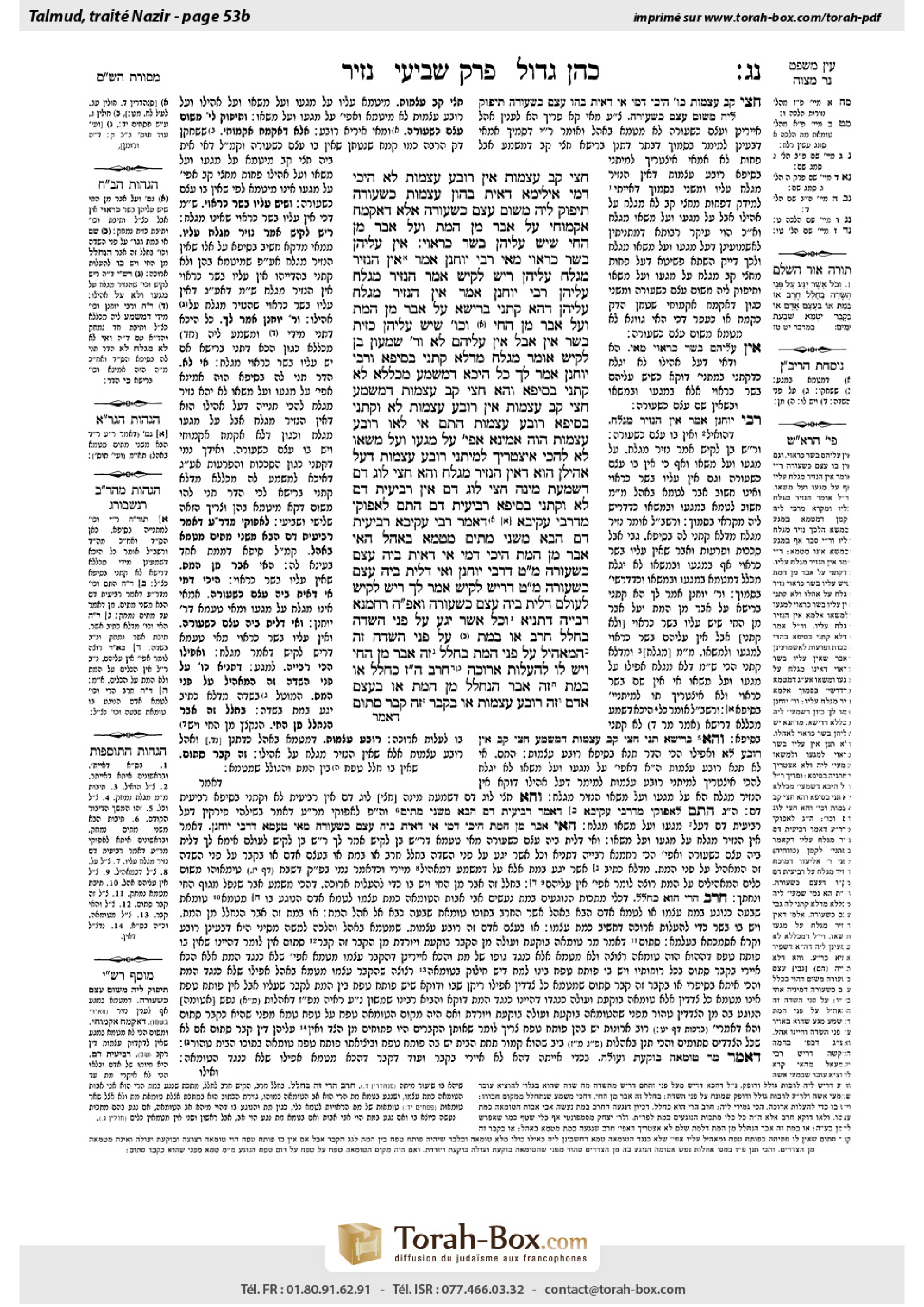
Nazir 53b: Talmud study for Daf Yomi
Daf Yomi is the daily study of one Talmud folio. Explore 37 tractates with scans, Hebrew text, Sefaria English and AI-generated French translations where annotated.
Passage selection and English or AI-generated French translation are available where the scan has annotations. Daf Study is independent of Torah-Box and Sefaria.
Browse Nazir · נזיר · All tractatesNazir 53b text and translations
This page of Nazir includes the Aramaic text, an English translation and an AI-generated French translation, alongside the scan above.
נזיר נ״ג ב · Aramaic and Hebrew text
חֲצִי קַב עֲצָמוֹת — אִין, רוֹבַע עֲצָמוֹת — לָא. הֵיכִי דָמֵי? אִילֵּימָא דְּאִית בְּהוֹן עֲצָמוֹת כִּשְׂעוֹרָה — תִּיפּוֹק לֵיהּ מִשּׁוּם עֶצֶם כִּשְׂעוֹרָה! אֶלָּא דְּאַקְמַח אַקְמוֹחֵי.
עַל אֵבֶר מִן הַמֵּת וְעַל אֵבֶר מִן הַחַי שֶׁיֵּשׁ עֲלֵיהֶן בָּשָׂר כָּרָאוּי. אֵין עֲלֵיהֶן בָּשָׂר כָּרָאוּי, מַאי? רַבִּי יוֹחָנָן אָמַר: אֵין הַנָּזִיר מְגַלֵּחַ עֲלֵיהֶן. רֵישׁ לָקִישׁ אָמַר: הַנָּזִיר מְגַלֵּחַ עֲלֵיהֶן.
רַבִּי יוֹחָנָן אָמַר: אֵין הַנָּזִיר מְגַלֵּחַ עֲלֵיהֶן, דְּהָא קָתָנֵי בְּרֵישָׁא: עַל אֵבֶר מִן הַמֵּת וְעַל אֵבֶר מִן הַחַי וְכוּ׳ שֶׁיֵּשׁ עֲלֵיהֶן כְּזַיִת בָּשָׂר — אִין, אֲבָל אֵין עֲלֵיהֶם — לָא.
וְרַבִּי שִׁמְעוֹן בֶּן לָקִישׁ אוֹמֵר: מְגַלֵּחַ. מִדְּלָא קָתָנֵי בְּסֵיפָא.
וְרַבִּי יוֹחָנָן אָמַר לָךְ: כׇּל הֵיכָא דְּמַשְׁמַע מִכְּלָלָא, לָא קָתָנֵי בְּסֵיפָא.
וְהָא חֲצִי קַב עֲצָמוֹת, דְּמַשְׁמַע חֲצִי קַב עֲצָמוֹת — אִין, רוֹבַע עֲצָמוֹת — לָא, וְקָתָנֵי בְּסֵיפָא רוֹבַע עֲצָמוֹת.
הָתָם אִי לָאו רוֹבַע עֲצָמוֹת, הֲוָה אָמֵינָא: אֲפִילּוּ עַל מַגָּעוֹ וְעַל מַשָּׂאוֹ לָא, לְהָכִי אִיצְטְרִיךְ לְמִיתְנֵי רוֹבַע עֲצָמוֹת, דְּעַל אֲהִילָן הוּא דְּאֵין הַנָּזִיר מְגַלֵּחַ.
וְהָא חֲצִי לוֹג דָּם, דְּשָׁמְעַתְּ מִינַּהּ חֲצִי לוֹג דָּם — אִין, רְבִיעִית דָּם — לָא, וְקָתָנֵי בְּסֵיפָא רְבִיעִית דָּם! הָתָם, לְאַפּוֹקֵי מִדְּרַבִּי עֲקִיבָא, דְּאָמַר רַבִּי עֲקִיבָא: רְבִיעִית דָּם הַבָּא מִשְּׁנֵי מֵתִים מְטַמֵּא בְּאֹהֶל.
הַאי אֵבֶר מִן הַמֵּת, הֵיכִי דָמֵי? אִי דְּאִית בֵּיהּ עֶצֶם כִּשְׂעוֹרָה, מַאי טַעְמָא דְּרַבִּי יוֹחָנָן? וְאִי דְּלֵית בֵּיהּ עֶצֶם כִּשְׂעוֹרָה, מַאי טַעְמָא דְּרֵישׁ לָקִישׁ? אָמַר לָךְ רֵישׁ לָקִישׁ: לְעוֹלָם דְּלֵית בֵּיהּ עֶצֶם כִּשְׂעוֹרָה, וַאֲפִילּוּ הָכִי רַחֲמָנָא רַבְּיֵיהּ.
דְּתַנְיָא: ״וְכֹל אֲשֶׁר יִגַּע עַל פְּנֵי הַשָּׂדֶה בַּחֲלַל חֶרֶב אוֹ בְמֵת״, ״עַל פְּנֵי הַשָּׂדֶה״ — זֶה הַמַּאֲהִיל עַל פְּנֵי הַמֵּת, ״בַּחֲלַל״ — זֶה אֵבֶר מִן הַחַי וְיֵשׁ לוֹ לְהַעֲלוֹת אֲרוּכָה.
״חֶרֶב״ הֲרֵי זֶה כְּחָלָל, ״אוֹ בְּמֵת״ — זֶה אֵבֶר הַנֶחְלָל מִן הַמֵּת, ״אוֹ בְּעֶצֶם אָדָם״ — זֶה רוֹבַע עֲצָמוֹת, ״אוֹ בְּקֶבֶר״ — זֶה קֶבֶר סָתוּם.
Nazir 53b · English translation
The Gemara analyzes this ruling of the mishna: A half-kav of bones, yes, a nazirite must shave if he contracts impurity from them; a quarter-kav of bones, no, he does not. What are the circumstances? If we say that they contain bones that are a barley-grain-bulk, let the tanna of the mishna derive the halakha that it imparts ritual impurity due to the fact that it is a bone that is a barley-grain-bulk. Rather, the mishna is referring to a situation where it has been made like flour. In that case, a half-kav of bones render people and items impure in a tent, although they do not include a bone the volume of a barley-grain-bulk.
§ The mishna taught that a nazirite shaves for a limb severed from a corpse and for a limb severed from a living person, upon either of which there is a fitting quantity of flesh. The Gemara asks: If there is not a fitting quantity of flesh upon them, what is the halakha? Rabbi Yoḥanan said: The nazirite does not shave for them. Reish Lakish said: The nazirite does shave for them.
The Gemara explains their respective opinions. Rabbi Yoḥanan said: The nazirite does not shave for them, as the tanna teaches in the first clause of the mishna in the list of sources of ritual impurity for which a nazirite must shave: For a limb severed from a corpse and for a limb severed from a living person that contains a fitting quantity of flesh. One can infer from this: Those upon which there is an olive-bulk of flesh, yes, he must shave for them, but if there is not that amount of flesh upon them, no, a nazirite need not shave due to them.
And Rabbi Shimon ben Lakish says that he shaves, employing the following reasoning: From the fact that the mishna does not teach the following in the latter clause, i.e., the subsequent mishna (54a), in the list of sources of impurity for which a nazirite need not shave: A limb that does not contain a fitting quantity of flesh, one can infer that a nazirite is obligated to shave for a limb of that type.
And Rabbi Yoḥanan could have said to you, in response to Rabbi Shimon ben Lakish’s argument: The fact that the mishna omits this case from the list is not proof, as the tanna does not teach in the latter clause anything that can be understood by inference from the earlier mishna.
The Gemara raises a difficulty against this claim of Rabbi Yoḥanan: But the first clause of the mishna lists the case of a half-kav of bones, which indicates: A half-kav of bones, yes, a nazirite must shave for that; a quarter-kav of bones, no, he is not obligated to shave for that. And yet the tanna teaches in the latter clause that a nazirite does not shave for a quarter-kav of bones. This shows that the next mishna does not rely on the rulings of this mishna. Rather, it lists all the items for which a nazirite need not shave.
The Gemara rejects this argument: There, had the tanna not taught a quarter-kav of bones, I would say that he need not shave even for touching it or carrying it. For this reason it was necessary for the mishna to teach the case of a quarter-kav of bones, to indicate that it is only for their ritual impurity contracted in a tent that a nazirite does not shave.
The Gemara raises a further difficulty: But the mishna lists a half-log of blood among those sources of impurity for which a nazirite must shave, from which you can learn that for a half-log of blood, yes, he shaves; for a quarter-log of blood, no, he does not shave. And yet the latter clause of the mishna teaches that he need not shave for a quarter-log of blood. The Gemara answers: It is also necessary to state this halakha unambiguously there, to exclude the opinion of Rabbi Akiva, as Rabbi Akiva said: A quarter-log of blood that comes from two corpses renders people and items impure in a tent, whereas the mishna simply states: A quarter-log, which indicates that all of the blood comes from a single corpse.
The Gemara analyzes the dispute between Rabbi Yoḥanan and Reish Lakish: What are the circumstances of this limb severed from a corpse that is not covered by sufficient flesh? If it contains a bone that is a barley-grain-bulk, what is Rabbi Yoḥanan’s reason for maintaining that a nazirite does not have to shave for this ritual impurity? A bone of this size imparts impurity even if there is no flesh upon it. And if it does not contain a bone that is a barley-grain-bulk, what is Reish Lakish’s reason for saying that a nazirite must shave due to this bone? The Gemara explains that Reish Lakish could have said to you: Actually we are dealing with a limb that does not contain a bone that is a barley-grain-bulk, and even so the Merciful One includes it as a source of ritual impurity.
This is as it is taught in a baraita: “And whoever in the open field touches one who is slain by the sword, or one who dies on his own, or a bone of a man, or a grave, shall be unclean seven days” (Numbers 19:16). This verse is expounded by the Sages as follows: “In the open field”; this is referring to the halakha of one who overlies a corpse, even without touching it. “One who is slain”; this is referring to a limb slain, i.e., severed, from a living person, that contains enough flesh for the limb to heal.
The Sages further derive from the phrase “one who is slain by the sword” that the legal status of a metal sword in terms of its degree of ritual impurity is like that of one who is slain, i.e., a metal implement, e.g., a sword, that was rendered impure through contact with a corpse is impure to the same degree of severity as a corpse itself. “Or one who dies on his own”; this is a limb that was slain, i.e., severed, from a corpse and is covered with enough flesh that it would heal if he were alive. “Or a bone of a man”; this is a quarter-kav of bones. “Or a grave”; this is a sealed grave, which imparts impurity when there is less than a handbreadth between the corpse and its cover.
Nazir 53b · Traduction française (IA)
La Guemara analyse cette règle de la Michna : un demi-kav d’ossements, oui, le nazir doit se raser s’il contracte l’impureté à leur contact ; un quart de kav d’ossements, non, il n’a pas à se raser. Dans quelles circonstances ? Si l’on suppose qu’ils contiennent des os ayant le volume d’un grain d’orge, que le tanna de la Michna déduise la halakha qu’ils transmettent l’impureté rituelle du fait qu’il s’agit d’un os ayant le volume d’un grain d’orge ! Il faut plutôt comprendre que la Michna parle d’ossements réduits en poudre. Dans ce cas, un demi-kav d’ossements rend les personnes et les objets impurs sous une tente, même s’ils ne comprennent aucun os ayant le volume d’un grain d’orge.
§ La Michna enseigne que le nazir se rase pour un membre détaché d’un cadavre et pour un membre détaché d’une personne vivante, si l’un ou l’autre contient une quantité suffisante de chair. La Guemara demande : Quelle est la halakha s’ils ne contiennent pas une quantité suffisante de chair ? Rabbi Yoḥanan dit : Le nazir ne se rase pas à cause d’eux. Reish Lakish dit : Le nazir se rase à cause d’eux.
La Guemara explique leurs opinions respectives. Rabbi Yoḥanan dit : Le nazir ne se rase pas à cause d’eux, car le tanna enseigne dans la première partie de la Michna, dans la liste des sources d’impureté rituelle pour lesquelles le nazir doit se raser : un membre détaché d’un cadavre et un membre détaché d’une personne vivante qui contient une quantité suffisante de chair. On peut en déduire que, s’ils contiennent un kazayit de chair, oui, le nazir doit se raser à cause d’eux ; mais s’ils ne contiennent pas cette quantité de chair, non, le nazir n’a pas à se raser à cause d’eux.
Rabbi Shimon ben Lakish, lui, dit que le nazir se rase, selon le raisonnement suivant : puisque la Michna n’enseigne pas dans sa seconde partie, c’est-à-dire dans la Michna suivante (54a), parmi les sources d’impureté pour lesquelles le nazir n’a pas à se raser, le cas d’un membre qui ne contient pas une quantité suffisante de chair, on peut en déduire que le nazir est tenu de se raser à cause d’un membre de ce type.
Et Rabbi Yoḥanan aurait pu te répondre, en réplique à l’argument de Rabbi Shimon ben Lakish : le fait que la Michna omette ce cas de la liste ne prouve rien, car le tanna n’enseigne pas dans la seconde partie un cas dont la halakha peut être déduite de la Michna précédente.
La Guemara soulève une difficulté contre cette affirmation de Rabbi Yoḥanan : pourtant, la première partie de la Michna énumère le cas d’un demi-kav d’ossements, ce qui indique que, pour un demi-kav d’ossements, oui, le nazir doit se raser ; pour un quart de kav d’ossements, non, il n’est pas tenu de se raser. Et pourtant, le tanna enseigne dans la seconde partie qu’un nazir n’a pas à se raser pour un quart de kav d’ossements. Cela montre que la Michna suivante ne s’appuie pas sur les règles de cette Michna. Au contraire, elle énumère tous les éléments pour lesquels le nazir n’a pas à se raser.
La Guemara rejette cet argument : dans ce cas, si le tanna n’avait pas enseigné le cas d’un quart de kav d’ossements, j’aurais dit que le nazir n’a pas à se raser même s’il les touche ou les porte. C’est pourquoi la Michna devait mentionner le cas d’un quart de kav d’ossements, afin d’indiquer que le nazir ne se rase pas uniquement en raison de l’impureté qu’ils transmettent sous une tente.
La Guemara soulève une autre difficulté : pourtant, la Michna compte un demi-log de sang parmi les sources d’impureté pour lesquelles le nazir doit se raser, d’où l’on peut déduire que, pour un demi-log de sang, oui, il se rase ; pour un quart de log de sang, non, il ne se rase pas. Et pourtant, la seconde partie de la Michna enseigne qu’il n’a pas à se raser pour un quart de log de sang. La Guemara répond : il est également nécessaire d’énoncer explicitement cette halakha là-bas, afin d’exclure l’opinion de Rabbi Akiva. En effet, Rabbi Akiva a dit : un quart de log de sang provenant de deux cadavres rend les personnes et les objets impurs sous une tente, tandis que la Michna dit simplement « un quart de log », ce qui indique que tout le sang provient d’un seul cadavre.
La Guemara analyse la controverse entre Rabbi Yoḥanan et Reish Lakish : dans quelles circonstances s’agit-il de ce membre détaché d’un cadavre qui ne contient pas une quantité suffisante de chair ? S’il contient un os ayant le volume d’un grain d’orge, quelle est la raison pour laquelle Rabbi Yoḥanan soutient que le nazir n’a pas à se raser en raison de cette impureté rituelle ? Un os de cette taille transmet l’impureté même s’il n’y a pas de chair dessus. Et s’il ne contient pas d’os ayant le volume d’un grain d’orge, quelle est la raison pour laquelle Reish Lakish dit que le nazir doit se raser à cause de ce membre ? La Guemara explique que Reish Lakish aurait pu te répondre : en réalité, il s’agit d’un membre qui ne contient pas d’os ayant le volume d’un grain d’orge et, malgré cela, le Miséricordieux l’inclut parmi les sources d’impureté rituelle.
C’est ce qui est enseigné dans une baraïta : « Et quiconque, en plein champ, touche un homme tué par l’épée, ou un homme mort de mort naturelle, ou un os humain, ou une tombe, sera impur pendant sept jours » (Nombres 19:16). Les Sages interprètent ce verset ainsi : « En plein champ » fait référence à la halakha de celui qui se trouve au-dessus d’un cadavre, même sans le toucher. « Un homme tué » fait référence à un membre arraché, c’est-à-dire détaché, d’une personne vivante et qui contient assez de chair pour que le membre puisse guérir.
Les Sages déduisent en outre de l’expression « tué par l’épée » que, quant à son degré d’impureté rituelle, le statut d’une épée de métal est semblable à celui d’un homme tué : un ustensile en métal, par exemple une épée, qui est devenu impur au contact d’un cadavre, est impur au même degré que le cadavre lui-même. « Ou un homme mort de mort naturelle » désigne un membre arraché, c’est-à-dire détaché, d’un cadavre et recouvert d’assez de chair pour qu’il puisse guérir si la personne était vivante. « Ou un os humain » désigne un quart de kav d’ossements. « Ou une tombe » désigne une tombe scellée, qui transmet l’impureté lorsque l’espace entre le cadavre et son couvercle est inférieur à une largeur de main.
Traduction française générée par IA à partir de l’édition anglaise de Sefaria. Vérifie toujours un passage avec le texte source.
Text from Sefaria: William Davidson Edition - Vocalized Aramaic (CC BY NC); William Davidson Edition - English (CC BY NC).