Nazir 54a: Talmud study for Daf Yomi
Daf Yomi is the daily study of one Talmud folio. Explore 37 tractates with scans, Hebrew text, Sefaria English and AI-generated French translations where annotated.
Passage selection and English or AI-generated French translation are available where the scan has annotations. Daf Study is independent of Torah-Box and Sefaria.
Browse Nazir · נזיר · All tractatesNazir 54a text and translations
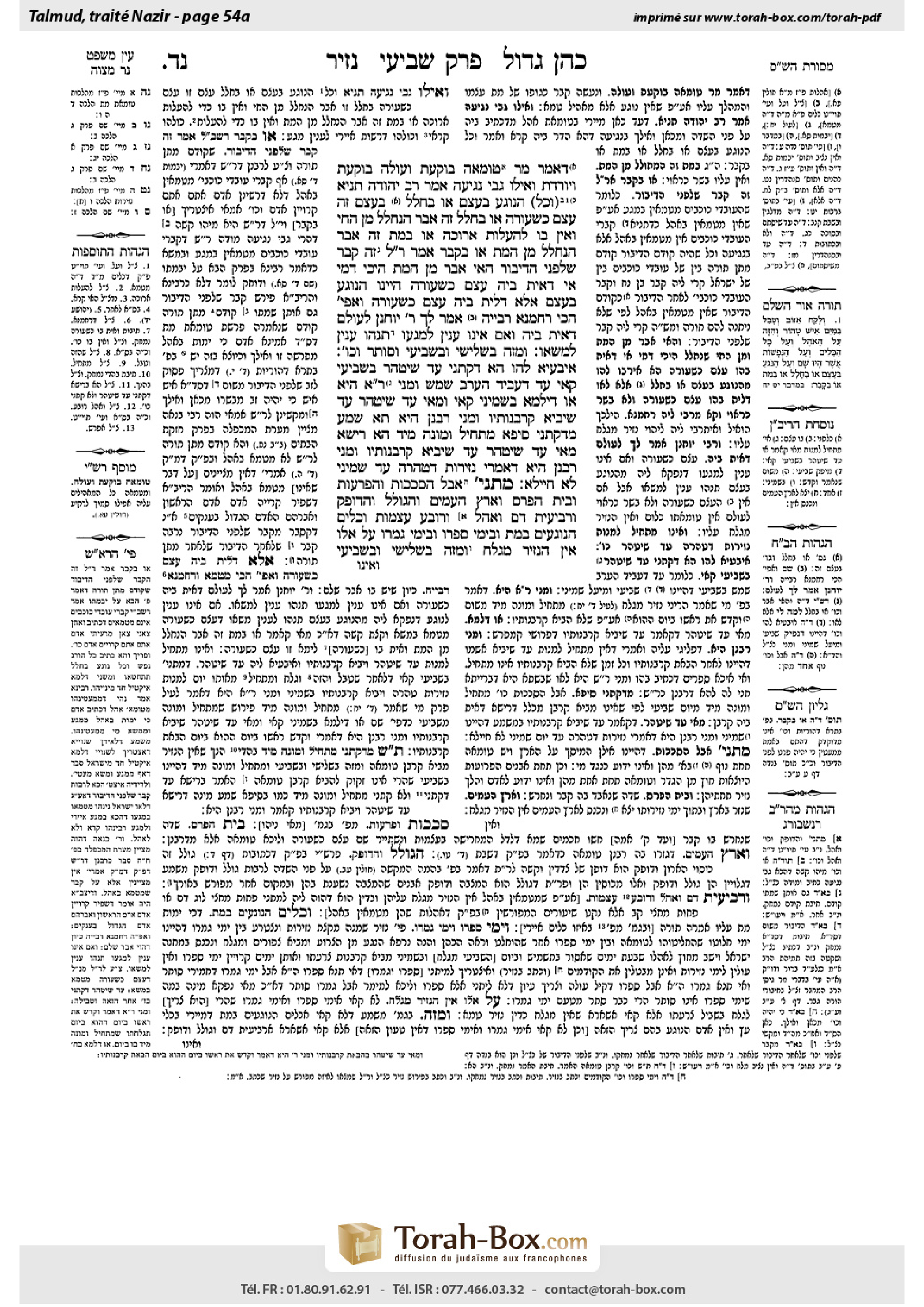
This page of Nazir includes the Aramaic text, an English translation and an AI-generated French translation, alongside the scan above.
נזיר נ״ד א · Aramaic and Hebrew text
דְּאָמַר מָר: טוּמְאָה בּוֹקַעַת וְעוֹלָה, בּוֹקַעַת וְיוֹרֶדֶת. וְאִילּוּ גַּבֵּי נְגִיעָה, אָמַר רַב יְהוּדָה, תַּנְיָא: ״(וְכׇל) הַנּוֹגֵעַ בַּעֶצֶם אוֹ בֶחָלָל״, ״בַּעֶצֶם״ — זֶה עֶצֶם כִּשְׂעוֹרָה, ״אוֹ בֶחָלָל״ — זֶה אֵבֶר הַנֶחְלָל מִן הַחַי וְאֵין בּוֹ לְהַעֲלוֹת אֲרוּכָה,
״אוֹ בְּמֵת״ — זֶה אֵבֶר הַנֶחְלָל מִן הַמֵּת, ״אוֹ בְקָבֶר״ — אָמַר רֵישׁ לָקִישׁ: זֶה קֶבֶר שֶׁלִּפְנֵי הַדִּיבּוּר.
הַאי אֵבֶר מִן הַמֵּת, הֵיכִי דָמֵי? אִי דְּאִית בֵּיהּ עֶצֶם כִּשְׂעוֹרָה הַיְינוּ הַנּוֹגֵעַ בַּעֶצֶם! אֶלָּא דְּלֵית בֵּיהּ עֶצֶם כִּשְׂעוֹרָה, וַאֲפִילּוּ הָכִי רַחֲמָנָא רַבְּיֵיהּ!
אָמַר לָךְ רַבִּי יוֹחָנָן: לְעוֹלָם דְּאִית בֵּיהּ. וְאִם אֵינוֹ עִנְיָן לְמַגָּעוֹ — תְּנֵהוּ עִנְיָן לְמַשָּׂאוֹ.
וּמַזֶּה בַּשְּׁלִישִׁי וּבַשְּׁבִיעִי וְסוֹתֵר וְכוּ׳.
אִיבַּעְיָא לְהוּ: הָא דְּקָתָנֵי ״עַד שֶׁיִּטְהַר״, בַּשְּׁבִיעִי קָאֵי — עַד דְּעָבֵיד הֶעֱרֵב שֶׁמֶשׁ, וּמַנִּי — רַבִּי אֱלִיעֶזֶר הִיא. אוֹ דִילְמָא בַּשְּׁמִינִי קָאֵי, וּמַאי ״עַד שֶׁיִּטְהַר״ — עַד שֶׁיָּבִיא קׇרְבְּנוֹתָיו. וּמַנִּי — רַבָּנַן הִיא?
תָּא שְׁמַע, מִדְּקָתָנֵי סֵיפָא: ״מַתְחִיל וּמוֹנֶה מִיָּד״, הָא רֵישָׁא מַאי ״עַד שֶׁיִּטְהַר״ — עַד שֶׁיָּבִיא קׇרְבְּנוֹתָיו, וּמַנִּי — רַבָּנַן הִיא דְּאָמְרִי: נְזִירוּת דְּטׇהֳרָה עַד שְׁמִינִי לָא חָיְילָא.
מַתְנִי׳ אֲבָל הַסְּכָכוֹת, וְהַפְּרָעוֹת, וּבֵית הַפְּרָס,
וְאֶרֶץ הָעַמִּים, וְהַגּוֹלֵל, וְהַדּוֹפֵק, וּרְבִיעִית דָּם, וְאֹהֶל, וְרוֹבַע עֲצָמוֹת, וְכֵלִים הַנּוֹגְעִים בְּמֵת, וּבִימֵי סְפָרוֹ, וּבִימֵי גְמָרוֹ — עַל אֵלּוּ אֵין הַנָּזִיר מְגַלֵּחַ.
וּמַזֶּה בַּשְּׁלִישִׁי וּבַשְּׁבִיעִי,
Nazir 54a · English translation
As the Master said: Ritual impurity in a sealed grave breaks through and ascends and breaks through and descends, so that the grave imparts impurity like the corpse itself. While with regard to contact with these sources of impurity, Rav Yehuda said that it is taught in a baraita that the verse “and upon him that touched a bone, or the slain, or the dead, or the grave” (Numbers 19:18) is expounded as follows: “A bone”; this is a bone that is a barley-grain-bulk. “Or the slain”; this is a limb slain, i.e., severed, from the living, which does not contain enough flesh for it to heal.
The baraita continues its interpretation of the verse. “Or the dead”; this is a limb slain from a corpse, which is not covered by enough flesh for it to heal were he alive. “Or the grave”; Reish Lakish said: This is a grave that contained a corpse from before the time the command of these halakhot was given to the Jewish people. These graves render people and items ritually impure by contact, but do not carry the halakhot of impurity imparted in a tent.
The Gemara asks: With regard to this limb from a corpse, which is listed above as imparting ritual impurity by contact, what are the circumstances of the case? If the limb contains a bone that is a barley-grain-bulk, this is included in the halakha of one who touches a bone, and it was already taught that a bone imparts impurity by contact. Rather, it must be that it does not contain a bone that is a barley-grain-bulk, and even so the Merciful One includes it in the halakhot of impurity, despite the fact that it does not contain enough flesh. This indicates that a nazirite shaves for a limb of this kind, in accordance with the opinion of Reish Lakish.
The Gemara responds: In answer to this proof of Reish Lakish, Rabbi Yoḥanan could have said to you: Actually, you should explain that it does contain a bone the volume of a barley-grain-bulk, and if it does not need to refer to the matter of its contact, as the verse explicitly states: “Anyone who touches a bone,” have it refer to the matter of its carrying, i.e., that one who carries it is also rendered ritually impure.
§ The mishna taught with regard to any nazirite who became impure from one of the listed sources of impurity: And a priest sprinkles the ashes of the red heifer on him on the third and on the seventh days, and he negates all the previous days he counted toward his naziriteship, and he does not begin counting a fresh term of naziriteship until after he becomes pure and brings his offerings.
A dilemma was raised before the Sages: What is the meaning of that which is taught that a nazirite does not start counting until he is purified? Does the mishna refer to one who is standing on the seventh day of his purification and mean: Until he performs the requisite waiting for sunset? And whose opinion is it? It is the opinion of Rabbi Eliezer, who rules that a nazirite starts counting from the eighth day, even before he brings his offerings. Or perhaps it is referring to one who is standing on the eighth day. And then, what is the meaning of: Until he is purified? It means: Until he brings his offerings. And who is the author of this opinion? It is the Rabbis, who maintain that he begins his fresh period of naziriteship only after he has sacrificed his offering of impurity (see 18b).
The Gemara answers: Come and hear a resolution of this dilemma from the fact that it teaches in the latter clause of the next mishna that a nazirite who does not have to bring an offering starts counting immediately after the conclusion of his seven days of purification. The Gemara infers from this mishna: If so, what is the meaning of the different term used in the first clause: Until he is purified? It means until he brings his offerings, and whose opinion is it? It is that of the Rabbis, who say that the naziriteship of purity does not commence until the eighth day.
MISHNA: The previous mishna listed the sources of ritual impurity for which a nazirite must shave. This mishna adds: However, the nazirite does not shave for these: The hanging branches over a corpse, i.e., a tree overhanging a body that a nazirite passes, but it is uncertain which branches are over a corpse; and the projecting stones from fences when the place of the impurity is unknown; and a beit haperas, a place that contained a grave and was plowed. In the latter case, the entire area around the grave is impure from a corpse due to an uncertainty, as it might contain human bones.
The mishna continues its list: And the land of the nations, i.e., a nazirite left Eretz Yisrael for another land. The Sages decreed that all land outside of Eretz Yisrael is ritually impure. And the grave cover; and the grave walls upon which the cover rests; and a quarter-log of blood from a corpse; and a tent; and a quarter-kav of bones of a corpse; and vessels that are touching a corpse. And if the nazirite is in the days of his counting, i.e., the seven days a leper must count after purification from his leprosy; or in his days of full leprosy, when he is a full-fledged leper, for these the nazirite does not shave. This is the case even if he is rendered impure by one of the sources listed in the previous mishna.
And in those cases listed that involve ritual impurity from a corpse, one sprinkles the purification water upon him on the third and on the seventh days of his purification,
Nazir 54a · Traduction française (IA)
Comme l’a enseigné le Maître : l’impureté rituelle d’une tombe scellée perce vers le haut, puis vers le bas, de sorte que la tombe transmet l’impureté comme le cadavre lui-même. Quant au contact avec ces sources d’impureté, Rav Yehouda a dit qu’une baraïta enseigne que le verset « et sur celui qui a touché un os, ou un tué, ou un mort, ou une tombe » (Nombres 19,18) s’interprète ainsi : « Un os » désigne un os dont le volume est celui d’un grain d’orge. « Ou un tué » désigne un membre sectionné du vivant, qui ne contient pas assez de chair pour pouvoir guérir.
La baraïta poursuit son interprétation du verset : « Ou un mort » désigne un membre sectionné d’un cadavre, qui n’est pas recouvert d’assez de chair pour guérir s’il était vivant. « Ou une tombe » : Reish Lakish a dit que cela désigne une tombe qui contenait un cadavre avant que le commandement relatif à ces halakhot ait été donné au peuple juif. Ces tombes rendent les personnes et les objets rituellement impurs par contact, mais ne sont pas soumises aux halakhot de l’impureté transmise sous une tente.
La Guemara demande : concernant ce membre provenant d’un cadavre, mentionné plus haut comme transmettant l’impureté rituelle par contact, de quel cas s’agit-il ? S’il contient un os dont le volume est celui d’un grain d’orge, cela relève de la halakha concernant celui qui touche un os, et il a déjà été enseigné qu’un os transmet l’impureté par contact. Il faut donc plutôt dire qu’il ne contient pas d’os dont le volume est celui d’un grain d’orge ; pourtant, le Miséricordieux l’inclut dans les halakhot de l’impureté, bien qu’il ne contienne pas assez de chair. Cela indique qu’un nazir se rase pour un membre de ce type, conformément à l’opinion de Reish Lakish.
La Guemara répond : pour réfuter cette preuve en faveur de Reish Lakish, Rabbi Yoḥanan aurait pu te dire : en réalité, il faut expliquer que le membre contient un os dont le volume est celui d’un grain d’orge. Et s’il n’est pas nécessaire de le mentionner à propos du contact, puisque le verset dit explicitement : « Quiconque touche un os », il faut l’entendre à propos du fait de le porter, c’est-à-dire que celui qui le porte devient lui aussi rituellement impur.
§ La Michna a enseigné, au sujet de tout nazir devenu impur par l’une des sources d’impureté énumérées : un prêtre lui asperge les cendres de la vache rousse le troisième et le septième jour ; il annule tous les jours déjà comptés pour son naziréat et ne commence à compter une nouvelle période de naziréat qu’après être redevenu pur et avoir apporté ses offrandes.
Une question fut posée aux Sages : que signifie l’enseignement selon lequel un nazir ne commence à compter qu’une fois purifié ? La Michna parle-t-elle de celui qui se trouve au septième jour de sa purification et veut-elle dire : jusqu’à ce qu’il attende le coucher du soleil, comme il le faut ? Et de qui est-ce l’opinion ? De Rabbi Eliezer, qui décide qu’un nazir commence à compter à partir du huitième jour, même avant d’apporter ses offrandes. Ou bien parle-t-elle de celui qui se trouve au huitième jour ? Dans ce cas, que signifie « jusqu’à ce qu’il soit purifié » ? Cela signifie : jusqu’à ce qu’il apporte ses offrandes. Et qui est l’auteur de cette opinion ? Les Rabbins, qui soutiennent qu’il ne commence sa nouvelle période de naziréat qu’après avoir offert son sacrifice d’impureté (voir 18b).
La Guemara répond : examinons cette question à la lumière de la clause finale de la Michna suivante, qui enseigne qu’un nazir qui n’a pas à apporter d’offrande commence à compter dès la fin de ses sept jours de purification. La Guemara déduit de cette Michna : si tel est le cas, que signifie l’expression différente employée dans la première clause, « jusqu’à ce qu’il soit purifié » ? Cela signifie : jusqu’à ce qu’il apporte ses offrandes. Et de qui est-ce l’opinion ? De celle des Rabbins, qui disent que le naziréat de pureté ne commence qu’au huitième jour.
MICHNA : La Michna précédente a énuméré les sources d’impureté rituelle pour lesquelles un nazir doit se raser. Cette Michna ajoute : toutefois, le nazir ne se rase pas dans les cas suivants : les branches qui surplombent un cadavre, c’est-à-dire un arbre surplombant un corps près duquel passe un nazir, alors qu’on ne sait pas quelles branches surplombent le cadavre ; les pierres en saillie de clôtures, lorsque l’emplacement de l’impureté est inconnu ; et un beit haperas, un lieu où se trouvait une tombe et qui a été labouré. Dans ce dernier cas, toute la zone autour de la tombe est impure à cause d’un cadavre, en raison d’un doute : elle pourrait contenir des ossements humains.
La Michna poursuit son énumération : le territoire des nations, c’est-à-dire le cas où un nazir a quitté la terre d’Israël pour se rendre dans un autre pays. Les Sages ont décrété que toutes les terres situées hors de la terre d’Israël sont rituellement impures. Sont également concernés le couvercle d’une tombe, les parois de la tombe sur lesquelles repose le couvercle, un quart de log de sang provenant d’un cadavre, une tente, un quart de kav d’ossements d’un cadavre et des ustensiles qui touchent un cadavre. Si le nazir est dans les jours de son compte, c’est-à-dire les sept jours qu’un lépreux doit compter après avoir été purifié de sa lèpre, ou dans les jours où il est pleinement lépreux, il ne se rase pas pour ces cas. Cela reste vrai même s’il devient impur par l’une des sources énumérées dans la Michna précédente.
Et, dans les cas énumérés qui impliquent une impureté rituelle due à un cadavre, on l’asperge d’eau de purification le troisième et le septième jour de sa purification.
Traduction française générée par IA à partir de l’édition anglaise de Sefaria. Vérifie toujours un passage avec le texte source.
Text from Sefaria: William Davidson Edition - Vocalized Aramaic (CC BY NC); William Davidson Edition - English (CC BY NC).