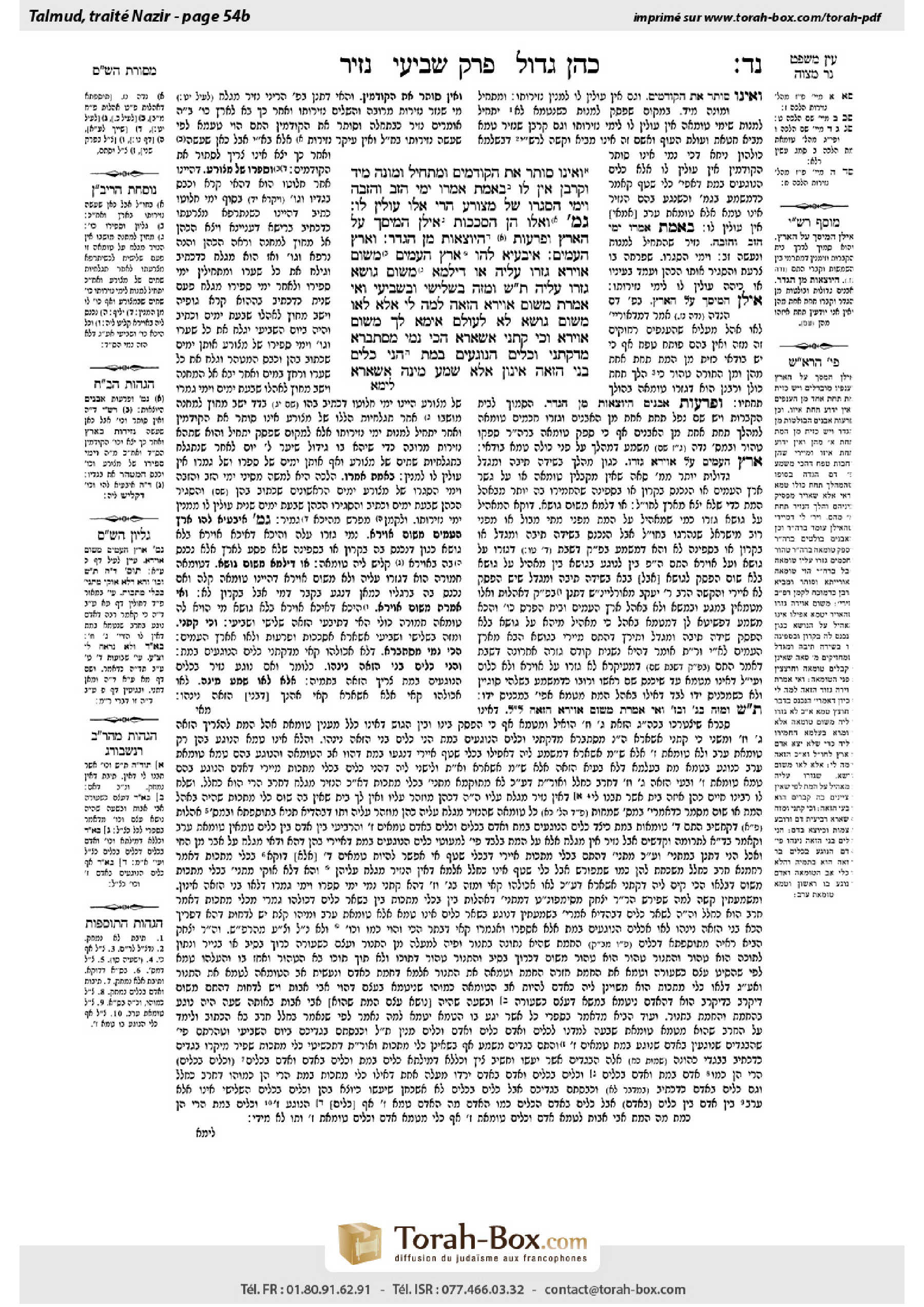
Nazir 54b: Talmud study for Daf Yomi
Daf Yomi is the daily study of one Talmud folio. Explore 37 tractates with scans, Hebrew text, Sefaria English and AI-generated French translations where annotated.
Passage selection and English or AI-generated French translation are available where the scan has annotations. Daf Study is independent of Torah-Box and Sefaria.
Browse Nazir · נזיר · All tractatesNazir 54b text and translations
This page of Nazir includes the Aramaic text, an English translation and an AI-generated French translation, alongside the scan above.
נזיר נ״ד ב · Aramaic and Hebrew text
וְאֵינוֹ סוֹתֵר אֶת הַקּוֹדְמִים, וּמַתְחִיל וּמוֹנֶה מִיָּד, וְקׇרְבָּן אֵין לוֹ. בֶּאֱמֶת אָמְרוּ: יְמֵי הַזָּב וְהַזָּבָה וִימֵי הֶסְגֵּרוֹ שֶׁל מְצוֹרָע, הֲרֵי אֵלּוּ עוֹלִין לוֹ.
גְּמָ׳ וְאֵלּוּ הֵן הַסְּכָכוֹת — אִילָן הַמֵּיסֵךְ עַל הָאָרֶץ. וּפְרָעוֹת — הַיּוֹצְאוֹת מִן הַגָּדֵר.
וְאֶרֶץ הָעַמִּים. אִיבַּעְיָא לְהוּ: אֶרֶץ הָעַמִּים, מִשּׁוּם אַוֵּירָא גָּזְרוּ עָלֶיהָ, אוֹ דִילְמָא מִשּׁוּם גּוּשָּׁא גָּזְרוּ עָלֶיהָ?
תָּא שְׁמַע: וּמַזֶּה בַּשְּׁלִישִׁי וּבַשְּׁבִיעִי. וְאִי אָמְרַתְּ מִשּׁוּם אַוֵּירָא, הַזָּאָה לְמָה לִי?
אֶלָּא לָאו, מִשּׁוּם גּוּשָּׁא? לָא, לְעוֹלָם אֵימָא לָךְ מִשּׁוּם אַוֵּירָא, וְכִי קָתָנֵי — אַשְּׁאָרָא.
הָכִי נָמֵי מִסְתַּבְּרָא, מִדְּקָתָנֵי: וְכֵלִים הַנּוֹגְעִים בְּמֵת. הָנֵי כֵּלִים בְּנֵי הַזָּאָה אִינּוּן? אֶלָּא שְׁמַע מִינַּהּ אַשְּׁאָרָא.
Nazir 54b · English translation
and he does not negate the earlier days of his naziriteship, but they are considered part of his naziriteship term. And he starts counting the rest of his naziriteship to complete his term immediately after his purification, and he has no obligation to sacrifice an offering of impurity for these sources of ritual impurity. Actually they said an ancient tradition that these days of the impurity of the zav (Leviticus 15:1–15) and the zava (Leviticus 15:25–30) and the days of the confinement of a leper before he is confirmed as a full-fledged leper (Leviticus 13:4–5) count for him toward the period of his naziriteship.
GEMARA: The Gemara explains the terms hangings and projections by citing a mishna (Oholot 8:2). And these are the hangings: A tree that overhangs the earth. And the projections are stones that protrude from a fence.
§ The mishna further taught: And the land of the nations does not render a nazirite obligated to shave, despite the fact that it is considered ritually impure. The Gemara inquires with regard to the nature of this impurity. A dilemma was raised before the Sages: Did the Sages decree the land of the nations impure with regard to the air, i.e., is one rendered impure merely by being there? Or perhaps they decreed it impure with regard to the earth, i.e., one who touches the ground or overlays it becomes impure.
The Gemara suggests: Come and hear a resolution to this question from the mishna, which lists one who enters the land of the nations and states: And one sprinkles on him on the third and on the seventh days. And if you say that the decree was with regard to the air, why do I need this sprinkling? He neither touched something ritually impure nor overlaid it.
Rather, is it not with regard to the earth that the land of the nations was decreed impure? The Gemara rejects this proof: No, actually I could say to you that the decree is due to the air, and when the mishna teaches that he receives the sprinkling, it is referring to the other items listed in the mishna, e.g., the grave cover, the grave walls, and a quarter-log of blood.
The Gemara comments: So too, it is reasonable that this is the case, from the fact that the mishna also teaches: And vessels that are touching a corpse. Now do people who touch these vessels require sprinkling? Does one who touches a vessel that is ritually impure from a corpse require the sprinkling of purification water? This individual is impure only until that evening. Rather, learn from this that the halakha that he is sprinkled on the third and on the seventh days does not refer to all the cases in the mishna but only to some of the others.
Nazir 54b · Traduction française (IA)
et il n’annule pas les jours antérieurs de son naziréat, mais ceux-ci sont considérés comme faisant partie de la durée de son naziréat. Il commence à compter le reste de son naziréat afin d’achever sa période immédiatement après sa purification, et il n’est pas tenu d’apporter un sacrifice pour impureté en raison de ces sources d’impureté rituelle. En réalité, ils ont transmis une ancienne tradition selon laquelle les jours d’impureté du zav (Lévitique 15, 1-15) et de la zava (Lévitique 15, 25-30), ainsi que les jours de réclusion d’un lépreux avant qu’il ne soit déclaré lépreux à part entière (Lévitique 13, 4-5), sont comptés pour lui dans la durée de son naziréat.
GUEMARA : La Guemara explique les termes « surplombs » et « saillies » en citant une Michna (Ohalot 8, 2). Les surplombs sont les branches d’un arbre qui s’étendent au-dessus du sol. Les saillies sont des pierres qui dépassent d’une clôture.
§ La Michna enseigne également que la terre des nations n’oblige pas le nazir à se raser, bien qu’elle soit considérée comme rituellement impure. La Guemara s’interroge sur la nature de cette impureté. Les Sages se sont posé la question suivante : les Sages ont-ils décrété que la terre des nations est impure en raison de l’air, c’est-à-dire qu’on devient impur simplement en s’y trouvant ? Ou bien ont-ils décrété qu’elle est impure en raison du sol, c’est-à-dire que celui qui touche le sol ou le recouvre devient impur ?
La Guemara propose : « Viens et entends » une réponse à cette question tirée de la Michna, qui énumère celui qui entre en terre des nations et enseigne : « On fait l’aspersion sur lui le troisième et le septième jour. » Si tu dis que le décret concerne l’air, pourquoi cette aspersion est-elle nécessaire ? Il n’a ni touché un élément rituellement impur ni recouvert un tel élément.
La terre des nations n’a-t-elle donc pas été décrétée impure en raison du sol ? La Guemara rejette cette preuve : « Non, en réalité, je pourrais te dire que le décret concerne l’air ; et lorsque la Michna enseigne qu’on fait l’aspersion sur lui, elle fait référence aux autres éléments énumérés dans la Michna, par exemple le couvercle d’une tombe, les parois d’une tombe et un quart de log de sang. »
La Guemara fait remarquer : « Il est donc raisonnable que ce soit le cas, puisque la Michna enseigne également : “Et les récipients qui sont en contact avec un cadavre.” » Or, ceux qui touchent ces récipients ont-ils besoin d’une aspersion ? Celui qui touche un récipient rendu rituellement impur par un cadavre a-t-il besoin de l’aspersion d’eau de purification ? Cet individu n’est impur que jusqu’au soir. Il faut donc en déduire que la règle selon laquelle on fait l’aspersion sur lui le troisième et le septième jour ne concerne pas tous les cas de la Michna, mais seulement certains des autres cas.
Traduction française générée par IA à partir de l’édition anglaise de Sefaria. Vérifie toujours un passage avec le texte source.
Text from Sefaria: William Davidson Edition - Vocalized Aramaic (CC BY NC); William Davidson Edition - English (CC BY NC).