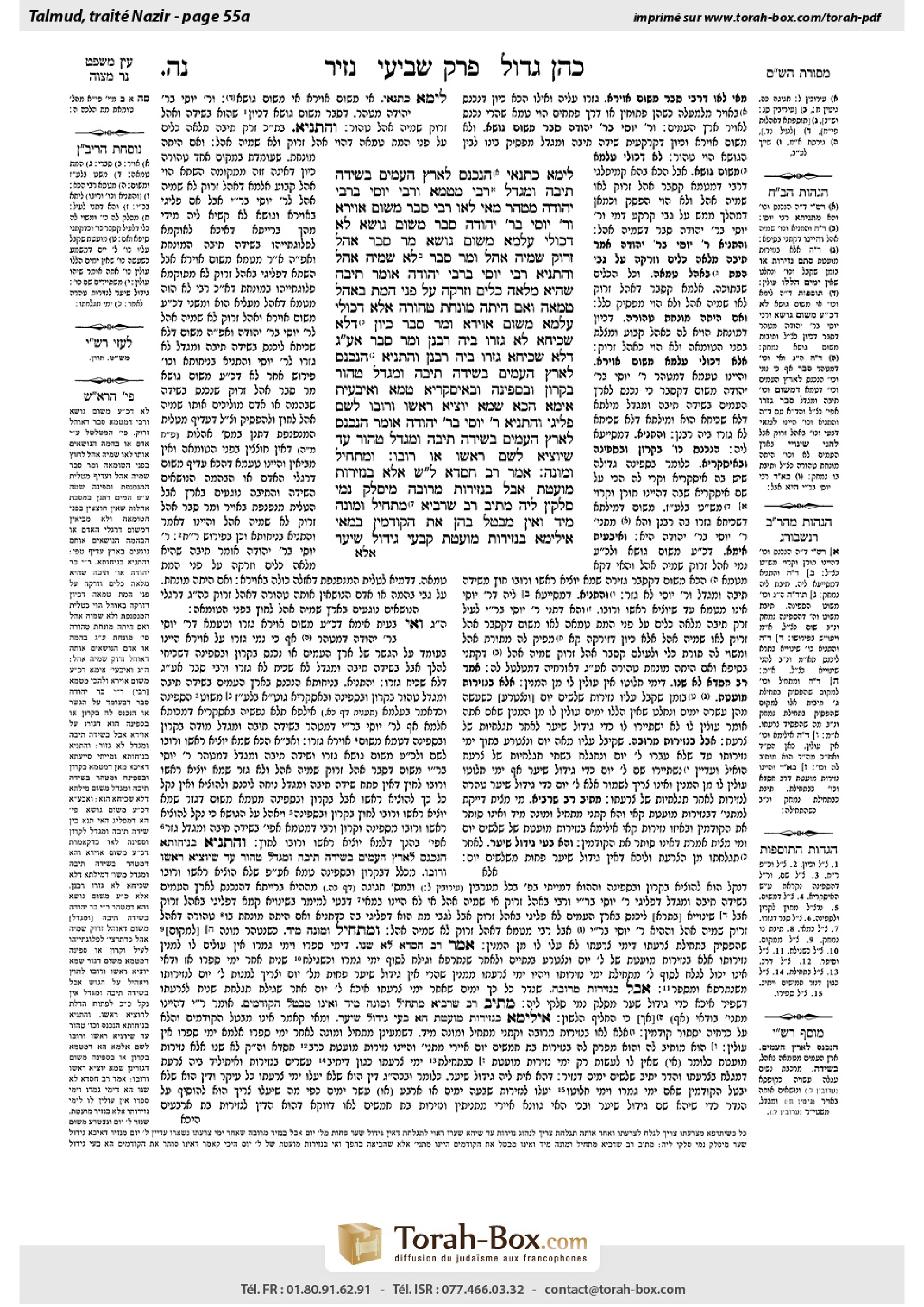
Nazir 55a: Talmud study for Daf Yomi
Daf Yomi is the daily study of one Talmud folio. Explore 37 tractates with scans, Hebrew text, Sefaria English and AI-generated French translations where annotated.
Passage selection and English or AI-generated French translation are available where the scan has annotations. Daf Study is independent of Torah-Box and Sefaria.
Browse Nazir · נזיר · All tractatesNazir 55a text and translations
This page of Nazir includes the Aramaic text, an English translation and an AI-generated French translation, alongside the scan above.
נזיר נ״ה א · Aramaic and Hebrew text
לֵימָא כְּתַנָּאֵי: הַנִּכְנָס לְאֶרֶץ הָעַמִּים בְּשִׁידָּה תֵּיבָה וּמִגְדָּל, רַבִּי מְטַמֵּא, וְרַבִּי יוֹסֵי בְּרַבִּי יְהוּדָה מְטַהֵר. מַאי לָאו: רַבִּי סָבַר מִשּׁוּם אַוֵּירָא, וְרַבִּי יוֹסֵי בְּרַבִּי יְהוּדָה סָבַר מִשּׁוּם גּוּשָּׁא?
לָא, דְּכוּלֵּי עָלְמָא מִשּׁוּם גּוּשָּׁא. מָר סָבַר: אֹהֶל זָרוּק — שְׁמֵיהּ אֹהֶל, וּמָר סָבַר: לָא שְׁמֵיהּ אֹהֶל.
וְהָתַנְיָא, רַבִּי יוֹסֵי בְּרַבִּי יְהוּדָה אוֹמֵר: תֵּיבָה שֶׁהִיא מְלֵאָה כֵּלִים, וּזְרָקָהּ עַל פְּנֵי הַמֵּת בְּאֹהֶל — טְמֵאָה, וְאִם הָיְתָה מוּנַּחַת — טְהוֹרָה.
אֶלָּא: דְּכוּלֵּי עָלְמָא מִשּׁוּם אַוֵּירָא, וּמָר סָבַר: כֵּיוָן דְּלָא שְׁכִיחָא — לָא גְּזַרוּ בֵּיהּ רַבָּנַן, וּמָר סָבַר: אַף עַל גַּב דְּלָא שְׁכִיחָא — גְּזַרוּ בֵּיהּ רַבָּנַן.
וְהַתַּנְיָא: הַנִּכְנָס לְאֶרֶץ הָעַמִּים בְּשִׁידָּה תֵּיבָה וּמִגְדָּל — טָהוֹר, בְּקָרוֹן וּבִסְפִינָה וּבְאִיסְקַרְיָא — טָמֵא.
וְאִיבָּעֵית אֵימָא: הָכָא שֶׁמָּא יוֹצִיא רֹאשׁוֹ וְרוּבּוֹ לְשָׁם פְּלִיגִי.
וְהָתַנְיָא, רַבִּי יוֹסֵי בְּרַבִּי יְהוּדָה אוֹמֵר: הַנִּכְנָס לְאֶרֶץ הָעַמִּים בְּשִׁידָּה תֵּיבָה וּמִגְדָּל — טָהוֹר, עַד שֶׁיּוֹצִיא לְשָׁם רֹאשׁוֹ אוֹ רוּבּוֹ.
וּמַתְחִיל וּמוֹנֶה. אָמַר רַב חִסְדָּא: לֹא שָׁנוּ אֶלָּא בִּנְזִירוּת מוּעֶטֶת. אֲבָל בִּנְזִירוּת מְרוּבָּה — מִיסְלָק נָמֵי סָלְקִין לֵיהּ.
מֵתִיב רַב שֵׁרֵבְיָא: מַתְחִיל וּמוֹנֶה מִיָּד, וְאֵין מְבַטֵּל בָּהֶן אֶת הַקּוֹדְמִין. בְּמַאי? אִילֵימָא בִּנְזִירוּת מוּעֶטֶת — קָבָעֵי גִּידּוּל שֵׂיעָר!
Nazir 55a · English translation
Let us say that this is parallel to a dispute between tanna’im, as it is taught: With regard to one who enters the land of the nations not on foot but in a chest, a box, or a cabinet, Rabbi Yehuda HaNasi deems him ritually impure. And Rabbi Yosei, son of Rabbi Yehuda, deems him pure. What, is it not correct to say that they disagree in this regard: Rabbi Yehuda HaNasi, who deems him impure, holds that the Sages decreed impurity with regard to the air, and Rabbi Yosei, son of Rabbi Yehuda, holds that the Sages decreed impurity with regard to the earth, and consequently he is not impure, as the container prevents him from overlying the impurity?
The Gemara rejects this suggestion: This is not necessarily the correct interpretation of their dispute, as one can say that everyone agrees that the decree is with regard to the earth, and their dispute concerns only the case of one who enters in a chest, a box, or a cabinet. One Sage, Rabbi Yosei, son of Rabbi Yehuda, holds that a moving tent, an item that serves as a tent as it passes over ritual impurity, is called a tent, and therefore a person who enters the land of the nations in a large container is protected from its impurity. And one Sage, Rabbi Yehuda HaNasi, holds that a moving tent is not called a tent. Consequently, nothing separates this individual from the impurity, and he becomes impure by overlying the land of the nations.
The Gemara asks: But isn’t it taught in a baraita that Rabbi Yosei, son of Rabbi Yehuda, says: A box that is full of utensils that one threw over a corpse in a tent, in such a manner that it overlay the corpse, is impure, and everything inside it is also rendered ritually impure, as it does not provide the protection of a tent. And if it was placed down and positioned as a tent over a corpse, it is pure, and its contents are protected from the impurity. This shows that according to the opinion of Rabbi Yosei, son of Rabbi Yehuda, a moving tent is not considered a tent, which contradicts the above claim.
In light of this argument, the Gemara concedes that the previous explanation of the dispute is incorrect. Rather, one must say that everyone agrees that the decree of impurity concerning the land of the nations is with regard to its air, and one Sage, Rabbi Yosei, son of Rabbi Yehuda, holds that since it is not common for one to move around in an enclosure, the Sages did not decree impurity with regard to this case. And one Sage, Rabbi Yehuda HaNasi, holds that although it is not common the Sages nevertheless decreed impurity with regard to it.
The Gemara adds: And it is taught in the Tosefta (Oholot 18:5) in accordance with this explanation of the opinion of Rabbi Yosei, son of Rabbi Yehuda: One who enters the land of the nations in a chest, a box, or a cabinet is ritually pure. If he was in a wagon [karon], boat, or raft [iskareya], he is ritually impure. The difference is that the latter vessels are commonly used to convey people.
And if you wish, say an alternative explanation of the dispute between Rabbi Yehuda HaNasi and Rabbi Yosei, son of Rabbi Yehuda. Both agree that the ritual impurity of the land of the nations is with regard to the earth, and a moving tent is considered a tent. Therefore, the person in question should be ritually pure according to both opinions. However, here they disagree with regard to a different issue, the concern lest he remove his head and the majority of his body from the chest, box, or cabinet into there, i.e., the land of the nations.
And it is taught likewise in a baraita that Rabbi Yosei, son of Rabbi Yehuda, says: One who enters the land of the nations in a chest, a box, or a cabinet is pure, unless he actually removes his head or the majority of his body into the land of the nations. By contrast, Rabbi Yehuda HaNasi renders him ritually impure due to concern that one’s head might protrude from the container.
§ The mishna taught that a nazirite who became ritually impure through sources of impurity that do not cause him to forfeit his naziriteship, including his days of leprosy, starts counting again from the day of his purification, as his period of impurity does not count toward his naziriteship. Rav Ḥisda said: They taught this halakha of a leper only with regard to a short naziriteship of thirty days, as he shaves his hair for purification from leprosy, and therefore he must count an additional thirty days to allow his hair to grow sufficiently to shave for his naziriteship. However, with regard to a lengthy naziriteship, when thirty days or more remain in his naziriteship after having shaved for his leprosy, those days also count toward his term, and he need not recount his days as a leper.
Rav Sherevya raises an objection from the mishna: He starts counting immediately, and he does not negate the earlier days due to them. To what case is the mishna referring? If we say it is referring to a short naziriteship, he requires a thirty-day period of hair growth, and as he shaved for purification of his leprosy, he must negate the earlier days as a practical manner, to enable his hair to regrow.
Nazir 55a · Traduction française (IA)
Disons que cela correspond à une controverse entre tannaïm, comme il est enseigné : celui qui pénètre dans le pays des nations, non pas à pied, mais dans un coffre, une caisse ou une armoire, Rabbi Yehouda HaNassi le déclare impur, tandis que Rabbi Yossei, fils de Rabbi Yehouda, le déclare pur. N’est-il pas juste de dire qu’ils divergent sur ce point : Rabbi Yehouda HaNassi, qui le déclare impur, estime que les Sages ont décrété l’impureté à l’égard de l’air, tandis que Rabbi Yossei, fils de Rabbi Yehouda, estime qu’ils l’ont décrétée à l’égard du sol ; par conséquent, l’homme n’est pas impur, puisque le contenant l’empêche de surplomber la source d’impureté ?
La Guemara rejette cette suggestion : ce n’est pas nécessairement la bonne interprétation de leur controverse, car on peut dire que tous reconnaissent que le décret concerne le sol et que leur désaccord porte uniquement sur le cas de celui qui entre dans un coffre, une caisse ou une armoire. Un Sage, Rabbi Yossei, fils de Rabbi Yehouda, estime qu’une tente mobile, c’est-à-dire un objet qui fait office de tente lorsqu’il passe au-dessus d’une source d’impureté rituelle, est appelée une tente ; par conséquent, celui qui pénètre dans le pays des nations dans un grand contenant est protégé de son impureté. L’autre Sage, Rabbi Yehouda HaNassi, estime qu’une tente mobile n’est pas appelée une tente. Par conséquent, rien ne sépare cet homme de l’impureté, et il devient impur en surplombant le pays des nations.
La Guemara demande : Mais n’est-il pas enseigné dans une baraïta que Rabbi Yossei, fils de Rabbi Yehouda, dit : une caisse remplie d’ustensiles, qu’on a jetée au-dessus d’un cadavre se trouvant sous une tente, de sorte qu’elle surplombe le cadavre, est impure, et tout ce qui se trouve à l’intérieur devient également rituellement impur, car elle n’assure pas la protection d’une tente. En revanche, si on l’a posée et installée comme une tente au-dessus d’un cadavre, elle est pure, et son contenu est protégé de l’impureté. Cela montre que, selon Rabbi Yossei, fils de Rabbi Yehouda, une tente mobile n’est pas considérée comme une tente, ce qui contredit l’affirmation précédente.
À la lumière de cet argument, la Guemara admet que l’explication précédente de leur controverse est erronée. Il faut plutôt dire que tous reconnaissent que le décret d’impureté concernant le pays des nations porte sur son air, et que Rabbi Yossei, fils de Rabbi Yehouda, estime que, puisque l’on ne se déplace pas habituellement dans un abri, les Sages n’ont pas décrété l’impureté dans ce cas. Rabbi Yehouda HaNassi, quant à lui, estime que, bien que cela ne soit pas courant, les Sages ont néanmoins décrété l’impureté dans ce cas.
La Guemara ajoute : la Tossefta (Oholot 18:5) enseigne également conformément à cette explication de l’opinion de Rabbi Yossei, fils de Rabbi Yehouda : celui qui pénètre dans le pays des nations dans un coffre, une caisse ou une armoire est rituellement pur. S’il se trouve dans un chariot [karon], un bateau ou un radeau [iskareya], il est rituellement impur. La différence tient au fait que ces derniers véhicules servent couramment à transporter des personnes.
Et si tu le souhaites, on peut donner une autre explication de la controverse entre Rabbi Yehouda HaNassi et Rabbi Yossei, fils de Rabbi Yehouda. Tous deux reconnaissent que l’impureté rituelle du pays des nations concerne le sol et qu’une tente mobile est considérée comme une tente. Par conséquent, selon les deux opinions, l’homme en question devrait être rituellement pur. Mais ici, leur désaccord porte sur une autre question : la crainte qu’il ne sorte sa tête et la majeure partie de son corps du coffre, de la caisse ou de l’armoire pour les faire passer dans le pays des nations.
Une baraïta enseigne de même que Rabbi Yossei, fils de Rabbi Yehouda, dit : celui qui pénètre dans le pays des nations dans un coffre, une caisse ou une armoire est pur, à moins qu’il ne sorte effectivement sa tête ou la majeure partie de son corps dans le pays des nations. En revanche, Rabbi Yehouda HaNassi le déclare rituellement impur, par crainte que sa tête ne dépasse du contenant.
§ La Michna enseignait qu’un nazir devenu rituellement impur par des sources d’impureté qui ne lui font pas perdre son statut de nazir, notamment pendant les jours où il est lépreux, recommence à compter à partir du jour de sa purification, car sa période d’impureté ne compte pas pour son naziréat. Rav Ḥisda dit : cette halakha concernant un lépreux n’a été enseignée que pour un naziréat court de trente jours, car il se rase les cheveux pour être purifié de la lèpre ; il doit donc compter trente jours supplémentaires, afin que ses cheveux repoussent suffisamment pour qu’il puisse se raser dans le cadre de son naziréat. Toutefois, dans le cas d’un naziréat de longue durée, lorsqu’il lui reste trente jours ou davantage après s’être rasé à cause de sa lèpre, ces jours comptent également dans la durée de son naziréat, et il n’a pas besoin de recompter les jours où il était lépreux.
Rav Sherevya soulève une objection à partir de la Michna : il recommence immédiatement à compter, et les jours antérieurs ne sont pas annulés pour cette raison. À quel cas la Michna fait-elle référence ? Si nous disons qu’elle parle d’un naziréat court, il lui faut trente jours pour laisser pousser ses cheveux ; puisqu’il s’est rasé afin d’être purifié de sa lèpre, il doit donc, en pratique, retrancher les jours antérieurs pour permettre à ses cheveux de repousser.
Traduction française générée par IA à partir de l’édition anglaise de Sefaria. Vérifie toujours un passage avec le texte source.
Text from Sefaria: William Davidson Edition - Vocalized Aramaic (CC BY NC); William Davidson Edition - English (CC BY NC).