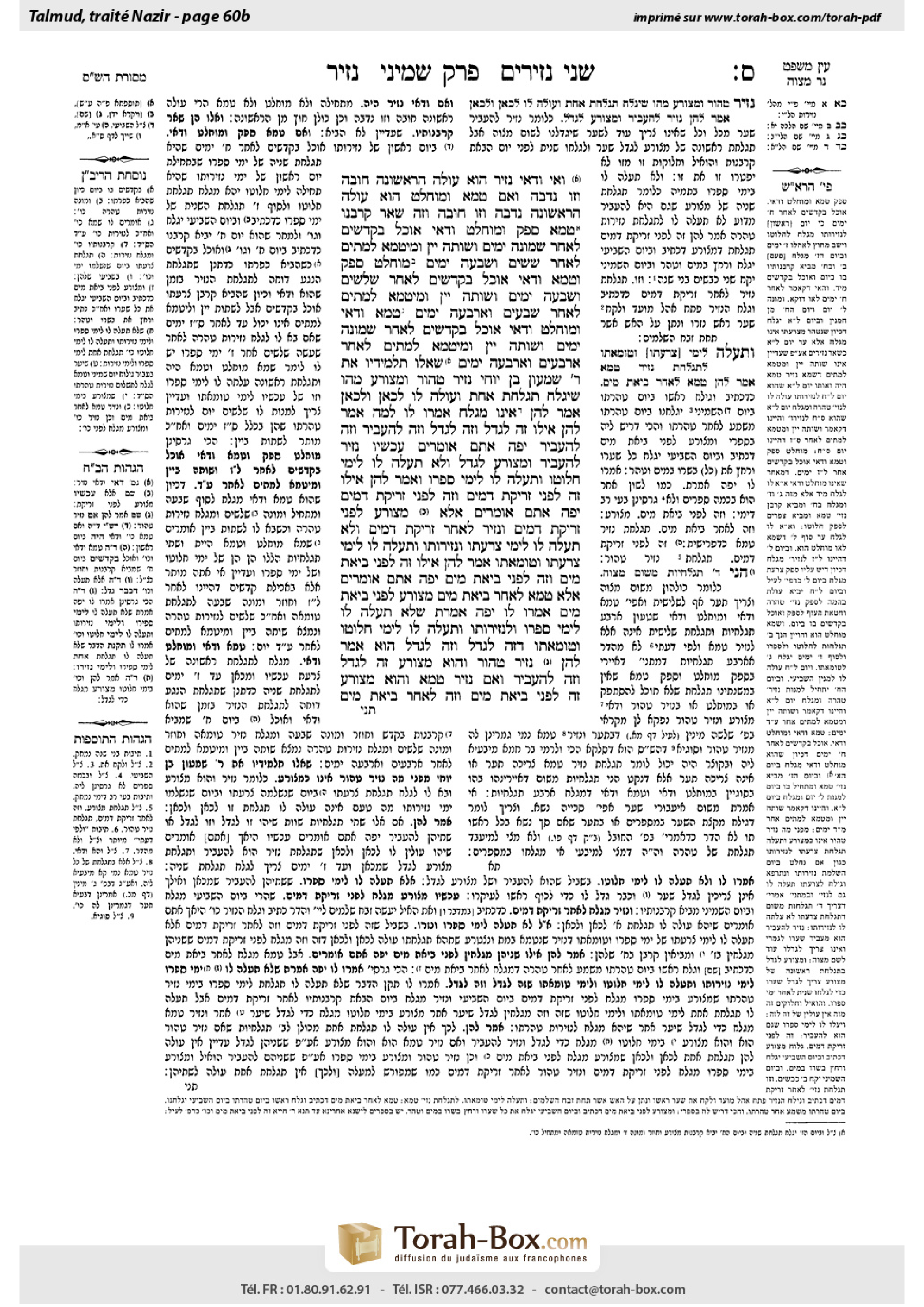
Nazir 60b: Talmud study for Daf Yomi
Daf Yomi is the daily study of one Talmud folio. Explore 37 tractates with scans, Hebrew text, Sefaria English and AI-generated French translations where annotated.
Passage selection and English or AI-generated French translation are available where the scan has annotations. Daf Study is independent of Torah-Box and Sefaria.
Browse Nazir · נזיר · All tractatesNazir 60b text and translations
This page of Nazir includes the Aramaic text, an English translation and an AI-generated French translation, alongside the scan above.
נזיר ס׳ ב · Aramaic and Hebrew text
וְאִי וַדַּאי נָזִיר הוּא — עוֹלָה הָרִאשׁוֹנָה חוֹבָה, וְזוֹ נְדָבָה. וְאִם טָמֵא וּמוּחְלָט הוּא — עוֹלָה הָרִאשׁוֹנָה נְדָבָה, וְזוֹ חוֹבָה, וְזֶה שְׁאָר קׇרְבָּנוֹ.
טָמֵא סָפֵק וּמוּחְלָט וַדַּאי — אוֹכֵל בְּקָדָשִׁים לְאַחַר שְׁמוֹנָה יָמִים, וְשׁוֹתֶה יַיִן וּמִיטַּמֵּא לְמֵתִים לְאַחַר שִׁשִּׁים וְשִׁבְעָה יָמִים.
מוּחְלָט סָפֵק וְטָמֵא וַדַּאי — אוֹכֵל בְּקָדָשִׁים לְאַחַר שְׁלֹשִׁים וְשִׁבְעָה יָמִים, וְשׁוֹתֶה יַיִן וּמִיטַּמֵּא לְמֵתִים לְאַחַר שִׁבְעִים וְאַרְבָּעָה יָמִים.
טָמֵא וַדַּאי וּמוּחְלָט וַדַּאי — אוֹכֵל בְּקָדָשִׁים לְאַחַר שְׁמוֹנָה יָמִים, וְשׁוֹתֶה יַיִן וּמִיטַּמֵּא לְמֵתִים לְאַחַר אַרְבָּעִים וְאַרְבָּעָה יָמִים.
שָׁאֲלוּ תַּלְמִידָיו אֶת רַבִּי שִׁמְעוֹן בֶּן יוֹחַי: נָזִיר טָהוֹר וּמְצוֹרָע, מַהוּ שֶׁיְּגַלֵּחַ תִּגְלַחַת אַחַת וְעוֹלָה לוֹ לְכָאן וּלְכָאן? אָמַר לָהֶן: אֵינוֹ מְגַלֵּחַ.
אָמְרוּ לוֹ: לָמָּה? אָמַר לָהֶן: אִילּוּ זֶה לְגַדֵּל וְזֶה לְגַדֵּל, וְזֶה לְהַעֲבִיר וְזֶה לְהַעֲבִיר — יָפֶה אַתֶּם אוֹמְרִים. עַכְשָׁיו, נָזִיר — לְהַעֲבִיר, וּמְצוֹרָע — לְגַדֵּל.
וְלֹא תַּעֲלֶה לוֹ לִימֵי חִלּוּטוֹ, וְתַעֲלֶה לוֹ לִימֵי סְפָרוֹ! וְאָמַר לָהֶן: אִילּוּ זֶה לִפְנֵי זְרִיקַת דָּמִים וְזֶה לִפְנֵי זְרִיקַת דָּמִים — יָפֶה אַתֶּם אוֹמְרִים, אֶלָּא מְצוֹרָע לִפְנֵי זְרִיקַת דָּמִים, וְנָזִיר לְאַחַר זְרִיקַת דָּמִים.
וְלֹא תַּעֲלֶה לוֹ לִימֵי צָרַעְתּוֹ וּנְזִירוּתוֹ, וְתַעֲלֶה לוֹ לִימֵי צָרַעְתּוֹ וְטוּמְאָתוֹ! אָמַר לָהֶן: אִילּוּ זֶה לִפְנֵי בִּיאַת מַיִם וְזֶה לִפְנֵי בִּיאַת מַיִם — יָפֶה אַתֶּם אוֹמְרִים. אֶלָּא טָמֵא לְאַחַר בִּיאַת מַיִם, מְצוֹרָע לִפְנֵי בִּיאַת מַיִם.
אָמְרוּ לוֹ: יָפֶה אָמַרְתָּ שֶׁלֹּא תַּעֲלֶה לוֹ לִימֵי סְפָרוֹ וְלִנְזִירוּתוֹ, וְתַעֲלֶה לוֹ לִימֵי חִלּוּטוֹ וְטוּמְאָתוֹ, דְּזֶה לְגַדֵּל וְזֶה לְגַדֵּל הוּא!
אָמַר לָהֶן: נָזִיר טָהוֹר וְהוּא מְצוֹרָע — זֶה לְגַדֵּל וְזֶה לְהַעֲבִיר, וְאִם נָזִיר טָמֵא וְהוּא מְצוֹרָע — זֶה לִפְנֵי בִּיאַת מַיִם וְזֶה לְאַחַר בִּיאַת מַיִם.
Nazir 60b · English translation
And if he was a definite nazirite from the start and was neither impure from a corpse nor a leper, the first burnt-offering he brought after his initial shaving was for his obligation of pure naziriteship, and this one he is bringing now is a gift offering. And if he was impure from a corpse and a confirmed leper, the first burnt-offering he brought was a gift offering and this one he is bringing now is for his obligation. And these, the guilt-offering and peace-offering he is currently bringing, are for the rest of his obligatory offerings. This concludes the Gemara’s analysis of the case of the baraita.
§ The Gemara addresses similar situations: A nazirite about whom it was uncertain if he was impure from a corpse, and he was a confirmed leper whose status was definite, partakes of sacrificial food after eight days. He counts seven days, after which he is purified from his leprosy. On the following day he brings his offerings and may partake of sacrificial food. And he may drink wine and become impure from the dead after sixty-seven days. He is required to count another thirty days for his naziriteship and shave, at which point he must observe another thirty days, in case his first shaving was for his impurity, and his second shaving is for his purity.
The Gemara discusses another case: A nazirite whose status as a confirmed leper was uncertain and who was definitely impure from a corpse partakes of sacrificial food after thirty-seven days. He shaves after seven days for his definite impurity and starts counting thirty days of naziriteship afresh. At the conclusion of this period he shaves again, which renders him pure from any uncertain leprosy, and may partake of sacrificial food. However, he may drink wine and become impure from the dead only after seventy-four days. Since he might have been a confirmed leper, his first two shavings, after seven and thirty-seven days, count only toward the two stages of his purification from leprosy, for his first shaving and after the days of his counting. He must therefore observe a further thirty days for his naziriteship of purity.
The Gemara mentions yet another case: A nazirite who was definitely impure from a corpse and he was a confirmed leper whose status was definite partakes of sacrificial food after eight days. He immediately shaves his first shaving for his leprosy, then counts seven days and shaves again for his leprosy and partakes of sacrificial food on the following day. And he may drink wine and become impure from the dead after forty-four days. He counts a further seven days of hair growth for his shaving of impurity, shaves, and finally observes thirty more days for his naziriteship of purity.
§ The students of Rabbi Shimon ben Yoḥai asked Rabbi Shimon ben Yoḥai: With regard to one who was a pure nazirite and a leper, what is the halakha concerning the possibility that he may shave one shaving and it will count for him both for this and for that? In other words, can it serve for his shaving of leprosy as well as for his naziriteship? He said to them: He may not shave once for both requirements.
They said to him: Why not? He said to them: If the aim of both shavings were the same, this one to grow hair and that one to grow hair, or this one to remove hair and that one to remove hair, you would have spoken well. Now in actual fact the two shavings have different functions: A nazirite shaves to remove his hair, and a leper shaves to grow hair, so that he can shave again after the days of his counting.
His students posed another question: But even if his shaving of naziriteship does not count for him as the shaving of the completion of his days of confirmed leprosy, let it at least count for him as the shaving at the end of the days of his counting, which is not followed by another act of shaving, and therefore is performed only for the purpose of removing his hair. And Rabbi Shimon ben Yoḥai said to them: If this one were performed before the sprinkling of blood and that one before the sprinkling of blood, you would have spoken well. However, a leper shaves before the sprinkling of his offering’s blood, and a nazirite does so after the sprinkling of the blood. Therefore, the two shavings are not equivalent.
Rabbi Shimon ben Yoḥai’s students asked him yet another question: And granted that his shaving does not count for his days of leprosy and his naziriteship, let it at least count for his days of leprosy and his shaving of naziriteship of impurity, both of which are performed before the sprinkling of the blood. He said to them: If this one shaved before his immersion in water, and that one before immersion in water, you would have spoken well. However, an impure nazirite shaves after immersion in water, whereas a leper shaves before immersion in water.
They said to Rabbi Shimon ben Yoḥai: You have spoken well, and convinced us that one shaving should not count for the days of his counting and for his naziriteship. But why not say that it should at least count for his days of confirmed leprosy and his naziriteship of impurity, as the purpose of this shaving is to grow hair and the purpose of that one is to grow hair.
He said to them: Here too the acts of shaving for naziriteship and leprosy are not exactly the same: If he is a pure nazirite and he is also a leper, the difference is that the aim of this one, the shaving of a leper, is to grow hair, and the aim of that one, the shaving of the pure nazirite, is to remove his hair. And if he is an impure nazirite and he is also a leper, the difference is that this shaving, of a leper, occurs before immersion in water, and that one, the shaving of an impure nazirite, is performed after immersion in water.
Nazir 60b · Traduction française (IA)
Et s’il était naziréen certain dès le départ, sans être impur à cause d’un mort ni lépreux, le premier holocauste qu’il a apporté après sa première tonte était destiné à accomplir son obligation de naziréat en état de pureté, tandis que celui qu’il apporte maintenant est une offrande volontaire. Et s’il était impur à cause d’un mort et lépreux confirmé, le premier holocauste qu’il a apporté était une offrande volontaire, tandis que celui qu’il apporte maintenant est destiné à accomplir son obligation. Quant au sacrifice de culpabilité et au sacrifice de paix qu’il apporte actuellement, ils constituent le reste de ses offrandes obligatoires. La Guemara conclut ainsi son analyse du cas de la baraïta.
§ La Guemara examine des situations analogues : un naziréen dont on ne sait pas s’il a été rendu impur à cause d’un mort et qui était certainement lépreux confirmé peut consommer des aliments consacrés au bout de huit jours. Il compte sept jours, au terme desquels il est purifié de sa lèpre. Le lendemain, il apporte ses offrandes et peut consommer des aliments consacrés. Il peut boire du vin et devenir impur au contact des morts au bout de soixante-sept jours. Il doit compter trente jours supplémentaires pour son naziréat et se tondre ; il doit alors observer encore trente jours, au cas où sa première tonte aurait été celle requise en raison de son impureté et sa seconde, celle requise pour sa purification.
La Guemara examine un autre cas : un naziréen dont le statut de lépreux confirmé est incertain, mais qui a certainement été rendu impur à cause d’un mort, peut consommer des aliments consacrés au bout de trente-sept jours. Il se tond au bout de sept jours en raison de son impureté certaine, puis recommence à compter trente jours de naziréat. À l’issue de cette période, il se tond de nouveau ; il est alors pur de toute lèpre éventuelle et peut consommer des aliments consacrés. Toutefois, il ne peut boire du vin ni devenir impur au contact des morts qu’au bout de soixante-quatorze jours. Comme il se peut qu’il ait été lépreux confirmé, ses deux premières tontes, au bout de sept et de trente-sept jours, ne comptent que pour les deux étapes de sa purification de la lèpre : la première tonte, puis celle qui suit les jours de son compte. Il doit donc observer trente jours supplémentaires pour son naziréat en état de pureté.
La Guemara mentionne encore un cas : un naziréen qui a certainement été rendu impur à cause d’un mort et qui était certainement lépreux confirmé peut consommer des aliments consacrés au bout de huit jours. Il effectue immédiatement sa première tonte au titre de sa lèpre, puis compte sept jours, se tond de nouveau au titre de sa lèpre et peut consommer des aliments consacrés le lendemain. Il peut boire du vin et devenir impur au contact des morts au bout de quarante-quatre jours. Il compte sept jours supplémentaires de pousse des cheveux en vue de sa tonte pour son impureté, se tond, puis observe enfin trente jours supplémentaires pour son naziréat en état de pureté.
§ Les élèves de Rabbi Shimon ben Yoḥai lui demandèrent : quelle est la halakha concernant celui qui est naziréen en état de pureté et lépreux ? Peut-il effectuer une seule tonte qui compterait à la fois pour ceci et pour cela, autrement dit, à la fois pour sa tonte de lépreux et pour son naziréat ? Il leur répondit : il ne peut pas effectuer une seule tonte pour satisfaire aux deux exigences.
Ils lui demandèrent : pourquoi pas ? Il leur répondit : si les deux tontes avaient le même objectif — l’une pour laisser pousser les cheveux et l’autre pour les laisser pousser, ou l’une pour les couper et l’autre pour les couper — votre raisonnement serait juste. Mais, en réalité, les deux tontes ont des fonctions différentes : un naziréen se tond pour couper ses cheveux, tandis qu’un lépreux se tond pour les laisser pousser, afin de pouvoir se tondre de nouveau après les jours de son compte.
Ses élèves soulevèrent une autre question : même si sa tonte de naziréat ne compte pas comme la tonte qui marque la fin des jours de sa lèpre confirmée, qu’elle compte au moins comme la tonte à la fin des jours de son compte, qui n’est suivie d’aucune autre tonte et n’est donc effectuée que pour couper ses cheveux. Rabbi Shimon ben Yoḥai leur répondit : si celle-ci avait lieu avant l’aspersion du sang et celle-là aussi avant l’aspersion du sang, votre raisonnement serait juste. Cependant, le lépreux se tond avant l’aspersion du sang de son offrande, tandis que le naziréen se tond après l’aspersion du sang. Les deux tontes ne sont donc pas équivalentes.
Les élèves de Rabbi Shimon ben Yoḥai lui posèrent encore une question : même si sa tonte ne compte ni pour les jours de sa lèpre ni pour son naziréat, qu’elle compte au moins pour les jours de sa lèpre et pour sa tonte de naziréat en état d’impureté, qui ont toutes deux lieu avant l’aspersion du sang. Il leur répondit : si, dans un cas, il se tondait avant son immersion dans l’eau et, dans l’autre, avant l’immersion dans l’eau, votre raisonnement serait juste. Cependant, un naziréen impur se tond après son immersion dans l’eau, tandis qu’un lépreux se tond avant son immersion dans l’eau.
Ils dirent à Rabbi Shimon ben Yoḥai : votre raisonnement est juste, et vous nous avez convaincus qu’une seule tonte ne peut compter à la fois pour les jours de son compte et pour son naziréat. Mais pourquoi ne pas dire qu’elle compte au moins pour les jours de sa lèpre confirmée et pour son naziréat en état d’impureté, puisque cette tonte a pour but de laisser pousser les cheveux, tout comme celle-là ?
Il leur répondit : ici aussi, les actes de tonte liés au naziréat et à la lèpre ne sont pas exactement identiques. S’il est naziréen en état de pureté et également lépreux, la différence est que cette tonte, celle du lépreux, a pour but de laisser pousser les cheveux, tandis que celle-là, la tonte du naziréen en état de pureté, a pour but de les couper. Et s’il est naziréen impur et également lépreux, la différence est que cette tonte, celle du lépreux, a lieu avant l’immersion dans l’eau, tandis que celle-là, la tonte du naziréen impur, a lieu après l’immersion dans l’eau.
Traduction française générée par IA à partir de l’édition anglaise de Sefaria. Vérifie toujours un passage avec le texte source.
Text from Sefaria: William Davidson Edition - Vocalized Aramaic (CC BY NC); William Davidson Edition - English (CC BY NC).