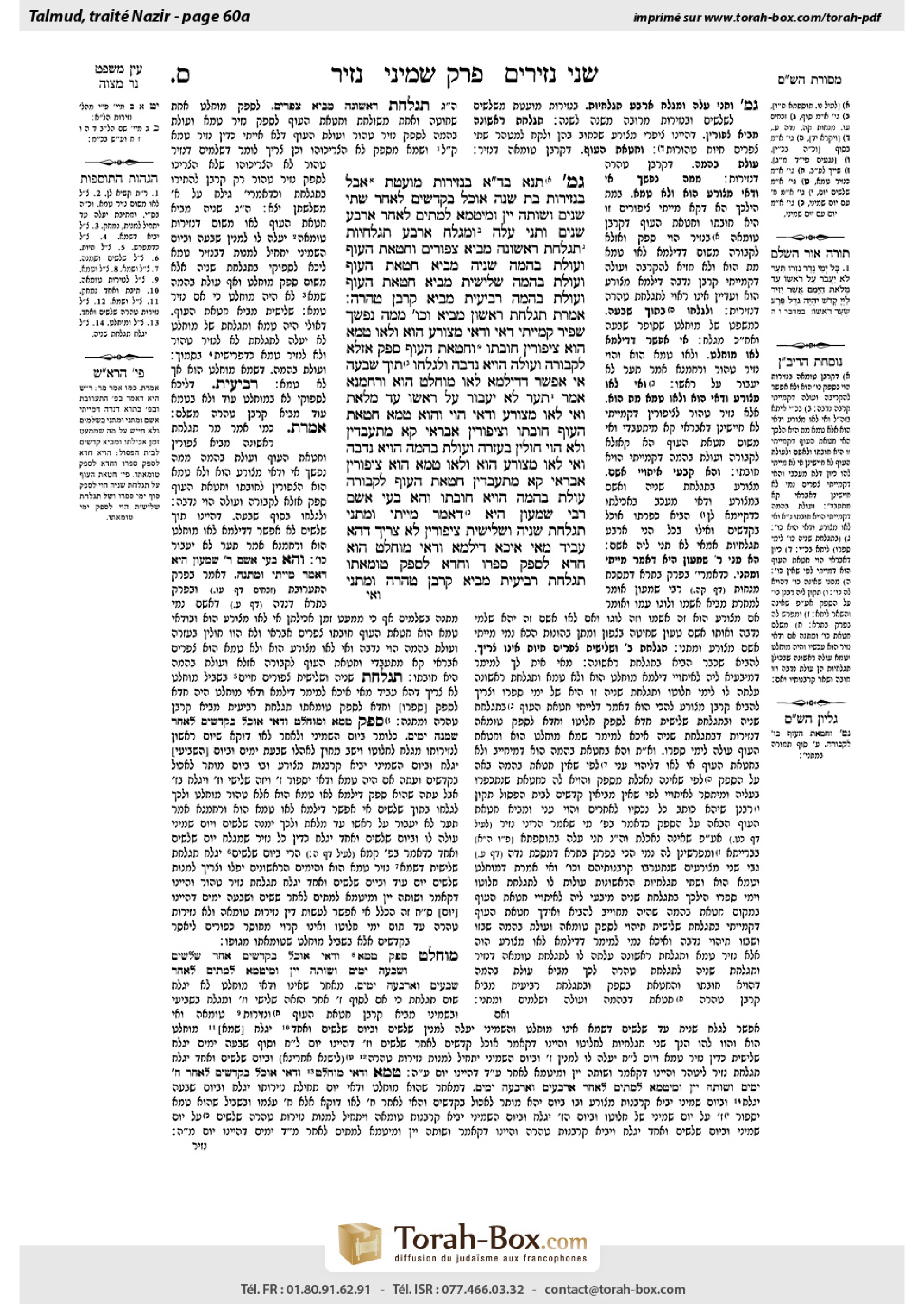
Nazir 60a: Talmud study for Daf Yomi
Daf Yomi is the daily study of one Talmud folio. Explore 37 tractates with scans, Hebrew text, Sefaria English and AI-generated French translations where annotated.
Passage selection and English or AI-generated French translation are available where the scan has annotations. Daf Study is independent of Torah-Box and Sefaria.
Browse Nazir · נזיר · All tractatesNazir 60a text and translations
This page of Nazir includes the Aramaic text, an English translation and an AI-generated French translation, alongside the scan above.
נזיר ס׳ א · Aramaic and Hebrew text
גְּמָ׳ תָּנָא: בַּמֶּה דְּבָרִים אֲמוּרִים — בִּנְזִירוּת מוּעֶטֶת, אֲבָל בִּנְזִירוּת בַּת שָׁנָה — אוֹכֵל בְּקָדָשִׁים לְאַחַר שְׁתֵּי שָׁנִים,
וְשׁוֹתֶה יַיִן וּמִיטַּמֵּא לְמֵתִים לְאַחַר אַרְבַּע שָׁנִים.
וְתָנֵי עֲלַהּ: וּמְגַלֵּחַ אַרְבַּע תִּגְלָחִיּוֹת. תִּגְלַחַת רִאשׁוֹנָה — מֵבִיא צִפּוֹרִים,
וְחַטַּאת הָעוֹף, וְעוֹלַת בְּהֵמָה. שְׁנִיָּה — מֵבִיא חַטַּאת הָעוֹף וְעוֹלַת בְּהֵמָה, שְׁלִישִׁית — מֵבִיא חַטַּאת הָעוֹף וְעוֹלַת בְּהֵמָה, רְבִיעִית — מֵבִיא קׇרְבַּן טׇהֳרָה.
אָמַרְתָּ: תִּגְלַחַת רִאשׁוֹן מֵבִיא וְכוּ׳. מִמָּה נַפְשָׁךְ שַׁפִּיר קָמַיְיתֵי, דְּאִי וַדַּאי מְצוֹרָע הוּא וְלָאו טָמֵא הוּא — צִיפּוֹרִין חוֹבָתוֹ, וְחַטַּאת הָעוֹף סָפֵק, אָזְלָא לִקְבוּרָה, וְעוֹלָה הָוְיָא נְדָבָה.
וּלְגַלְּחוֹ תּוֹךְ שִׁבְעָה אִי אֶפְשָׁר, דְּדִילְמָא לָאו מוּחְלָט הוּא, וְרַחֲמָנָא אָמַר ״תַּעַר לֹא יַעֲבֹר עַל רֹאשׁוֹ עַד מְלֹאת״.
וְאִי לָאו מְצוֹרָע וַדַּאי הָוֵי, וְהוּא טָמֵא — חַטַּאת הָעוֹף חוֹבָתוֹ, וְצִיפּוֹרִין אַבָּרַאי קָא מִתְעַבְדִין, וְלָא הָוֵי חוּלִּין בַּעֲזָרָה. וְעוֹלַת בְּהֵמָה הָוְיָא נְדָבָה.
וְאִי לָאו מְצוֹרָע הוּא וְלָאו טָמֵא הוּא — צִיפּוֹרִין אַבָּרַאי קָא מִתְעַבְדִין, חַטַּאת הָעוֹף לִקְבוּרָה, עוֹלַת בְּהֵמָה הָוְיָא חוֹבָתוֹ. וְהָא בָּעֵי אָשָׁם! רַבִּי שִׁמְעוֹן הִיא, דְּאָמַר: מַיְיתֵי וּמַתְנֵי.
תִּגְלַחַת שְׁנִיָּה וּשְׁלִישִׁית צִיפּוֹרִין לָא צְרִיךְ, דְּהָא עֲבַיד, מַאי אִיכָּא: דִּילְמָא וַדַּאי מוּחְלָט הוּא, חֲדָא — לִסְפֵק סְפָרוֹ,
וַחֲדָא, לִסְפֵק טוּמְאָתוֹ. תִּגְלַחַת רְבִיעִית — מֵבִיא קׇרְבַּן טׇהֳרָה וּמַתְנֵי,
Nazir 60a · English translation
GEMARA: The Sage taught: In what case is this statement of the mishna said? With regard to a short naziriteship of thirty days. However, with regard to a naziriteship of a year, he partakes of sacrificial food only after two years. He cannot shave until a year has passed, in case he is not a leper; he may shave the second time only a year later, in case he was impure during the first year and this second year was his naziriteship observed in purity. At this stage he may partake of sacrificial meat, for if he was a full-fledged leper he has shaved twice.
Yet if the first two shavings were for his leprosy, he has not shaved for his naziriteship at all, and therefore he must observe a third year of naziriteship and shave. He then must observe another year of naziriteship and shave again, as perhaps his third shaving was for impurity and the fourth will be for his naziriteship in purity. And consequently he may drink wine and become impure from the dead only after four years.
And it is taught with regard to the halakha of the mishna (Tosefta 6:1): And he shaves with four separate acts of shaving, each time for its own reason. How so? For his first shaving, after the thirty days of an unspecified naziriteship or at the end of the period he vowed to observe naziriteship, he brings two birds of a leper: One is slaughtered over spring water and the other is sent away (Leviticus 14:4–7).
And he also brings a bird sin-offering for his shaving of impure naziriteship, as he may have contracted impurity from a corpse, and an animal burnt-offering for his shaving of purity, as he may not have contracted impurity from a corpse. For his second shaving he brings a bird sin-offering and an animal burnt-offering. For his third shaving he again brings a bird sin-offering and an animal burnt-offering. And for the fourth shaving he brings an offering of purity.
The Gemara analyzes the details and reasons for this halakha: You said in this baraita that for the first shaving he brings the two birds of a leper, as well as a bird sin-offering and an animal burnt-offering. The Gemara explains: In this manner he brings the proper offerings whichever way you look at it. As, if his status as a leper is definite and he is not impure, the birds he brings are for his obligation to purify himself from leprosy. And as the bird sin-offering in case he was impure was brought due to uncertainty, it goes for burial, like all bird sin-offerings sacrificed in a case of uncertainty, which cannot be eaten. And the bird burnt-offering that he brought in case he was an impure nazirite is a gift offering.
The Gemara further explains: But it is not possible to shave him right after seven days, as one usually does when purified from leprosy, as perhaps he is not a confirmed leper and has no obligation to shave but is bound by the naziriteship vow, and the Merciful One says: “No razor shall come upon his head; until the days are fulfilled in which he consecrated himself to the Lord” (Numbers 6:5). This verse teaches that he cannot shave until the end of his naziriteship. Therefore, he shaves only after thirty days.
The Gemara continues to clarify the various uncertainties concerning the first shaving. And if he is not a definite leper but he is impure from a corpse, the bird sin-offering is for his obligation as an impure nazirite, and there is no problem with the unnecessary rituals of a leper’s birds, as they are performed outside the Temple, and are not subject to the prohibition against bringing non-sacred animals into the Temple courtyard. Therefore, the slaughter of one of the birds outside the Temple is not a transgression. And the animal burnt-offering is considered a gift offering.
And if he is neither a leper nor impure he has also acted correctly, as the birds are performed outside the Temple, which means no transgression is committed, while the bird sin-offering of uncertain necessity goes to burial, and the animal burnt-offering is for his obligation, like any nazirite who completes his naziriteship. The Gemara asks: But isn’t a leper required to bring a guilt-offering to complete his atonement and permit him to partake of sacrificial food? The Gemara answers: This ruling is in accordance with the opinion of Rabbi Shimon, who said that one may bring a guilt-offering and stipulate as follows: If I am obligated to bring this offering then it is for my obligation; and if not, it shall be a voluntary peace-offering.
For the second and third shavings he does not need to bring birds again, as he has already performed this ritual. What is the potential concern? That perhaps he was previously a confirmed leper of definite status. For this reason, one of the bird sin-offerings he brings at the second shaving is for the days of his counting when his status was uncertain. After the first purification of a confirmed leper he counts seven days, or thirty days in this case due to the uncertainty, and brings a sin-offering.
And the one sin-offering he brings at his third shaving is for his uncertain impurity. If he was a leper, the offerings he brought on the previous occasion were for purification of his leprosy, not his naziriteship. This means that, if he was impure, he is still required to bring a sin-offering for his impurity as a nazirite. Furthermore, the animal burnt-offerings he brings for his second and third shavings are for his naziriteship of purity. For his fourth shaving he brings an offering of purity and stipulates as follows:
Nazir 60a · Traduction française (IA)
GUEMARA : Le Sage a enseigné : Dans quel cas cette déclaration de la Michna s’applique-t-elle ? À propos d’un naziréat court de trente jours. En revanche, pour un naziréat d’un an, il ne peut consommer des aliments consacrés qu’après deux ans. Il ne peut se raser avant qu’une année se soit écoulée, au cas où il ne serait pas lépreux ; il ne peut se raser une deuxième fois qu’un an plus tard, au cas où il aurait été impur pendant la première année et où cette deuxième année serait celle de son naziréat observé dans la pureté. À ce stade, il peut consommer de la viande sacrificielle, car, s’il était bel et bien lépreux, il se serait rasé deux fois.
Cependant, si ses deux premiers rasages étaient liés à sa lèpre, il ne s’est pas rasé du tout au titre de son naziréat ; il doit donc observer une troisième année de naziréat et se raser. Il doit ensuite observer une autre année de naziréat et se raser de nouveau, car il se peut que son troisième rasage ait été lié à l’impureté et que le quatrième soit celui de son naziréat observé dans la pureté. Par conséquent, il ne peut boire de vin ni devenir impur au contact d’un mort qu’après quatre ans.
Et il est enseigné au sujet de la halakha de la Michna (Tossefta 6:1) : Il se rase en quatre fois, chaque rasage répondant à une raison différente. Comment cela ? Pour son premier rasage, après les trente jours d’un naziréat sans durée précisée ou à la fin de la période pendant laquelle il a fait vœu d’être nazir, il apporte deux oiseaux de lépreux : l’un est égorgé au-dessus d’eau vive et l’autre est envoyé au loin (Lévitique 14:4–7).
Il apporte également un sacrifice expiatoire d’oiseau pour son rasage au titre d’un naziréat impur, car il se peut qu’il ait contracté l’impureté d’un cadavre, ainsi qu’un holocauste animal pour son rasage au titre d’un naziréat observé dans la pureté, car il se peut qu’il n’ait pas contracté l’impureté d’un cadavre. Pour son deuxième rasage, il apporte un sacrifice expiatoire d’oiseau et un holocauste animal. Pour son troisième rasage, il apporte de nouveau un sacrifice expiatoire d’oiseau et un holocauste animal. Pour le quatrième rasage, il apporte une offrande de pureté.
La Guemara examine les détails et les raisons de cette halakha : tu as dit dans cette baraïta que, pour le premier rasage, il apporte les deux oiseaux de lépreux, ainsi qu’un sacrifice expiatoire d’oiseau et un holocauste animal. La Guemara explique : Ainsi, quelle que soit l’hypothèse, il apporte les offrandes appropriées. En effet, s’il est certainement lépreux et n’est pas impur, les oiseaux qu’il apporte répondent à son obligation de se purifier de la lèpre. Quant au sacrifice expiatoire d’oiseau qu’il apporte au cas où il aurait été impur, puisqu’il est offert en raison d’un doute, il est destiné à être enterré, comme tous les sacrifices expiatoires d’oiseaux offerts en cas de doute, qui ne peuvent être consommés. Quant à l’holocauste d’oiseau qu’il apporte au cas où il aurait été un nazir impur, c’est une offrande volontaire.
La Guemara explique encore : Il n’est toutefois pas possible de le raser dès le septième jour, comme on le fait habituellement lorsqu’on est purifié de la lèpre, car il se peut qu’il ne soit pas un lépreux confirmé et qu’il n’ait donc aucune obligation de se raser, mais qu’il soit tenu par son vœu de naziréat. Or, le Miséricordieux dit : « Le rasoir ne passera pas sur sa tête jusqu’à l’accomplissement des jours pendant lesquels il s’est consacré à l’Éternel » (Nombres 6:5). Ce verset enseigne qu’il ne peut se raser avant la fin de son naziréat. Il ne se rase donc qu’après trente jours.
La Guemara poursuit l’examen des différentes incertitudes concernant le premier rasage. S’il n’est pas certainement lépreux, mais qu’il est impur à cause d’un cadavre, le sacrifice expiatoire d’oiseau répond à son obligation de nazir impur. Il n’y a pas de problème à accomplir les rites superflus liés aux oiseaux du lépreux, car ils se font hors du Temple et ne sont pas soumis à l’interdiction d’introduire des animaux non consacrés dans la cour du Temple. Par conséquent, égorger l’un des oiseaux hors du Temple ne constitue pas une transgression. L’holocauste animal est considéré comme une offrande volontaire.
S’il n’est ni lépreux ni impur, il a également agi comme il convient : les rites concernant les oiseaux se font hors du Temple, si bien qu’aucune transgression n’est commise ; le sacrifice expiatoire d’oiseau dont la nécessité est incertaine est destiné à être enterré, et l’holocauste animal répond à son obligation, comme pour tout nazir qui achève son naziréat. La Guemara demande : Mais un lépreux n’est-il pas tenu d’apporter un sacrifice de culpabilité pour achever son expiation et être autorisé à consommer des aliments consacrés ? La Guemara répond : Cette décision est conforme à l’opinion de Rabbi Shimon, qui a dit qu’on peut apporter un sacrifice de culpabilité en posant la condition suivante : si je suis tenu d’apporter cette offrande, qu’elle réponde à mon obligation ; sinon, qu’elle soit une offrande volontaire de paix.
Pour les deuxième et troisième rasages, il n’a pas besoin d’apporter de nouveau des oiseaux, puisqu’il a déjà accompli ce rite. Quelle est l’incertitude ? Il se peut qu’il ait auparavant été un lépreux confirmé dont le statut était certain. C’est pourquoi l’un des sacrifices expiatoires d’oiseau qu’il apporte lors du deuxième rasage répond à son obligation pour les jours de son décompte, alors que son statut était incertain. Après la première purification d’un lépreux confirmé, celui-ci compte sept jours — ou trente jours dans ce cas, en raison du doute — puis apporte un sacrifice expiatoire.
Le sacrifice expiatoire qu’il apporte lors de son troisième rasage répond à son obligation pour son impureté incertaine. S’il était lépreux, les offrandes apportées précédemment servaient à le purifier de sa lèpre, et non au titre de son naziréat. Cela signifie que, s’il était impur, il doit encore apporter un sacrifice expiatoire pour son impureté en tant que nazir. De plus, les holocaustes animaux qu’il apporte pour ses deuxième et troisième rasages répondent aux obligations de son naziréat observé dans la pureté. Pour son quatrième rasage, il apporte une offrande de pureté en posant la condition suivante :
Traduction française générée par IA à partir de l’édition anglaise de Sefaria. Vérifie toujours un passage avec le texte source.
Text from Sefaria: William Davidson Edition - Vocalized Aramaic (CC BY NC); William Davidson Edition - English (CC BY NC).