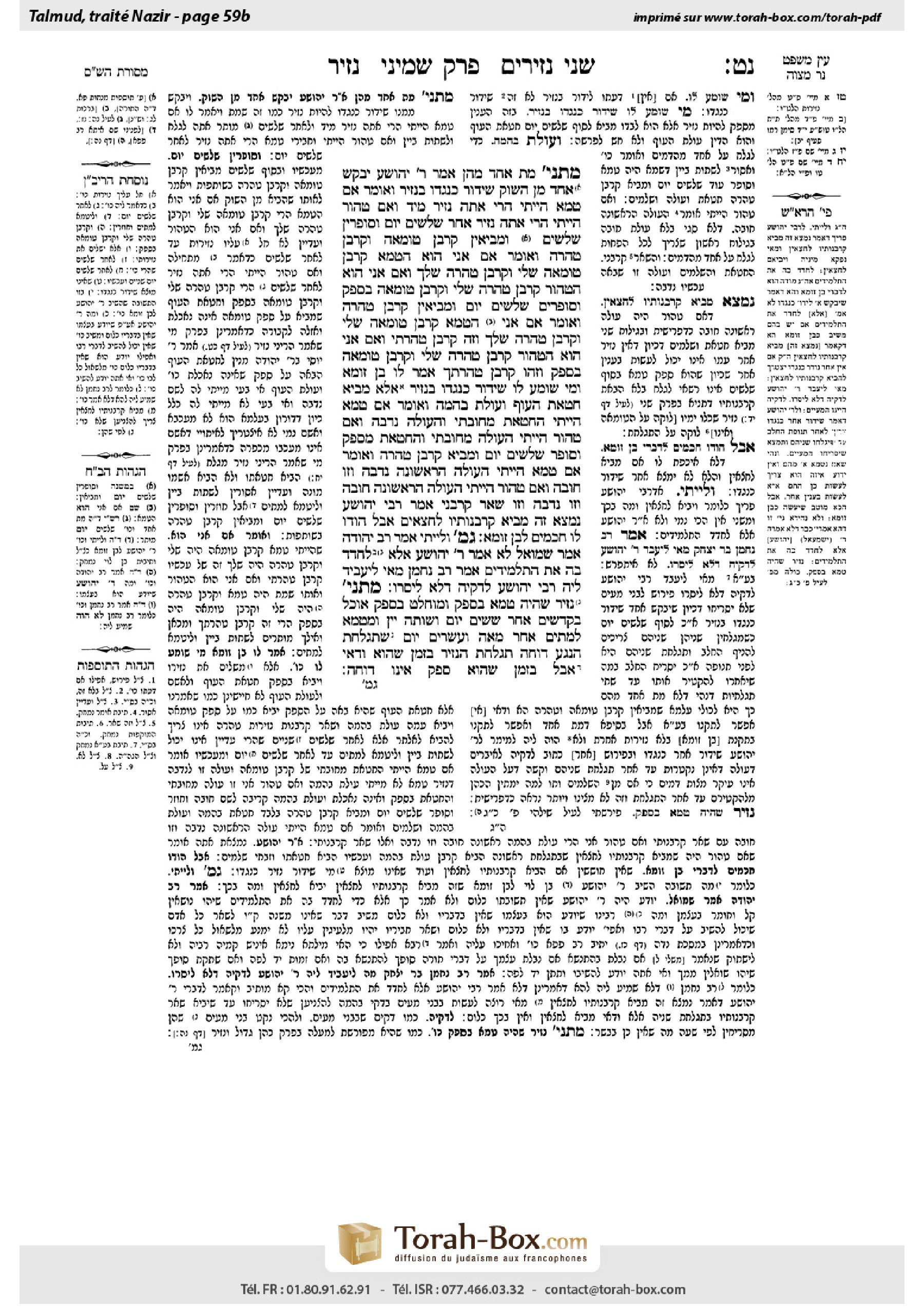
Nazir 59b: Talmud study for Daf Yomi
Daf Yomi is the daily study of one Talmud folio. Explore 37 tractates with scans, Hebrew text, Sefaria English and AI-generated French translations where annotated.
Passage selection and English or AI-generated French translation are available where the scan has annotations. Daf Study is independent of Torah-Box and Sefaria.
Browse Nazir · נזיר · All tractatesNazir 59b text and translations
This page of Nazir includes the Aramaic text, an English translation and an AI-generated French translation, alongside the scan above.
נזיר נ״ט ב · Aramaic and Hebrew text
מַתְנִי׳ מֵת אֶחָד מֵהֶן, אָמַר רַבִּי יְהוֹשֻׁעַ: יְבַקֵּשׁ אֶחָד מִן הַשּׁוּק שֶׁיִּדּוֹר כְּנֶגְדּוֹ בְּנָזִיר.
וְאוֹמֵר: אִם טָמֵא הָיִיתִי — הֲרֵי אַתָּה נָזִיר מִיָּד, וְאִם טָהוֹר הָיִיתִי — הֲרֵי אַתָּה נָזִיר אַחַר שְׁלֹשִׁים יוֹם. וְסוֹפְרִין שְׁלֹשִׁים, וּמְבִיאִין קׇרְבַּן טוּמְאָה וְקׇרְבַּן טׇהֳרָה. וְאוֹמֵר: אִם אֲנִי הוּא הַטָּמֵא — קׇרְבַּן טוּמְאָה שֶׁלִּי, וְקׇרְבַּן טׇהֳרָה שֶׁלְּךָ. וְאִם אֲנִי הוּא הַטָּהוֹר — קׇרְבַּן טׇהֳרָה שֶׁלִּי, וְקׇרְבַּן טוּמְאָה בְּסָפֵק.
וְסוֹפְרִים שְׁלֹשִׁים יוֹם, וּמְבִיאִין קׇרְבַּן טׇהֳרָה, וְאוֹמֵר: אִם אֲנִי הַטָּמֵא — קׇרְבַּן טוּמְאָה שֶׁלִּי, וְקׇרְבַּן טׇהֳרָה — שֶׁלְּךָ, וָזֶה קׇרְבַּן טׇהֳרָתִי. וְאִם אֲנִי הוּא הַטָּהוֹר — קׇרְבַּן טׇהֳרָה שֶׁלִּי, וְקׇרְבַּן טוּמְאָה בְּסָפֵק, וְזֶהוּ קׇרְבַּן טׇהֳרָתְךָ.
אָמַר לוֹ בֶּן זוֹמָא: וּמִי שׁוֹמֵעַ לוֹ שֶׁיִּדּוֹר כְּנֶגְדּוֹ בְּנָזִיר? אֶלָּא: מֵבִיא חַטַּאת הָעוֹף וְעוֹלַת בְּהֵמָה, וְאוֹמֵר: אִם טָמֵא הָיִיתִי — הַחַטָּאת מֵחוֹבָתִי, וְהָעוֹלָה נְדָבָה. וְאִם טָהוֹר הָיִיתִי — הָעוֹלָה מֵחוֹבָתִי, וְהַחַטָּאת מִסָּפֵק.
וְסוֹפֵר שְׁלֹשִׁים יוֹם, וּמֵבִיא קׇרְבַּן טׇהֳרָה, וְאוֹמֵר: אִם טָמֵא הָיִיתִי — הָעוֹלָה הָרִאשׁוֹנָה נְדָבָה, וְזוֹ חוֹבָה. וְאִם טָהוֹר הָיִיתִי — הָעוֹלָה הָרִאשׁוֹנָה חוֹבָה, וְזוֹ נְדָבָה, וְזוֹ שְׁאָר קׇרְבָּנִי.
אָמַר רַבִּי יְהוֹשֻׁעַ: נִמְצָא זֶה מֵבִיא קׇרְבְּנוֹתָיו לַחֲצָאִים. אֲבָל הוֹדוּ לוֹ חֲכָמִים לְבֶן זוֹמָא.
גְּמָ׳ וְלַיְיתֵי! אָמַר רַב יְהוּדָה אָמַר שְׁמוּאֵל: לֹא אָמַר רַבִּי יְהוֹשֻׁעַ אֶלָּא לְחַדֵּד בָּהּ אֶת הַתַּלְמִידִים.
אָמַר רַב נַחְמָן: מַאי לֶיעְבֵּיד לֵיהּ רַבִּי יְהוֹשֻׁעַ לְדַקַּיָּה דְּלָא לֵיסְרוּ.
מַתְנִי׳ נָזִיר שֶׁהָיָה טָמֵא בְּסָפֵק וּמוּחְלָט בְּסָפֵק — אוֹכֵל בְּקָדָשִׁים אַחַר שִׁשִּׁים יוֹם.
וְשׁוֹתֶה יַיִן, וּמִטַּמֵּא לַמֵּתִים אַחַר מֵאָה וְעֶשְׂרִים יוֹם.
שֶׁתִּגְלַחַת הַנֶּגַע דּוֹחֶה תִּגְלַחַת הַנָּזִיר בִּזְמַן שֶׁהוּא וַדַּאי. אֲבָל בִּזְמַן שֶׁהוּא סָפֵק — אֵינוֹ דּוֹחֶה.
Nazir 59b · English translation
MISHNA: The previous mishna described how two nazirites sacrifice offerings of impurity and purity, in a situation in which one of them has become impure but they do not know which one. This mishna discusses what must be done if one of them dies before bringing his offerings. Rabbi Yehoshua said: The surviving nazirite asks someone in the marketplace, a non-nazirite, to vow to be a nazirite corresponding to him, i.e., under the same conditions as his own naziriteship, so that he can bring offerings together with him.
And he says to him as follows: If I was impure, you are hereby a nazirite immediately; and if I was pure, you are hereby a nazirite after thirty days. And they both proceed to count thirty days and bring an offering of impurity and an offering of purity. And the nazirite who was defined as having uncertain impurity says: If I am the impure one, the offering of impurity is mine and the offering of purity is yours; and if I am the pure one, the offering of purity is mine and the offering of impurity we brought shall be of uncertain status.
And they subsequently count another thirty days and bring an offering of purity, and the first nazirite says: If I was the impure one, the offering of impurity that we sacrificed at the end of the first thirty days was mine, and the offering of purity we brought then was yours; and this offering I am bringing now is my offering of purity. And if I was the pure one, and the deceased nazirite was impure, the offering of purity we brought thirty days ago was mine, and the offering of impurity we brought earlier was of uncertain status, and this is your offering of purity.
Ben Zoma said to Rabbi Yehoshua: And who will listen to him to vow to be a nazirite corresponding to him? How can one design a halakha on the assumption that a non-nazirite will agree to be a nazirite for a lengthy term? Rather, a different procedure is available: After thirty days of naziriteship he brings a bird sin-offering and an animal burnt-offering, and says: If I was impure, the sin-offering is for my obligation as an impure nazirite, and the burnt-offering is a regular gift offering. And if I was pure, the burnt-offering is for my obligation as a pure nazirite, and the sin-offering is of uncertain status.
And he counts another thirty days, and brings an offering of purity, and says: If I was impure, the first burnt-offering I brought should be considered a gift offering, and this one I am bringing now is for my obligation. And if I was pure, the first burnt-offering I brought is for my obligation as a pure nazirite, and this one I am bringing now is a gift offering. And these, i.e., the sin-offering and peace-offering I am sacrificing now, comprises the rest of my offerings that I was obligated to bring earlier.
Rabbi Yehoshua said: According to your opinion, it turns out that this nazirite brings his offerings in halves, i.e., in stages. If he was pure, he brings his burnt-offering thirty days before the rest of his offerings. However, the Rabbis agreed with ben Zoma, and disregarded the concern about splitting up the offerings.
GEMARA: The mishna taught that Rabbi Yehoshua countered ben Zoma’s opinion by pointing out that his solution would cause the nazirite to bring his offerings in stages. The Gemara asks: What is wrong with that? And let him bring the offerings in stages. Rav Yehuda said that Shmuel said: Rabbi Yehoshua said this comment only to sharpen the minds of the students. He did not really maintain that it is prohibited to act in this manner; rather, he wanted to test his disciples to see if they were aware of the halakha.
Rav Naḥman said, in a light-hearted vein: What will Rabbi Yehoshua do with the intestines of his animals so that they will not spoil? If he insists that the offerings of purity must all be brought at the same time, the only way to do so is to wait thirty days after slaughtering the burnt-offering before burning its intestines, which is certainly impractical.
MISHNA: In the case of a nazirite who, on the first day of his naziriteship, was impure from a corpse as a matter of uncertainty and was also a confirmed leper as a matter of uncertainty, i.e., it was uncertain whether or not he had leprosy, how can he fulfill the shaving obligations of a pure nazirite and an impure leper? The problem facing this nazirite is that a leper must shave both when he begins his purification process and at the close of it, one week later. However, a nazirite is prohibited from shaving. Additionally, a leper may not partake of sacrificial food, but a nazirite may. Therefore, he may partake of sacrificial food sixty days after he may have become impure, when the uncertainty with regard to leprosy will have been clarified. He shaves for the first time for his leprosy after thirty days, and for the second time thirty days later, the shaving of the end of the purification process; at which point he brings the offerings of a purified leper and may partake of sacrificial food.
But he may drink wine and become impure from the dead, effectively ending his naziriteship, only after 120 days. This is because he might have been a full-fledged leper, which means that his shavings count toward his leprosy, not his naziriteship. Consequently, after the first sixty days he must observe another thirty days of naziriteship and shave again. Even then he has yet to fulfill all his obligations, as he might have been impure from a corpse, which means his shaving after ninety days was for his impurity. He must therefore remain a nazirite for another thirty days, before shaving one final time at the end of 120 days to fulfill his naziriteship obligation.
The mishna notes: The reason that he cannot shave for his leprosy after seven days and perform the second shaving of a leper seven days later is because the shaving of leprosy overrides the prohibition of the shaving of a nazirite only when his status as a leper is definite. However, when his status as a leper is uncertain, the shaving does not override his naziriteship, and therefore he must wait thirty days before each of his shavings for leprosy.
Nazir 59b · Traduction française (IA)
MICHNA : La Michna précédente décrivait comment deux naziréens apportent des sacrifices d’impureté et de pureté, alors que l’un d’eux est devenu impur sans qu’ils sachent lequel. Cette Michna traite de ce qu’il faut faire si l’un d’eux meurt avant d’apporter ses sacrifices. Rabbi Yehoshoua dit : Le naziréen survivant demande à quelqu’un rencontré sur la place du marché, qui n’est pas naziréen, de faire vœu de devenir naziréen dans les mêmes conditions que lui, afin qu’il puisse apporter ses sacrifices avec lui.
Et il lui dit ceci : « Si j’étais impur, tu deviens naziréen dès maintenant ; et si j’étais pur, tu deviens naziréen dans trente jours. » Tous deux comptent alors trente jours et apportent un sacrifice d’impureté et un sacrifice de pureté. Le naziréen dont le statut d’impureté était incertain dit : « Si je suis celui qui était impur, le sacrifice d’impureté est le mien et le sacrifice de pureté est le tien ; et si je suis celui qui était pur, le sacrifice de pureté est le mien, et le sacrifice d’impureté que nous avons apporté est de statut incertain. »
Ensuite, ils comptent encore trente jours et apportent un sacrifice de pureté. Le premier naziréen dit : « Si j’étais celui qui était impur, le sacrifice d’impureté que nous avons offert au terme des trente premiers jours était le mien, et le sacrifice de pureté que nous avons apporté alors était le tien ; le sacrifice que j’apporte maintenant est mon sacrifice de pureté. Mais si j’étais celui qui était pur et que le naziréen décédé était impur, le sacrifice de pureté que nous avons apporté il y a trente jours était le mien, le sacrifice d’impureté que nous avons apporté auparavant était de statut incertain, et celui-ci est ton sacrifice de pureté. »
Ben Zoma dit à Rabbi Yehoshoua : « Mais qui l’écoutera et fera vœu de devenir naziréen dans les mêmes conditions que lui ? Comment peut-on établir une halakha en supposant qu’un non-naziréen acceptera de devenir naziréen pour une longue période ? Il existe plutôt une autre procédure : au terme de trente jours de naziréat, il apporte un sacrifice expiatoire d’oiseau et un holocauste animal, et dit : “Si j’étais impur, le sacrifice expiatoire acquitte mon obligation de naziréen impur, et l’holocauste est une offrande volontaire ordinaire. Mais si j’étais pur, l’holocauste acquitte mon obligation de naziréen pur, et le sacrifice expiatoire est de statut incertain.” »
Il compte encore trente jours, apporte un sacrifice de pureté et dit : « Si j’étais impur, le premier holocauste que j’ai apporté doit être considéré comme une offrande volontaire, et celui que j’apporte maintenant acquitte mon obligation. Mais si j’étais pur, le premier holocauste que j’ai apporté acquitte mon obligation de naziréen pur, et celui que j’apporte maintenant est une offrande volontaire. Ces sacrifices, c’est-à-dire le sacrifice expiatoire et le sacrifice de paix que j’offre maintenant, constituent le reste des sacrifices que j’étais tenu d’apporter auparavant. »
Rabbi Yehoshoua dit : « Selon ton avis, il s’ensuit que ce naziréen apporte ses sacrifices en plusieurs fois, c’est-à-dire par étapes. S’il était pur, il apporte son holocauste trente jours avant le reste de ses sacrifices. » Cependant, les Sages furent d’accord avec Ben Zoma et écartèrent l’objection selon laquelle les sacrifices seraient apportés séparément.
GUEMARA : La Michna enseigne que Rabbi Yehoshoua répondit à l’avis de Ben Zoma en faisant remarquer que sa solution obligerait le naziréen à apporter ses sacrifices par étapes. La Guemara demande : « Qu’y a-t-il de mal à cela ? Qu’il apporte donc ses sacrifices par étapes ! » Rav Yehouda dit au nom de Shmuel : Rabbi Yehoshoua ne fit cette remarque que pour aiguiser l’esprit des élèves. Il ne soutenait pas réellement qu’il est interdit de procéder ainsi ; il voulait plutôt mettre ses disciples à l’épreuve pour voir s’ils connaissaient la halakha.
Rav Naḥman dit sur le ton de la plaisanterie : « Que fera Rabbi Yehoshoua des intestins de ses animaux pour éviter qu’ils ne se gâtent ? » S’il insiste pour que tous les sacrifices de pureté soient apportés en même temps, le seul moyen d’y parvenir serait d’attendre trente jours après avoir abattu l’animal destiné à l’holocauste avant d’en brûler les intestins, ce qui est évidemment impraticable.
MICHNA : Dans le cas d’un naziréen qui, le premier jour de son naziréat, était peut-être impur à cause d’un cadavre et était également peut-être un lépreux avéré, c’est-à-dire qu’on ne savait pas s’il était ou non atteint de lèpre, comment peut-il accomplir les obligations de rasage d’un naziréen pur et d’un lépreux impur ? Le problème auquel il est confronté est qu’un lépreux doit se raser au début de son processus de purification, puis à la fin de celui-ci, une semaine plus tard. Or, il est interdit au naziréen de se raser. De plus, un lépreux ne peut pas consommer de nourriture consacrée, tandis qu’un naziréen le peut. Il peut donc consommer de la nourriture consacrée soixante jours après le moment où il a pu devenir impur, lorsque le doute concernant la lèpre aura été levé. Il se rase une première fois à cause de sa lèpre au terme de trente jours, puis une seconde fois trente jours plus tard, à la fin du processus de purification ; à ce moment-là, il apporte les sacrifices d’un lépreux purifié et peut consommer de la nourriture consacrée.
Mais il ne peut boire de vin ni devenir impur au contact des morts — ce qui mettrait effectivement fin à son naziréat — qu’au bout de 120 jours. En effet, il se peut qu’il ait été pleinement lépreux, auquel cas ses rasages comptent pour sa lèpre et non pour son naziréat. Par conséquent, après les soixante premiers jours, il doit observer encore trente jours de naziréat et se raser de nouveau. Même alors, il n’a pas encore accompli toutes ses obligations, car il se peut qu’il ait été impur à cause d’un cadavre, auquel cas le rasage effectué au bout de quatre-vingt-dix jours était celui dû à son impureté. Il doit donc rester naziréen trente jours de plus, puis se raser une dernière fois au terme des 120 jours afin d’accomplir son obligation de naziréat.
La Michna précise qu’il ne peut pas se raser au titre de sa lèpre après sept jours, puis effectuer le second rasage du lépreux sept jours plus tard, car le rasage imposé par la lèpre ne l’emporte sur l’interdiction faite au naziréen de se raser que lorsque son statut de lépreux est certain. En revanche, lorsque son statut de lépreux est incertain, le rasage ne l’emporte pas sur son naziréat ; il doit donc attendre trente jours avant chacun de ses rasages dus à la lèpre.
Traduction française générée par IA à partir de l’édition anglaise de Sefaria. Vérifie toujours un passage avec le texte source.
Text from Sefaria: William Davidson Edition - Vocalized Aramaic (CC BY NC); William Davidson Edition - English (CC BY NC).