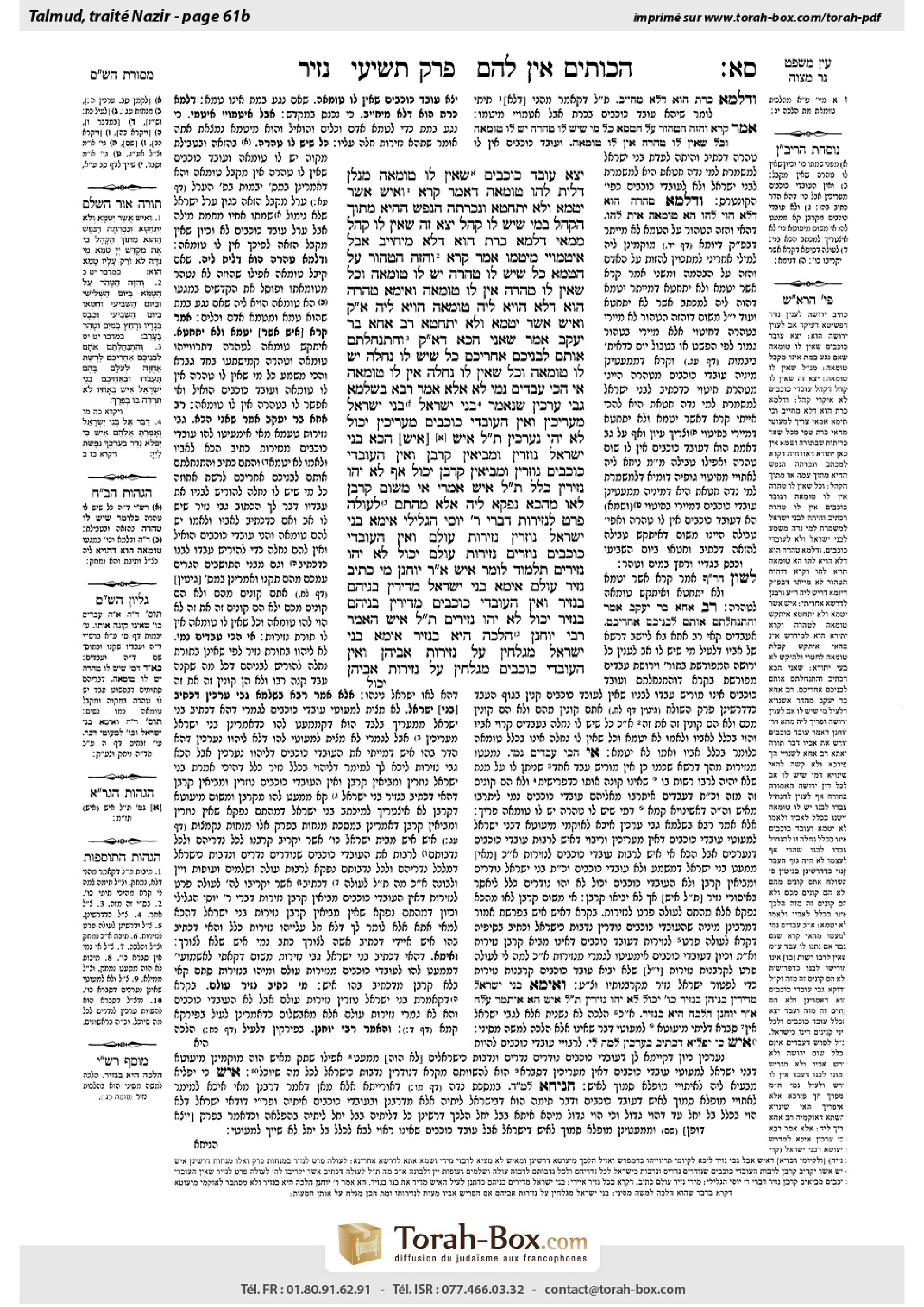
Nazir 61b: Talmud study for Daf Yomi
Daf Yomi is the daily study of one Talmud folio. Explore 37 tractates with scans, Hebrew text, Sefaria English and AI-generated French translations where annotated.
Passage selection and English or AI-generated French translation are available where the scan has annotations. Daf Study is independent of Torah-Box and Sefaria.
Browse Nazir · נזיר · All tractatesNazir 61b text and translations
This page of Nazir includes the Aramaic text, an English translation and an AI-generated French translation, alongside the scan above.
נזיר ס״א ב · Aramaic and Hebrew text
יָצָא גּוֹי שֶׁאֵין לוֹ טוּמְאָה. מְנָלַן דְּלֵית לְהוּ טוּמְאָה? דְּאָמַר קְרָא: ״וְאִישׁ אֲשֶׁר יִטְמָא וְלֹא יִתְחַטָּא וְנִכְרְתָה הַנֶּפֶשׁ הָהִיא מִתּוֹךְ הַקָּהָל״, בְּמִי שֶׁיֵּשׁ לוֹ קָהָל, יָצָא זֶה שֶׁאֵין לוֹ קָהָל.
מִמַּאי? דִּלְמָא כָּרֵת הוּא דְּלָא מִיחַיַּיב, אֲבָל אִיטַּמּוֹיֵי מִיטַמּוּ? אָמַר קְרָא ״וְהִזָּה הַטָּהוֹר עַל הַטָּמֵא״, כֹּל שֶׁיֵּשׁ לוֹ טׇהֳרָה — יֵשׁ לוֹ טוּמְאָה, וְכֹל שֶׁאֵין לוֹ טׇהֳרָה — אֵין לוֹ טוּמְאָה.
וְאֵימָא: טׇהֳרָה הוּא דְּלָא הָוְיָא לֵיהּ, טוּמְאָה הָוְיָא לֵיהּ! אָמַר קְרָא: ״וְאִישׁ אֲשֶׁר יִטְמָא וְלֹא יִתְחַטָּא״.
רַב אַחָא בַּר יַעֲקֹב אָמַר: שָׁאנֵי הָכָא, דְּאָמַר קְרָא: ״וְהִתְנַחַלְתֶּם אֹתָם לִבְנֵיכֶם אַחֲרֵיכֶם״.
כֹּל שֶׁיֵּשׁ לוֹ נַחֲלָה — יֵשׁ לוֹ טוּמְאָה, וְכֹל שֶׁאֵין לוֹ נַחֲלָה — אֵין לוֹ טוּמְאָה. אִי הָכִי עֲבָדִים נָמֵי לָא!
אֶלָּא אָמַר רָבָא: בִּשְׁלָמָא גַּבֵּי עֲרָכִין, שֶׁנֶּאֱמַר: ״בְּנֵי יִשְׂרָאֵל״ — בְּנֵי יִשְׂרָאֵל מַעֲרִיכִין, וְאֵין הַגּוֹיִם מַעֲרִיכִין. יָכוֹל לֹא יְהוּ נֶעֱרָכִין, תַּלְמוּד לוֹמַר: ״אִישׁ״.
הָכָא, בְּנֵי יִשְׂרָאֵל נוֹזְרִין וּמְבִיאִין קׇרְבָּן, וְאֵין הַגּוֹיִם נוֹזְרִין וּמְבִיאִין קׇרְבָּן. יָכוֹל אַף לֹא יְהוּ נְזִירִין כְּלָל — תַּלְמוּד לוֹמַר: ״אִישׁ״?
אָמְרִי: אִי מִשּׁוּם קׇרְבָּן לָאו מֵהָכָא נָפְקָא לֵיהּ, אֶלָּא מֵהָתָם: ״לְעוֹלָה״ — פְּרָט לִנְזִירוּת, דִּבְרֵי רַבִּי יוֹסֵי הַגְּלִילִי!
אֵימָא: בְּנֵי יִשְׂרָאֵל נוֹזְרִין נְזִירוּת עוֹלָם, וְאֵין הַגּוֹיִם נוֹזְרִים נְזִירוּת עוֹלָם. יָכוֹל לֹא יְהוּ נְזִירִים — תַּלְמוּד לוֹמַר: ״אִישׁ״! אָמַר רַבִּי יוֹחָנָן: מִי כְּתִיב ״נְזִיר עוֹלָם״?
אֵימָא: בְּנֵי יִשְׂרָאֵל מַדִּירִין בְּנֵיהֶם בְּנָזִיר, וְאֵין הַגּוֹיִם מַדִּירִין בְּנֵיהֶם בְּנָזִיר. יָכוֹל לֹא יְהוּ נְזִירִים — תַּלְמוּד לוֹמַר: ״אִישׁ״! הָאָמַר רַבִּי יוֹחָנָן: הֲלָכָה הִיא בְּנָזִיר.
אֵימָא: בְּנֵי יִשְׂרָאֵל מְגַלְּחִין עַל נְזִירוּת אֲבִיהֶן, וְאֵין הַגּוֹיִם מְגַלְּחִין עַל נְזִירוּת אֲבִיהֶן.
Nazir 61b · English translation
which excludes a gentile, who has no potential to become ritually impure. A gentile is not rendered impure even if he touches a corpse. An individual of this kind cannot become a nazirite. The Gemara asks: From where do we derive that gentiles do not have the ability to become ritually impure? It is as the verse states with regard to one who enters the Temple in a state of impurity: “But the man who shall be impure and shall not purify himself, that soul shall be cut off from the midst of the assembly” (Numbers 19:20). This indicates that the halakhot of ritual impurity apply only to one who has membership in the assembly of the Jewish people and excludes this gentile, who has no membership in the assembly, i.e., he is not part of the Jewish people.
The Gemara asks: From where is it derived that this verse teaches that ritual impurity does not apply to a gentile at all? Perhaps the verse is referring merely to excision from the World-to-Come [karet], i.e., it is teaching that he is not liable to receive karet for entering the Temple when impure, but that perhaps a gentile does become impure. The Gemara answers that the previous verse states: “And the pure person shall sprinkle upon the impure”; this indicates that anyone who has the possibility of attaining ritual purity by means of the waters of purification also has the potential for ritual impurity, and anyone who does not have the possibility of attaining purity by means of the waters of purification does not have the potential for impurity either.
The Gemara asks: But one can say that it is only purity by means of the waters of purification that he does not have, but he does have the potential for impurity. The Gemara answers: It is for this reason that the verse states: “But the man who shall be impure and shall not purify himself” (Numbers 19:20), to teach that these two statuses are interdependent. One who cannot be purified by the waters of purification cannot become impure in the first place.
Rav Aḥa bar Ya’akov said a different reason why a gentile cannot become a nazirite, despite the fact that the term “man” does include gentiles in the case of valuations. Here, with regard to naziriteship, it is different, as the verse prohibits a nazirite from becoming impure for his father and mother. This prohibition is not relevant for gentiles because the verse states: “And you shall make them an inheritance for your children after you” (Leviticus 25:46). This verse establishes a child as one to whom a person can bequeath his slaves, the subject of this verse.
Rav Aḥa bar Ya’akov explains: This verse teaches that anyone who has inheritance, i.e., he has the ability to bequeath his slaves to his children, also has the status of a father with regard to impurity, and the verse prohibiting a nazirite from becoming impure to bury his father can be addressing him. But anyone who does not have inheritance does not have the status of a father with regard to impurity. Since a gentile cannot bequeath slaves to his child (see Gittin 38a), the status of a father with regard to impurity also does not apply to him. Consequently, the verse prohibiting a nazirite from becoming impure to bury his father cannot be addressing him. The Gemara asks: If so, slaves should also not be included in the halakhot of ritual impurity or naziriteship, as they too cannot bequeath slaves to their children.
Rather, Rava said a different reason why a gentile cannot become a nazirite, even though he is included in the halakhot of valuations, and despite the fact that the term “man” appears in both passages. Granted, with regard to valuations, as it is stated: “Speak to the children of Israel” (Leviticus 27:2), one can derive that the children of Israel can take a valuation vow but gentiles cannot take a valuation vow. One might have thought that gentiles cannot be valuated either. Therefore, the verse states: “Man” (Leviticus 27:2), so as to include a gentile in only one aspect of the halakhot of valuations, i.e., that a gentile can be the subject of a valuation. This does not negate the derivation from “the children of Israel” that gentiles are generally excluded.
Rava continues his explanation: However, here, in the case of naziriteship, there is no possibility of interpreting the word “man” to include a gentile in only one aspect of the halakhot of naziriteship. Rava explains: If one would suggest the following derivation: From the phrase “the children of Israel” (Numbers 6:2) derive that the children of Israel can both take a vow of naziriteship and bring the nazirite offering, but gentiles cannot both take a vow of naziriteship and bring the nazirite offering, one might have thought that gentiles cannot be nazirites at all; therefore, the verse states: “Man,” which includes gentiles in one aspect of the halakhot of naziriteship, i.e., that they can become nazirites.
Rava continues his explanation: However, the Sages would say in response to this suggestion: If the phrase “the children of Israel” is written due to the need to exclude a gentile from bringing a nazirite offering, one does not need to derive this halakha from here, and this is because it is already derived from there, as a baraita teaches that the verse: “Any man from the house of Israel, or of the strangers in Israel, who sacrifices his offering, whether it be any of their vows, or any of their gift offerings, which are sacrificed to the Lord as a burnt-offering” (Leviticus 22:18), excludes a gentile from the offering of naziriteship; this is the statement of Rabbi Yosei HaGelili. Therefore, the phrase “the children of Israel” must exclude gentiles from the entire passage of naziriteship, and not just from bringing the offerings.
The Gemara asks: But it can still be argued that “the children of Israel” is excluding a gentile from only some aspects of naziriteship, as one can say that this phrase teaches that the children of Israel can take a vow of permanent naziriteship, but gentiles cannot take a vow of permanent naziriteship, and one might have thought that gentiles cannot be nazirites at all. The verse therefore states: “Man,” to teach that they can become nazirites. The Gemara answers: Rabbi Yoḥanan said: Is it written: A permanent nazirite? Since the verse does not specify a particular type of naziriteship, it excludes gentiles from all types.
The Gemara offers another suggestion: But it can still be argued that “the children of Israel” is excluding a gentile from only some aspects of naziriteship, as one can say that this phrase teaches that “the children of Israel” can vow that their minor sons be nazirites, but gentiles cannot vow that their minor sons be nazirites; and one might have thought that gentiles cannot be nazirites at all. The verse therefore states: “Man,” to teach that they can become nazirites. The Gemara answers: Didn’t Rabbi Yoḥanan say that the fact that a father can take a vow that his minor son will be a nazirite is a halakha transmitted to Moses at Sinai with regard to a nazirite? Since this halakha is not stated in the Torah, it cannot be excluded by a verse.
The Gemara offers another suggestion: But it can still be argued that “the children of Israel” is excluding a gentile from only some aspects of naziriteship, as one can say that this phrase teaches that “the children of Israel” can shave and cut their hair by means of the offerings of their fathers’ naziriteships, but gentiles cannot shave and cut their hair by means of their fathers’ naziriteships. In other words, if the father of a nazirite, who was himself a nazirite, died after having separated his nazirite offerings, the son is able to bring those offerings at the close of his own naziriteship.
Nazir 61b · Traduction française (IA)
ce qui exclut un non-Juif, qui n’a aucune possibilité de devenir rituellement impur. Un non-Juif ne devient pas impur, même s’il touche un cadavre. Un individu de cette sorte ne peut pas devenir nazir. La Guemara demande : D’où déduisons-nous que les non-Juifs ne peuvent pas devenir rituellement impurs ? Le verset concernant celui qui entre dans le Temple en état d’impureté dit : « Mais l’homme qui sera impur et ne se purifiera pas, cette personne sera retranchée du milieu de l’assemblée » (Nombres 19, 20). Cela indique que les lois de l’impureté rituelle ne s’appliquent qu’à celui qui appartient à l’assemblée du peuple juif, et exclut ce non-Juif, qui n’appartient pas à l’assemblée, c’est-à-dire qui ne fait pas partie du peuple juif.
La Guemara demande : D’où déduit-on que ce verset enseigne que l’impureté rituelle ne s’applique pas du tout à un non-Juif ? Peut-être le verset fait-il seulement référence à l’excision du monde à venir [karet], c’est-à-dire qu’il enseigne qu’il n’encourt pas le karet pour être entré dans le Temple en état d’impureté, sans pour autant exclure qu’un non-Juif puisse devenir impur. La Guemara répond que le verset précédent dit : « Et l’homme pur aspergera sur l’impur » ; cela indique que quiconque peut accéder à la pureté rituelle au moyen des eaux de purification peut également devenir rituellement impur, et que quiconque ne peut pas accéder à la pureté au moyen des eaux de purification ne peut pas non plus devenir impur.
La Guemara demande : Mais on pourrait dire qu’il ne peut pas accéder à la pureté au moyen des eaux de purification, mais qu’il peut néanmoins devenir impur. La Guemara répond : C’est pour cette raison que le verset dit : « Mais l’homme qui sera impur et ne se purifiera pas » (Nombres 19, 20), afin d’enseigner que ces deux statuts sont interdépendants. Celui qui ne peut pas être purifié par les eaux de purification ne peut pas devenir impur en premier lieu.
Rav Aḥa bar Ya’akov donna une autre raison pour laquelle un non-Juif ne peut pas devenir nazir, bien que le terme « homme » inclue les non-Juifs dans le cas des évaluations. Ici, en ce qui concerne le naziréat, c’est différent, car le verset interdit au nazir de devenir impur pour son père et sa mère. Cette interdiction ne concerne pas les non-Juifs, car le verset dit : « Vous les transmettrez en héritage à vos enfants après vous » (Lévitique 25, 46). Ce verset établit qu’un enfant est une personne à qui l’on peut léguer ses esclaves, objet de ce verset.
Rav Aḥa bar Ya’akov explique : Ce verset enseigne que quiconque a des héritiers, c’est-à-dire qu’il peut léguer ses esclaves à ses enfants, a également le statut de père en matière d’impureté, et le verset interdisant au nazir de devenir impur pour enterrer son père peut donc le concerner. Mais celui qui n’a pas d’héritiers n’a pas le statut de père en matière d’impureté. Puisqu’un non-Juif ne peut pas léguer des esclaves à son enfant (voir Gittin 38a), le statut de père en matière d’impureté ne s’applique pas non plus à lui. Par conséquent, le verset interdisant au nazir de devenir impur pour enterrer son père ne peut pas le concerner. La Guemara demande : Si tel est le cas, les esclaves ne devraient pas non plus être inclus dans les lois de l’impureté rituelle ou du naziréat, puisqu’ils ne peuvent pas non plus léguer des esclaves à leurs enfants.
Rava donna plutôt une autre raison pour laquelle un non-Juif ne peut pas devenir nazir, bien qu’il soit inclus dans les lois des évaluations, et malgré le fait que le terme « homme » figure dans les deux passages. Il est vrai que, dans le cas des évaluations, puisque le verset dit : « Parle aux enfants d’Israël » (Lévitique 27, 2), on peut déduire que les enfants d’Israël peuvent prononcer un vœu d’évaluation, mais que les non-Juifs ne le peuvent pas. On aurait pu penser que les non-Juifs ne peuvent pas non plus faire l’objet d’une évaluation. Le verset dit donc : « Homme » (Lévitique 27, 2), afin d’inclure un non-Juif dans un seul aspect des lois des évaluations, à savoir qu’un non-Juif peut faire l’objet d’une évaluation. Cela ne contredit pas la déduction tirée de l’expression « les enfants d’Israël », selon laquelle les non-Juifs sont généralement exclus.
Rava poursuit son explication : Cependant, ici, dans le cas du naziréat, il n’est pas possible d’interpréter le mot « homme » comme incluant un non-Juif dans un seul aspect des lois du naziréat. Rava explique : Si l’on proposait la déduction suivante — de l’expression « les enfants d’Israël » (Nombres 6, 2), on déduit que les enfants d’Israël peuvent à la fois prononcer un vœu de naziréat et apporter le sacrifice du nazir, tandis que les non-Juifs ne peuvent ni prononcer un vœu de naziréat ni apporter le sacrifice du nazir —, on aurait pu penser que les non-Juifs ne peuvent pas devenir nazir du tout. Le verset dit donc : « Homme », ce qui inclut les non-Juifs dans un aspect des lois du naziréat, à savoir qu’ils peuvent devenir nazir.
Rava poursuit son explication : Cependant, les Sages répondraient à cette proposition : Si l’expression « les enfants d’Israël » figure pour exclure un non-Juif de l’apport du sacrifice du nazir, il n’est pas nécessaire de déduire cette halakha d’ici, car elle se déduit déjà d’ailleurs. En effet, une baraïta enseigne que le verset « Tout homme de la maison d’Israël ou des étrangers qui résident en Israël, qui présente son offrande, qu’il s’agisse de l’un de leurs vœux ou de l’un de leurs dons, offerts à l’Éternel en holocauste » (Lévitique 22, 18) exclut un non-Juif de l’offrande du naziréat ; telle est la déclaration de Rabbi Yosei HaGelili. Par conséquent, l’expression « les enfants d’Israël » doit exclure les non-Juifs de l’ensemble du passage sur le naziréat, et pas seulement de l’apport des sacrifices.
La Guemara demande : Mais on peut encore soutenir que l’expression « les enfants d’Israël » exclut un non-Juif de certains aspects seulement du naziréat : elle enseignerait que les enfants d’Israël peuvent prononcer un vœu de naziréat perpétuel, mais que les non-Juifs ne le peuvent pas. On aurait alors pu penser que les non-Juifs ne peuvent pas devenir nazir du tout. Le verset dit donc : « Homme », pour enseigner qu’ils peuvent devenir nazir. La Guemara répond : Rabbi Yoḥanan a dit : Est-il écrit « nazir perpétuel » ? Puisque le verset ne précise aucun type particulier de naziréat, il exclut les non-Juifs de tous les types.
La Guemara propose une autre possibilité : Mais on peut encore soutenir que l’expression « les enfants d’Israël » exclut un non-Juif de certains aspects seulement du naziréat : elle enseignerait que les enfants d’Israël peuvent faire vœu de naziréat pour leurs fils mineurs, tandis que les non-Juifs ne le peuvent pas. On aurait alors pu penser que les non-Juifs ne peuvent pas devenir nazir du tout. Le verset dit donc : « Homme », pour enseigner qu’ils peuvent devenir nazir. La Guemara répond : Rabbi Yoḥanan n’a-t-il pas dit que le fait qu’un père puisse faire vœu de naziréat pour son fils mineur est une halakha relative au nazir, transmise à Moïse au Sinaï ? Puisque cette halakha n’est pas énoncée dans la Torah, elle ne peut pas être exclue par un verset.
La Guemara propose une autre possibilité : Mais on peut encore soutenir que l’expression « les enfants d’Israël » exclut un non-Juif de certains aspects seulement du naziréat : elle enseignerait que les enfants d’Israël peuvent se raser et se couper les cheveux grâce aux offrandes de naziréat de leurs pères, tandis que les non-Juifs ne le peuvent pas. Autrement dit, si le père d’un nazir, qui était lui-même nazir, meurt après avoir mis à part ses offrandes de naziréat, son fils peut les apporter à la fin de son propre naziréat.
Traduction française générée par IA à partir de l’édition anglaise de Sefaria. Vérifie toujours un passage avec le texte source.
Text from Sefaria: William Davidson Edition - Vocalized Aramaic (CC BY NC); William Davidson Edition - English (CC BY NC).