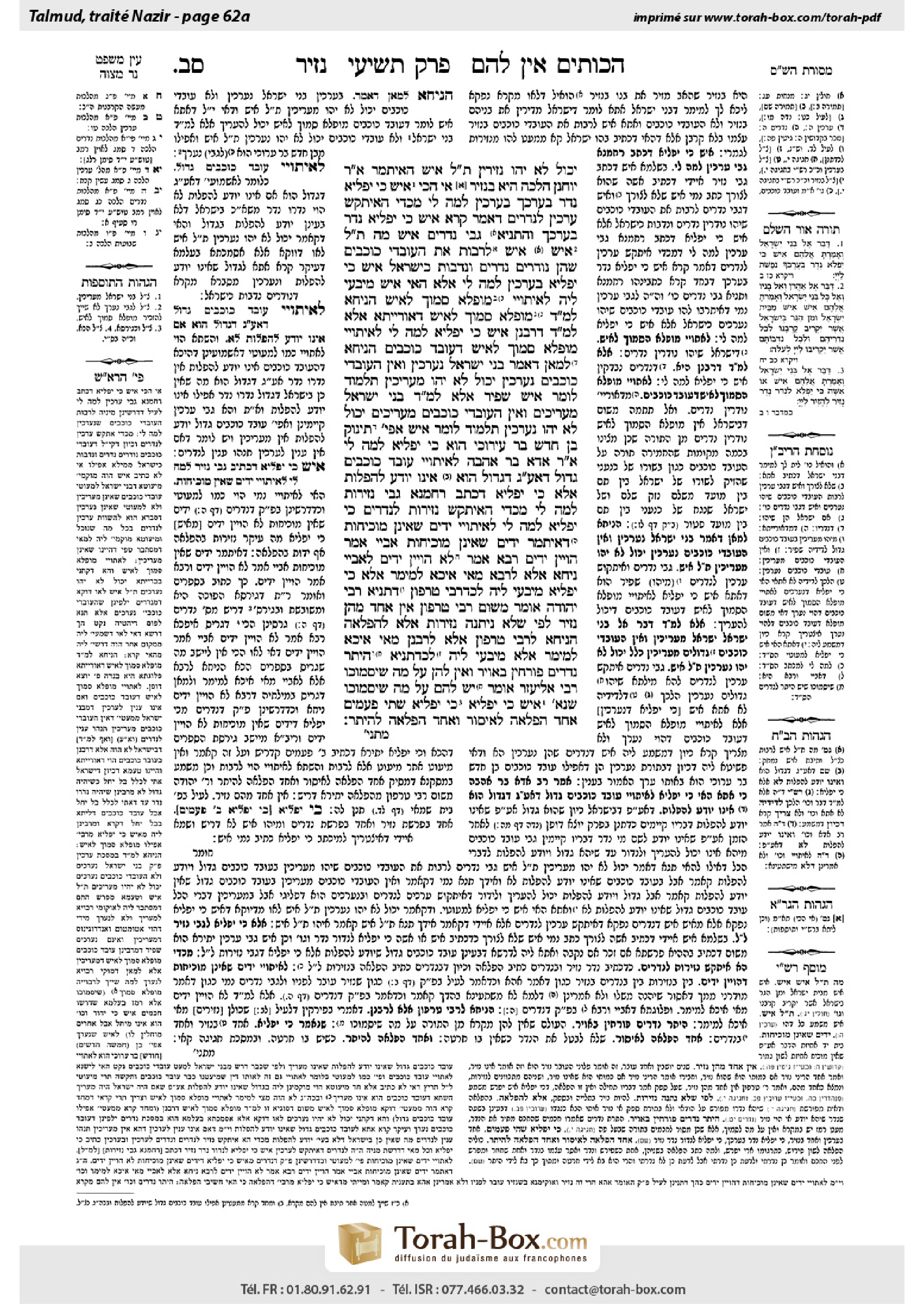
Nazir 62a: Talmud study for Daf Yomi
Daf Yomi is the daily study of one Talmud folio. Explore 37 tractates with scans, Hebrew text, Sefaria English and AI-generated French translations where annotated.
Passage selection and English or AI-generated French translation are available where the scan has annotations. Daf Study is independent of Torah-Box and Sefaria.
Browse Nazir · נזיר · All tractatesNazir 62a text and translations
This page of Nazir includes the Aramaic text, an English translation and an AI-generated French translation, alongside the scan above.
נזיר ס״ב א · Aramaic and Hebrew text
יָכוֹל לֹא יְהוּ נְזִירִין — תַּלְמוּד לוֹמַר: ״אִישׁ״! הָאִיתְּמַר אָמַר רַבִּי יוֹחָנָן: הֲלָכָה הִיא בְּנָזִיר.
אִי הָכִי ״אִישׁ כִּי יַפְלִא נֶדֶר בְּעֶרְכְּךָ״, בַּעֲרָכִין, לְמָה לִי? מִכְּדֵי הָאִיתַּקַּשׁ עֲרָכִין לִנְדָרִים, דְּאָמַר קְרָא ״אִישׁ כִּי יַפְלִא נֶדֶר בְּעֶרְכְּךָ״, וְהָתַנְיָא גַּבֵּי נְדָרִים: ״אִישׁ״. מָה תַּלְמוּד לוֹמַר ״אִישׁ אִישׁ״ — לְרַבּוֹת אֶת הַגּוֹיִם שֶׁהֵן נוֹדְרִים נְדָרִים וּנְדָבוֹת כְּיִשְׂרָאֵל.
״אִישׁ כִּי יַפְלִא״ בַּעֲרָכִין לְמָה לִי? אֶלָּא הַאי ״אִישׁ״, מִיבְּעֵי לֵיהּ לְאֵיתוֹיֵי מוּפְלָא סָמוּךְ לְאִישׁ.
הָנִיחָא לְמַאן דְּאָמַר מוּפְלָא סָמוּךְ לְאִישׁ דְּאוֹרָיְיתָא. אֶלָּא לְמַאן דְּאָמַר דְּרַבָּנַן, ״אִישׁ כִּי יַפְלִיא״ לְמָה לִי? לְאֵיתוֹיֵי מוּפְלָא סָמוּךְ לְאִישׁ דְּגוֹי.
הָנִיחָא לְמַאן דְּאָמַר בְּנֵי יִשְׂרָאֵל נֶעֱרָכִין, וְאֵין הַגּוֹיִם נֶעֱרָכִין. יָכוֹל לֹא יְהוּ מַעֲרִיכִין, תַּלְמוּד לוֹמַר: ״אִישׁ״ — שַׁפִּיר.
אֶלָּא לְמַאן דְּאָמַר: בְּנֵי יִשְׂרָאֵל מַעֲרִיכִים, וְאֵין הַגּוֹיִם מַעֲרִיכִים. יָכוֹל לֹא יְהוּ נֶעֱרָכִין, תַּלְמוּד לוֹמַר: ״אִישׁ״ — אֲפִילּוּ תִּינוֹק בֶּן חֹדֶשׁ בַּר עָירוּכִי הוּא, ״כִּי יַפְלִיא״ לְמָה לִי?
אָמַר רַב אַדָּא בַּר אַהֲבָה: לְאֵיתוֹיֵי גּוֹי גָּדוֹל, דְּאַף עַל גַּב דְּגָדוֹל הוּא — אֵינוֹ יוֹדֵעַ לְהַפְלוֹת.
אֶלָּא: ״כִּי יַפְלִיא״ דִּכְתַב רַחֲמָנָא גַּבֵּי נְזִירוּת, לְמָה לִי? מִכְּדֵי הָאִיתַּקַּשׁ נְזִירוּת לִנְדָרִים, ״כִּי יַפְלִיא״ לְמָה לִי?
לְאֵיתוֹיֵי יָדַיִם שֶׁאֵינָן מוֹכִיחוֹת. דְּאִיתְּמַר: יָדַיִם שֶׁאֵינָן מוֹכִיחוֹת, אַבָּיֵי אָמַר: הָוְיָין יָדַיִם. רָבָא אָמַר: לָא הָוְיָין יָדַיִם. לְאַבָּיֵי נִיחָא. אֶלָּא לְרָבָא, מַאי אִיכָּא לְמֵימַר?
אֶלָּא: ״כִּי יַפְלִיא״ מִיבְּעֵי לֵיהּ לְכִדְרַבִּי טַרְפוֹן, דְּתַנְיָא, רַבִּי יְהוּדָה אוֹמֵר מִשּׁוּם רַבִּי טַרְפוֹן: אֵין אֶחָד מֵהֶן נָזִיר, לְפִי שֶׁלֹּא נִיתְּנָה נְזִירוּת אֶלָּא לְהַפְלָאָה. הָנִיחָא לְרַבִּי טַרְפוֹן, אֶלָּא לְרַבָּנַן מַאי אִיכָּא לְמֵימַר?
אֶלָּא: מִיבְּעֵי לֵיהּ לְכִדְתַנְיָא: הֶיתֵּר נְדָרִים — פּוֹרְחִין בָּאֲוִיר, וְאֵין לָהֶן עַל מַה שֶּׁיִּסְמוֹכוּ.
רַבִּי אֱלִיעֶזֶר אוֹמֵר: יֵשׁ לָהֶם עַל מַה שֶּׁיִּסְמוֹכוּ, שֶׁנֶּאֱמַר: ״אִישׁ כִּי יַפְלִא״, ״כִּי יַפְלִא״, שְׁתֵּי פְעָמִים. אֶחָד הַפְלָאָה לְאִיסּוּר, וְאֶחָד הַפְלָאָה לְהֶיתֵּר.
Nazir 62a · English translation
One might have thought that gentiles cannot be nazirites at all. The verse therefore states: “Man,” to teach that they can become nazirites. The Gemara answers: Wasn’t it stated that Rabbi Yoḥanan said that the halakha that a son may use his father’s nazirite offerings is a halakha transmitted to Moses at Sinai with regard to a nazirite? Since this halakha does not appear in the Torah, the verse cannot be coming to exclude it.
§ The Gemara asks: If so, why do I need the verse: “When a man shall clearly utter a vow of persons to the Lord, according to your valuation” (Leviticus 27:2), stated with regard to valuations, from which it is derived that gentiles are included in the halakhot of valuations? After all, aren’t valuations juxtaposed to vows, as the verse states: “When a man shall clearly utter a vow of persons to the Lord, according to your valuation.” And isn’t it taught in a baraita with regard to a verse dealing with vows: “Any man [ish] from the house of Israel, or of the strangers in Israel, who sacrifices his offering, whether it be any of their vows, or any of their gift offerings, which are sacrificed to the Lord as a burnt-offering” (Leviticus 22:18), what is the meaning when the verse states the extra emphasis: “Any man [ish ish]”? The baraita explains: This serves to include the gentiles, that they can take a vow for vow offerings and gift offerings like a Jew. It can be derived from this juxtaposition that gentiles are included in the halakhot of valuations.
The Gemara now restates its question: In that case, why do I need the phrase “when a man shall clearly utter a vow” stated with regard to valuations? Rather, this term, “man,” does not include gentiles, but is necessary to include a minor one year before he or she reaches majority. If a minor takes a vow one year before coming of age, and shows a clear understanding of his statement, the vow takes effect. This individual is included in the halakhot of valuations as well.
The Gemara comments: This works out well according to the one who says that a minor one year before he or she reaches majority must fulfill his or her vows by Torah law, because the verse serves as the source for this halakha. However, according to the one who says that this halakha applies by rabbinic law, why do I need the verse “when a man shall clearly utter a vow”? The Gemara answers: The verse serves to include a minor one year before he or she reaches majority who is a gentile, that this halakha applies to gentiles by Torah law.
The Gemara comments: This works out well according to the one who says that it is inferred from the phrase: “The children of Israel” (Leviticus 27:2), that Jews can be valuated but gentiles cannot be valuated; and one might have thought that gentiles cannot take a valuation vow. Therefore, the verse states: “Man.” According to this opinion it is fine, as the phrase “when a man shall clearly utter a vow” can teach that if a gentile close to adulthood grasps the meaning of vows, he can take a valuation vow.
However, according to the one who says that the children of Israel can take a valuation vow but gentiles cannot take a valuation vow, one might have thought that gentiles cannot be valuated; therefore, the verse states the additional term: “Man,” to teach that anyone, even a month-old baby, can be valuated according to the assigned value stated in the Torah. According to this opinion, it is of no importance how old the subject of the vow is, and therefore the verse clearly cannot be including a gentile on the verge of adulthood. Consequently, the question remains: Why do I need the phrase “when a man shall clearly utter a vow”?
Rav Adda bar Ahava said: The verse is referring to all vows, and serves to include, i.e., to teach, the halakha of a type of adult gentile, who although he is an adult, he does not know how to clearly utter a vow. The verse teaches that his vows are invalid, as derived from the phrase “when a man shall clearly vow.” Vows of a gentile are valid only if he can express them clearly.
Having clarified the verse concerning valuations, the Gemara asks: However, concerning the verse: “When a man or woman shall clearly utter a vow” (Numbers 6:2), which the Merciful One writes with regard to naziriteship, why do I need it? After all, isn’t the halakha of naziriteship juxtaposed to vows; why do I need the verse “when a man or woman shall clearly utter”?
The Gemara answers: This verse serves to include the case of one who vowed by means of ambiguous intimations, i.e., he expressed only part of the formula of the vow, so that his meaning is unclear. As it was stated that amora’im had a dispute with regard to this issue: With regard to ambiguous intimations, Abaye said that they are considered intimations to vows, and the vows take effect, and Rava said that they are not considered intimations to vows, and the vows do not take effect. According to the opinion of Abaye, this answer works out well, as the phrase “when a man shall clearly utter,” serves to include all pronouncements indicative of vows, even ambiguous intimations. However, according to the opinion of Rava, what is there to say?
Rather, the Gemara explains that the phrase “when a man or woman shall clearly utter” is necessary for that which was stated by Rabbi Tarfon, as it is taught in the Tosefta (3:19) that Rabbi Yehuda said in the name of Rabbi Tarfon: If several people took a vow of naziriteship as part of a wager with regard to an uncertain occurrence, not one of them is a nazirite, as naziriteship is imposed upon someone only if his vow is explicitly enunciated. That is, one is a nazirite only if he vows in a definitive manner, not if there was any uncertainty involved. The Gemara asks: This works out well according to the opinion of Rabbi Tarfon. However, according to the opinion of the Rabbis, who disagree with his ruling, what is there to say?
Rather, the phrase “when a man or woman shall clearly utter” is necessary for that which is taught in a baraita: The halakhot of dissolution of vows, namely that one may request from a halakhic authority to dissolve them, fly in the air and have nothing to lean upon, i.e., these halakhot are not mentioned explicitly in the Torah.
Rabbi Eliezer says: The halakhot of dissolution of vows have a basis upon which to lean, as it is stated: “When a man shall clearly utter a vow” (Leviticus 27:2) and: “When a man or woman shall clearly utter a vow” (Numbers 6:2), twice. One explicit utterance is for prohibition, i.e., when one takes a vow, he is bound to keep it, and one explicit utterance is for dissolution, i.e., in the event that he provides a halakhic authority with a reason why the vow should no longer apply, the vow can be dissolved and he will no longer be bound by it. This is an allusion in the Torah for the dissolution of vows.
Nazir 62a · Traduction française (IA)
On aurait pu penser que les non-Juifs ne peuvent absolument pas être naziréens. Le verset dit donc : « Un homme », pour enseigner qu’ils peuvent le devenir. La Guemara répond : N’a-t-on pas enseigné que Rabbi Yoḥanan a dit que la halakha selon laquelle un fils peut utiliser les offrandes de naziréat de son père est une halakha transmise à Moïse au Sinaï concernant le naziréat ? Puisque cette halakha ne figure pas dans la Torah, le verset ne peut pas avoir pour but de l’exclure.
§ La Guemara demande : Dans ce cas, pourquoi ai-je besoin du verset : « Lorsqu’un homme fera clairement un vœu concernant des personnes vouées à l’Éternel, selon ton estimation » (Lévitique 27, 2), énoncé au sujet des évaluations, dont on déduit que les non-Juifs sont soumis aux halakhot des évaluations ? Après tout, les évaluations ne sont-elles pas rapprochées des vœux, comme le dit le verset : « Lorsqu’un homme fera clairement un vœu concernant des personnes vouées à l’Éternel, selon ton estimation » ? Et n’enseigne-t-on pas dans une baraïta, à propos d’un verset traitant des vœux : « Tout homme [ish] de la maison d’Israël, ou parmi les étrangers qui séjournent en Israël, qui présente son offrande, qu’il s’agisse de l’un de leurs vœux ou de l’une de leurs offrandes volontaires, offerts à l’Éternel en holocauste » (Lévitique 22, 18), que signifie l’insistance supplémentaire du verset : « Tout homme [ish ish] » ? La baraïta explique : Cela sert à inclure les non-Juifs, qui peuvent faire des vœux pour des sacrifices votifs et des offrandes volontaires, comme un Juif. On peut déduire de ce rapprochement que les non-Juifs sont soumis aux halakhot des évaluations.
La Guemara reformule alors sa question : Dans ce cas, pourquoi ai-je besoin de l’expression « lorsqu’un homme fera clairement un vœu », énoncée au sujet des évaluations ? Le terme « homme » n’inclut donc pas les non-Juifs ; il est plutôt nécessaire pour inclure un mineur, un an avant d’atteindre la majorité. Si un mineur formule un vœu un an avant sa majorité et comprend clairement ce qu’il dit, son vœu prend effet. Cet individu est également soumis aux halakhot des évaluations.
La Guemara fait remarquer : Cela convient selon celui qui dit qu’un mineur, un an avant d’atteindre la majorité, doit accomplir ses vœux en vertu de la Torah, puisque le verset constitue la source de cette halakha. Mais, selon celui qui dit que cette halakha relève du droit rabbinique, pourquoi ai-je besoin du verset « lorsqu’un homme fera clairement un vœu » ? La Guemara répond : Le verset sert à inclure un mineur non juif, un an avant d’atteindre la majorité, et à enseigner que cette halakha s’applique aux non-Juifs en vertu de la Torah.
La Guemara fait remarquer : Cela convient selon celui qui déduit de l’expression « les enfants d’Israël » (Lévitique 27, 2) que les Juifs peuvent faire l’objet d’une évaluation, mais pas les non-Juifs ; on aurait pu penser que les non-Juifs ne peuvent pas prononcer un vœu d’évaluation. Le verset dit donc : « Homme ». Selon cette opinion, cela convient, car l’expression « lorsqu’un homme fera clairement un vœu » peut enseigner qu’un non-Juif proche de la majorité, s’il comprend le sens des vœux, peut prononcer un vœu d’évaluation.
Cependant, selon celui qui dit que les enfants d’Israël peuvent prononcer un vœu d’évaluation, mais que les non-Juifs ne le peuvent pas, on aurait pu penser que les non-Juifs ne peuvent pas faire l’objet d’une évaluation ; le verset emploie donc le terme supplémentaire « homme », pour enseigner que n’importe qui, même un bébé âgé d’un mois, peut faire l’objet d’une évaluation selon la valeur fixée par la Torah. Selon cette opinion, l’âge de la personne concernée par le vœu n’a aucune importance ; le verset ne peut donc manifestement pas inclure un non-Juif sur le point d’atteindre la majorité. La question demeure par conséquent : pourquoi ai-je besoin de l’expression « lorsqu’un homme fera clairement un vœu » ?
Rav Adda bar Ahava a dit : Le verset porte sur tous les vœux et sert à inclure, c’est-à-dire à enseigner, le cas d’un non-Juif adulte qui, bien qu’étant adulte, ne sait pas formuler clairement un vœu. Le verset enseigne que ses vœux ne sont pas valides, comme on le déduit de l’expression « lorsqu’un homme fera clairement un vœu ». Les vœux d’un non-Juif ne sont valides que s’il peut les formuler clairement.
Après avoir élucidé le verset concernant les évaluations, la Guemara demande : Cependant, pourquoi ai-je besoin du verset « Lorsqu’un homme ou une femme fera clairement un vœu » (Nombres 6, 2), que le Miséricordieux a écrit à propos du naziréat ? Après tout, le naziréat n’est-il pas rapproché des vœux ? Pourquoi ai-je besoin de l’expression « lorsqu’un homme ou une femme fera clairement un vœu » ?
La Guemara répond : Ce verset sert à inclure le cas de celui qui a fait un vœu au moyen d’allusions ambiguës, c’est-à-dire qu’il n’a exprimé qu’une partie de la formule du vœu, de sorte que son intention n’est pas claire. En effet, des amoraïm ont été en désaccord sur cette question : au sujet des allusions ambiguës, Abaye a dit qu’elles sont considérées comme des allusions à des vœux et que les vœux prennent effet ; Rava a dit qu’elles ne sont pas considérées comme des allusions à des vœux et que les vœux ne prennent pas effet. Selon l’opinion d’Abaye, cette réponse convient, car l’expression « lorsqu’un homme fera clairement un vœu » sert à inclure toute déclaration indiquant un vœu, même les allusions ambiguës. Mais, selon l’opinion de Rava, que peut-on répondre ?
La Guemara explique plutôt que l’expression « lorsqu’un homme ou une femme fera clairement un vœu » est nécessaire pour ce qu’a enseigné Rabbi Tarfon, comme il est enseigné dans la Tosefta (3, 19) : Rabbi Yehuda a dit au nom de Rabbi Tarfon que si plusieurs personnes ont fait un vœu de naziréat dans le cadre d’un pari portant sur un événement incertain, aucune d’entre elles n’est naziréenne, car le naziréat ne s’impose à quelqu’un que si son vœu est explicitement formulé. Autrement dit, on n’est naziréen que si l’on fait un vœu de manière catégorique, et non si une incertitude est en jeu. La Guemara demande : Cela convient selon l’opinion de Rabbi Tarfon. Mais, selon l’opinion des Rabbins, qui contestent sa décision, que peut-on répondre ?
L’expression « lorsqu’un homme ou une femme fera clairement un vœu » est plutôt nécessaire pour ce qui est enseigné dans une baraïta : les halakhot de l’annulation des vœux, à savoir qu’on peut demander à une autorité halakhique de les annuler, flottent dans les airs et ne reposent sur aucun appui ; autrement dit, ces halakhot ne sont pas mentionnées explicitement dans la Torah.
Rabbi Eliezer dit : Les halakhot de l’annulation des vœux ont un fondement sur lequel s’appuyer, comme il est dit : « Lorsqu’un homme fera clairement un vœu » (Lévitique 27, 2) et : « Lorsqu’un homme ou une femme fera clairement un vœu » (Nombres 6, 2), deux fois. Une déclaration explicite concerne l’interdiction, c’est-à-dire que lorsqu’on fait un vœu, on est tenu de le respecter ; l’autre déclaration explicite concerne l’annulation, c’est-à-dire que si l’on présente à une autorité halakhique une raison pour laquelle le vœu ne devrait plus s’appliquer, celui-ci peut être annulé et l’on n’y est plus tenu. C’est une allusion dans la Torah à l’annulation des vœux.
Traduction française générée par IA à partir de l’édition anglaise de Sefaria. Vérifie toujours un passage avec le texte source.
Text from Sefaria: William Davidson Edition - Vocalized Aramaic (CC BY NC); William Davidson Edition - English (CC BY NC).