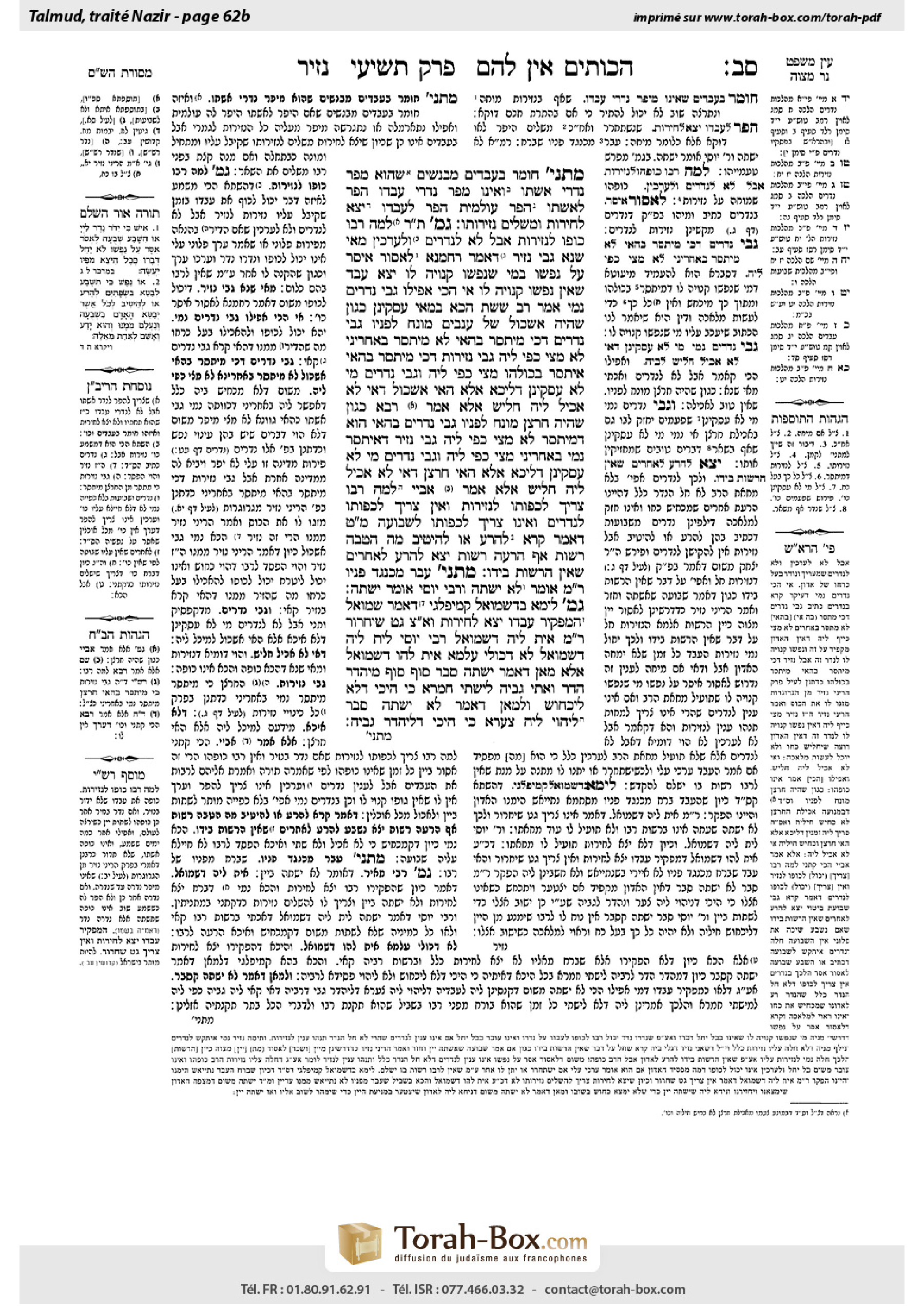
Nazir 62b: Talmud study for Daf Yomi
Daf Yomi is the daily study of one Talmud folio. Explore 37 tractates with scans, Hebrew text, Sefaria English and AI-generated French translations where annotated.
Passage selection and English or AI-generated French translation are available where the scan has annotations. Daf Study is independent of Torah-Box and Sefaria.
Browse Nazir · נזיר · All tractatesNazir 62b text and translations
This page of Nazir includes the Aramaic text, an English translation and an AI-generated French translation, alongside the scan above.
נזיר ס״ב ב · Aramaic and Hebrew text
מַתְנִי׳ חוֹמֶר בָּעֲבָדִים מִבַּנָּשִׁים, שֶׁהוּא מֵפֵר נִדְרֵי אִשְׁתּוֹ, וְאֵינוֹ מֵפֵר נִדְרֵי עַבְדּוֹ. הֵפֵר לְאִשְׁתּוֹ — הֵפֵר עוֹלָמִית. הֵפֵר לְעַבְדּוֹ — יָצָא לְחֵירוּת וּמַשְׁלִים נְזִירוּתוֹ.
גְּמָ׳ תָּנוּ רַבָּנַן: לְמָה רַבּוֹ כּוֹפוֹ? לִנְזִירוּת, אֲבָל לֹא לִנְדָרִים וְלַעֲרָכִין.
מַאי שְׁנָא גַּבֵּי נָזִיר — דְּאָמַר רַחֲמָנָא ״לֶאְסֹר אִסָּר עַל נַפְשׁוֹ״, בְּמִי שֶׁנַּפְשׁוֹ קְנוּיָה לוֹ — יָצָא עֶבֶד שֶׁאֵין נַפְשׁוֹ קְנוּיָה לוֹ. אִי הָכִי, אֲפִילּוּ גַּבֵּי נְדָרִים נָמֵי!
אָמַר רַב שֵׁשֶׁת, הָכָא בְּמַאי עָסְקִינַן: כְּגוֹן שֶׁהָיָה אֶשְׁכּוֹל שֶׁל עֲנָבִים מוּנָּח לְפָנָיו. גַּבֵּי נְדָרִים, דְּכִי מִיתְּסַר בְּהַאי לָא מִיתְּסַר בְּאַחֲרִינֵי — לָא מָצֵי כָּפֵי לֵיהּ.
גַּבֵּי נְזִירוּת, דְּכִי מִיתְּסַר בְּהַאי אִיתְּסַר בְּכוּלְּהוּ — מָצֵי כָּפֵי לֵיהּ. וְגַבֵּי נְדָרִים, מִי לָא עָסְקִינַן דְּלֵיכָּא אֶלָּא הַאי אֶשְׁכּוֹל, דְּאִי לָא אָכֵיל לֵיהּ, חָלֵישׁ?
אֶלָּא אָמַר רָבָא: כְּגוֹן שֶׁהָיָה חַרְצָן מוּנָּח לְפָנָיו. גַּבֵּי נְדָרִים, בְּהַאי הוּא דְּמִיתְּסַר — לָא מָצֵי כָּפֵי לֵיהּ. גַּבֵּי נָזִיר, דְּאִיתְּסַר נָמֵי בְּאַחֲרֵינִי — מָצֵי כָּפֵי לֵיהּ.
וְגַבֵּי נְדָרִים, מִי לָא עָסְקִינַן דְּלֵיכָּא אֶלָּא הַאי חַרְצָן, דְּאִי לָא אָכֵיל לֵיהּ, חָלֵישׁ?
אֶלָּא אָמַר אַבָּיֵי: לְמָה רַבּוֹ צָרִיךְ לִכְפּוֹתוֹ — לִנְזִירוּת. וְאֵין צָרִיךְ לִכְפּוֹתוֹ לִנְדָרִים, וְאֵינוֹ צָרִיךְ לִכְפּוֹתוֹ לִשְׁבוּעָה.
מַאי טַעְמָא? דְּאָמַר קְרָא: ״לְהָרַע אוֹ לְהֵיטִיב״, מָה הֲטָבָה רְשׁוּת — אַף הֲרָעָה רְשׁוּת. יָצָא לְהָרַע לַאֲחֵרִים — שֶׁאֵין הָרְשׁוּת בְּיָדוֹ.
מַתְנִי׳ עָבַר מִכְּנֶגֶד פָּנָיו, רַבִּי מֵאִיר אוֹמֵר: לֹא יִשְׁתֶּה, וְרַבִּי יוֹסֵי אוֹמֵר: יִשְׁתֶּה.
גְּמָ׳ לֵימָא בְּדִשְׁמוּאֵל קָמִיפַּלְגִי, דְּאָמַר שְׁמוּאֵל: הַמַּפְקִיר עַבְדּוֹ יָצָא לְחֵירוּת, וְאֵין צָרִיךְ גֵּט שִׁיחְרוּר.
רַבִּי מֵאִיר אִית לֵיהּ דִּשְׁמוּאֵל. רַבִּי יוֹסֵי לֵית לֵיהּ דִּשְׁמוּאֵל.
לָא, דְּכוּלֵּי עָלְמָא אִית לְהוּ דִּשְׁמוּאֵל. אֶלָּא: מַאן דְּאָמַר יִשְׁתֶּה, סָבַר: סוֹף סוֹף מִיהְדָּר הָדַר וְאָתֵי גַּבֵּיהּ, לִישְׁתֵּי חַמְרָא כִּי הֵיכִי דְּלָא לִיכְחוֹשׁ. וּלְמַאן דְּאָמַר לֹא יִשְׁתֶּה, סָבַר: לֶיהֱוֵי לֵיהּ צַעְרָא כִּי הֵיכִי דְּלִיהְדַּר גַּבֵּיהּ.
Nazir 62b · English translation
MISHNA: The previous mishna taught that the naziriteship of women includes a stringency that does not apply to slaves. This mishna adds: There is a greater stringency in the case of slaves than in the case of women, as a man can nullify the vows of his wife but he cannot nullify the vows of his slave, despite the fact that he can prevent him from fulfilling them in practice. Similarly, if he nullified the naziriteship of his wife it is permanently nullified, and it remains nullified even if she is later divorced or widowed. Conversely, if he nullified the naziriteship of his slave by forcing him to violate the terms of his vow of naziriteship, when the slave is emancipated he completes his naziriteship.
GEMARA: The Sages taught (Tosefta 6:4): With regard to what matter can his master force a slave? With regard to naziriteship. However, he cannot force his slave in the case of other vows and valuations. This baraita is apparently saying that a master cannot prevent his slave from fulfilling the terms of a vow.
The Gemara asks: What is different with regard to a nazirite that a master can force his slave to transgress his naziriteship, as the Merciful One states: “To bind his soul with a bond” (Numbers 30:3), from which it is inferred that the Torah is referring only to one whose soul is in his possession, i.e., who is not owned by another; this excludes a slave, whose soul is not in his possession because he is under his master’s control. If so, then even with regard to vows that same halakha should apply as well, as that verse is written in the context of vows in general, not specifically vows of naziriteship. Why is a master unable to compel his slave to break a vow?
Rav Sheshet said: With what are we dealing here? With a case where a cluster of grapes was placed before the slave and he vowed not to derive benefit from it. With regard to vows, when he is prohibited from eating this cluster he is not rendered prohibited from eating others; therefore, the master cannot force him to eat it, as he has no reason to insist that the slave consume this particular cluster of grapes.
By contrast, with regard to naziriteship, when he is prohibited from eating this cluster he is rendered prohibited from consuming all others; therefore, the master can force him to eat. This is because the lack of food weakens the slave, who is the property of his master. The Gemara asks: And with regard to vows, are we not dealing even with a situation where he has only this cluster before him and he vows not to eat it, in which case if he does not eat it he is weakened? Why can’t the master compel him to eat the grapes in this case?
Rather, Rava said that the difference between vows of naziriteship and other vows concerns a case where there was a grape seed, which provides only negligible nourishment, that was placed before the slave, and he vowed not to eat it. With regard to vows, concerning which he is prohibited to eat only this one seed, the master cannot force him to eat it, as refraining from eating a grape seed would not weaken him. With regard to a nazirite, who is prohibited from consuming other grape products as well, the master can force him.
The Gemara again asks: And with regard to vows, are we not dealing even with a situation where he has only this grape seed in front of him, in which case if he does not eat it he would be weakened? Why, then, can the master compel him to violate only his naziriteship vow but not a regular vow?
Rather, Abaye said that the baraita does not in fact list cases in which a master can compel his slave to violate his vow, but rather means the following: With regard to what situation is a master who wants to negate his slave’s vow required to force his slave to violate his vow by stating explicitly that he does not want him to fulfill it? It is the case of a vow of naziriteship. But he is not required to force him in the case of other vows and he is not required to force him in the case of an oath, as these do not take effect at all.
What is the reason for this? It is as the verse states with regard to oaths: “Or if anyone swear clearly with his lips to do evil, or to do good” (Leviticus 5:4). Just as the “good” mentioned in this verse is referring to a voluntary action, so too the “evil” is voluntary, e.g., if he takes an oath not to derive benefit from an item. This excludes a slave, whose oath or vow would cause evil to others, as it is not in his power to affect his master adversely. Therefore, his statement is invalid. Here too, as the owner will suffer if his slave’s diet is restricted, a slave may not accept a vow or an oath upon himself.
MISHNA: In a case where a slave took a vow of naziriteship but was prevented by his master from fulfilling the terms of his vow, the Sages engaged in a dispute what the halakha would be if he permanently left his master’s presence, i.e., he ran away without being emancipated. Rabbi Meir says: He may not drink wine. Since the slave is free in practice, his vow goes into effect. And Rabbi Yosei says: He may drink wine, as he is not emancipated.
GEMARA: The Gemara suggests: Shall we say that Rabbi Meir and Rabbi Yosei disagree with regard to the following statement of Shmuel? As Shmuel said: With regard to one who renounces ownership of his slave, the slave is emancipated, and he does not require a bill of manumission. This halakha indicates that if a slave is free in practice, he no longer requires a bill of manumission but is automatically considered a freeman.
The Gemara asks: If so, should one say that Rabbi Meir is of the opinion that the ruling is in accordance with the opinion of Shmuel, and therefore the slave is obligated in naziriteship as soon as he runs away, like any other freed slave, and Rabbi Yosei is of the opinion that the ruling is not in accordance with the opinion of Shmuel?
The Gemara rejects this suggestion: No, it is possible that everyone is of the opinion that the ruling is in accordance with the opinion of Shmuel. Rather, the mishna is referring to a case where the master refused to declare the runaway ownerless, and was intent on recovering him. Consequently, the slave is not in fact a freeman at all, and the tanna’im disagree with regard to the following: Rabbi Yosei, the one who says that he may drink wine, maintains that the slave will ultimately return and come back to his master, and therefore it is preferable for him to drink wine so that he should not be weakened by the time he returns. And according to Rabbi Meir, the one who says that he may not drink wine, he maintains that it is better that the slave should suffer by being deprived of wine, so that he will return to his master, as the desire to drink wine will spur him to return.
Nazir 62b · Traduction française (IA)
MICHNA : La Michna précédente enseignait que le naziréat des femmes comporte une rigueur qui ne s’applique pas aux esclaves. Cette Michna ajoute qu’il existe une rigueur plus grande dans le cas des esclaves que dans celui des femmes : un homme peut annuler les vœux de son épouse, mais il ne peut pas annuler ceux de son esclave, bien qu’il puisse l’empêcher en pratique de les accomplir. De même, s’il a annulé le naziréat de son épouse, celui-ci est définitivement annulé et le reste même si elle est ensuite divorcée ou veuve. À l’inverse, s’il a annulé le naziréat de son esclave en le contraignant à transgresser les termes de son vœu de naziréat, l’esclave achève son naziréat lorsqu’il est affranchi.
GUEMARA : Les Sages ont enseigné (Tossefta 6:4) : Dans quel domaine son maître peut-il contraindre un esclave ? Dans le domaine du naziréat. En revanche, il ne peut pas le contraindre dans le cas d’autres vœux ou de déclarations d’évaluation. Cette baraïta semble donc dire qu’un maître ne peut pas empêcher son esclave d’accomplir les termes d’un vœu.
La Guemara demande : En quoi le naziréat est-il différent, pour que son maître puisse contraindre son esclave à y contrevenir ? Car le Miséricordieux dit : « Pour lier son âme d’un lien » (Nombres 30:3), ce dont on déduit que la Torah ne vise que celui dont l’âme est en sa possession, c’est-à-dire qui n’appartient pas à autrui ; cela exclut l’esclave, dont l’âme n’est pas en sa possession puisqu’il est sous l’autorité de son maître. Si tel est le cas, la même halakha devrait aussi s’appliquer aux vœux, puisque ce verset est écrit dans le contexte des vœux en général, et non spécifiquement des vœux de naziréat. Pourquoi un maître ne peut-il pas contraindre son esclave à rompre un vœu ?
Rav Chéchet dit : De quelle situation s’agit-il ici ? D’un cas où une grappe de raisin a été placée devant l’esclave et où il a fait vœu de ne pas en tirer profit. Dans le cas des vœux, lorsqu’il lui est interdit de manger cette grappe, il ne lui est pas pour autant interdit d’en manger d’autres. Le maître ne peut donc pas le contraindre à la manger, puisqu’il n’a aucune raison d’insister pour que l’esclave consomme cette grappe précise.
En revanche, dans le cas du naziréat, lorsqu’il lui est interdit de manger cette grappe, il lui est également interdit d’en consommer d’autres ; le maître peut donc le contraindre à manger. En effet, le manque de nourriture affaiblit l’esclave, qui est la propriété de son maître. La Guemara demande : Mais, dans le cas des vœux, ne pourrait-il pas s’agir d’une situation où cette grappe est la seule à sa disposition et où il fait vœu de ne pas la manger, de sorte que, s’il ne la mange pas, il sera affaibli ? Pourquoi le maître ne peut-il pas alors le contraindre à manger les raisins ?
Rava dit plutôt que la différence entre les vœux de naziréat et les autres vœux concerne le cas où un pépin de raisin, qui ne fournit qu’une nourriture négligeable, a été placé devant l’esclave et où il a fait vœu de ne pas le manger. Dans le cas des vœux, puisqu’il lui est interdit de manger uniquement ce pépin, le maître ne peut pas le contraindre à le manger, car s’abstenir de manger un pépin de raisin ne l’affaiblirait pas. En revanche, le maître peut contraindre le nazir, à qui il est également interdit de consommer d’autres produits de la vigne.
La Guemara demande à nouveau : Mais, dans le cas des vœux, ne pourrait-il pas s’agir d’une situation où ce pépin de raisin est le seul devant lui, de sorte que, s’il ne le mange pas, il sera affaibli ? Pourquoi le maître peut-il donc le contraindre à transgresser son vœu de naziréat, mais pas un vœu ordinaire ?
Abayé dit plutôt que la baraïta n’énumère pas, en réalité, des cas où un maître peut contraindre son esclave à transgresser son vœu. Elle signifie plutôt ceci : Dans quelle situation un maître qui veut annuler le vœu de son esclave doit-il le contraindre à le transgresser en déclarant explicitement qu’il ne veut pas qu’il l’accomplisse ? C’est dans le cas d’un vœu de naziréat. En revanche, il n’a pas besoin de le contraindre dans le cas d’autres vœux, ni dans celui d’un serment, car ceux-ci ne prennent pas effet du tout.
Quelle en est la raison ? C’est ce qu’indique le verset au sujet des serments : « Si quelqu’un jure clairement de ses lèvres de faire le mal ou le bien » (Lévitique 5:4). De même que le « bien » mentionné dans ce verset désigne une action volontaire, de même le « mal » est volontaire, par exemple s’il prête serment de ne pas tirer profit d’un objet. Cela exclut l’esclave, dont le serment ou le vœu causerait du tort à autrui, puisqu’il n’a pas le pouvoir de porter préjudice à son maître. Sa déclaration est donc invalide. Ici aussi, puisque son propriétaire pâtirait si le régime alimentaire de son esclave était restreint, un esclave ne peut pas s’imposer un vœu ou un serment.
MICHNA : Lorsqu’un esclave a fait vœu de naziréat, mais que son maître l’a empêché d’en accomplir les termes, les Sages ont discuté de la halakha dans le cas où il quitte définitivement la présence de son maître, c’est-à-dire s’il s’enfuit sans être affranchi. Rabbi Meïr dit : Il ne peut pas boire de vin. Puisque l’esclave est libre en pratique, son vœu prend effet. Rabbi Yossé, lui, dit : Il peut boire du vin, car il n’est pas affranchi.
GUEMARA : La Guemara suggère : Faut-il dire que Rabbi Meïr et Rabbi Yossé sont en désaccord au sujet de l’affirmation suivante de Chmouel ? Car Chmouel a dit : Celui qui renonce à la propriété de son esclave l’affranchit, et l’esclave n’a pas besoin d’un acte d’affranchissement. Cette halakha indique que si un esclave est libre en pratique, il n’a plus besoin d’un acte d’affranchissement et est automatiquement considéré comme un homme libre.
La Guemara demande : Si tel est le cas, faut-il dire que Rabbi Meïr considère que la halakha suit l’opinion de Chmouel, et que l’esclave est donc soumis au naziréat dès qu’il s’enfuit, comme tout autre esclave affranchi, tandis que Rabbi Yossé considère que la halakha ne suit pas l’opinion de Chmouel ?
La Guemara rejette cette suggestion : Non, il est possible que tous considèrent que la halakha suit l’opinion de Chmouel. La Michna parle plutôt d’un cas où le maître a refusé de déclarer l’esclave en fuite sans propriétaire et avait l’intention de le récupérer. Par conséquent, l’esclave n’est en réalité pas du tout un homme libre, et les tannaïm sont en désaccord sur le point suivant : Rabbi Yossé, qui dit qu’il peut boire du vin, estime que l’esclave finira par revenir auprès de son maître ; il vaut donc mieux qu’il boive du vin afin de ne pas être affaibli au moment de son retour. Selon Rabbi Meïr, qui dit qu’il ne peut pas boire de vin, il vaut mieux que l’esclave souffre d’en être privé, afin qu’il revienne auprès de son maître, car son désir de boire du vin le poussera à revenir.
Traduction française générée par IA à partir de l’édition anglaise de Sefaria. Vérifie toujours un passage avec le texte source.
Text from Sefaria: William Davidson Edition - Vocalized Aramaic (CC BY NC); William Davidson Edition - English (CC BY NC).